Georgia Physical Security Market Size & Growth Rate (2026-2032)
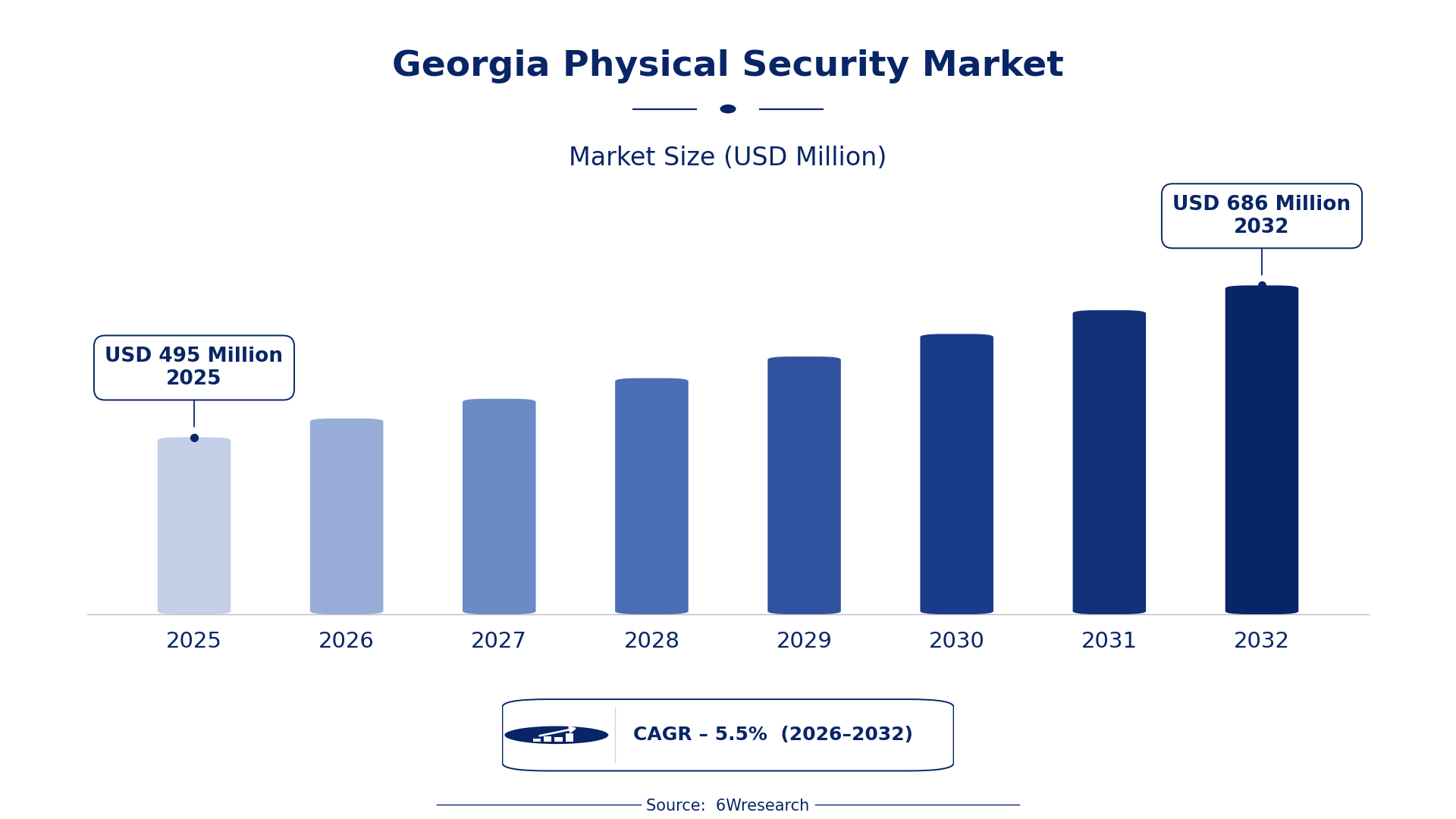
The Georgia Physical Security Market was estimated at USD 495 Million in 2025 and is projected to reach USD 686 Million by 2032, growing at a CAGR of 5.5% from 2026 to 2032.
Georgia Physical Security Market Synopsis
The rising emphasis on security in various sectors, including government, transportation, and commercial enterprises, fuels the Georgia Physical Security Market. A growing number of infrastructure development projects and urbanization initiatives amplify the demand for advanced security systems, such as video surveillance and biometric recognition technologies.
As organizations become increasingly aware of the necessity for robust security measures, investments in physical security solutions are on the rise. This trend is accentuated by regulatory requirements and a collective concern for public safety, driving a comprehensive approach to safeguarding assets and facilities across the state.
Georgia Physical Security Market Year-wise Growth Rate and Key Drivers
This graph illustrates the annual growth rates of the Georgia Physical Security Market from 2021 to 2032, highlighting a steady upward trajectory and projected expansion over the forecast period.
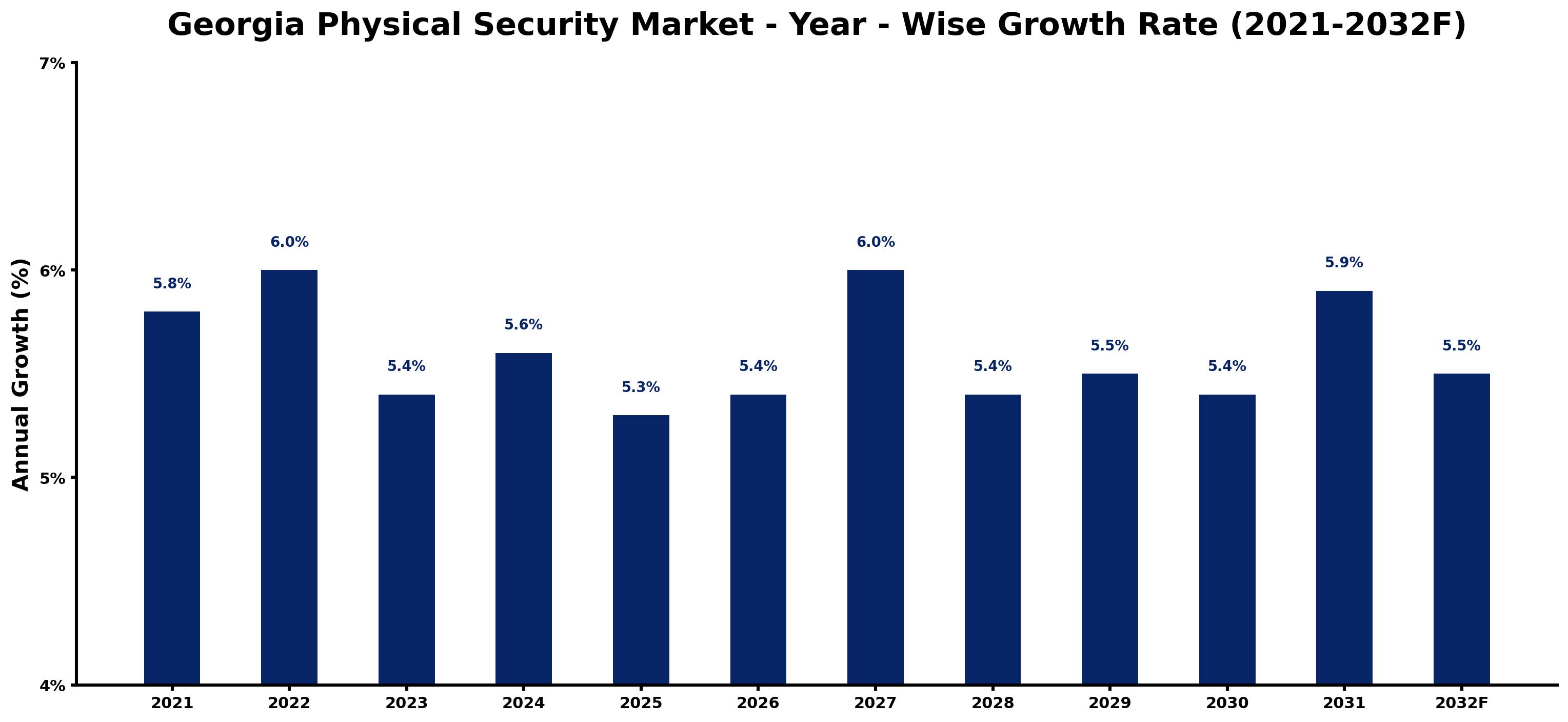
The table below presents the year‑wise growth rates along with the key drivers influencing the market
| Year | Growth Rate | Major Drivers |
| 2021 | 5.8% | Government initiatives enhancing border security and monitoring. |
| 2022 | 6.0% | Increased investment in private sector security solutions. |
| 2023 | 5.4% | Growing awareness of cybersecurity among physical security providers. |
| 2024 | 5.6% | Urban development plans necessitating enhanced security measures. |
| 2025 | 5.3% | Increased property crime rates driving security system demand. |
| 2026 | 5.4% | Adoption of smart surveillance technologies by businesses. |
| 2027 | 6.0% | Regulatory push for enhanced security systems in schools. |
| 2028 | 5.4% | Rising international events increasing venue security requirements. |
| 2029 | 5.5% | Local terrorist threats prompting upgrades in security protocols. |
| 2030 | 5.4% | Growth of residential complexes needing integrated security solutions. |
| 2031 | 5.9% | Local government contracts for security service improvements. |
| 2032 | 5.5% | Tourism recovery requiring heightened public safety measures. |
Note: Market size estimations and growth projections presented in this report are based on 6Wresearch's proprietary forecasting methodology, utilizing the latest available industry data, government publications, and primary research inputs.
Georgia Physical Security Market Key Takeaways
Below are some of the specific key takeaways from the market, including:
- Strong growth is supported by urbanization and infrastructure development across Georgia.
- Increased investments in video surveillance and access control systems reflect rising security concerns.
- Technological advancements, including AI integration, are reshaping market offerings.
- Challenges like compliance and privacy issues continue to influence strategic decisions in security investments.
- Residential and smart home security markets are emerging as significant growth areas.
Evaluation of Restraints in Georgia Physical Security Market
The Georgia Physical Security Market grapples with challenges stemming from rapid technological advancements. Companies find themselves in a constant cycle of upgrading security systems, which can strain financial resources. This is especially pronounced for smaller organizations facing tight budgets. Additionally, the complexity of emerging security threats necessitates more sophisticated approaches, complicating the integration of traditional security measures with new technologies. The burden of regulatory compliance, coupled with privacy concerns, adds another layer of difficulty for businesses looking to enhance their security protocols.
Georgia Physical Security Market Trends
A marked trend towards intelligent and interconnected security systems is evident in Georgia's market. Businesses are increasingly turning to biometric technologies and advanced video analytics to provide real-time monitoring and enhanced protection. There's also a growing demand for cloud-based solutions, which offer flexibility and scalability to adapt to evolving security needs. The integration of physical security systems with IT networks is gaining traction, allowing for centralized management and streamlined operations.
Georgia Physical Security Market Opportunities
Investment opportunities abound, particularly in areas like video surveillance, intrusion detection, and advanced access control systems. Organizations are seeking innovative security technologies that improve infrastructure resilience. The residential security sector is also ripe for investment, driven by the rising interest in smart home solutions. Companies focusing on cybersecurity integration and artificial intelligence applications in video surveillance stand to benefit significantly from the market’s growth.
Government Initiatives in the Georgia Physical Security Market
Government policies play a crucial role in shaping the Georgia Physical Security Market. The state’s focus on enhancing safety through regulatory frameworks surrounding building codes and access control significantly impacts investment decisions. Collaborative efforts between state and local law enforcement agencies aim to implement innovative security measures, addressing both current and emerging threats.
- A comprehensive infrastructure protection program was launched in early 2023, aimed at bolstering security measures across public facilities.
- Currently, ongoing initiatives are focused on upgrading emergency response protocols through enhanced surveillance systems and access controls.
- Future plans include a statewide campaign to increase awareness of smart security technologies, expected to roll out in late 2025.
- A regulatory framework is being refined in 2024 to ensure compliance with new security technologies and privacy regulations.
- The state government is engaging with technology vendors for pilot programs on advanced threat detection systems, scheduled to begin in mid-2025.
Future Insights of the Georgia Physical Security Market
Looking ahead to 2026-2032, the Georgia Physical Security Market is expected to maintain a steady growth trajectory. The emphasis on public safety will drive demand for more comprehensive and advanced security solutions. The integration of next-generation technologies, like AI and machine learning, will shape how security measures are implemented. As organizations increasingly recognize the importance of safeguarding assets, the market is likely to witness an influx of innovative products and services designed to meet evolving security challenges.
Georgia Physical Security Market Latest Developments
Recent months have shown a significant uptick in activity within the Georgia Physical Security Market. Companies are increasingly launching new products and enhancing existing technologies to meet the evolving demands of security in various sectors. Collaborative projects between public and private entities have also surged, indicating a collective push towards enhanced safety and security.
- A leading regional operator launched a cutting-edge biometric access control system in Q1 2025, aimed at both commercial and residential sectors.
- An initiative to integrate AI-driven video analytics into existing security frameworks is currently underway, started in late 2024 and projected to be completed by mid-2025.
- Plans for an upcoming collaborative effort between technology vendors and local governments to enhance public surveillance systems are set to kick off in early 2026.
- A major technology vendor is currently piloting cloud-based security solutions across government facilities, an initiative that began in Q2 2025 and remains ongoing.
- In late 2024, a public-private partnership aimed at improving critical infrastructure security was successfully completed, with results showing improved response times to security threats.
Georgia Physical Security Market - Key Attractiveness of the Report
- 10 Years of Market Numbers
- Historical Data Starting from 2022 to 2025
- Base Year: 2025
- Forecast Data until 2032
- Key Performance Indicators Impacting the Market
- Major Upcoming Developments and Projects
Key Highlights of the Report:
- Georgia Physical Security Market Outlook
- Market Size of Georgia Physical Security Market, 2025
- Forecast of Georgia Physical Security Market, 2032
- Historical Data and Forecast of Georgia Physical Security Revenues & Volume for the Period 2022-2032F
- Georgia Physical Security Market Trend Evolution
- Georgia Physical Security Market Drivers and Challenges
- Georgia Physical Security Price Trends
- Georgia Physical Security Porter's Five Forces
- Georgia Physical Security Industry Life Cycle
- Historical Data and Forecast of Georgia Physical Security Market Revenues & Volume By Component for the Period 2022-2032F
- Historical Data and Forecast of Georgia Physical Security Market Revenues & Volume By Systems (PACS, PSIM, PIAM, Video Surveillance, Fire and Life Safety) for the Period 2022-2032F
- Historical Data and Forecast of Georgia Physical Security Market Revenues & Volume By Services for the Period 2022-2032F
- Historical Data and Forecast of Georgia Physical Security Market Revenues & Volume By Vertical for the Period 2022-2032F
- Historical Data and Forecast of Georgia Physical Security Market Revenues & Volume By BFSI for the Period 2022-2032F
- Historical Data and Forecast of Georgia Physical Security Market Revenues & Volume By Government for the Period 2022-2032F
- Historical Data and Forecast of Georgia Physical Security Market Revenues & Volume By Retail for the Period 2022-2032F
- Historical Data and Forecast of Georgia Physical Security Market Revenues & Volume By Transportation for the Period 2022-2032F
- Historical Data and Forecast of Georgia Physical Security Market Revenues & Volume By Residential for the Period 2022-2032F
- Historical Data and Forecast of Georgia Physical Security Market Revenues & Volume By Telecom and IT for the Period 2022-2032F
- Historical Data and Forecast of Georgia Physical Security Market Revenues & Volume By Other Verticals (Healthcare, Manufacturing, Energy and Utilities, and Education). for the Period 2022-2032F
- Historical Data and Forecast of Georgia Physical Security Market Revenues & Volume By Organization Size for the Period 2022-2032F
- Historical Data and Forecast of Georgia Physical Security Market Revenues & Volume By SMEs for the Period 2022-2032F
- Historical Data and Forecast of Georgia Physical Security Market Revenues & Volume By Large Enterprises for the Period 2022-2032F
- Georgia Physical Security Import Export Trade Statistics
- Market Opportunity Assessment By Component
- Market Opportunity Assessment By Vertical
- Market Opportunity Assessment By Organization Size
- Georgia Physical Security Top Companies Market Share
- Georgia Physical Security Competitive Benchmarking By Technical and Operational Parameters
- Georgia Physical Security Company Profiles
- Georgia Physical Security Key Strategic Recommendations






































