France Policy Management in Telecom Market Size & Growth Rate (2026-2032)
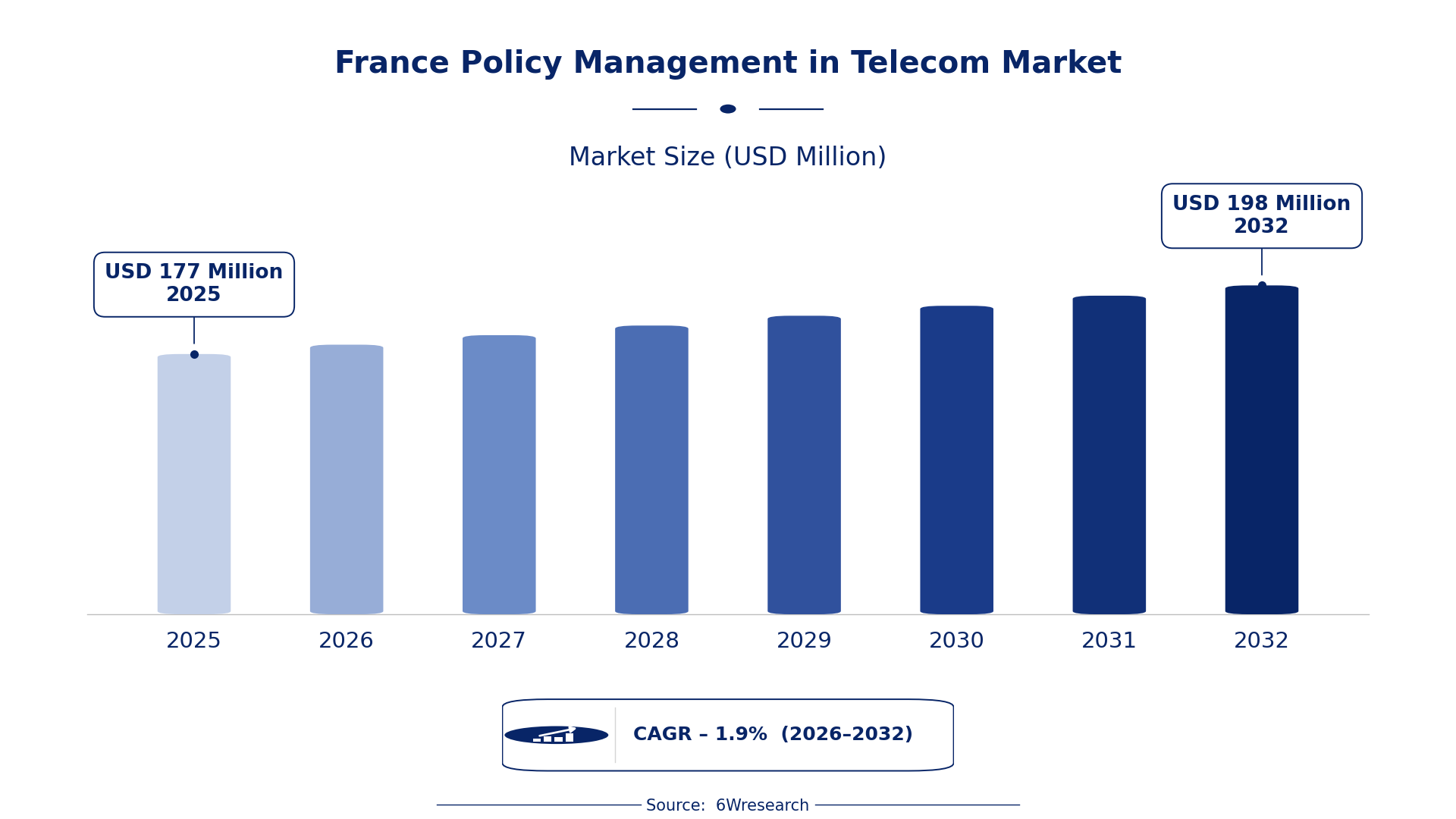
The France Policy Management in Telecom Market was estimated at USD 177 Million in 2025 and is projected to reach USD 198 Million by 2032, growing at a CAGR of 1.9% from 2026 to 2032.
France Policy Management in Telecom Market Synopsis
In recent years, the France Policy Management in Telecom Market has experienced moderate growth driven by regulatory compliance and the need for efficient service delivery. As 5G technologies expand, operators are finding that advanced policy management systems are critical for maintaining a competitive edge and satisfying increasing consumer demands.
Looking ahead, the focus will shift toward integrating artificial intelligence and analytics within policy management frameworks. This technological infusion will enhance decision-making capabilities, allowing operators to better tailor their services to consumer preferences and adapt to the fast-paced telecommunications environment.
France Policy Management in Telecom Market Year-wise Growth Rate and Key Drivers
This graph illustrates the annual growth rates of the France Policy Management in Telecom Market from 2021 to 2032, highlighting a steady upward trajectory and projected expansion over the forecast period.
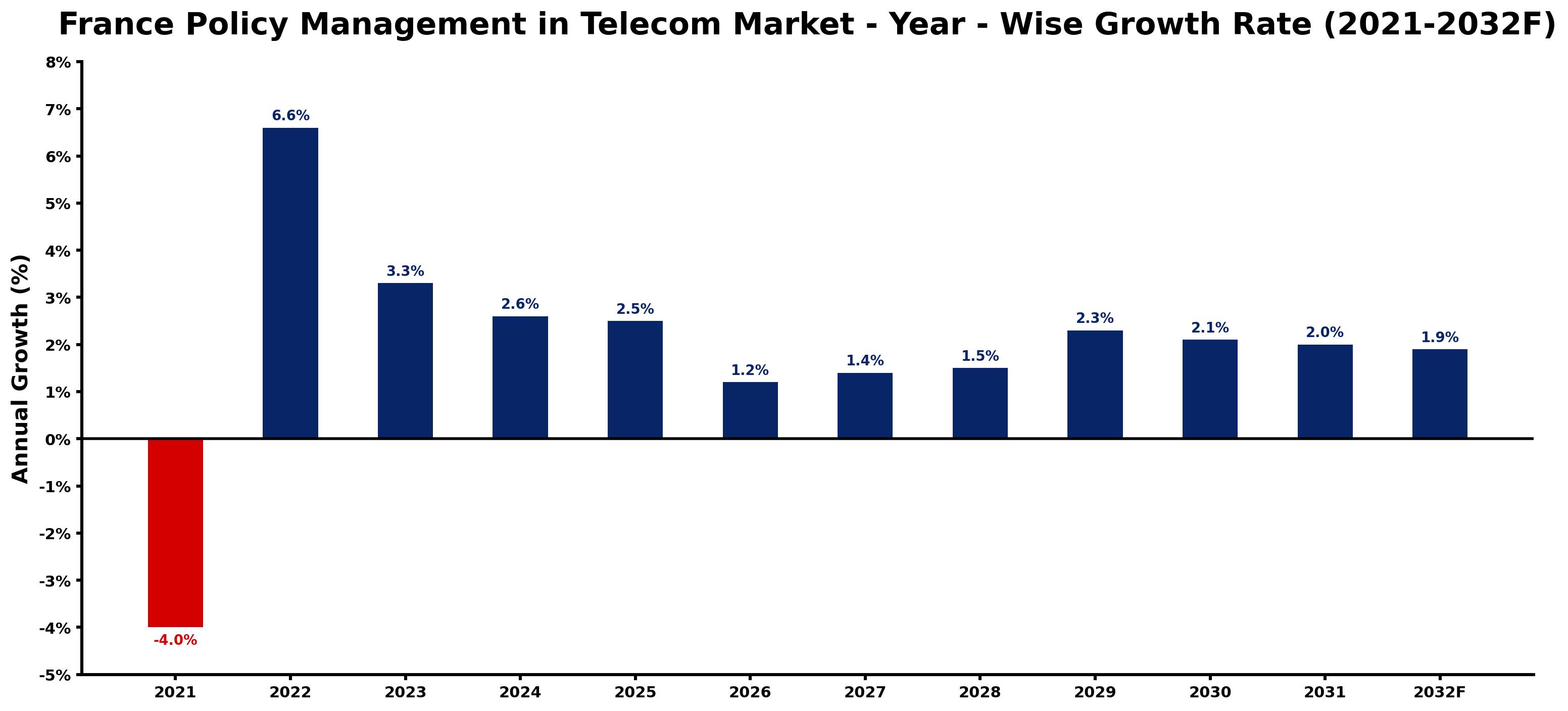
The table below presents the year‑wise growth rates along with the key drivers influencing the market
| Year | Growth Rate | Major Drivers |
| 2021 | -4.0% | ARCEP revisions limited new telecom service licenses. |
| 2022 | 6.6% | Implementation of France's Digital Act boosts telecom policies. |
| 2023 | 3.3% | Increased focus on cybersecurity in telecom regulations. |
| 2024 | 2.6% | Promotion of sustainable telecom practices by government initiatives. |
| 2025 | 2.5% | ARCEP's new guidelines enhance market competition and transparency. |
| 2026 | 1.2% | Rising consumer expectations drive policy reforms in telecom. |
| 2027 | 1.4% | Government support for rural broadband expansion encourages investment. |
| 2028 | 1.5% | Adoption of AI-driven policy management tools in telecom. |
| 2029 | 2.3% | Incentives for telecom companies to improve customer data protection. |
| 2030 | 2.1% | EU directives on telecom interoperability foster compliance strategies. |
| 2031 | 2.0% | Launch of national awareness campaigns for telecom user rights. |
| 2032 | 1.9% | ARCEP's initiatives to address telecom service quality concerns. |
Note: Market size estimations and growth projections presented in this report are based on 6Wresearch's proprietary forecasting methodology, utilizing the latest available industry data, government publications, and primary research inputs.
France Policy Management in Telecom Market Key Takeaways
Below are some of the specific key takeaways from the market, including:
- Ongoing investment in policy enforcement solutions is reshaping service delivery models.
- Technological advancements are vital for addressing complex network demands and ensuring quality of service.
- The emergence of IoT has amplified the need for effective subscriber management strategies.
- Regulatory frameworks continuously evolve, impacting market strategies and operational models.
- Operators are increasingly focused on personalization as a primary driver for customer satisfaction.
Evaluation of Restraints in France Policy Management in Telecom Market
Several restraints are holding back growth in the France Policy Management in Telecom Market. A key issue is the intricate web of regulatory compliance demands that operators must navigate, which can complicate policy implementation and enforcement. Furthermore, the increasing complexity of telecommunications networks makes it challenging to maintain interoperability between different systems and devices. Data privacy concerns are also becoming more pronounced, as consumers demand greater transparency regarding how their data is handled, which in turn pressures operators to develop robust compliance frameworks.
France Policy Management in Telecom Market Trends
Several trends are shaping the France Policy Management in Telecom Market. The rise of 5G technology is pushing telecom operators to adopt more sophisticated policy management systems that can handle higher data traffic and varied service levels. Additionally, the demand for personalized services is prompting operators to harness advanced analytics capabilities to tailor offerings to individual subscriber needs. Lastly, the integration of artificial intelligence into policy management solutions is gaining traction, enabling real-time data processing and more effective decision-making.
France Policy Management in Telecom Market Opportunities
There are notable opportunities for growth in the France Policy Management in Telecom Market, particularly as IoT adoption continues to accelerate. Operators that invest in adaptive policy management systems will be well-positioned to capitalize on the influx of connected devices and the services associated with them. Additionally, as consumer expectations for seamless connectivity rise, the demand for dynamic bandwidth allocation and quality of service enforcement will create openings for innovative solutions. The intersection of regulatory compliance and advanced technology also presents opportunities for service differentiation among operators.
Government Initiatives in the France Policy Management in Telecom Market
Government initiatives are integral to shaping the France Policy Management in Telecom Market. With an aim to enhance competition and protect consumer rights, the regulatory landscape is continually adapting. Regulatory bodies are focusing on promoting transparency and accountability among telecom operators, which directly influences policy management strategies within the industry.
- A regulatory framework introduced in 2025 mandates transparency in billing practices, aiming to protect consumer rights.
- Currently underway is a national digital infrastructure upgrade programme designed to enhance broadband accessibility and network efficiency.
- A planned public-private initiative expected to improve telecom infrastructure access is set to launch in 2028, focusing on rural connectivity.
- Recent policy discussions have focused on introducing measures to bolster data privacy and security for consumers using telecom services.
- An ongoing review of spectrum allocation procedures aims to facilitate more efficient resource use among telecom operators.
Future Insights of the France Policy Management in Telecom Market
The future trajectory of the France Policy Management in Telecom Market looks promising as advancements in technology continue to unfold. By 2032, the integration of AI-driven analytics will not only optimize service delivery but also enhance customer engagement strategies. Operators that can effectively manage policy compliance while offering personalized services will likely emerge as market leaders, fostering sustainable growth in this sector.
France Policy Management in Telecom Market Latest Developments
In the past 12-14 months, the France Policy Management in Telecom Market has witnessed a series of strategic developments aimed at enhancing operational capabilities and consumer service. These activities reflect a robust effort to adapt to rapidly evolving market demands and technological advancements.
- A major technology vendor launched an upgraded policy management platform in Q1 2025, designed to enhance analytics capabilities and user experience.
- One of the leading regional operators began a pilot program in mid-2025 to test AI-driven policy enforcement algorithms that adapt to real-time network conditions.
- By late 2025, a collaborative initiative between telecom operators and regulatory bodies aimed at standardizing data privacy practices was completed successfully.
- Currently ongoing, a service upgrade program is enhancing real-time decision-making capabilities for network management, started in Q2 2025 and remains underway.
- A rollout of a new consumer-facing application is planned for early 2026, aimed at allowing users to manage their service preferences effectively.
France Policy Management in Telecom Market - Key Attractiveness of the Report
- 10 Years of Market Numbers
- Historical Data Starting from 2022 to 2025
- Base Year: 2025
- Forecast Data until 2032
- Key Performance Indicators Impacting the Market
- Major Upcoming Developments and Projects
Key Highlights of the Report:
- France Policy Management in Telecom Market Outlook
- Market Size of France Policy Management in Telecom Market, 2025
- Forecast of France Policy Management in Telecom Market, 2032
- Historical Data and Forecast of France Policy Management in Telecom Revenues & Volume for the Period 2022-2032F
- France Policy Management in Telecom Market Trend Evolution
- France Policy Management in Telecom Market Drivers and Challenges
- France Policy Management in Telecom Price Trends
- France Policy Management in Telecom Porter's Five Forces
- France Policy Management in Telecom Industry Life Cycle
- Historical Data and Forecast of France Policy Management in Telecom Market Revenues & Volume By Network for the Period 2022-2032F
- Historical Data and Forecast of France Policy Management in Telecom Market Revenues & Volume By Fixed for the Period 2022-2032F
- Historical Data and Forecast of France Policy Management in Telecom Market Revenues & Volume By Wireless for the Period 2022-2032F
- Historical Data and Forecast of France Policy Management in Telecom Market Revenues & Volume By Component for the Period 2022-2032F
- Historical Data and Forecast of France Policy Management in Telecom Market Revenues & Volume By Solutions for the Period 2022-2032F
- Historical Data and Forecast of France Policy Management in Telecom Market Revenues & Volume By Services for the Period 2022-2032F
- Historical Data and Forecast of France Policy Management in Telecom Market Revenues & Volume By Deployment for the Period 2022-2032F
- Historical Data and Forecast of France Policy Management in Telecom Market Revenues & Volume By Cloud for the Period 2022-2032F
- Historical Data and Forecast of France Policy Management in Telecom Market Revenues & Volume By On-Premises for the Period 2022-2032F
- France Policy Management in Telecom Import Export Trade Statistics
- Market Opportunity Assessment By Network
- Market Opportunity Assessment By Component
- Market Opportunity Assessment By Deployment
- France Policy Management in Telecom Top Companies Market Share
- France Policy Management in Telecom Competitive Benchmarking By Technical and Operational Parameters
- France Policy Management in Telecom Company Profiles
- France Policy Management in Telecom Key Strategic Recommendations






































