Iraq Policy Management in Telecom Market Size & Growth Rate (2026-2032)
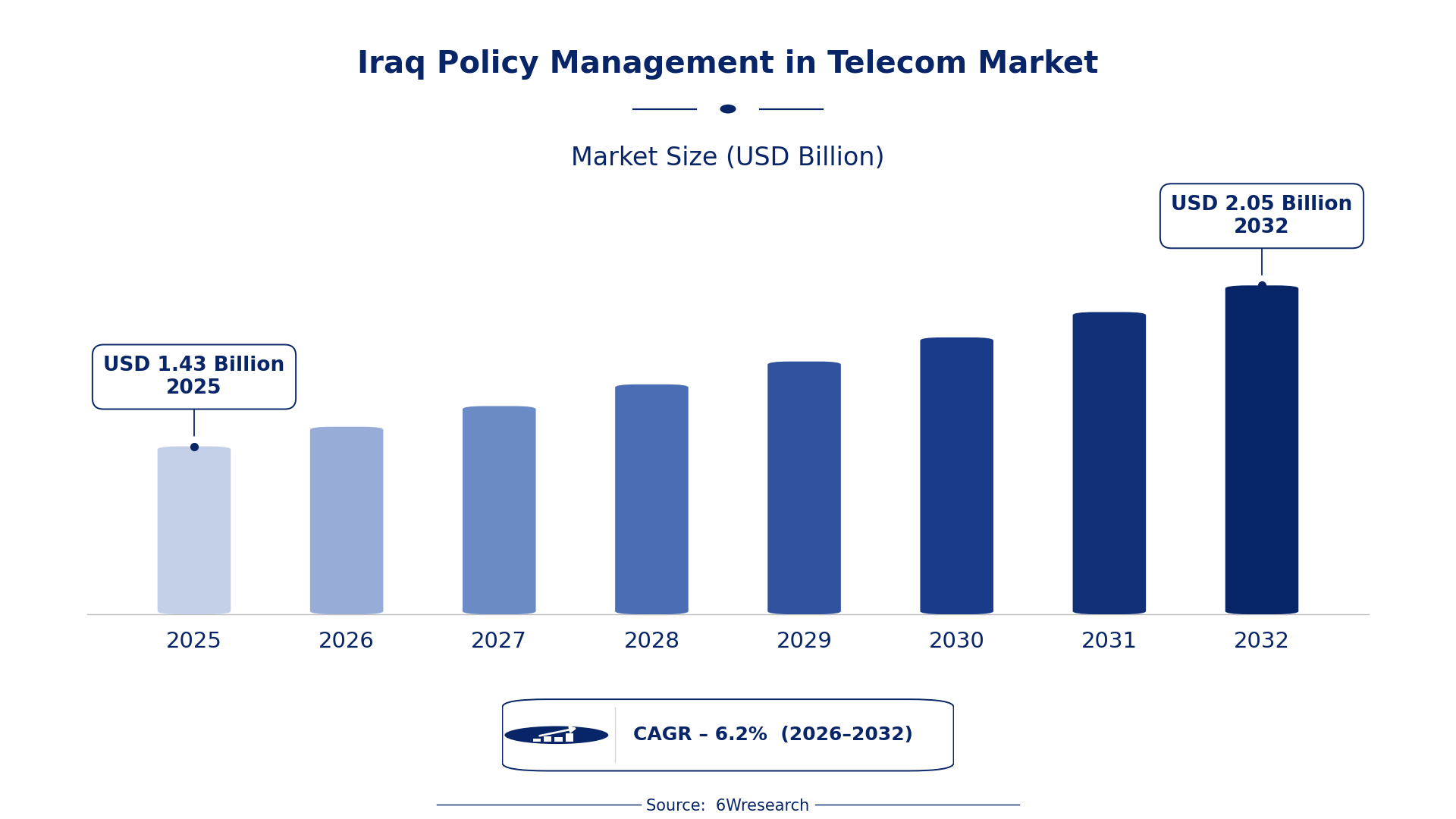
The Iraq Policy Management in Telecom Market was estimated at USD 1433 Million in 2025 and is projected to reach USD 2051 Million by 2032, growing at a CAGR of 6.2% from 2026 to 2032.
Iraq Policy Management in Telecom Market Synopsis
The Iraq Policy Management in Telecom Market has experienced notable momentum recently, driven by the surge in mobile data consumption and the demand for efficient network solutions. Operators are rapidly adopting advanced policy management tools, recognizing their critical role in enhancing customer experience.
Looking ahead, the market is set for substantial growth, fueled by increased smartphone penetration and the digital economy's expansion. However, the lack of a cohesive regulatory framework and outdated infrastructure poses challenges that may temper this growth if not addressed.
Iraq Policy Management in Telecom Market Year-wise Growth Rate and Key Drivers
This graph illustrates the annual growth rates of the Iraq Policy Management in Telecom Market from 2021 to 2032, highlighting a steady upward trajectory and projected expansion over the forecast period.
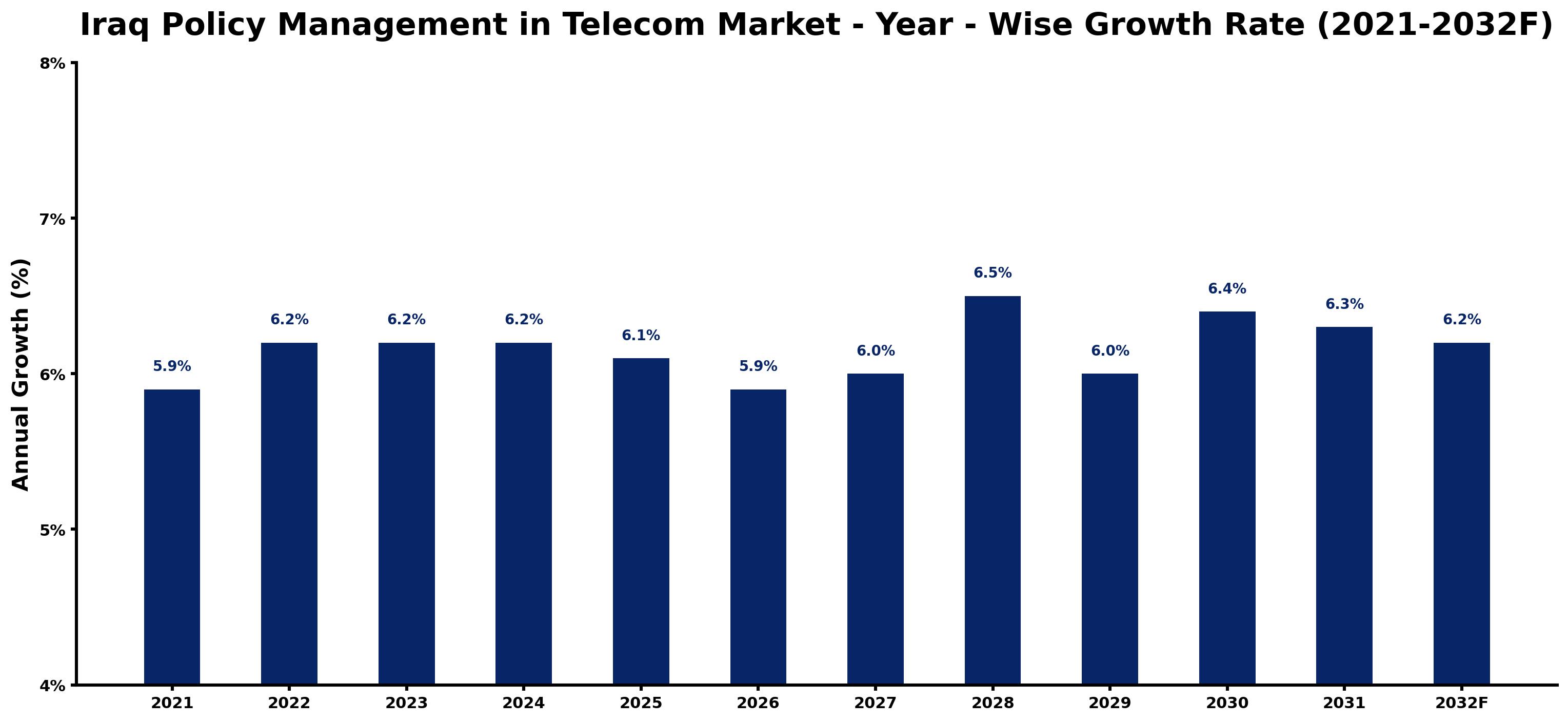
The table below presents the year‑wise growth rates along with the key drivers influencing the market
| Year | Growth Rate | Major Drivers |
| 2021 | 5.9% | Ministry of Communications' new licensing framework boosts investment. |
| 2022 | 6.2% | Rising smartphone penetration enhances digital policy management needs. |
| 2023 | 6.2% | Increased demand for mobile data drives policy optimization efforts. |
| 2024 | 6.2% | Government initiatives promote broadband access in rural areas. |
| 2025 | 6.1% | Telecom sector reforms encourage foreign investment participation. |
| 2026 | 5.9% | Emerging cybersecurity policies strengthen telecom infrastructure resilience. |
| 2027 | 6.0% | Collaborations with tech firms enhance telecom service efficiency. |
| 2028 | 6.5% | Youth population growth drives demand for telecom services. |
| 2029 | 6.0% | 5G rollout sparks new policy frameworks and innovation. |
| 2030 | 6.4% | Government incentives support telecom technology modernization initiatives. |
| 2031 | 6.3% | Regulatory improvements simplify compliance for telecom operators. |
| 2032 | 6.2% | Increasing digital services adoption prompts policy revisions. |
Note: Market size estimations and growth projections presented in this report are based on 6Wresearch's proprietary forecasting methodology, utilizing the latest available industry data, government publications, and primary research inputs.
Iraq Policy Management in Telecom Market Key Takeaways
Below are some of the specific key takeaways from the market, including:
- The rising demand for mobile data services significantly drives market growth.
- Telecom operators are increasingly focusing on personalized data plans to improve customer satisfaction.
- Regulatory inefficiencies hinder optimal investment and development in the sector.
- Technological adoption remains a critical challenge due to the need for skilled professionals.
- Upcoming initiatives from the government aim to enhance the telecom infrastructure and regulatory framework.
Evaluation of Restraints in Iraq Policy Management in Telecom Market
Several restraints currently hold back the Iraq Policy Management in Telecom Market. Chief among these are regulatory inefficiencies, which create an unpredictable environment for telecom operators. The absence of a cohesive strategy for telecom management leads to uneven service quality and stifled innovation. Furthermore, the outdated infrastructure in many regions necessitates significant capital investment for upgrades, often hampered by the prevailing economic instability and security concerns. These factors combined create hurdles that could slow market advancement unless addressed effectively.
Iraq Policy Management in Telecom Market Trends
Several key trends are shaping the Iraq Policy Management in Telecom Market. The rise of 5G technology is forcing operators to enhance their policy management capabilities to support advanced services and applications. Additionally, the integration of artificial intelligence and machine learning in policy management tools is improving network optimization and customer interaction. As users increasingly demand seamless connectivity and tailored services, telecom companies are focusing on developing innovative data packages that cater to diverse customer needs.
Iraq Policy Management in Telecom Market Opportunities
The Iraq Policy Management in Telecom Market is rich with opportunities for growth and investment. With the government's commitment to improving the telecom infrastructure, stakeholders can expect favorable conditions for the introduction of cutting-edge technologies. As mobile data consumption continues to rise, telecom operators have the chance to innovate their service offerings, capitalizing on the trend toward personalized plans. Additionally, partnerships with technology vendors to enhance policy management tools may yield significant improvements in operational efficiency and customer satisfaction.
Government Initiatives in the Iraq Policy Management in Telecom Market
Government initiatives play a crucial role in shaping the Iraq Policy Management in Telecom Market. The regulatory framework established is aimed at fostering fair competition and encouraging technological advancements. By prioritizing telecommunications development, the government is focusing on enhancing service quality and improving network reliability for the growing digital economy.
- A recently completed regulatory framework focuses on billing transparency, enhancing consumer trust in telecom services.
- Currently underway is a national digital infrastructure upgrade programme aimed at modernizing telecom networks across urban and rural areas.
- A planned public-private initiative is expected to expand telecom infrastructure access by 2028, facilitating growth in underserved regions.
- New standards for policy management systems are being introduced to optimize service delivery and customer experience.
- Ongoing discussions around telecom tariffs are expected to lead to a revised pricing strategy that promotes affordability and accessibility.
Future Insights of the Iraq Policy Management in Telecom Market
From 2026 to 2032, the Iraq Policy Management in Telecom Market is expected to undergo transformative changes. As mobile data traffic grows exponentially, telecom operators will be pushed to adopt more sophisticated policy management solutions. Enhanced government regulations and initiatives are likely to create a more conducive environment for investment, enabling operators to innovate and meet consumer demands effectively. The push towards 5G and its accompanying technology will further accelerate growth, allowing for the delivery of advanced services that cater to a broader audience.
Iraq Policy Management in Telecom Market Latest Developments
In the past year, the Iraq Policy Management in Telecom Market has seen several significant developments. Telecom operators have been increasingly focused on upgrading their infrastructure to support evolving consumer needs and the expanding digital economy. As regulatory frameworks tighten, companies are aligning their strategies accordingly to maintain compliance and competitiveness.
- A leading regional operator launched a new policy management tool in early 2025 to enhance network performance and customer satisfaction.
- Ongoing partnerships between telecom firms and technology vendors aim to streamline operations and introduce innovative solutions, now in the pilot phase.
- A recent regulatory initiative has mandated service quality benchmarks that operators must meet to avoid penalties, implemented in Q3 2025.
- A comprehensive training program for telecom professionals is underway, focusing on advanced policy management systems and technology adoption.
- Plans for a major telecom infrastructure investment are expected to kick off in late 2026, aimed at expanding network coverage across underserved regions.
Iraq Policy Management in Telecom Market - Key Attractiveness of the Report
- 10 Years of Market Numbers
- Historical Data Starting from 2022 to 2025
- Base Year: 2025
- Forecast Data until 2032
- Key Performance Indicators Impacting the Market
- Major Upcoming Developments and Projects
Key Highlights of the Report:
- Iraq Policy Management in Telecom Market Outlook
- Market Size of Iraq Policy Management in Telecom Market, 2025
- Forecast of Iraq Policy Management in Telecom Market, 2032
- Historical Data and Forecast of Iraq Policy Management in Telecom Revenues & Volume for the Period 2022-2032F
- Iraq Policy Management in Telecom Market Trend Evolution
- Iraq Policy Management in Telecom Market Drivers and Challenges
- Iraq Policy Management in Telecom Price Trends
- Iraq Policy Management in Telecom Porter's Five Forces
- Iraq Policy Management in Telecom Industry Life Cycle
- Historical Data and Forecast of Iraq Policy Management in Telecom Market Revenues & Volume By Network for the Period 2022-2032F
- Historical Data and Forecast of Iraq Policy Management in Telecom Market Revenues & Volume By Fixed for the Period 2022-2032F
- Historical Data and Forecast of Iraq Policy Management in Telecom Market Revenues & Volume By Wireless for the Period 2022-2032F
- Historical Data and Forecast of Iraq Policy Management in Telecom Market Revenues & Volume By Component for the Period 2022-2032F
- Historical Data and Forecast of Iraq Policy Management in Telecom Market Revenues & Volume By Solutions for the Period 2022-2032F
- Historical Data and Forecast of Iraq Policy Management in Telecom Market Revenues & Volume By Services for the Period 2022-2032F
- Historical Data and Forecast of Iraq Policy Management in Telecom Market Revenues & Volume By Deployment for the Period 2022-2032F
- Historical Data and Forecast of Iraq Policy Management in Telecom Market Revenues & Volume By Cloud for the Period 2022-2032F
- Historical Data and Forecast of Iraq Policy Management in Telecom Market Revenues & Volume By On-Premises for the Period 2022-2032F
- Iraq Policy Management in Telecom Import Export Trade Statistics
- Market Opportunity Assessment By Network
- Market Opportunity Assessment By Component
- Market Opportunity Assessment By Deployment
- Iraq Policy Management in Telecom Top Companies Market Share
- Iraq Policy Management in Telecom Competitive Benchmarking By Technical and Operational Parameters
- Iraq Policy Management in Telecom Company Profiles
- Iraq Policy Management in Telecom Key Strategic Recommendations






































