Vietnam Policy Management in Telecom Market Size & Growth Rate (2026-2032)
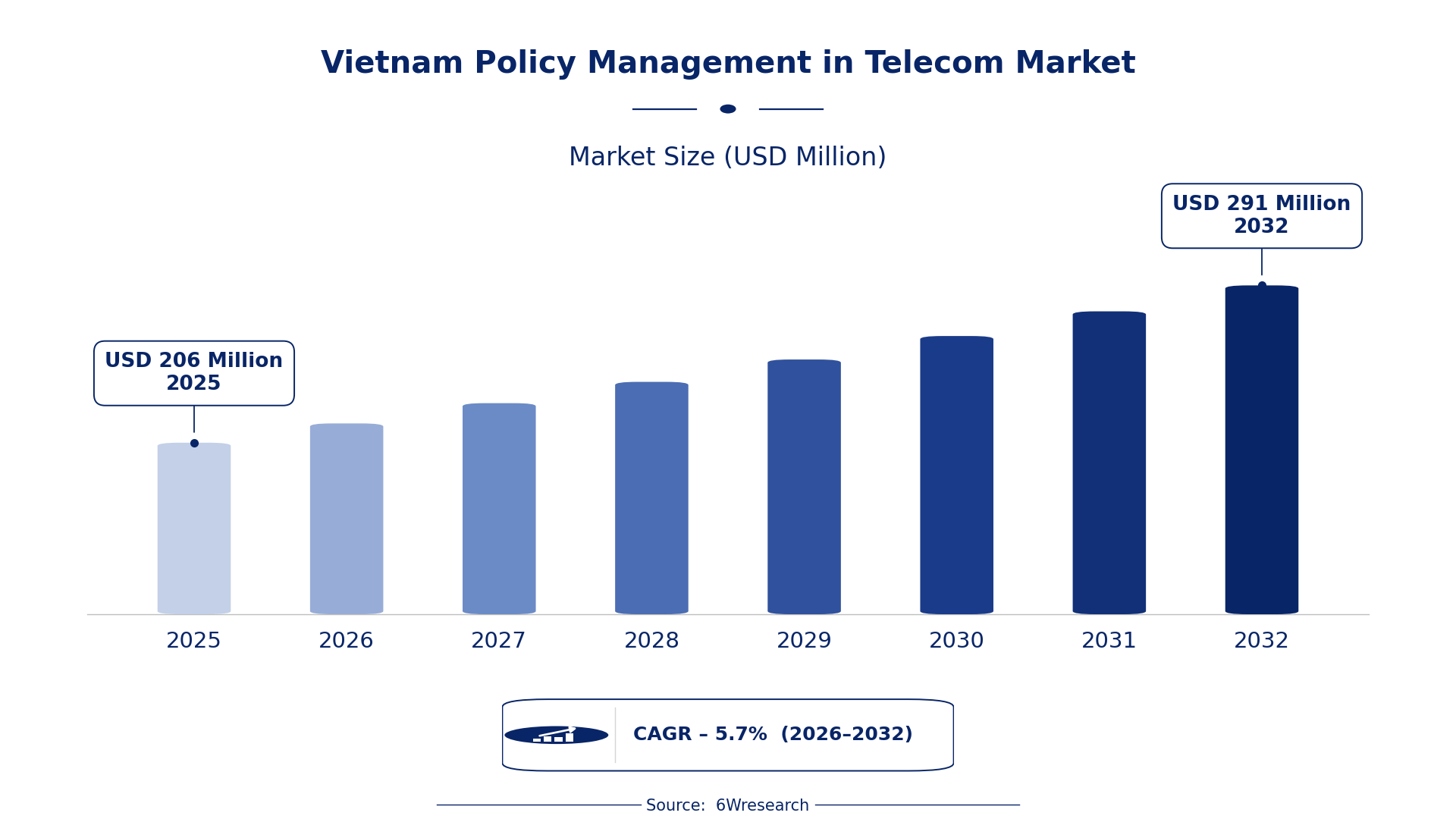
The Vietnam Policy Management in Telecom Market was estimated at USD 206 Million in 2025 and is projected to reach USD 291 Million by 2032, growing at a CAGR of 5.7% from 2026 to 2032.
Vietnam Policy Management in Telecom Market Synopsis
In Vietnam, the telecommunications sector is under intense scrutiny as regulatory frameworks become more complex. This dynamic environment demands advanced policy management solutions to ensure compliance and efficiency. Telecom operators increasingly recognize that effective policy management is not just a necessity but a strategic advantage.
Telecom providers are tasked with the dual challenge of enhancing customer experiences while adhering to stringent regulations. The rise of technologies such as 5G and IoT heightens the urgency for robust policy management frameworks, as service delivery and operational efficiencies hang in the balance.
Vietnam Policy Management in Telecom Market Year-wise Growth Rate and Key Drivers
This graph illustrates the annual growth rates of the Vietnam Policy Management in Telecom Market from 2021 to 2032, highlighting a steady upward trajectory and projected expansion over the forecast period.
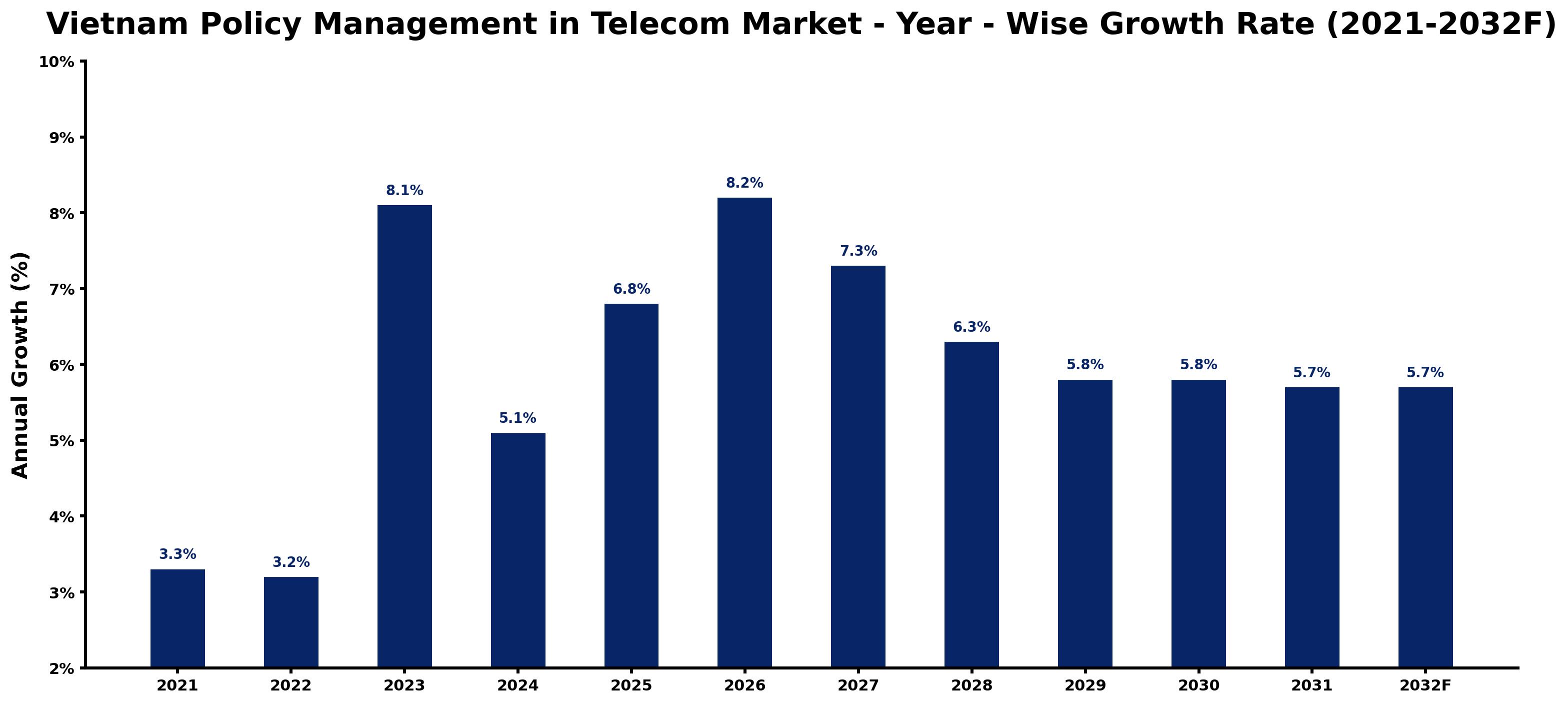
The table below presents the year‑wise growth rates along with the key drivers influencing the market
| Year | Growth Rate | Major Drivers |
| 2021 | 3.3% | Vietnam's Ministry of Information supports telecom regulatory reforms. |
| 2022 | 3.2% | Increased smartphone penetration boosts telecom policy engagement. |
| 2023 | 8.1% | 5G rollout accelerates competition among telecom providers. |
| 2024 | 5.1% | Government incentives for broadband expansion enhance telecom access. |
| 2025 | 6.8% | Youth population drives demand for mobile data services. |
| 2026 | 8.2% | Local startups innovate in telecom policy technologies. |
| 2027 | 7.3% | Rising foreign investments in Vietnam's telecom sector. |
| 2028 | 6.3% | Government focus on digital economy fuels telecom advancements. |
| 2029 | 5.8% | Increased cybersecurity laws raise telecom service provider standards. |
| 2030 | 5.8% | Growing adoption of e-commerce enhances telecom usage. |
| 2031 | 5.7% | Wireless service subscriptions surge among rural communities. |
| 2032 | 5.7% | Policy adjustments improve telecommunications infrastructure funding. |
Note: Market size estimations and growth projections presented in this report are based on 6Wresearch's proprietary forecasting methodology, utilizing the latest available industry data, government publications, and primary research inputs.
Vietnam Policy Management in Telecom Market Key Takeaways
Below are some of the specific key takeaways from the market, including:
- Policy management solutions are essential for navigating regulatory complexities in the telecom sector.
- The transition to 5G and IoT is significantly shaping the demand for real-time policy management solutions.
- Telecom operators are prioritizing compliance with evolving data privacy and security regulations.
- Agility in policy frameworks has become vital as customer expectations shift rapidly.
- Industry players are focusing on resource optimization to enhance service quality and security.
Evaluation of Restraints in Vietnam Policy Management in Telecom Market
Several obstacles impede the growth of the Vietnam Policy Management in Telecom Market. The rapid evolution of telecommunications technology makes it difficult for service providers to keep their policies updated. Frequent regulatory changes necessitate a continuous revision process, which can strain resources. Additionally, concerns regarding data privacy must be addressed; as operators manage sensitive customer information, the need for stringent security protocols is paramount. The integration of legacy systems with new policy management solutions often adds another layer of complexity that can hinder progress.
Vietnam Policy Management in Telecom Market Trends
The market is witnessing a shift towards automated policy management solutions as operators aim to streamline operations and reduce human error. The emergence of AI-driven analytics tools is also becoming a key trend, allowing telecom companies to better anticipate customer needs and regulatory changes. Additionally, the focus on customer-centric policy management is leading to innovations that enhance user experience, reflecting a broader trend toward service personalization in the industry.
Vietnam Policy Management in Telecom Market Opportunities
A variety of growth opportunities exist within the Vietnam Policy Management in Telecom Market. The rollout of 5G technology presents a chance for telecom operators to innovate their service offerings while leveraging advanced policy management tools. As IoT applications expand, companies can develop specialized policies tailored to new services, providing a competitive edge. Furthermore, the growing emphasis on data security opens avenues for policy solutions that prioritize customer trust and compliance.
Government Initiatives in the Vietnam Policy Management in Telecom Market
Government policy is playing an influential role in shaping the Vietnam Policy Management in Telecom Market. Regulatory bodies are actively working to create frameworks that balance innovation with consumer protection, which is essential for the industry's sustainable growth. Current efforts emphasize enhancing digital infrastructure, ensuring data privacy, and fostering compliance with international standards.
- A regulatory framework introduced in early 2025 mandating stricter data protection measures for telecom operators.
- A national digital infrastructure upgrade programme currently underway, focusing on improving service accessibility across rural regions.
- A public-private initiative planned for 2026 to enhance the integration of IoT within telecommunications, focusing on policy alignment.
- Recent efforts to streamline licensing processes for new service providers, aimed at fostering market competition and innovation.
Future Insights of the Vietnam Policy Management in Telecom Market
Looking ahead to 2026-2032, the Vietnam Policy Management in Telecom Market is likely to become increasingly sophisticated. The demand for agile, real-time policy management solutions will escalate as technologies evolve. Operators that prioritize adaptability and customer-centric policies will likely outperform competitors. Increased collaboration between telecom companies and regulatory bodies will be pivotal in navigating the complex landscape, ultimately driving innovation while ensuring compliance.
Vietnam Policy Management in Telecom Market Latest Developments
In the past year, the Vietnam Policy Management in Telecom Market has seen a series of pivotal developments that reflect the industry's response to evolving challenges. With operators under pressure to enhance service delivery and comply with new regulations, the market has demonstrated remarkable adaptability.
- A leading regional operator launched an upgraded policy management solution in Q1 2025, focusing on regulatory compliance and operational efficiency.
- An initiative that began in early 2025 is currently underway, emphasizing the integration of AI tools for enhanced data analytics in policy management.
- A collaborative project between telecom companies and government bodies was completed in mid-2025 to establish clearer guidelines for data protection.
- Upcoming in late 2026 is a planned rollout of a national program aimed at improving the interoperability of telecom services through standardized policies.
Vietnam Policy Management in Telecom Market - Key Attractiveness of the Report
- 10 Years of Market Numbers
- Historical Data Starting from 2022 to 2025
- Base Year: 2025
- Forecast Data until 2032
- Key Performance Indicators Impacting the Market
- Major Upcoming Developments and Projects
Key Highlights of the Report:
- Vietnam Policy Management in Telecom Market Outlook
- Market Size of Vietnam Policy Management in Telecom Market, 2025
- Forecast of Vietnam Policy Management in Telecom Market, 2032
- Historical Data and Forecast of Vietnam Policy Management in Telecom Revenues & Volume for the Period 2022-2032F
- Vietnam Policy Management in Telecom Market Trend Evolution
- Vietnam Policy Management in Telecom Market Drivers and Challenges
- Vietnam Policy Management in Telecom Price Trends
- Vietnam Policy Management in Telecom Porter's Five Forces
- Vietnam Policy Management in Telecom Industry Life Cycle
- Historical Data and Forecast of Vietnam Policy Management in Telecom Market Revenues & Volume By Network for the Period 2022-2032F
- Historical Data and Forecast of Vietnam Policy Management in Telecom Market Revenues & Volume By Fixed for the Period 2022-2032F
- Historical Data and Forecast of Vietnam Policy Management in Telecom Market Revenues & Volume By Wireless for the Period 2022-2032F
- Historical Data and Forecast of Vietnam Policy Management in Telecom Market Revenues & Volume By Component for the Period 2022-2032F
- Historical Data and Forecast of Vietnam Policy Management in Telecom Market Revenues & Volume By Solutions for the Period 2022-2032F
- Historical Data and Forecast of Vietnam Policy Management in Telecom Market Revenues & Volume By Services for the Period 2022-2032F
- Historical Data and Forecast of Vietnam Policy Management in Telecom Market Revenues & Volume By Deployment for the Period 2022-2032F
- Historical Data and Forecast of Vietnam Policy Management in Telecom Market Revenues & Volume By Cloud for the Period 2022-2032F
- Historical Data and Forecast of Vietnam Policy Management in Telecom Market Revenues & Volume By On-Premises for the Period 2022-2032F
- Vietnam Policy Management in Telecom Import Export Trade Statistics
- Market Opportunity Assessment By Network
- Market Opportunity Assessment By Component
- Market Opportunity Assessment By Deployment
- Vietnam Policy Management in Telecom Top Companies Market Share
- Vietnam Policy Management in Telecom Competitive Benchmarking By Technical and Operational Parameters
- Vietnam Policy Management in Telecom Company Profiles
- Vietnam Policy Management in Telecom Key Strategic Recommendations






































