Malaysia Policy Management in Telecom Market Size & Growth Rate (2026-2032)
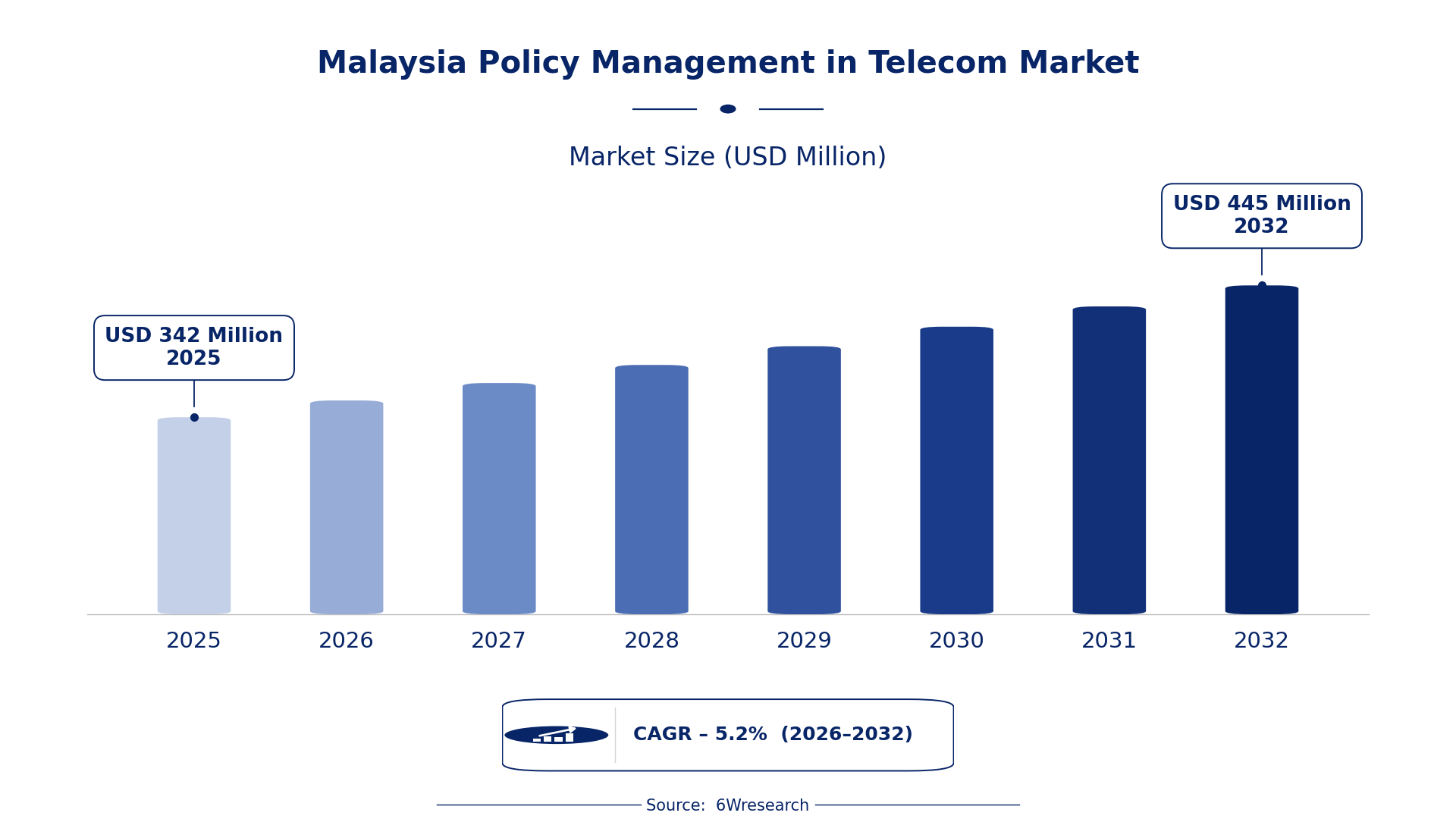
The Malaysia Policy Management in Telecom Market was estimated at USD 342 Million in 2025 and is projected to reach USD 445 Million by 2032, growing at a CAGR of 5.2% from 2026 to 2032.
Malaysia Policy Management in Telecom Market Synopsis
The demand for efficient policy management solutions is a key factor shaping the Malaysia Policy Management in Telecom Market. As telecom services become increasingly complex, operators must implement sophisticated platforms that not only allocate bandwidth but also enforce quality of service metrics to ensure customer satisfaction.
In Malaysia, the emphasis on real-time policy enforcement and the use of advanced algorithms is becoming indispensable. As the industry expands to include IoT and personalized services, telecom operators are investing heavily in policy management solutions to maintain competitive advantage and regulatory compliance.
Malaysia Policy Management in Telecom Market Year-wise Growth Rate and Key Drivers
This graph illustrates the annual growth rates of the Malaysia Policy Management in Telecom Market from 2021 to 2032, highlighting a steady upward trajectory and projected expansion over the forecast period.
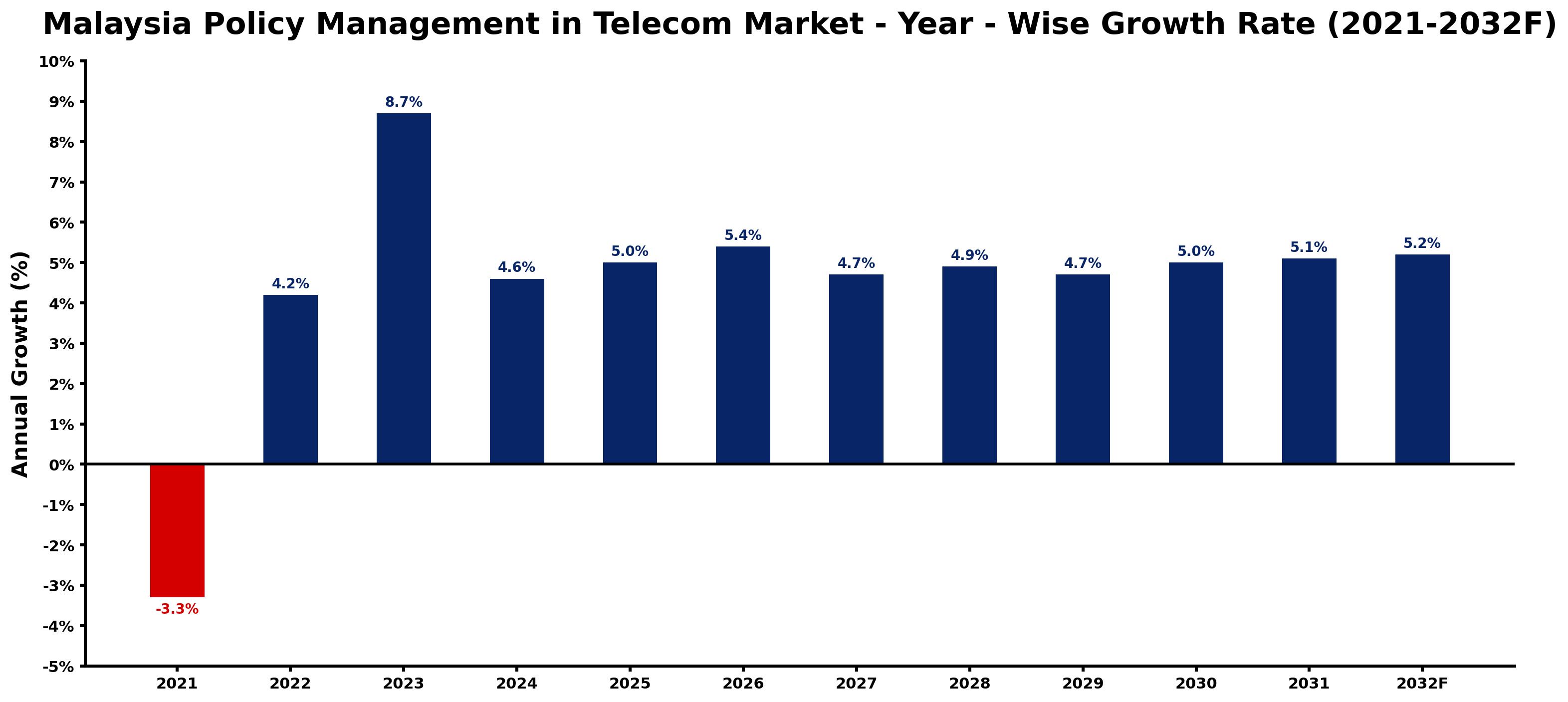
The table below presents the year‑wise growth rates along with the key drivers influencing the market
| Year | Growth Rate | Major Drivers |
| 2021 | -3.3% | Uncertainty from Malaysian Communications and Multimedia Commission regulations. |
| 2022 | 4.2% | Introduction of MCMC’s Digital Connectivity Plan boost |
| 2023 | 8.7% | 5G deployment by Telekom Malaysia driving policy innovation |
| 2024 | 4.6% | Strengthened data protection regulations enhancing consumer trust |
| 2025 | 5.0% | Increased consumer demand for better telecom service regulation |
| 2026 | 5.4% | Government incentives for smart telecom infrastructure development |
| 2027 | 4.7% | Implementation of National Fiberisation Plan advancing deployment speeds |
| 2028 | 4.9% | Emerging digital services requiring robust telecom policies |
| 2029 | 4.7% | Rise in e-commerce necessitating updated telecom regulations |
| 2030 | 5.0% | Expanding IoT applications prompting policy adaptations in telecom |
| 2031 | 5.1% | Regulatory support for virtual telecom service providers increases |
| 2032 | 5.2% | Strengthened cybersecurity measures enhancing telecom policy landscape |
Note: Market size estimations and growth projections presented in this report are based on 6Wresearch's proprietary forecasting methodology, utilizing the latest available industry data, government publications, and primary research inputs.
Malaysia Policy Management in Telecom Market Key Takeaways
Below are some of the specific key takeaways from the market, including:
- The market is projected to grow steadily, driven by increasing regulatory compliance and customer service demands.
- Operators are focusing on dynamic policy management platforms to optimize bandwidth allocation.
- The integration of machine learning in policy management solutions is on the rise, enhancing network performance.
- Real-time enforcement of policies is critical to maintaining service quality in diverse telecom offerings.
- Stringent data privacy regulations are propelling the adoption of advanced policy frameworks.
Evaluation of Restraints in Malaysia Policy Management in Telecom Market
While the market is experiencing growth, several constraints hinder its full potential. Regulatory frameworks are not just evolving but require constant adaptation, which can strain resources. Issues of network neutrality present challenges in ensuring fair competition among telecom providers, complicating the landscape. Balancing innovation with consumer protection remains a critical focus for the Malaysian government, and misalignment in these areas can restrict market expansion.
Malaysia Policy Management in Telecom Market Trends
Several trends are reshaping the Malaysia Policy Management in Telecom Market. First, the adoption of AI and machine learning technologies is becoming more prevalent, driving efficiency and customer-focused service offerings. Second, there is a notable shift toward policy automation, allowing for quicker responses to network demands. Lastly, the focus on security and data compliance is influencing how operators manage their policies, as they aim to protect user data while complying with stringent regulations.
Malaysia Policy Management in Telecom Market Opportunities
Investment opportunities in the Malaysian market are ripe, particularly in areas related to advanced analytics and policy automation. As telecom operators seek to streamline operations and enhance customer engagement, solutions that facilitate personalized service offerings will be in high demand. Furthermore, emerging technologies, such as 5G, will necessitate innovative policy management strategies, providing a fertile ground for new entrants and established players alike.
Government Initiatives in the Malaysia Policy Management in Telecom Market
The Malaysian government is actively shaping the policy management environment within the telecom sector. With a clear focus on regulatory compliance and the promotion of industry innovation, government initiatives aim to fortify the market's infrastructure and create a favorable operating landscape for telecom operators.
- A regulatory framework implemented in 2025 mandates stricter data protection measures for telecom operators.
- Ongoing initiatives promote the integration of AI technologies into policy management systems for improved performance.
- A national digital infrastructure upgrade programme is currently in its rollout phase, focusing on enhancing connectivity.
- A planned public-private partnership aims to expand access to rural areas by 2028, ensuring equitable service availability.
Future Insights of the Malaysia Policy Management in Telecom Market
Looking ahead to 2026-2032, the Malaysia Policy Management in Telecom Market is expected to evolve significantly. The increasing complexity of services, coupled with heightened regulatory scrutiny, will drive demand for sophisticated policy management solutions. Operators that can adeptly integrate real-time data analytics and AI into their operations will likely capture a larger share of the market. As consumer expectations rise, telecom companies must prioritize personalization and compliance, positioning themselves to thrive amidst the changing landscape.
Malaysia Policy Management in Telecom Market Latest Developments
In the past year, the Malaysia Policy Management in Telecom Market has seen considerable activity as operators adapt to evolving customer needs and regulatory requirements. Key advancements in technology and service offerings indicate a commitment to enhancing user experience and operational efficiency.
- A major telecom operator launched an updated policy management platform in Q2 2025, designed to enhance real-time data processing capabilities.
- An initiative that began in early 2025 aims to integrate machine learning into existing policy frameworks, improving service delivery and compliance.
- A partnership formed in late 2025 between local operators focuses on developing standardized policy enforcement mechanisms across networks.
- A regulatory review process is currently underway to assess the effectiveness of existing policies, with recommendations expected by mid-2026.
Malaysia Policy Management in Telecom Market - Key Attractiveness of the Report
- 10 Years of Market Numbers
- Historical Data Starting from 2022 to 2025
- Base Year: 2025
- Forecast Data until 2032
- Key Performance Indicators Impacting the Market
- Major Upcoming Developments and Projects
What are the current trends in Malaysia’s telecom policy management?
Key Highlights of the Report:
- Malaysia Policy Management in Telecom Market Outlook
- Market Size of Malaysia Policy Management in Telecom Market, 2025
- Forecast of Malaysia Policy Management in Telecom Market, 2032
- Historical Data and Forecast of Malaysia Policy Management in Telecom Revenues & Volume for the Period 2022-2032F
- Malaysia Policy Management in Telecom Market Trend Evolution
- Malaysia Policy Management in Telecom Market Drivers and Challenges
- Malaysia Policy Management in Telecom Price Trends
- Malaysia Policy Management in Telecom Porter's Five Forces
- Malaysia Policy Management in Telecom Industry Life Cycle
- Historical Data and Forecast of Malaysia Policy Management in Telecom Market Revenues & Volume By Network for the Period 2022-2032F
- Historical Data and Forecast of Malaysia Policy Management in Telecom Market Revenues & Volume By Fixed for the Period 2022-2032F
- Historical Data and Forecast of Malaysia Policy Management in Telecom Market Revenues & Volume By Wireless for the Period 2022-2032F
- Historical Data and Forecast of Malaysia Policy Management in Telecom Market Revenues & Volume By Component for the Period 2022-2032F
- Historical Data and Forecast of Malaysia Policy Management in Telecom Market Revenues & Volume By Solutions for the Period 2022-2032F
- Historical Data and Forecast of Malaysia Policy Management in Telecom Market Revenues & Volume By Services for the Period 2022-2032F
- Historical Data and Forecast of Malaysia Policy Management in Telecom Market Revenues & Volume By Deployment for the Period 2022-2032F
- Historical Data and Forecast of Malaysia Policy Management in Telecom Market Revenues & Volume By Cloud for the Period 2022-2032F
- Historical Data and Forecast of Malaysia Policy Management in Telecom Market Revenues & Volume By On-Premises for the Period 2022-2032F
- Malaysia Policy Management in Telecom Import Export Trade Statistics
- Market Opportunity Assessment By Network
- Market Opportunity Assessment By Component
- Market Opportunity Assessment By Deployment
- Malaysia Policy Management in Telecom Top Companies Market Share
- Malaysia Policy Management in Telecom Competitive Benchmarking By Technical and Operational Parameters
- Malaysia Policy Management in Telecom Company Profiles
- Malaysia Policy Management in Telecom Key Strategic Recommendations






































