Philippines Policy Management in Telecom Market Size & Growth Rate (2026-2032)
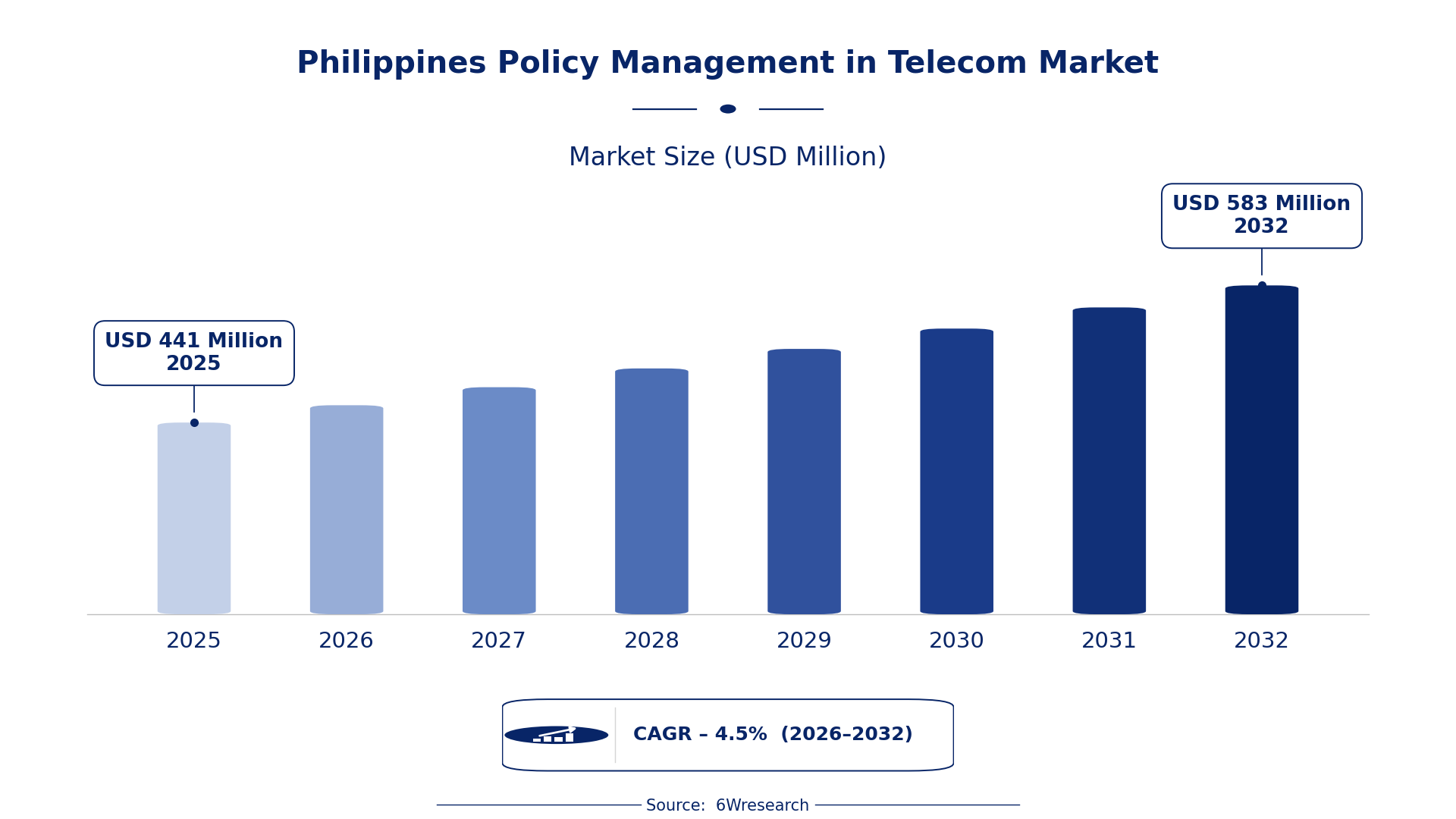
The Philippines Policy Management in Telecom Market was estimated at USD 441 Million in 2025 and is projected to reach USD 583 Million by 2032, growing at a CAGR of 4.5% from 2026 to 2032.
Philippines Policy Management in Telecom Market Synopsis
The Philippines Policy Management in Telecom Market has seen substantial growth recently as the demand for data management and network optimization intensifies. Telecommunications operators are increasingly recognizing the value of effective policy management solutions to enhance operational efficiency and improve customer experience.
Looking ahead, this market is expected to evolve as regulatory frameworks tighten and customer expectations shift towards greater transparency and responsiveness. The integration of advanced analytics and automation tools into policy management systems will be a critical driver of innovation and competitive advantage.
Philippines Policy Management in Telecom Market Year-wise Growth Rate and Key Drivers
This graph illustrates the annual growth rates of the Philippines Policy Management in Telecom Market from 2021 to 2032, highlighting a steady upward trajectory and projected expansion over the forecast period.
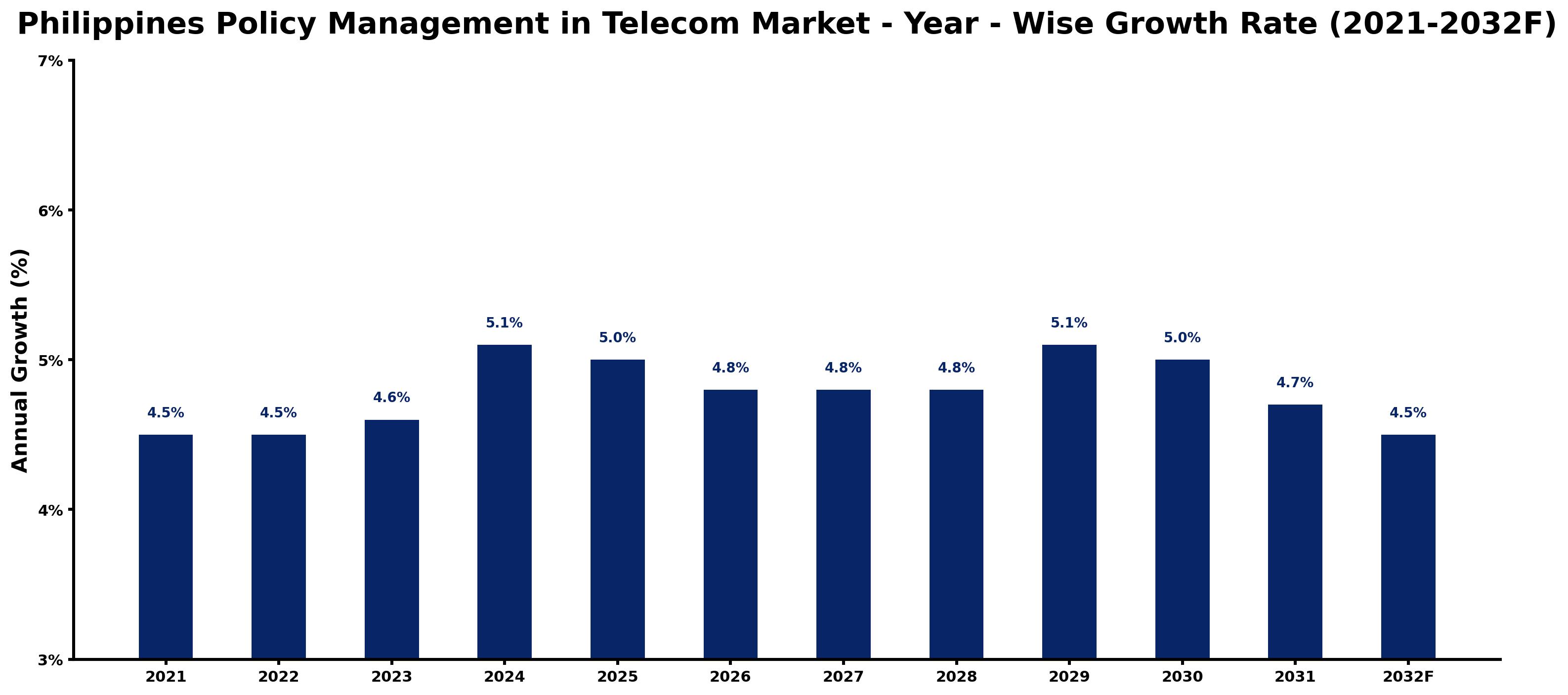
The table below presents the year‑wise growth rates along with the key drivers influencing the market
| Year | Growth Rate | Major Drivers |
| 2021 | 4.5% | Philippine National Broadband Plan promotes telecom policy improvements. |
| 2022 | 4.5% | Regulatory reforms enhance competition among telecom operators. |
| 2023 | 4.6% | Innovative telecom policies support increased digital services adoption. |
| 2024 | 5.1% | Expanded 5G licensing boosts telecom infrastructure investments. |
| 2025 | 5.0% | Increased foreign investment improves telecom industry dynamics. |
| 2026 | 4.8% | Continuing digital transformation initiatives drive telecom policy adjustments. |
| 2027 | 4.8% | Government initiatives focus on improved connectivity in rural areas. |
| 2028 | 4.8% | Emerging telehealth services require updated telecom regulatory frameworks. |
| 2029 | 5.1% | Strong demand for mobile services drives telecom policy enhancements. |
| 2030 | 5.0% | Digital payment solutions mandate stronger telecom regulatory support. |
| 2031 | 4.7% | Growing e-commerce sector impacts telecom service policies positively. |
| 2032 | 4.5% | Sustained demand for internet access influences telecom regulation reforms. |
Note: Market size estimations and growth projections presented in this report are based on 6Wresearch's proprietary forecasting methodology, utilizing the latest available industry data, government publications, and primary research inputs.
Philippines Policy Management in Telecom Market Key Takeaways
Below are some of the specific key takeaways from the market, including:
- Growth is underpinned by the rising demand for high-speed internet and mobile services.
- Regulatory compliance remains a central challenge for telecom operators.
- Emerging technologies are set to redefine policy management practices.
- Investment in automation and AI-driven solutions is on the rise.
- Collaborative efforts between government and private sectors aim to enhance infrastructure resilience.
Evaluation of Restraints in Philippines Policy Management in Telecom Market
Telecom operators in the Philippines face significant hurdles in managing policy compliance amidst a complex regulatory environment. One major restraint is the fragmented nature of regulations across different jurisdictions, which complicates enforcement and monitoring. Additionally, the rapid pace of technological advancement often outstrips existing regulatory frameworks, leading to gaps in oversight that can hinder effective policy implementation. Operators must also navigate the challenges of customer retention and satisfaction while managing costs, making it imperative that they strike a balance between regulatory compliance and service quality.
Philippines Policy Management in Telecom Market Trends
Key trends influencing the Philippines Policy Management in Telecom Market include the increasing adoption of cloud-based solutions, which allow for scalable and flexible policy management approaches. Operators are also prioritizing customer experience through enhanced data analytics, enabling them to tailor services more precisely to user needs. Furthermore, the push towards digital transformation is prompting telecom companies to invest in real-time policy enforcement capabilities, fostering a more agile operational framework.
Philippines Policy Management in Telecom Market Opportunities
The potential for growth in the Philippines Policy Management in Telecom Market lies in the expansion of 5G technology, which is expected to drive demand for more sophisticated policy management solutions. Operators have the chance to develop innovative service offerings that capitalize on higher data speeds and lower latency. Additionally, partnerships with technology vendors can help enhance operational efficiencies and create new revenue streams through value-added services.
Government Initiatives in the Philippines Policy Management in Telecom Market
Government policy is increasingly shaping the Philippines Policy Management in Telecom Market as regulators seek to enhance service quality and expand connectivity. The Philippines government has prioritized a regulatory framework that not only promotes investment but also ensures compliance with data privacy and customer protection laws. This approach is vital for fostering a competitive telecom environment while addressing the needs of consumers.
- A regulatory framework introduced in 2025 mandating billing transparency to enhance customer trust.
- A national digital infrastructure upgrade programme currently underway, aiming to expand access to underserved areas.
- A planned public-private initiative expected to bolster telecom infrastructure resilience by 2028.
- The implementation of data protection regulations initiated in early 2025 to safeguard consumer privacy.
- Ongoing discussions regarding spectrum allocation reforms to facilitate 5G deployment by 2026.
Future Insights of the Philippines Policy Management in Telecom Market
From 2026 to 2032, the Philippines Policy Management in Telecom Market is set for transformative growth driven by advancements in technology and evolving regulatory demands. Operators will increasingly rely on data analytics to refine their policy management strategies and enhance service delivery. As the market matures, a focus on transparency and consumer rights will become essential, shaping operational practices and competitive strategies.
Philippines Policy Management in Telecom Market Latest Developments
Recent developments in the Philippines Policy Management in Telecom Market indicate a proactive approach among telecom operators to enhance service quality and operational efficiency. In the last year, companies have initiated strategic collaborations and technology upgrades to stay competitive and responsive to customer needs.
- A major technology vendor launched a new policy management solution in Q2 2025, designed to optimize data traffic management.
- An initiative to implement AI-driven analytics for real-time policy enforcement began in early 2025 and is currently ongoing.
- Several leading operators are in the planning phase for a service enhancement rollout scheduled for late 2026, focused on improving customer engagement.
- A partnership formed in mid-2025 between two regional players aims to enhance infrastructure resilience through shared resources.
- A pilot program for automated compliance checks began in Q3 2025, currently under evaluation for broader implementation.
Philippines Policy Management in Telecom Market - Key Attractiveness of the Report
- 10 Years of Market Numbers
- Historical Data Starting from 2022 to 2025
- Base Year: 2025
- Forecast Data until 2032
- Key Performance Indicators Impacting the Market
- Major Upcoming Developments and Projects
Key Highlights of the Report:
- Philippines Policy Management in Telecom Market Outlook
- Market Size of Philippines Policy Management in Telecom Market, 2025
- Forecast of Philippines Policy Management in Telecom Market, 2032
- Historical Data and Forecast of Philippines Policy Management in Telecom Revenues & Volume for the Period 2022-2032F
- Philippines Policy Management in Telecom Market Trend Evolution
- Philippines Policy Management in Telecom Market Drivers and Challenges
- Philippines Policy Management in Telecom Price Trends
- Philippines Policy Management in Telecom Porter's Five Forces
- Philippines Policy Management in Telecom Industry Life Cycle
- Historical Data and Forecast of Philippines Policy Management in Telecom Market Revenues & Volume By Network for the Period 2022-2032F
- Historical Data and Forecast of Philippines Policy Management in Telecom Market Revenues & Volume By Fixed for the Period 2022-2032F
- Historical Data and Forecast of Philippines Policy Management in Telecom Market Revenues & Volume By Wireless for the Period 2022-2032F
- Historical Data and Forecast of Philippines Policy Management in Telecom Market Revenues & Volume By Component for the Period 2022-2032F
- Historical Data and Forecast of Philippines Policy Management in Telecom Market Revenues & Volume By Solutions for the Period 2022-2032F
- Historical Data and Forecast of Philippines Policy Management in Telecom Market Revenues & Volume By Services for the Period 2022-2032F
- Historical Data and Forecast of Philippines Policy Management in Telecom Market Revenues & Volume By Deployment for the Period 2022-2032F
- Historical Data and Forecast of Philippines Policy Management in Telecom Market Revenues & Volume By Cloud for the Period 2022-2032F
- Historical Data and Forecast of Philippines Policy Management in Telecom Market Revenues & Volume By On-Premises for the Period 2022-2032F
- Philippines Policy Management in Telecom Import Export Trade Statistics
- Market Opportunity Assessment By Network
- Market Opportunity Assessment By Component
- Market Opportunity Assessment By Deployment
- Philippines Policy Management in Telecom Top Companies Market Share
- Philippines Policy Management in Telecom Competitive Benchmarking By Technical and Operational Parameters
- Philippines Policy Management in Telecom Company Profiles
- Philippines Policy Management in Telecom Key Strategic Recommendations






































