France Trolley Market Size, Share & Growth Rate
The France Trolley Market was estimated at USD 203 Million in 2025 and is projected to reach USD 228 Million by 2032, growing at a CAGR of 1.7% from 2026 to 2032. This growth trajectory reflects a rising demand for ergonomically designed and multifunctional trolleys across various sectors including retail and healthcare. The trend towards urbanization and increased consumer preference for convenience-driven solutions plays a significant role in accelerating market expansion.
France Trolley Market Year-wise Growth Rate and Key Drivers
This graph highlights how the France Trolley Market has steadily grown over the years, supported by major growth factors.
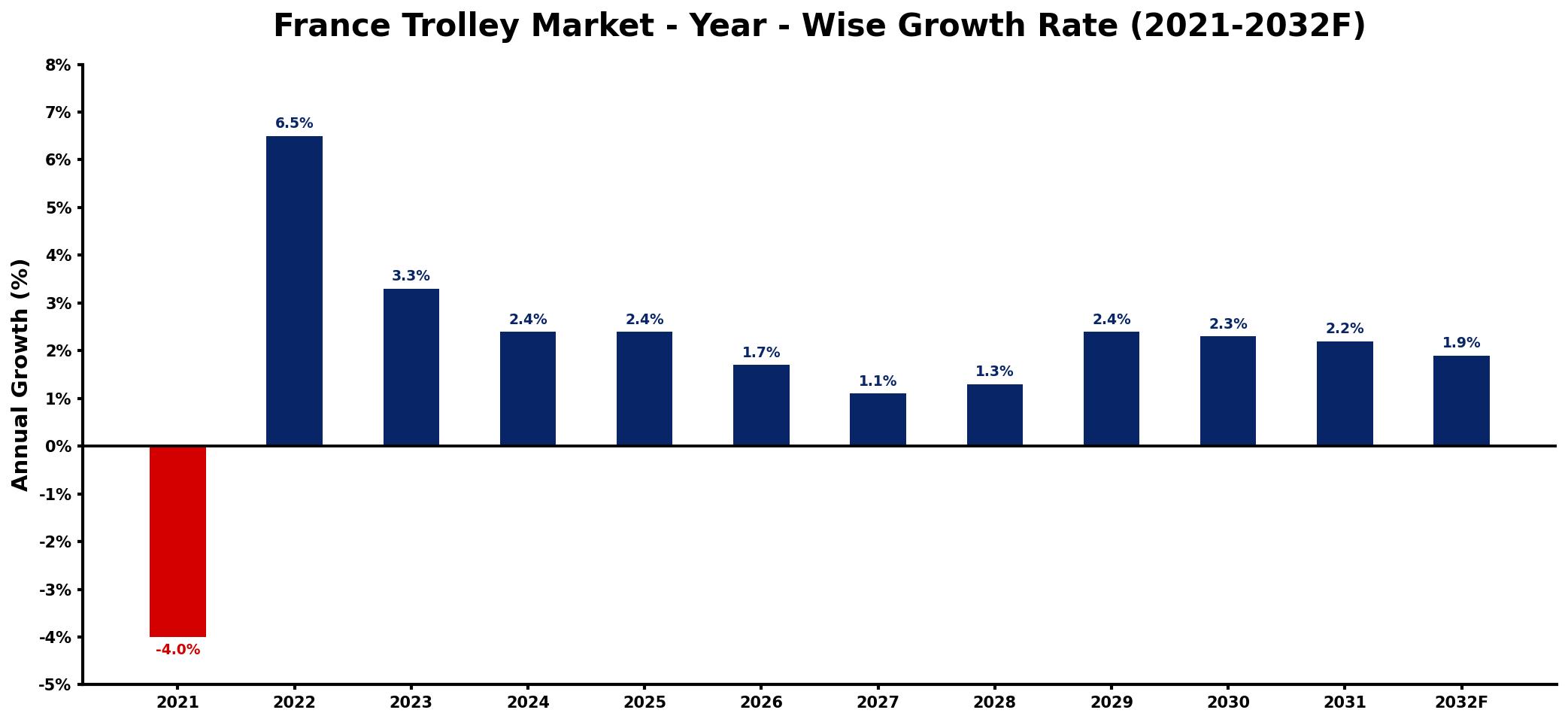
The table below presents the year‑wise growth rates along with the key drivers influencing the market
| Year | Growth Rate | Major Drivers |
| 2021 | -4.0% | decreased consumer spending habits |
| 2022 | 6.5% | rising e-commerce delivery demand |
| 2023 | 3.3% | increased urbanization trends globally |
| 2024 | 2.4% | growing travel and tourism industry |
| 2025 | 2.4% | expansion of retail distribution networks |
| 2026 | 1.7% | enhanced logistics and transportation solutions |
| 2027 | 1.1% | increased focus on sustainability initiatives |
| 2028 | 1.3% | growing popularity of outdoor activities |
| 2029 | 2.4% | rising disposable income levels |
| 2030 | 2.3% | expanding healthcare application demand |
| 2031 | 2.2% | increased investment in infrastructure projects |
| 2032 | 1.9% | growing demand for convenience solutions |
Note: Market size estimations and growth projections presented in this report are based on 6Wresearch's proprietary forecasting methodology, utilizing the latest available industry data, government publications, and primary research inputs.
France Trolley Market Synopsis
A notable aspect of the France trolley market is the increasing integration of smart features, such as RFID tracking, into trolley designs. This technological advancement not only aids retailers in inventory management but also enhances customer interactions, marking a shift towards more interactive shopping experiences.
Additionally, the demand for service trolleys in sectors like hospitality and healthcare highlights the need for solutions that improve operational efficiency. As these industries seek to enhance service quality, the versatility of trolleys becomes paramount in meeting diverse requirements and optimizing workflow.
France Trolley Market Key Takeaways
- The market is buoyed by a shift towards convenience in consumer behavior and service efficiency across industries.
- Smart technologies are being integrated into trolley designs, enhancing operational capabilities for retailers.
- Urbanization continues to drive the need for innovative and ergonomic transportation solutions.
- Regulatory frameworks focus on ensuring safety and ergonomics, supporting market stability.
- Competitive pressures are spurring innovation and differentiation among trolley manufacturers.
Evaluation of Restraints in France Trolley Market
Despite the positive outlook, the France trolley market faces constraints from evolving consumer preferences that demand constant innovation. Market saturation in certain categories has led to intense competition, compelling manufacturers to rethink their strategies. Additionally, adapting to alternative luggage solutions can divert potential customers, adding to the need for differentiation in product offerings. Manufacturers must balance cost-effectiveness with the demand for high-quality and innovative products to stay relevant.
France Trolley Market Trends
Current trends in the France trolley market indicate a strong inclination towards customization and modular design. Customers are increasingly seeking trolleys that can be tailored to specific functions, particularly in dynamic retail and service environments. Furthermore, sustainability is becoming a key focus, with manufacturers exploring eco-friendly materials and production methods to appeal to environmentally conscious consumers.
France Trolley Market Opportunities
Significant growth opportunities lie in the adaptation of trolleys for various emerging sectors. For instance, the expanding e-commerce landscape opens avenues for specialized trolleys designed for logistics and home delivery. Additionally, the healthcare sector's ongoing transformation presents opportunities for trolleys that cater specifically to patient care and service efficiency.
Government Initiatives in the France Trolley Market
The French government has implemented several policies aimed at ensuring product safety and consumer protection within the trolley market. Regulatory standards focus on materials and ergonomic design to enhance user experience and minimize injury risks. This supportive framework not only safeguards consumers but also stimulates market growth by establishing clear guidelines for manufacturers, ensuring that they remain compliant while innovating.
Future Insights of the France Trolley Market
Looking ahead to the period of 2026-2032, the France trolley market is expected to evolve in response to technological advancements and changing consumer behaviors. The ongoing integration of smart features will likely enhance the functionality of trolleys, making them indispensable in retail and logistics. Furthermore, as sustainability becomes more critical, manufacturers who prioritize eco-friendly practices will be well-positioned for growth, catering to a market increasingly concerned with environmental impacts.
France Trolley Market Latest Developments (2025 - 2026)
In recent months, the France trolley market has seen a surge in interest surrounding customizable trolley solutions tailored to specific industries. Innovations in materials and design have captured attention, with many manufacturers focusing on enhancing durability and functionality. Moreover, the adoption of contactless payment systems within trolley designs is gaining traction, responding to the growing consumer preference for seamless shopping experiences.
France Trolley Market - Key Attractiveness of the Report
- 10 Years of Market Numbers
- Historical Data Starting from 2022 to 2025
- Base Year: 2025
- Forecast Data until 2032
- Key Performance Indicators Impacting the Market
- Major Upcoming Developments and Projects
Key Highlights of the Report:
- France Trolley Market Outlook
- Market Size of France Trolley Market, 2025
- Forecast of France Trolley Market, 2032
- Historical Data and Forecast of France Trolley Revenues & Volume for the Period 2022-2032F
- France Trolley Market Trend Evolution
- France Trolley Market Drivers and Challenges
- France Trolley Price Trends
- France Trolley Porter's Five Forces
- France Trolley Industry Life Cycle
- Historical Data and Forecast of France Trolley Market Revenues & Volume By Product for the Period 2022-2032F
- Historical Data and Forecast of France Trolley Market Revenues & Volume By Manual for the Period 2022-2032F
- Historical Data and Forecast of France Trolley Market Revenues & Volume By Electric for the Period 2022-2032F
- Historical Data and Forecast of France Trolley Market Revenues & Volume By Application for the Period 2022-2032F
- Historical Data and Forecast of France Trolley Market Revenues & Volume By Commercial for the Period 2022-2032F
- Historical Data and Forecast of France Trolley Market Revenues & Volume By Non-commercial for the Period 2022-2032F
- Historical Data and Forecast of France Trolley Market Revenues & Volume By Distribution for the Period 2022-2032F
- Historical Data and Forecast of France Trolley Market Revenues & Volume By Offline for the Period 2022-2032F
- Historical Data and Forecast of France Trolley Market Revenues & Volume By Online for the Period 2022-2032F
- France Trolley Import Export Trade Statistics
- Market Opportunity Assessment By Product
- Market Opportunity Assessment By Application
- Market Opportunity Assessment By Distribution
- France Trolley Top Companies Market Share
- France Trolley Competitive Benchmarking By Technical and Operational Parameters
- France Trolley Company Profiles
- France Trolley Key Strategic Recommendations






































