Iraq Trolley Market Size, Share & Growth Rate
The Iraq Trolley Market was estimated at USD 446 Million in 2025 and is projected to reach USD 621 Million by 2032, growing at a CAGR of 4.8% from 2026 to 2032. This growth trajectory is primarily fueled by a robust expansion in the retail and hospitality sectors, alongside a rising urban population that demands efficient material handling solutions. The increasing prevalence of supermarkets, hotels, and transportation hubs is spurring the adoption of trolleys, enhancing both convenience and operational efficiency.
Iraq Trolley Market Year-wise Growth Rate and Key Drivers
This graph highlights how the Iraq Trolley Market has steadily grown over the years, supported by major growth factors.
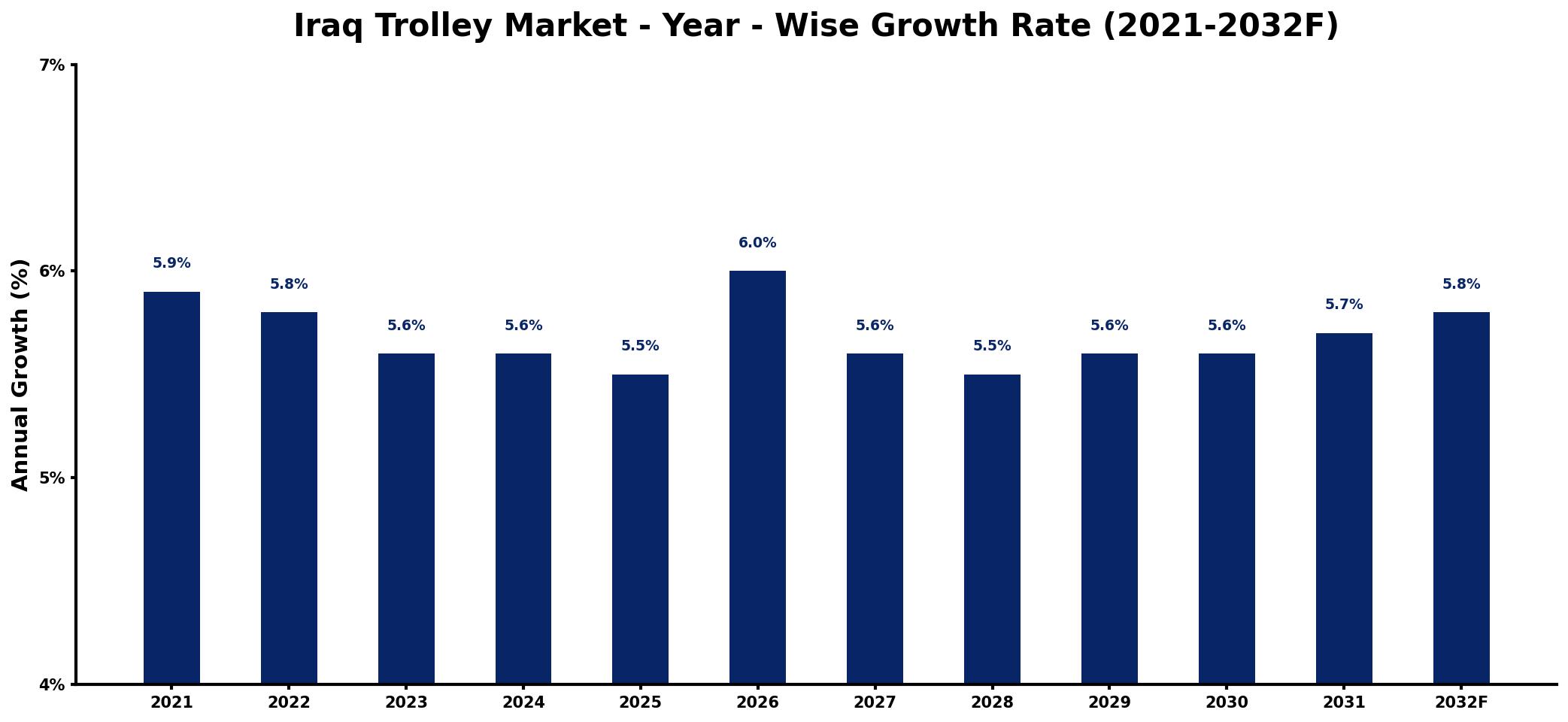
The table below presents the year‑wise growth rates along with the key drivers influencing the market
| Year | Growth Rate | Major Drivers |
| 2021 | 5.9% | Rising consumer purchasing power |
| 2022 | 5.8% | Expansion of retail infrastructure |
| 2023 | 5.6% | increased capital investment inflows |
| 2024 | 5.6% | Growth in e-commerce logistics |
| 2025 | 5.5% | Investment in transportation networks |
| 2026 | 6.0% | Surge in tourism activities |
| 2027 | 5.6% | Enhanced supply chain efficiencies |
| 2028 | 5.5% | Boost in local manufacturing capacity |
| 2029 | 5.6% | Development of green technologies |
| 2030 | 5.6% | Strengthened trade agreements benefits |
| 2031 | 5.7% | Improvement in logistics services |
| 2032 | 5.8% | growing commercial sector adoption |
Note: Market size estimations and growth projections presented in this report are based on 6Wresearch's proprietary forecasting methodology, utilizing the latest available industry data, government publications, and primary research inputs.
Iraq Trolley Market Synopsis
In Iraq, trolleys play a vital role in logistics, particularly in urban areas where retail and hospitality services are proliferating. The demand for shopping carts and luggage trolleys has surged, highlighting a shift toward improved customer service and operational efficiency in commercial establishments.
The market is characterized by diverse trolley designs catering to specific applications, such as lightweight shopping carts for grocery stores and more robust models for industrial uses. This variety not only facilitates efficient material movement but also supports the growing needs of both consumers and businesses.
Iraq Trolley Market Key Takeaways
- The market is experiencing significant growth driven by retail and urbanization trends.
- Government initiatives are fostering a conducive environment for trolley market expansion.
- Urban infrastructure development plays a crucial role in enhancing trolley accessibility.
- Technological advancements are leading to improved trolley designs and materials.
- There is an increasing shift towards sustainable trolley solutions, aligning with global trends.
Evaluation of Restraints in Iraq Trolley Market
Despite the optimistic growth outlook, the Iraq Trolley Market faces several challenges. The competition from alternative transportation methods, such as motorized carts and delivery services, poses a significant threat. Additionally, limited infrastructure investment can restrict the widespread adoption of trolley systems, leading to accessibility issues in both urban and rural areas. Maintenance and funding deficiencies also hinder the reliability and efficiency of trolley services, impacting user confidence and demand.
Iraq Trolley Market Trends
The landscape of the Iraq Trolley Market is currently influenced by several trends. The adoption of e-commerce is prompting retailers to invest in efficient in-store logistics, including trolleys that facilitate quicker shopping experiences. Furthermore, there is a growing emphasis on ergonomic designs, catering to a workforce that values comfort and usability. Additionally, sustainability is becoming a key focus, with manufacturers exploring eco-friendly materials and designs to reduce environmental impact.
Iraq Trolley Market Opportunities
As the Iraqi economy continues to stabilize, significant opportunities lie in expanding the trolley market. Investment in modern retail spaces and transportation hubs is poised to elevate the demand for advanced trolley solutions. Moreover, the government's focus on infrastructure improvements and urban development creates a promising environment for manufacturers and investors seeking to capitalize on the growing market potential.
Government Initiatives in the Iraq Trolley Market
The Iraqi government recognizes the pivotal role of efficient logistics and retail infrastructure in fostering economic growth. As a result, various policies have been introduced to support the trolley market, including regulations aimed at enhancing design standards and ensuring durability. Public spending initiatives targeting urban transportation improvements further underscore the governments commitment to facilitating a robust trolley market.
Future Insights of the Iraq Trolley Market
Looking forward, the Iraq Trolley Market is set for a transformative phase from 2026 to 2032. Enhanced infrastructure and urbanization will likely result in increased trolley adoption across various sectors. Coupled with ongoing technological innovations, such as automated and smart trolley solutions, the market is expected to evolve significantly, positioning itself as a critical component of Iraqs broader logistics framework.
Iraq Trolley Market Latest Developments (2025 - 2026)
Recent developments in the Iraq Trolley Market indicate a shift towards more sustainable practices, with manufacturers exploring environmentally friendly materials for production. Concurrently, there is a notable increase in collaboration between private and public sectors to enhance trolley accessibility within urban centers. Investment in research and development is also being prioritized to foster innovation in trolley design and functionality.
Iraq Trolley Market - Key Attractiveness of the Report
- 10 Years of Market Numbers
- Historical Data Starting from 2022 to 2025
- Base Year: 2025
- Forecast Data until 2032
- Key Performance Indicators Impacting the Market
- Major Upcoming Developments and Projects
Key Highlights of the Report:
- Iraq Trolley Market Outlook
- Market Size of Iraq Trolley Market, 2025
- Forecast of Iraq Trolley Market, 2032
- Historical Data and Forecast of Iraq Trolley Revenues & Volume for the Period 2022-2032F
- Iraq Trolley Market Trend Evolution
- Iraq Trolley Market Drivers and Challenges
- Iraq Trolley Price Trends
- Iraq Trolley Porter's Five Forces
- Iraq Trolley Industry Life Cycle
- Historical Data and Forecast of Iraq Trolley Market Revenues & Volume By Product for the Period 2022-2032F
- Historical Data and Forecast of Iraq Trolley Market Revenues & Volume By Manual for the Period 2022-2032F
- Historical Data and Forecast of Iraq Trolley Market Revenues & Volume By Electric for the Period 2022-2032F
- Historical Data and Forecast of Iraq Trolley Market Revenues & Volume By Application for the Period 2022-2032F
- Historical Data and Forecast of Iraq Trolley Market Revenues & Volume By Commercial for the Period 2022-2032F
- Historical Data and Forecast of Iraq Trolley Market Revenues & Volume By Non-commercial for the Period 2022-2032F
- Historical Data and Forecast of Iraq Trolley Market Revenues & Volume By Distribution for the Period 2022-2032F
- Historical Data and Forecast of Iraq Trolley Market Revenues & Volume By Offline for the Period 2022-2032F
- Historical Data and Forecast of Iraq Trolley Market Revenues & Volume By Online for the Period 2022-2032F
- Iraq Trolley Import Export Trade Statistics
- Market Opportunity Assessment By Product
- Market Opportunity Assessment By Application
- Market Opportunity Assessment By Distribution
- Iraq Trolley Top Companies Market Share
- Iraq Trolley Competitive Benchmarking By Technical and Operational Parameters
- Iraq Trolley Company Profiles
- Iraq Trolley Key Strategic Recommendations






































