Singapore Trolley Market Size, Share & Growth Rate
The Singapore Trolley Market was estimated at USD 203 Million in 2025 and is projected to reach USD 273 Million by 2032, growing at a CAGR of 4.3% from 2026 to 2032. This growth trajectory is primarily fueled by a robust expansion in the retail and logistics sectors, where the need for efficient material handling solutions is becoming increasingly critical. Additionally, the rise of e-commerce and the corresponding demand for last-mile delivery solutions are propelling the need for specialized trolleys across various industries.
Singapore Trolley Market Year-wise Growth Rate and Key Drivers
This graph highlights how the Singapore Trolley Market has steadily grown over the years, supported by major growth factors.
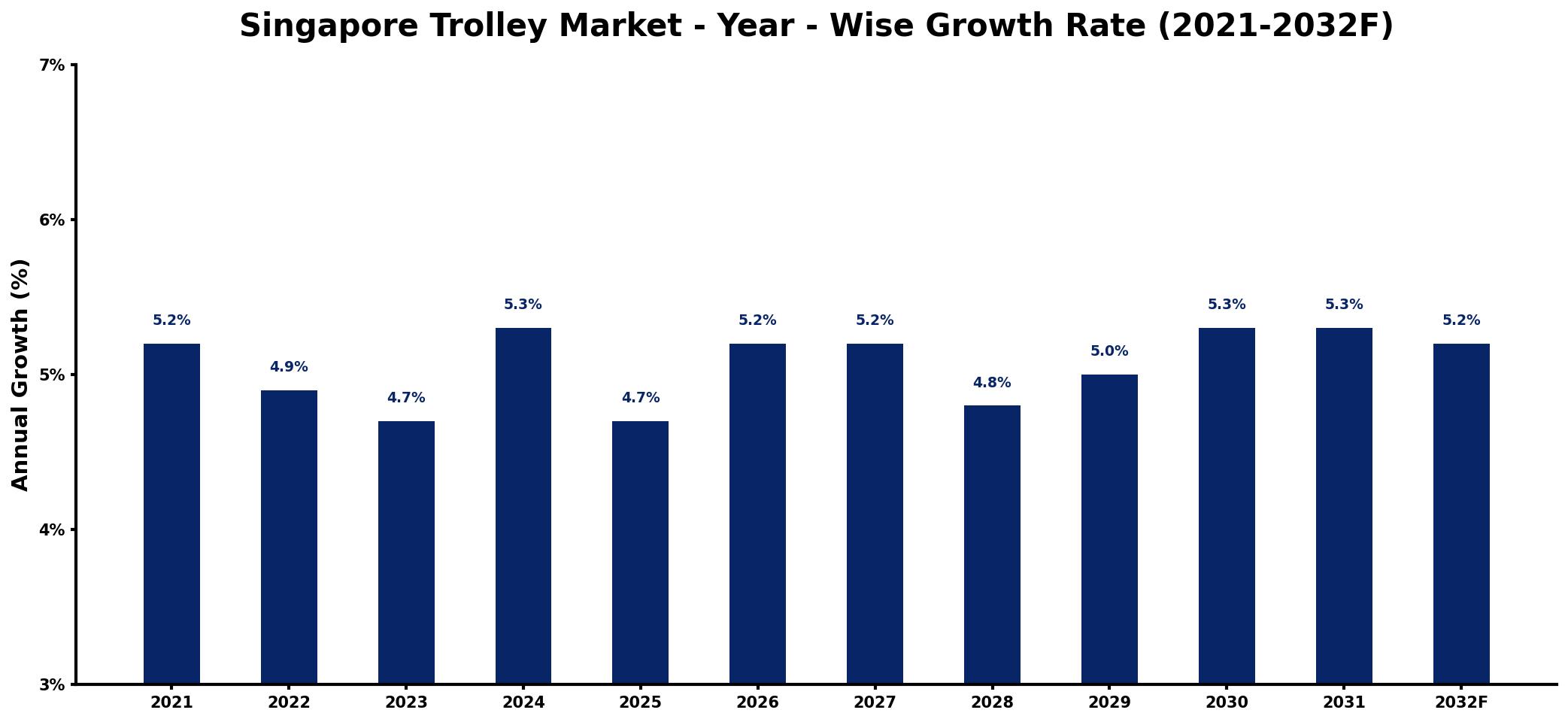
The table below presents the year‑wise growth rates along with the key drivers influencing the market
| Year | Growth Rate | Major Drivers |
| 2021 | 5.2% | Rise in e-commerce logistics demand |
| 2022 | 4.9% | Expansion of urban retail spaces |
| 2023 | 4.7% | Growth in grocery delivery services |
| 2024 | 5.3% | Increase in tourism and travel |
| 2025 | 4.7% | Development of smart shopping solutions |
| 2026 | 5.2% | Surge in online grocery shopping |
| 2027 | 5.2% | Rising demand for convenience products |
| 2028 | 4.8% | increased domestic production output |
| 2029 | 5.0% | Investment in automated retail solutions |
| 2030 | 5.3% | stronger distribution network expansion |
| 2031 | 5.3% | improved processing technologies adoption |
| 2032 | 5.2% | increased production capacity utilization |
Note: Market size estimations and growth projections presented in this report are based on 6Wresearch's proprietary forecasting methodology, utilizing the latest available industry data, government publications, and primary research inputs.
Singapore Trolley Market Synopsis
The trolley market in Singapore is characterized by its dynamic growth and adaptability. As a pivotal logistics hub in Southeast Asia, the demand for effective material handling equipment, including trolleys, is steadily increasing to meet the needs of both local and international businesses.
The versatility of trolleys across multiple sectors—ranging from warehousing to manufacturing—is key to their growing prominence. As businesses seek to optimize operations and improve efficiency, the reliance on trolleys for simplifying the movement of goods becomes more apparent.
Singapore Trolley Market Key Takeaways
- The market is expected to grow at a CAGR of 4.3% from 2026 to 2032.
- Increasing e-commerce activities are driving the demand for specialized trolleys.
- Singapore's strategic location enhances its role as a logistics and trade center, further boosting trolley usage.
- Local manufacturers are focusing on quality to combat competition from low-cost imports.
- Environmental sustainability is becoming a priority in trolley production.
Evaluation of Restraints in Singapore Trolley Market
Despite the promising growth in the Singapore trolley market, several restraints persist. Competition from low-cost imports poses a significant challenge for local manufacturers, often forcing them to reconsider pricing strategies while maintaining high-quality standards. Additionally, as environmental concerns gain traction, manufacturers face pressure to adopt more sustainable practices and materials in trolley production, which can initially increase costs. Balancing quality, sustainability, and competitiveness is an ongoing hurdle that stakeholders must navigate.
Singapore Trolley Market Trends
Current trends in the Singapore trolley market indicate a shift towards innovation and technology integration. Businesses are increasingly looking for trolleys equipped with ergonomic designs and enhanced functionalities to improve user experience. Furthermore, the focus on sustainability is leading manufacturers to explore eco-friendly materials and production methods. Additionally, the rise of automation in logistics is influencing trolley designs to accommodate automated systems, highlighting the market's responsiveness to evolving industry needs.
Singapore Trolley Market Opportunities
There are substantial opportunities for growth within the Singapore trolley market, particularly in the realm of customized solutions. As various industries seek to streamline their operations, the demand for specialized trolleys that cater to unique business requirements is on the rise. Moreover, investment in e-commerce fulfillment centers is expected to fuel the need for innovative trolleys designed for efficient last-mile delivery. These evolving needs create a fertile ground for both local and international players to expand their offerings and market reach.
Government Initiatives in the Singapore Trolley Market
The Singapore government is actively promoting initiatives aimed at enhancing the logistics sector, which indirectly supports the trolley market. Public spending on infrastructure improvements and logistics capabilities has created an environment conducive to growth in material handling solutions. Furthermore, policies that encourage technological innovation and sustainability in manufacturing processes are likely to benefit trolley manufacturers looking to adapt to market demands. These initiatives provide a supportive backdrop for the ongoing evolution of the trolley market.
Future Insights of the Singapore Trolley Market
Looking ahead to the period from 2026 to 2032, the Singapore trolley market is expected to continue its upward trajectory, driven by sustained growth in e-commerce and logistics. As industries adapt to changing consumer behaviors, the demand for versatile and efficient trolleys will likely increase. Moreover, the integration of smart technologies and a focus on sustainability will shape the development of new products, ensuring that manufacturers remain competitive in an evolving landscape. With the right strategies, companies can leverage these trends to capture significant market share.
Singapore Trolley Market Latest Developments (2025 - 2026)
Recently, the trolley market in Singapore has seen a shift towards more customizable and specialized solutions as businesses seek tailored material handling equipment. Innovations in design and technology are being prioritized, with manufacturers introducing trolleys that integrate smart features and improved ergonomics. The market is also responding to increasing consumer demands for sustainability, prompting several companies to explore eco-friendly materials and production techniques. These developments indicate a progressive trend towards enhancing operational efficiency while addressing environmental considerations.
Singapore Trolley Market - Key Attractiveness of the Report
- 10 Years of Market Numbers
- Historical Data Starting from 2022 to 2025
- Base Year: 2025
- Forecast Data until 2032
- Key Performance Indicators Impacting the Market
- Major Upcoming Developments and Projects
Key Highlights of the Report:
- Singapore Trolley Market Outlook
- Market Size of Singapore Trolley Market, 2025
- Forecast of Singapore Trolley Market, 2032
- Historical Data and Forecast of Singapore Trolley Revenues & Volume for the Period 2022-2032F
- Singapore Trolley Market Trend Evolution
- Singapore Trolley Market Drivers and Challenges
- Singapore Trolley Price Trends
- Singapore Trolley Porter's Five Forces
- Singapore Trolley Industry Life Cycle
- Historical Data and Forecast of Singapore Trolley Market Revenues & Volume By Product for the Period 2022-2032F
- Historical Data and Forecast of Singapore Trolley Market Revenues & Volume By Manual for the Period 2022-2032F
- Historical Data and Forecast of Singapore Trolley Market Revenues & Volume By Electric for the Period 2022-2032F
- Historical Data and Forecast of Singapore Trolley Market Revenues & Volume By Application for the Period 2022-2032F
- Historical Data and Forecast of Singapore Trolley Market Revenues & Volume By Commercial for the Period 2022-2032F
- Historical Data and Forecast of Singapore Trolley Market Revenues & Volume By Non-commercial for the Period 2022-2032F
- Historical Data and Forecast of Singapore Trolley Market Revenues & Volume By Distribution for the Period 2022-2032F
- Historical Data and Forecast of Singapore Trolley Market Revenues & Volume By Offline for the Period 2022-2032F
- Historical Data and Forecast of Singapore Trolley Market Revenues & Volume By Online for the Period 2022-2032F
- Singapore Trolley Import Export Trade Statistics
- Market Opportunity Assessment By Product
- Market Opportunity Assessment By Application
- Market Opportunity Assessment By Distribution
- Singapore Trolley Top Companies Market Share
- Singapore Trolley Competitive Benchmarking By Technical and Operational Parameters
- Singapore Trolley Company Profiles
- Singapore Trolley Key Strategic Recommendations






































