Georgia AI in Telecommunication Market Size & Growth Rate (2026-2032)
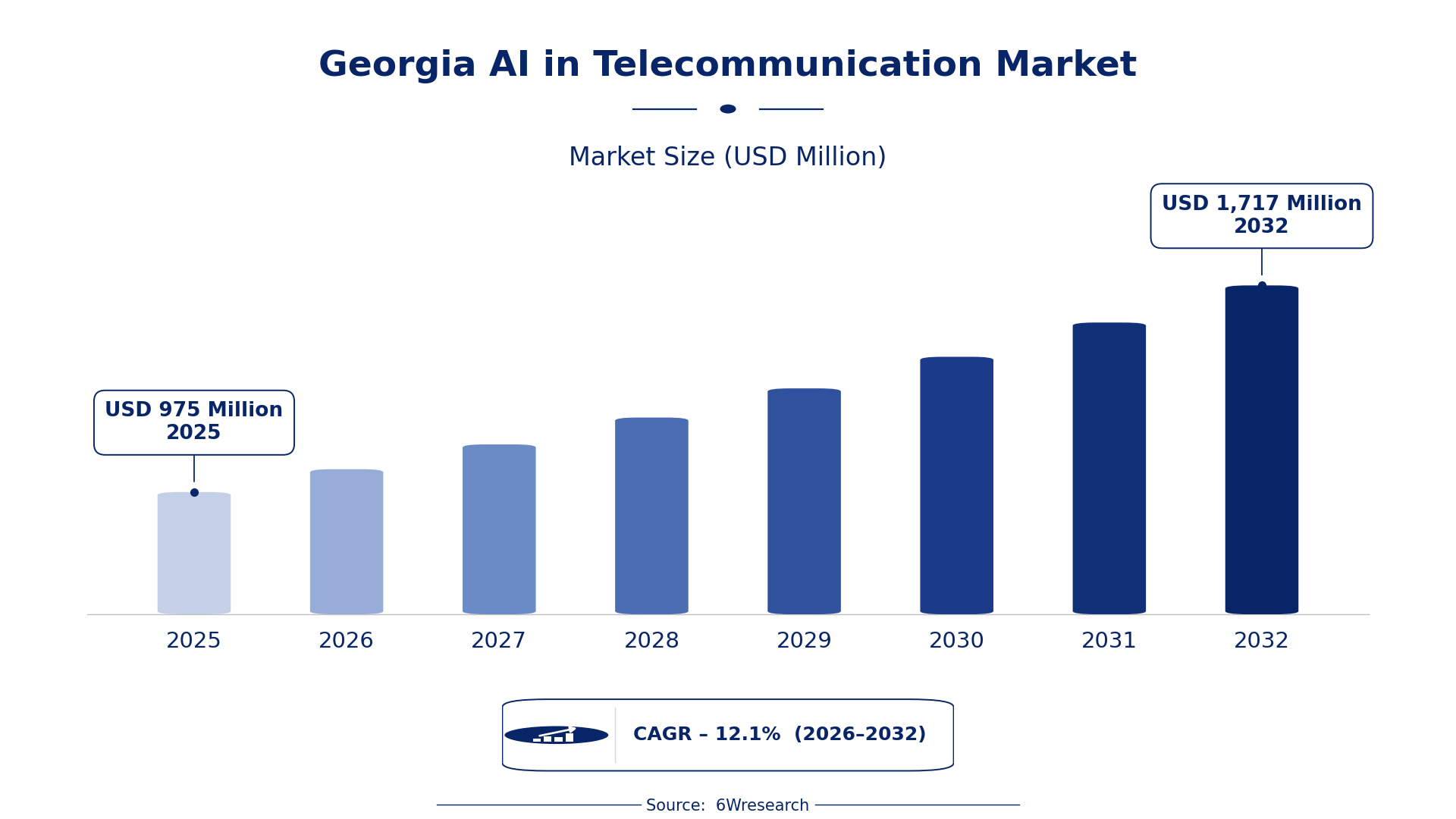
The Georgia AI in Telecommunication Market was estimated at USD 975 Million in 2025 and is projected to reach USD 1717 Million by 2032, growing at a CAGR of 12.1% from 2026 to 2032.
Georgia AI in Telecommunication Market Synopsis
The rapid advancements in artificial intelligence technologies are the strongest force shaping the Georgia AI in Telecommunication market today. Telecom companies are increasingly adopting AI solutions to enhance their operational efficiency, optimize customer service, and manage networks more effectively.
As Georgia transitions towards a more digitized economy, the integration of AI into telecommunications is driving significant changes. This shift not only improves communication infrastructure but also offers personalized experiences to users, ultimately enhancing customer satisfaction in a highly competitive market.
Georgia AI in Telecommunication Market Year-wise Growth Rate and Key Drivers
This graph illustrates the annual growth rates of the Georgia AI in Telecommunication Market from 2021 to 2032, highlighting a steady upward trajectory and projected expansion over the forecast period.
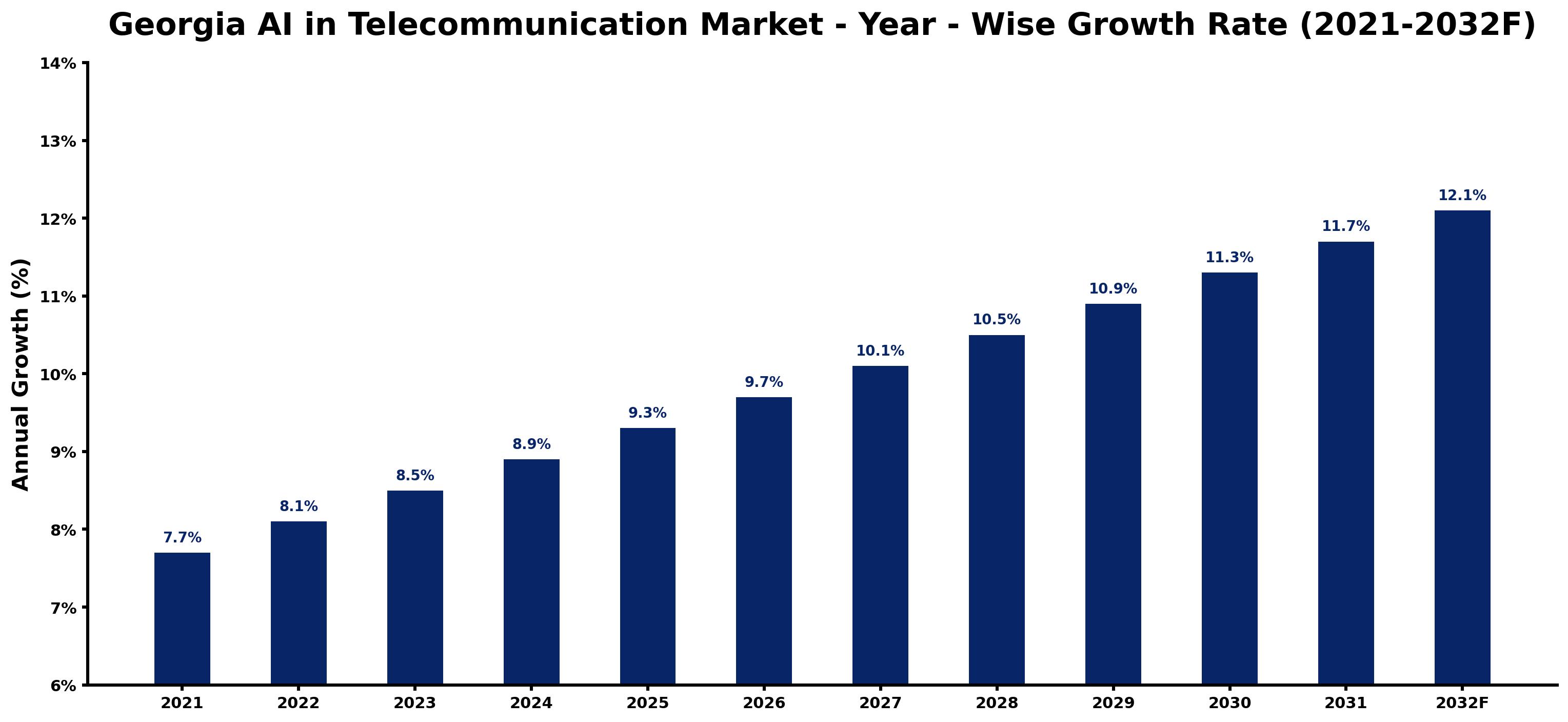
The table below presents the year‑wise growth rates along with the key drivers influencing the market
| Year | Growth Rate | Major Drivers |
| 2021 | 7.7% | Introduction of Georgian National Strategy for AI development. |
| 2022 | 8.1% | Government incentives for telecom companies adopting AI solutions. |
| 2023 | 8.5% | Increased 5G rollout enhancing AI application potentials. |
| 2024 | 8.9% | Partnerships with AI firms to modernize telecom infrastructure. |
| 2025 | 9.3% | Rise in mobile data usage driving AI integration. |
| 2026 | 9.7% | Telecom regulatory agency promoting AI for network efficiency. |
| 2027 | 10.1% | Growing popularity of AI chatbots among local businesses. |
| 2028 | 10.5% | Investment in AI research funded by Georgian government. |
| 2029 | 10.9% | Emerging startups focusing on AI for communication enhancement. |
| 2030 | 11.3% | Public initiatives pushing AI literacy in telecommunications sector. |
| 2031 | 11.7% | Expanding digital economy spurring AI telecommunication innovations. |
| 2032 | 12.1% | Increased focus on cybersecurity fostering AI telecommunication measures. |
Note: Market size estimations and growth projections presented in this report are based on 6Wresearch's proprietary forecasting methodology, utilizing the latest available industry data, government publications, and primary research inputs.
Georgia AI in Telecommunication Market Key Takeaways
Below are some of the specific key takeaways from the market, including:
- The demand for AI solutions in telecom is fueled by the rollout of 5G technology.
- AI-driven network optimization tools are becoming essential for efficient operations.
- Investments in customer service automation are on the rise to enhance user experience.
- Predictive analytics are playing a crucial role in network maintenance and security.
- Government policies are supporting AI integration in the telecommunications sector.
Evaluation of Restraints in Georgia AI in Telecommunication Market
One of the main restraints in the Georgia AI in Telecommunication market is the challenge of integrating new AI technology with existing infrastructure. Telecom companies face significant costs and complexities when updating their systems to accommodate AI solutions. In addition, ensuring data security while using AI is a pressing issue, given the sensitive nature of customer information. Lastly, the fear of job losses due to automation can lead to employee resistance, further complicating integration efforts.
Georgia AI in Telecommunication Market Trends
A notable trend in the Georgia AI in Telecommunication market is the growing use of machine learning and natural language processing to enhance customer interactions. Companies are deploying chatbots and virtual assistants to provide immediate responses and personalized services to users. Additionally, predictive maintenance powered by AI is becoming increasingly common, helping operators anticipate infrastructure needs and prevent service disruptions.
Furthermore, the focus on cybersecurity has intensified. AI technologies are being harnessed to detect anomalies and prevent fraud, thereby safeguarding sensitive data and enhancing customer trust. This emphasis on securing telecommunication networks through AI is setting companies apart in a crowded marketplace.
Georgia AI in Telecommunication Market Opportunities
Investment opportunities in the Georgia AI in Telecommunication market are numerous, particularly in areas like AI-enhanced network optimization and customer service solutions. Companies can capitalize on the rising demand for data analytics and real-time monitoring systems to improve operational efficiencies. The confluence of AI and telecommunications presents a favorable investment landscape, with businesses poised to benefit from advanced technologies and enhanced service offerings.
Government Initiatives in the Georgia AI in Telecommunication Market
The Georgian government has adopted a proactive approach to foster the growth of artificial intelligence in the telecommunications sector. By prioritizing regulatory frameworks and public-sector initiatives, the government aims to create a supportive environment that encourages innovation and collaboration. These policies not only address technical advancements but also emphasize ethical considerations surrounding AI deployment.
- A recently completed funding program aimed at bolstering AI research and development within the telecom sector.
- A current initiative that focuses on attracting AI talent through educational partnerships and internships.
- A planned regulatory framework set to enhance data privacy protections for consumers using AI services in telecommunications.
- A newly launched public-private partnership intended to expand telecom infrastructure in rural areas, integrating AI solutions.
- Ongoing efforts to develop guidelines for the responsible use of AI technologies across telecommunication networks.
Future Insights of the Georgia AI in Telecommunication Market
Looking ahead, the Georgia AI in Telecommunication market is expected to thrive between 2026 and 2032. The continued integration of AI technologies in telecom operations will redefine service delivery and network efficiency. As companies embrace the full capabilities of AI, including the impacts of 5G and IoT, tailored customer experiences will become the norm, leading to stronger market competition and enhanced user satisfaction.
Georgia AI in Telecommunication Market Latest Developments
Recent activity in the Georgia AI in Telecommunication market indicates a trend towards embracing innovative technologies and solutions. Over the past year, companies have taken strategic steps to incorporate AI across various facets of their operations. This push is not only about enhancing service quality but also about staying competitive in a rapidly advancing sector.
- A major technology vendor rolled out an AI-powered analytics platform in early 2025, enhancing network performance monitoring.
- An ongoing initiative initiated by a leading regional operator aims to integrate AI in customer service, currently under development.
- A planned technology upgrade expected to begin in Q3 2025 will introduce AI-driven predictive maintenance tools across the region.
- A partnership established between telecom operators and AI startups in late 2024 is focusing on developing advanced cybersecurity solutions.
- A recent announcement of a dedicated AI innovation center is expected to be launched in mid-2026 to foster research and collaboration.
Georgia AI in Telecommunication Market - Key Attractiveness of the Report
- 10 Years of Market Numbers
- Historical Data Starting from 2022 to 2025
- Base Year: 2025
- Forecast Data until 2032
- Key Performance Indicators Impacting the Market
- Major Upcoming Developments and Projects
Key Highlights of the Report:
- Georgia AI in Telecommunication Market Outlook
- Market Size of Georgia AI in Telecommunication Market, 2025
- Forecast of Georgia AI in Telecommunication Market, 2032
- Historical Data and Forecast of Georgia AI in Telecommunication Revenues & Volume for the Period 2022-2032F
- Georgia AI in Telecommunication Market Trend Evolution
- Georgia AI in Telecommunication Market Drivers and Challenges
- Georgia AI in Telecommunication Price Trends
- Georgia AI in Telecommunication Porter's Five Forces
- Georgia AI in Telecommunication Industry Life Cycle
- Historical Data and Forecast of Georgia AI in Telecommunication Market Revenues & Volume By Application for the Period 2022-2032F
- Historical Data and Forecast of Georgia AI in Telecommunication Market Revenues & Volume By Customer analytics for the Period 2022-2032F
- Historical Data and Forecast of Georgia AI in Telecommunication Market Revenues & Volume By Network security for the Period 2022-2032F
- Historical Data and Forecast of Georgia AI in Telecommunication Market Revenues & Volume By Network optimization for the Period 2022-2032F
- Historical Data and Forecast of Georgia AI in Telecommunication Market Revenues & Volume By Self-diagnostics for the Period 2022-2032F
- Historical Data and Forecast of Georgia AI in Telecommunication Market Revenues & Volume By Virtual assistance for the Period 2022-2032F
- Historical Data and Forecast of Georgia AI in Telecommunication Market Revenues & Volume By Others (contact center analytics and marketing campaign analytics) for the Period 2022-2032F
- Historical Data and Forecast of Georgia AI in Telecommunication Market Revenues & Volume By Component for the Period 2022-2032F
- Historical Data and Forecast of Georgia AI in Telecommunication Market Revenues & Volume By Solutions for the Period 2022-2032F
- Historical Data and Forecast of Georgia AI in Telecommunication Market Revenues & Volume By Services for the Period 2022-2032F
- Historical Data and Forecast of Georgia AI in Telecommunication Market Revenues & Volume By Deployment Mode for the Period 2022-2032F
- Historical Data and Forecast of Georgia AI in Telecommunication Market Revenues & Volume By Cloud for the Period 2022-2032F
- Historical Data and Forecast of Georgia AI in Telecommunication Market Revenues & Volume By On-premises for the Period 2022-2032F
- Historical Data and Forecast of Georgia AI in Telecommunication Market Revenues & Volume By Technology for the Period 2022-2032F
- Historical Data and Forecast of Georgia AI in Telecommunication Market Revenues & Volume By Machine learning and deep learning for the Period 2022-2032F
- Historical Data and Forecast of Georgia AI in Telecommunication Market Revenues & Volume By Natural Language Processing (NLP) for the Period 2022-2032F
- Georgia AI in Telecommunication Import Export Trade Statistics
- Market Opportunity Assessment By Application
- Market Opportunity Assessment By Component
- Market Opportunity Assessment By Deployment Mode
- Market Opportunity Assessment By Technology
- Georgia AI in Telecommunication Top Companies Market Share
- Georgia AI in Telecommunication Competitive Benchmarking By Technical and Operational Parameters
- Georgia AI in Telecommunication Company Profiles
- Georgia AI in Telecommunication Key Strategic Recommendations






































