Georgia Apiculture Market Size, Share & Growth Rate
The Georgia Apiculture Market was estimated at USD 244 Million in 2025 and is projected to reach USD 334 Million by 2032, growing at a CAGR of 4.6% from 2026 to 2032. This upward trajectory is driven by the increasing consumer demand for local, organic honey products and the vital role of bees in agricultural pollination. As awareness of the health benefits of honey grows, coupled with supportive government policies, the market is poised for robust growth in the coming years.
Georgia Apiculture Market Year-wise Growth Rate and Key Drivers
This graph highlights how the Georgia Apiculture Market has steadily grown over the years, supported by major growth factors.
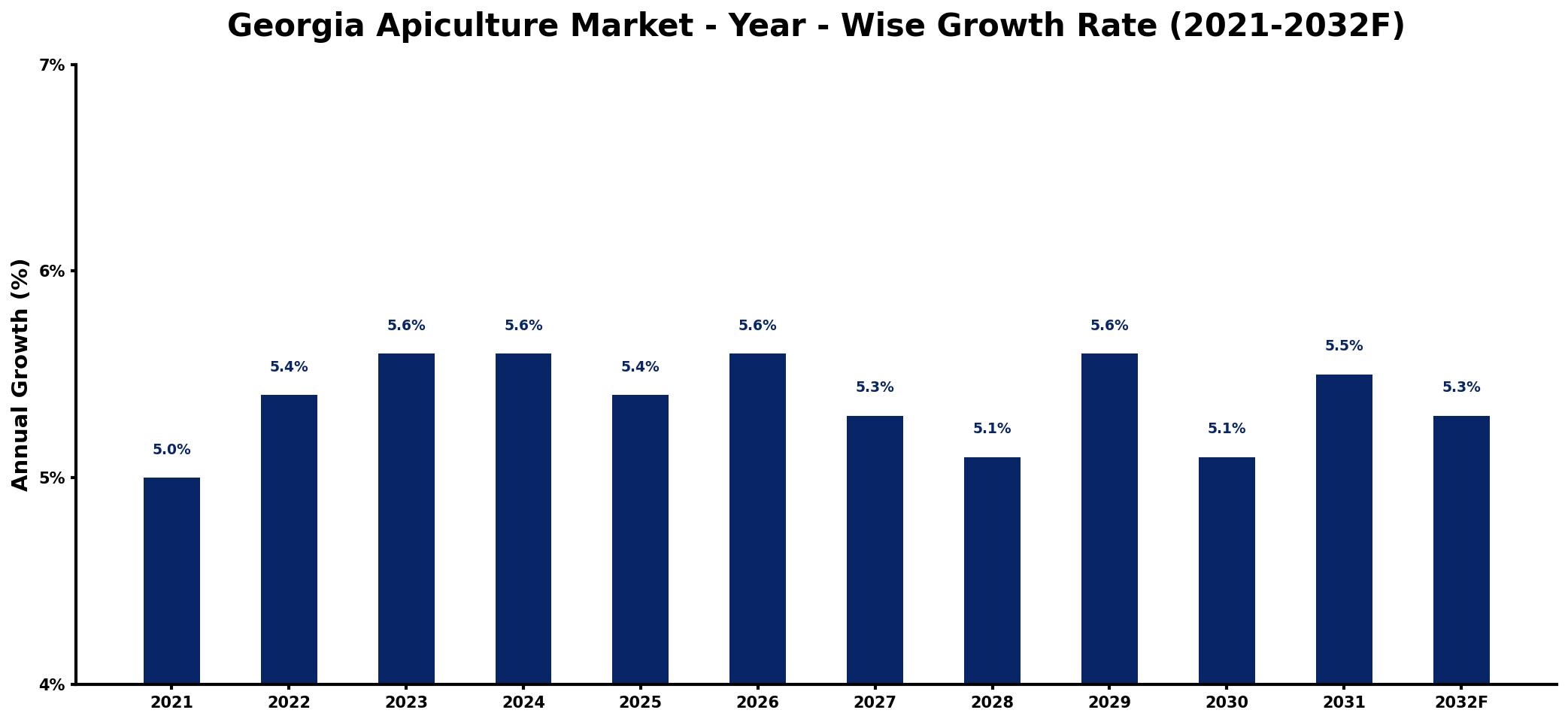
The table below presents the year‑wise growth rates along with the key drivers influencing the market
| Year | Growth Rate | Major Drivers |
| 2021 | 5.0% | Increased consumer interest in sustainability |
| 2022 | 5.4% | Growing demand for natural sweeteners |
| 2023 | 5.6% | Expansion of organic farming practices |
| 2024 | 5.6% | Rising popularity of local products |
| 2025 | 5.4% | Investment in pollinator health initiatives |
| 2026 | 5.6% | Surge in educational workshops offered |
| 2027 | 5.3% | Enhanced marketing of honey benefits |
| 2028 | 5.1% | Strengthened partnerships with local businesses |
| 2029 | 5.6% | Boost in urban farming initiatives |
| 2030 | 5.1% | Increased focus on biodiversity conservation |
| 2031 | 5.5% | Heightened awareness of health benefits |
| 2032 | 5.3% | Growth in specialty product offerings |
Note: Market size estimations and growth projections presented in this report are based on 6Wresearch's proprietary forecasting methodology, utilizing the latest available industry data, government publications, and primary research inputs.
Georgia Apiculture Market Synopsis
The Georgia Apiculture Market is witnessing a vibrant expansion, underpinned by a rich agricultural landscape that supports diverse bee forage. Beekeepers are increasingly focused on high-value honey production, including unique varieties such as tupelo and sourwood, which further enhances the state's reputation in the honey industry.
Additionally, Georgia's apiculture sector is integral to pollination services, facilitating the growth of fruits and vegetables. Government initiatives aimed at promoting sustainable beekeeping practices and ensuring the health of bee populations have significantly bolstered the market's resilience.
Georgia Apiculture Market Key Takeaways
- The market is characterized by a strong local demand for high-quality honey and bee products.
- Innovative beekeeping practices are emerging to address challenges like pests and climate change.
- Government support is instrumental in advancing research and initiatives for beekeeping sustainability.
- Investment opportunities are growing in value-added honey products and beekeeping technologies.
- Consumer preferences are increasingly shifting toward organic and locally sourced honey.
Evaluation of Restraints in Georgia Apiculture Market
While the Georgia Apiculture Market is thriving, it is not without its challenges. The prevalence of pests and diseases poses a serious threat to bee colonies, often resulting in decreased honey production. Moreover, the application of pesticides in agriculture jeopardizes the health of pollinator populations, further complicating the landscape for beekeepers. Compounding these challenges is the competition posed by imported honey, which often undercuts local producers on price. Lastly, climate change introduces unpredictability in weather patterns, impacting bee foraging behaviors and overall productivity.
Georgia Apiculture Market Trends
The market is currently experiencing notable trends that are shaping demand. A significant rise in consumer awareness regarding the health benefits of natural and raw honey is driving a shift towards local sourcing. Sustainability is also becoming a central theme, with many consumers actively seeking out bee-friendly habitats and supporting eco-conscious practices. This trend is paralleled by a growing number of hobbyist beekeepers, further diversifying the market and creating a community focused on preserving bee populations.
Georgia Apiculture Market Opportunities
The Georgia Apiculture Market presents diverse investment opportunities for stakeholders. Investing in modern beekeeping technology and infrastructure can enhance productivity and honey yields significantly. Furthermore, the development of value-added products such as beeswax candles, skin care items, or mead allows producers to capitalize on the artisanal market. There is also a compelling opportunity in research focused on bee health and sustainable practices, which not only promises profitability but also supports the long-term viability of the industry.
Government Initiatives in the Georgia Apiculture Market
Georgia's government has implemented a variety of supportive measures aimed at bolstering the apiculture industry. These initiatives include financial incentives for beekeepers to expand their operations and increase honey output. Additionally, the focus on promoting sustainable practices is crucial for maintaining healthy bee populations. Regulations are in place to ensure the quality and safety of honey products, contributing to consumer confidence and enhancing the reputation of Georgias honey in both domestic and international markets.
Future Insights of the Georgia Apiculture Market
Looking ahead to the years 2026-2032, the Georgia Apiculture Market is poised for promising growth. The increasing preference for natural and organic products will likely escalate demand, as will the state's ideal climatic conditions for beekeeping. While challenges such as climate variability and pest management remain, the focus on innovation and education among stakeholders is expected to mitigate these risks. As the market adapts, it will continue to thrive, reinforcing the essential role of bees in agriculture and local economies.
Georgia Apiculture Market Latest Developments (2025 - 2026)
In recent months, the Georgia Apiculture Market has seen a surge in community engagement, with numerous workshops and training sessions aimed at educating new beekeepers. This grassroots movement is fostering a deeper appreciation for the craft and underscoring the importance of bee conservation. Moreover, there have been collaborative efforts between beekeepers and local farmers to enhance pollination strategies, showcasing the interdependence of agriculture and apiculture.
Georgia Apiculture Market - Key Attractiveness of the Report
- 10 Years of Market Numbers
- Historical Data Starting from 2022 to 2025
- Base Year: 2025
- Forecast Data until 2032
- Key Performance Indicators Impacting the Market
- Major Upcoming Developments and Projects
Key Highlights of the Report:
- Georgia Apiculture Market Outlook
- Market Size of Georgia Apiculture Market, 2025
- Forecast of Georgia Apiculture Market, 2032
- Historical Data and Forecast of Georgia Apiculture Revenues & Volume for the Period 2022-2032F
- Georgia Apiculture Market Trend Evolution
- Georgia Apiculture Market Drivers and Challenges
- Georgia Apiculture Price Trends
- Georgia Apiculture Porter's Five Forces
- Georgia Apiculture Industry Life Cycle
- Historical Data and Forecast of Georgia Apiculture Market Revenues & Volume By Product Type for the Period 2022-2032F
- Historical Data and Forecast of Georgia Apiculture Market Revenues & Volume By Honey for the Period 2022-2032F
- Historical Data and Forecast of Georgia Apiculture Market Revenues & Volume By Beeswax for the Period 2022-2032F
- Historical Data and Forecast of Georgia Apiculture Market Revenues & Volume By Live-bees for the Period 2022-2032F
- Historical Data and Forecast of Georgia Apiculture Market Revenues & Volume By Others for the Period 2022-2032F
- Historical Data and Forecast of Georgia Apiculture Market Revenues & Volume By Application for the Period 2022-2032F
- Historical Data and Forecast of Georgia Apiculture Market Revenues & Volume By Medical for the Period 2022-2032F
- Historical Data and Forecast of Georgia Apiculture Market Revenues & Volume By Food Beverages for the Period 2022-2032F
- Historical Data and Forecast of Georgia Apiculture Market Revenues & Volume By Cosmetics for the Period 2022-2032F
- Historical Data and Forecast of Georgia Apiculture Market Revenues & Volume By Others for the Period 2022-2032F
- Georgia Apiculture Import Export Trade Statistics
- Market Opportunity Assessment By Product Type
- Market Opportunity Assessment By Application
- Georgia Apiculture Top Companies Market Share
- Georgia Apiculture Competitive Benchmarking By Technical and Operational Parameters
- Georgia Apiculture Company Profiles
- Georgia Apiculture Key Strategic Recommendations






































