Georgia Metal Recycling Market Summary
The georgia metal recycling market was estimated at USD 1285 Million in 2025 and is projected to reach USD 1847 Million by 2032, growing at a CAGR of 6.3% from 2026 to 2032.
Georgia Metal Recycling Market Year-wise Growth Rate and Key Drivers
This graph highlights how the Georgia Metal Recycling Market has steadily grown over the past five years, supported by major growth factors.
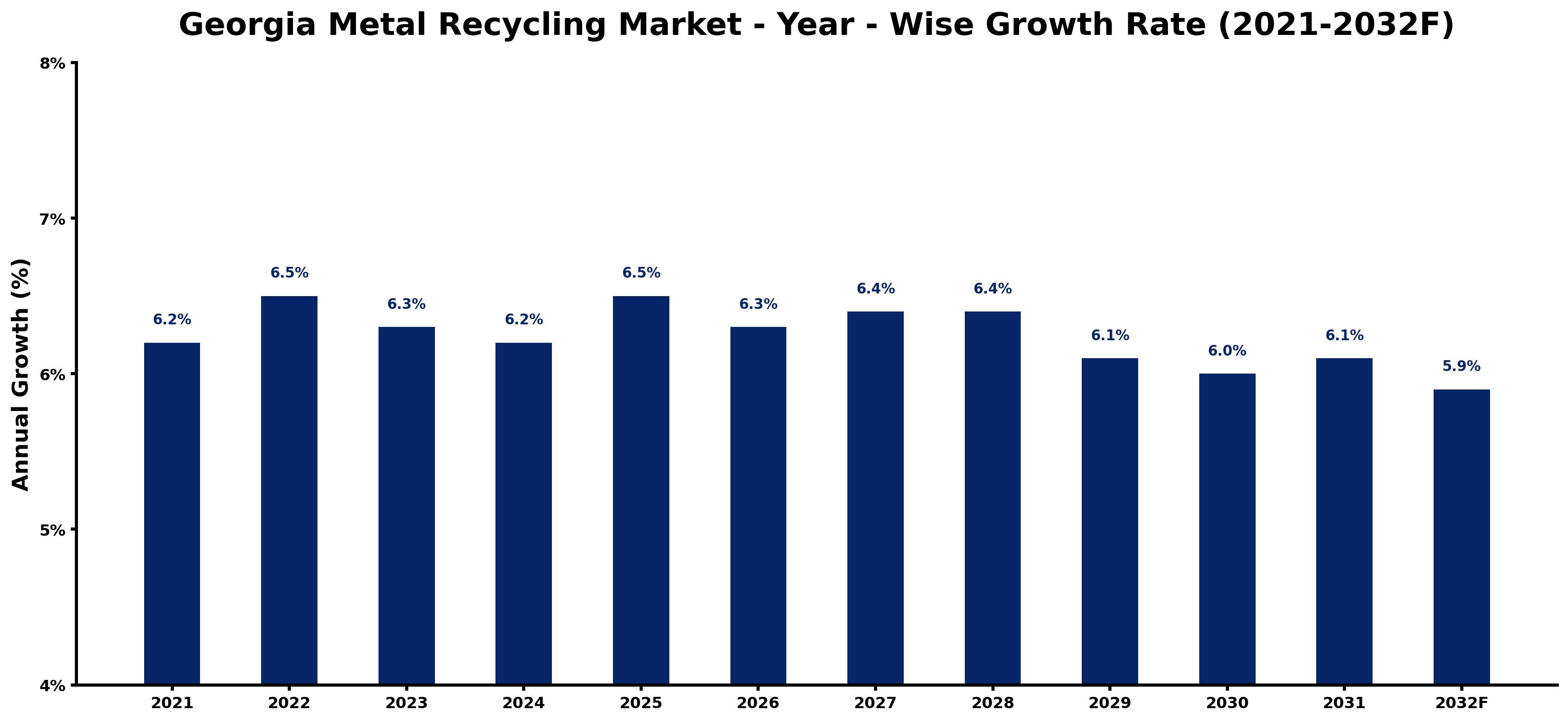
The table below presents the year wise growth rates along with the key drivers influencing the market
| Year | Growth Rate | Major Drivers |
| 2021 | 6.2% | Local initiatives promote metal recycling awareness among communities and businesses alike. |
| 2022 | 6.5% | Investments in recycling facilities aim to improve efficiency and overall output significantly. |
| 2023 | 6.3% | Construction sector demand leads to increased scrap metal availability for recycling operations. |
| 2024 | 6.2% | Technological innovations enhance sorting processes, boosting the quality of recycled metals. |
| 2025 | 6.5% | Partnerships between local governments and recyclers foster educational programs on sustainability. |
| 2026 | 6.3% | Economic recovery post-pandemic encourages investment in sustainable practices across industries. |
| 2027 | 6.4% | Public-private collaborations create incentives for businesses to enhance recycling capabilities. |
| 2028 | 6.4% | Emergence of e-waste management solutions expands the types of metals available for recycling. |
| 2029 | 6.1% | Consumer preferences shift towards eco-friendly products, driving demand for recycled materials. |
| 2030 | 6.0% | Increased urban development projects generate more construction waste requiring metal recycling. |
| 2031 | 6.1% | Technological advancements streamline logistics, optimizing the metal recycling supply chain significantly. |
| 2032 | 5.9% | Global market trends highlight the importance of recycled metals in manufacturing processes. |
Note - Market size estimations and growth projections presented in this report are based on 6Wresearch's advanced forecasting approach, validated with industry datasets as of June 2026.
Georgia Metal Recycling Market Synopsis
The Georgia Metal Recycling Market is projected to reach 6.3% and witness significant growth during the forecast period (2026-2032). Metal recycling plays an essential role in the state's circular economy, aiding in resource conservation and minimizing environmental impact. This sector includes the collection, processing, and recovery of both ferrous and non-ferrous metals from various sources such as end-of-life products, industrial scrap, and manufacturing residue. The pressing emphasis on environmental stewardship, coupled with numerous recycling initiatives, has generated a robust demand for metal recycling services, thereby propelling market expansion and encouraging investment in recycling infrastructure and related technologies.
Georgia Metal Recycling Market Growth Drivers
The continual growth of the Georgia Metal Recycling Market is driven by a myriad of factors that reflect a commitment to sustainability and resource conservation. First, the increasing awareness of circular economy principles has led industries and consumers alike to prioritize recycling. Second, regulatory initiatives that promote recycling have further accelerated demand for metal recovery services. Third, advancements in recycling technologies enhance the efficiency of material recovery processes, making it economically viable for companies to participate. Fourth, the growing need for reducing waste and conserving resources contributes significantly to market dynamics. Lastly, the economic incentives provided for recycling operations encourage investments in innovative solutions that align with environmental goals.
Georgia Metal Recycling Market Challenges and Restraints
Despite its growth potential, the Georgia Metal Recycling Market faces several challenges that could impede its progress. One major obstacle is the increasing demand for recycled metals that necessitates efficient collection and processing infrastructure. Companies operating in this market must invest substantially in technology and logistics to enhance recycling processes. Another challenge is the issue of metal contamination; maintaining high-quality standards is crucial for recyclers to ensure market competitiveness. Furthermore, fluctuations in scrap metal prices can introduce volatility and uncertainty, demanding effective risk management strategies from operators. Lastly, the need for ongoing education about recycling practices among consumers and businesses is critical to improving collection rates and minimizing contamination issues.
Georgia Metal Recycling Market Investment Opportunities
The landscape of the Georgia Metal Recycling Market presents numerous investment opportunities spurred by increasing public and private sector engagement. As more industries pivot toward sustainable practices, investments in advanced recycling technologies are particularly attractive, focusing on the efficiency of material recovery processes. Additionally, public-private partnerships aiming to enhance infrastructure for collection and processing can offer lucrative returns. Investment in educational initiatives to raise awareness about recycling and its benefits serves as an additional opportunity for growth. Furthermore, innovative solutions that leverage data analytics and automation will become increasingly important in streamlining operations. Lastly, funding for community recycling programs can facilitate greater participation, leading to higher volumes of recyclables entering the market.
Georgia Metal Recycling Market Government Investment and Initiatives
The government of Georgia plays a pivotal role in fostering the growth of the metal recycling market by implementing various supportive policies and initiatives. These include establishing recycling mandates and waste management regulations that create a regulatory framework encouraging the recovery and reuse of metal materials. Additionally, the government offers financial incentives for recycling facilities to bolster development in this sector. Public spending directed toward enhancing recycling infrastructure has been instrumental in advancing this market. Furthermore, the alignment of state goals with broader environmental sustainability objectives aids in establishing a resilient recycling ecosystem. These government initiatives not only support the recovery of valuable metal resources but also work to mitigate the environmental impacts associated with metal production and consumption in Georgia.
Georgia Metal Recycling Market Latest Developments (May 2025 - June 2026)
Recent developments within the Georgia Metal Recycling Market indicate a shift toward more sustainable practices and innovative technologies. The period from May 2025 to June 2026 has seen increased advocacy for advanced recycling methods, aimed at optimizing recovery rates and minimizing contamination. Furthermore, collaborations between government agencies and private recyclers have intensified to enhance the collection infrastructure statewide. New policies encouraging the use of recycled metals in manufacturing have also emerged, signaling a potential shift in market dynamics. Investments in public awareness campaigns regarding the importance of recycling have gained traction, aiming to boost participation rates. Overall, these developments reflect an ongoing evolution toward a more resilient and environmentally friendly metal recycling system in Georgia.
Georgia Metal Recycling Market - Key Attractiveness of the Report
- 10 Years of Market Numbers
- Historical Data Starting from 2022 to 2025
- Base Year: 2025
- Forecast Data until 2032
- Key Performance Indicators Impacting the Market
- Major Upcoming Developments and Projects
Key Highlights of the Report:
- Georgia Metal Recycling Market Outlook
- Market Size of Georgia Metal Recycling Market, 2025
- Forecast of Georgia Metal Recycling Market, 2032
- Historical Data and Forecast of Georgia Metal Recycling Revenues & Volume for the Period 2022-2032F
- Georgia Metal Recycling Market Trend Evolution
- Georgia Metal Recycling Market Drivers and Challenges
- Georgia Metal Recycling Price Trends
- Georgia Metal Recycling Porter's Five Forces
- Georgia Metal Recycling Industry Life Cycle
- Historical Data and Forecast of Georgia Metal Recycling Market Revenues & Volume By Metal Type for the Period 2022-2032F
- Historical Data and Forecast of Georgia Metal Recycling Market Revenues & Volume By Ferrous Metal for the Period 2022-2032F
- Historical Data and Forecast of Georgia Metal Recycling Market Revenues & Volume By Non-ferrous Metal for the Period 2022-2032F
- Historical Data and Forecast of Georgia Metal Recycling Market Revenues & Volume By Scrap Types for the Period 2022-2032F
- Historical Data and Forecast of Georgia Metal Recycling Market Revenues & Volume By Old Scrap for the Period 2022-2032F
- Historical Data and Forecast of Georgia Metal Recycling Market Revenues & Volume By New Scrap for the Period 2022-2032F
- Historical Data and Forecast of Georgia Metal Recycling Market Revenues & Volume By Equipment Types for the Period 2022-2032F
- Historical Data and Forecast of Georgia Metal Recycling Market Revenues & Volume By Shears for the Period 2022-2032F
- Historical Data and Forecast of Georgia Metal Recycling Market Revenues & Volume By Shredders for the Period 2022-2032F
- Historical Data and Forecast of Georgia Metal Recycling Market Revenues & Volume By Briquette Machines for the Period 2022-2032F
- Historical Data and Forecast of Georgia Metal Recycling Market Revenues & Volume By Granulating Machines for the Period 2022-2032F
- Historical Data and Forecast of Georgia Metal Recycling Market Revenues & Volume By Others for the Period 2022-2032F
- Historical Data and Forecast of Georgia Metal Recycling Market Revenues & Volume By End-users for the Period 2022-2032F
- Historical Data and Forecast of Georgia Metal Recycling Market Revenues & Volume By Building & Construction for the Period 2022-2032F
- Historical Data and Forecast of Georgia Metal Recycling Market Revenues & Volume By Packaging for the Period 2022-2032F
- Historical Data and Forecast of Georgia Metal Recycling Market Revenues & Volume By Automotive for the Period 2022-2032F
- Historical Data and Forecast of Georgia Metal Recycling Market Revenues & Volume By Industrial Machinery for the Period 2022-2032F
- Historical Data and Forecast of Georgia Metal Recycling Market Revenues & Volume By Electronics & Electrical Equipment for the Period 2022-2032F
- Historical Data and Forecast of Georgia Metal Recycling Market Revenues & Volume By Shipbuilding for the Period 2022-2032F
- Historical Data and Forecast of Georgia Metal Recycling Market Revenues & Volume By Others for the Period 2022-2032F
- Georgia Metal Recycling Import Export Trade Statistics
- Market Opportunity Assessment By Metal Type
- Market Opportunity Assessment By Scrap Types
- Market Opportunity Assessment By Equipment Types
- Market Opportunity Assessment By End-users
- Georgia Metal Recycling Top Companies Market Share
- Georgia Metal Recycling Competitive Benchmarking By Technical and Operational Parameters
- Georgia Metal Recycling Company Profiles
- Georgia Metal Recycling Key Strategic Recommendations






































