Georgia Oil & Gas Pumps Market Size, Share & Growth Rate
The Georgia Oil & Gas Pumps Market was estimated at USD 360 Million in 2025 and is projected to reach USD 508 Million by 2032, growing at a CAGR of 5.0% from 2026 to 2032. This trajectory is fueled by the robust expansion of oil and gas exploration activities, particularly in key shale plays such as the Permian Basin and Eagle Ford. Furthermore, increased investments in upstream operations and technological advancements are enhancing operational efficiency, driving demand for innovative pump solutions.
Georgia Oil & Gas Pumps Market Year-wise Growth Rate and Key Drivers
This graph highlights how the Georgia Oil & Gas Pumps Market has steadily grown over the years, supported by major growth factors.
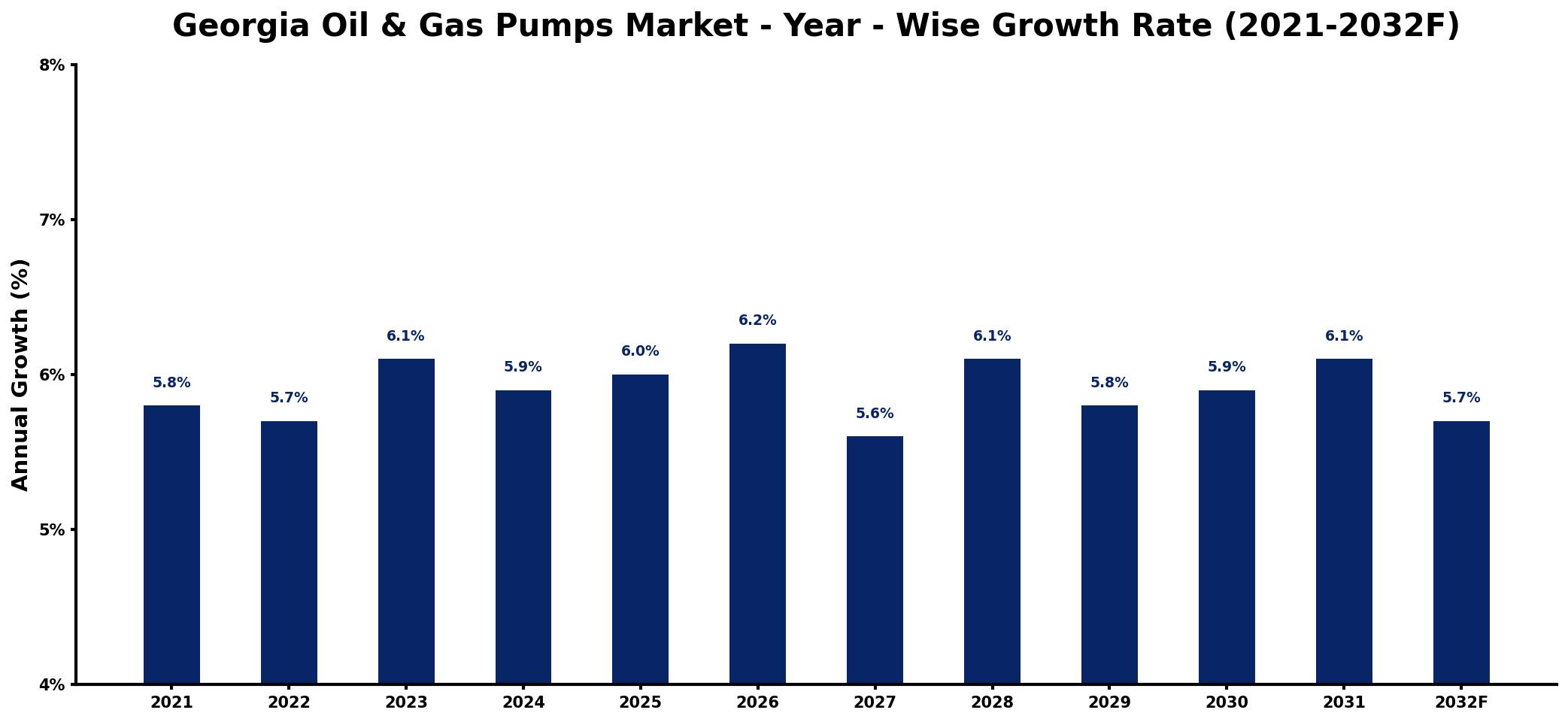
The table below presents the year‑wise growth rates along with the key drivers influencing the market
| Year | Growth Rate | Major Drivers |
| 2021 | 5.8% | Rising demand for energy solutions |
| 2022 | 5.7% | Increased investment in infrastructure |
| 2023 | 6.1% | Growing industrial activity nationwide |
| 2024 | 5.9% | Expansion of renewable energy projects |
| 2025 | 6.0% | Surge in construction activities |
| 2026 | 6.2% | Enhanced regulatory support initiatives |
| 2027 | 5.6% | Stabilization of global energy markets |
| 2028 | 6.1% | Technological advancements in efficiency |
| 2029 | 5.8% | Rising consumer energy awareness |
| 2030 | 5.9% | Increased focus on sustainability efforts |
| 2031 | 6.1% | Growth in alternative energy sectors |
| 2032 | 5.7% | Strengthening partnerships in energy sector |
Note: Market size estimations and growth projections presented in this report are based on 6Wresearch's proprietary forecasting methodology, utilizing the latest available industry data, government publications, and primary research inputs.
Georgia Oil & Gas Pumps Market Synopsis
The Georgia Oil & Gas Pumps Market is currently undergoing significant transformation, driven by advancements in pumping technologies and a growing emphasis on sustainability. With the region's oil and gas exploration flourishing, demand for specialized pumps in drilling, production, and transportation applications is on the rise. Companies are increasingly looking for solutions that not only improve efficiency but also align with environmental regulations.
Additionally, as operational challenges intensify due to the harsh environments associated with oil and gas activities, the need for more durable and reliable pumping systems has become paramount. This shift toward robust technology is not merely about performance; it reflects a broader industry move towards sustainability and predictive maintenance, setting the stage for a prosperous market landscape.
- The market is poised for steady growth, driven by increasing exploration activities and infrastructure development.
- Technological advancements such as smart pumps are gaining traction, enhancing operational efficiencies.
- Investments in eco-friendly pump solutions are becoming a priority for companies seeking to minimize environmental impact.
- Demand for predictive maintenance solutions is rising, aimed at reducing downtime and optimizing performance.
- Ongoing government support for the oil and gas sector creates a favorable investment climate for market participants.
While the Georgia Oil & Gas Pumps Market is primed for growth, several restraints loom on the horizon. Fluctuating oil prices have the potential to disrupt investment strategies, creating an environment of uncertainty for manufacturers and suppliers. Additionally, geopolitical tensions can lead to supply chain disruptions that further challenge market stability. Companies are also grappling with the increasing costs associated with adhering to stringent environmental regulations, which necessitate investment in sustainable and efficient pump technologies. Balancing these challenges will require innovation, agility, and strategic customer engagement to sustain market momentum.
Several trends are shaping the Georgia Oil & Gas Pumps Market. The adoption of advanced technologies like digital monitoring systems is on the rise, enabling companies to enhance performance while streamlining operations. Furthermore, sustainability initiatives are prompting a shift towards eco-friendly pump solutions, reflecting an industry-wide commitment to reducing carbon footprints. Demand for higher reliability and durability in pumps continues to grow, with market players exploring predictive maintenance capabilities to address maintenance challenges proactively.
The landscape of the Georgia Oil & Gas Pumps Market is rich with investment opportunities. The increasing global demand for oil and gas has spurred a corresponding need for efficient pumping systems tailored for extraction and processing. Innovations that offer enhanced performance in challenging operational environments are particularly appealing. Additionally, strategic collaborations with local oil and gas firms can unlock pathways for market entry and expansion, capitalizing on the supportive regulatory environment fostered by the government.
The Georgia government has been proactive in implementing policies that emphasize environmental protection and operational safety within the oil and gas sector. Regulatory frameworks mandate adherence to strict maintenance guidelines, leak detection protocols, and spill prevention measures to mitigate environmental risks. Furthermore, initiatives aimed at monitoring emissions from pump operations reflect a commitment to improving air quality while safeguarding public health. These policies not only promote best practices but also foster an industry culture centered on sustainability and accountability.
The outlook for the Georgia Oil & Gas Pumps Market is promising as it prepares for consistent growth through 2032. The continual expansion of exploration and production activities, paired with advancements in pump technology, will underpin this trajectory. As companies increasingly prioritize operational efficiency and sustainability, the market will likely witness a surge in demand for innovative pump solutions. This evolving landscape, marked by strategic investments and government support, signals an optimistic future for stakeholders in the Georgia oil and gas pumps sector.
Recent developments in the Georgia Oil & Gas Pumps Market reflect a strong commitment to innovation and sustainability. Companies are launching new advanced pumping technologies designed to operate efficiently in demanding conditions, with an increasing focus on eco-friendly solutions. Additionally, partnerships between local firms and technology providers are becoming more common, aimed at enhancing performance and reliability. These initiatives indicate a robust shift towards integrating smart technology and sustainability into operational strategies.
- 10 Years of Market Numbers
- Historical Data Starting from 2022 to 2025
- Base Year: 2025
- Forecast Data until 2032
- Key Performance Indicators Impacting the Market
- Major Upcoming Developments and Projects
Key Highlights of the Report:
- Georgia Oil & Gas Pumps Market Outlook
- Market Size of Georgia Oil & Gas Pumps Market, 2025
- Forecast of Georgia Oil & Gas Pumps Market, 2032
- Historical Data and Forecast of Georgia Oil & Gas Pumps Revenues & Volume for the Period 2022-2032F
- Georgia Oil & Gas Pumps Market Trend Evolution
- Georgia Oil & Gas Pumps Market Drivers and Challenges
- Georgia Oil & Gas Pumps Price Trends
- Georgia Oil & Gas Pumps Porter's Five Forces
- Georgia Oil & Gas Pumps Industry Life Cycle
- Historical Data and Forecast of Georgia Oil & Gas Pumps Market Revenues & Volume By Type for the Period 2022-2032F
- Historical Data and Forecast of Georgia Oil & Gas Pumps Market Revenues & Volume By Submersible Pumps for the Period 2022-2032F
- Historical Data and Forecast of Georgia Oil & Gas Pumps Market Revenues & Volume By Non-submersible Pumps for the Period 2022-2032F
- Historical Data and Forecast of Georgia Oil & Gas Pumps Market Revenues & Volume By Pump Type for the Period 2022-2032F
- Historical Data and Forecast of Georgia Oil & Gas Pumps Market Revenues & Volume By Centrifugal Pump for the Period 2022-2032F
- Historical Data and Forecast of Georgia Oil & Gas Pumps Market Revenues & Volume By Positive Displacement Pump for the Period 2022-2032F
- Historical Data and Forecast of Georgia Oil & Gas Pumps Market Revenues & Volume By Cryogenic Pump for the Period 2022-2032F
- Historical Data and Forecast of Georgia Oil & Gas Pumps Market Revenues & Volume By Application for the Period 2022-2032F
- Historical Data and Forecast of Georgia Oil & Gas Pumps Market Revenues & Volume By Upstream for the Period 2022-2032F
- Historical Data and Forecast of Georgia Oil & Gas Pumps Market Revenues & Volume By Midstream for the Period 2022-2032F
- Historical Data and Forecast of Georgia Oil & Gas Pumps Market Revenues & Volume By Downstream for the Period 2022-2032F
- Georgia Oil & Gas Pumps Import Export Trade Statistics
- Market Opportunity Assessment By Type
- Market Opportunity Assessment By Pump Type
- Market Opportunity Assessment By Application
- Georgia Oil & Gas Pumps Top Companies Market Share
- Georgia Oil & Gas Pumps Competitive Benchmarking By Technical and Operational Parameters
- Georgia Oil & Gas Pumps Company Profiles
- Georgia Oil & Gas Pumps Key Strategic Recommendations






































