Georgia Photosensitive Semiconductor Device Market Size, Share & Growth Rate
The Georgia Photosensitive Semiconductor Device Market was estimated at USD 860 Million in 2025 and is projected to reach USD 1591 Million by 2032, growing at a CAGR of 9.2% from 2026 to 2032. This remarkable trajectory is driven by surging demand for high-performance sensors across various sectors, notably automotive, consumer electronics, and industrial automation. Georgia's solid semiconductor ecosystem, supported by innovation and a skilled workforce, further catalyzes this growth, establishing the state as a pivotal hub for advanced imaging technologies.
Georgia Photosensitive Semiconductor Device Market Year-wise Growth Rate and Key Drivers
This graph highlights how the Georgia Photosensitive Semiconductor Device Market has steadily grown over the years, supported by major growth factors.
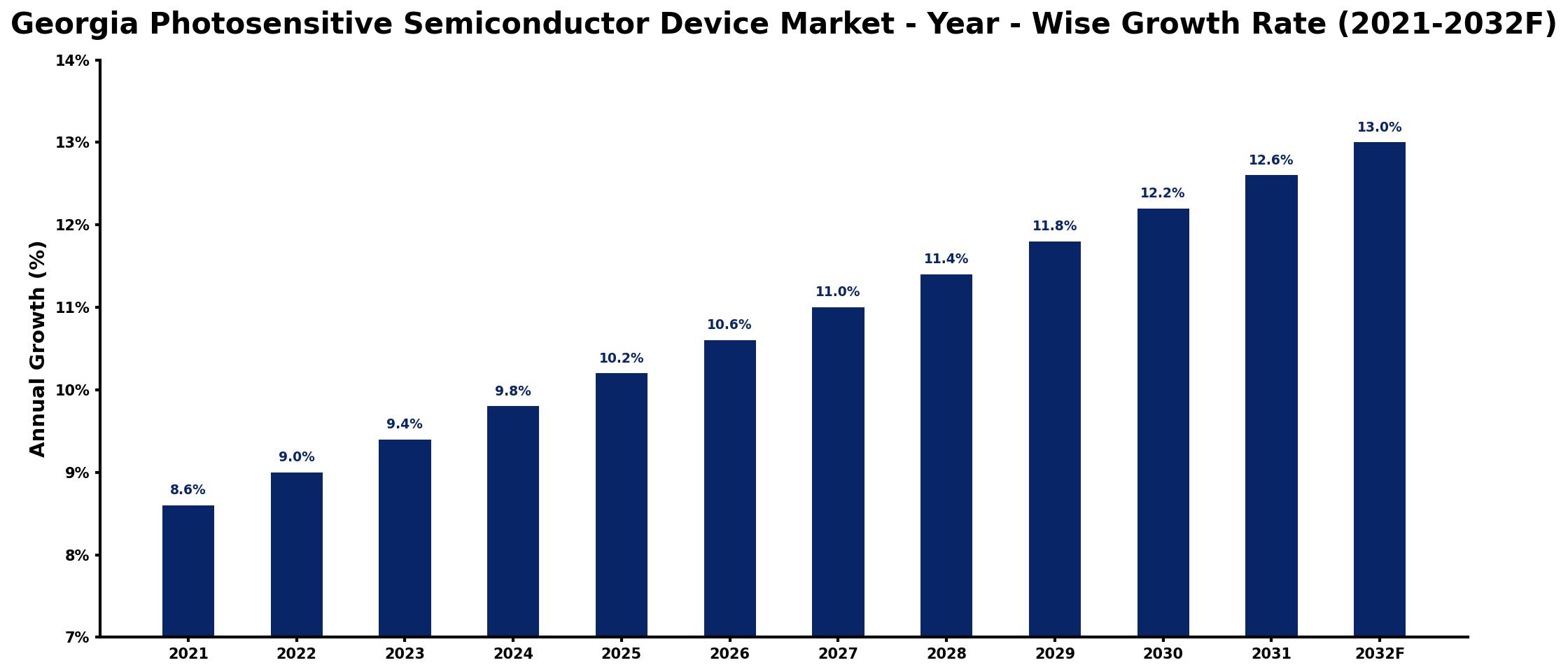
The table below presents the year‑wise growth rates along with the key drivers influencing the market
| Year | Growth Rate | Major Drivers |
| 2021 | 8.6% | Rising demand for renewable energy |
| 2022 | 9.0% | Increased investment in automation |
| 2023 | 9.4% | Expansion of smart technology applications |
| 2024 | 9.8% | Growth in electric vehicle market |
| 2025 | 10.2% | Surge in consumer electronics production |
| 2026 | 10.6% | Advancements in telecommunications infrastructure |
| 2027 | 11.0% | Emergence of IoT solutions market |
| 2028 | 11.4% | Development of smart city initiatives |
| 2029 | 11.8% | Boost in aerospace technology projects |
| 2030 | 12.2% | Heightened focus on energy efficiency |
| 2031 | 12.6% | increased domestic production output |
| 2032 | 13.0% | rising export shipment volumes |
Note: Market size estimations and growth projections presented in this report are based on 6Wresearch's proprietary forecasting methodology, utilizing the latest available industry data, government publications, and primary research inputs.
Georgia Photosensitive Semiconductor Device Market Synopsis
The most significant force shaping the Georgia Photosensitive Semiconductor Device Market today is the demand for advanced imaging technologies. The integration of AI, IoT, and autonomous vehicle systems necessitates high-resolution, efficient sensors that can function in diverse environments. As companies innovate to meet these requirements, Georgia emerges as a key player in the global landscape.
Additionally, the market is witnessing a shift towards environmentally sustainable and energy-efficient devices. Local research institutions and companies are dedicating resources to develop innovative semiconductor materials and processes that align with global sustainability goals, enhancing their competitiveness while addressing market needs.
Georgia Photosensitive Semiconductor Device Market Key Takeaways
- Strong growth projected in the next several years, driven by rising sensor demand.
- Innovative solutions such as 3D imaging and backside illumination are gaining traction.
- Focus on sustainability is reshaping product development and manufacturing practices.
- Investment in R&D is critical for companies to navigate competitive market dynamics.
- Policy support enhances opportunities for local firms and promotes industry growth.
Evaluation of Restraints in Georgia Photosensitive Semiconductor Device Market
Despite the promising outlook, the Georgia photosensitive semiconductor device market faces several constraints. Intense competition from global players can overshadow local advancements, making it challenging for smaller companies to differentiate themselves. Rapid technological evolution demands constant innovation, which can strain R&D budgets and resources. Furthermore, economic fluctuations can influence demand patterns, requiring businesses to be agile and adaptive in their strategies. Access to a skilled workforce is crucial for maintaining high-quality production, and any shortages in this area can impede growth.
Georgia Photosensitive Semiconductor Device Market Trends
The demand for advanced image sensors is on the rise, particularly for applications in automotive, smartphones, and security systems. Companies are investing in new technologies that enhance low-light sensitivity and processing speed, enabling better performance in varied conditions. Furthermore, the convergence of AI and imaging technologies is leading to innovations in facial recognition and automated systems, amplifying the need for robust sensors capable of supporting such applications.
Moreover, an increased emphasis on environmentally friendly production methods is driving development in sustainable semiconductor materials. Research initiatives are focusing on reducing energy consumption during manufacturing while improving the lifecycle of devices, aligning with global sustainability targets.
Georgia Photosensitive Semiconductor Device Market Opportunities
Investment opportunities in the Georgia photosensitive semiconductor device market are substantial. The rise of facial recognition technology and autonomous driving systems is propelling the demand for cutting-edge imaging solutions. Additionally, sectors such as healthcare and consumer electronics present avenues for growth as they increasingly incorporate advanced imaging technologies. With Georgia's strategic positioning and supportive ecosystem for semiconductor manufacturing, there exists significant potential for investors to tap into the high-performance sensor market.
Government Initiatives in the Georgia Photosensitive Semiconductor Device Market
Government policies are pivotal in fostering the growth of the Georgia photosensitive semiconductor device market. Initiatives aimed at promoting innovation through research grants and tax incentives are boosting investment in R&D. Regulations ensure that products meet safety and quality standards, while efforts to protect intellectual property encourage fair competition among businesses. These policies create a conducive environment for industry expansion, ultimately contributing to economic growth in the region.
Future Insights of the Georgia Photosensitive Semiconductor Device Market
Looking ahead to 2026-2032, the Georgia Photosensitive Semiconductor Device Market is set for significant expansion. The increasing integration of AI and machine learning technologies in various applications will further drive demand for high-performance sensors. As companies continue to innovate and adopt sustainable manufacturing practices, Georgia is expected to strengthen its position in the global semiconductor landscape, becoming a crucial player in the development of next-generation imaging solutions.
Georgia Photosensitive Semiconductor Device Market Latest Developments (2025 - 2026)
In recent months, the industry has seen a surge in collaborative projects focusing on enhancing image sensor capabilities, particularly in low-light conditions and high-speed processing. Local companies are increasingly engaging in partnerships with research institutions to accelerate innovation. Additionally, several initiatives have been launched to promote sustainable practices within the semiconductor manufacturing process, aligning with environmental goals set by both industry stakeholders and governmental bodies.
Georgia Photosensitive Semiconductor Device Market - Key Attractiveness of the Report
- 10 Years of Market Numbers
- Historical Data Starting from 2022 to 2025
- Base Year: 2025
- Forecast Data until 2032
- Key Performance Indicators Impacting the Market
- Major Upcoming Developments and Projects
Key Highlights of the Report:
- Georgia Photosensitive Semiconductor Device Market Outlook
- Market Size of Georgia Photosensitive Semiconductor Device Market, 2025
- Forecast of Georgia Photosensitive Semiconductor Device Market, 2032
- Historical Data and Forecast of Georgia Photosensitive Semiconductor Device Revenues & Volume for the Period 2022-2032F
- Georgia Photosensitive Semiconductor Device Market Trend Evolution
- Georgia Photosensitive Semiconductor Device Market Drivers and Challenges
- Georgia Photosensitive Semiconductor Device Price Trends
- Georgia Photosensitive Semiconductor Device Porter's Five Forces
- Georgia Photosensitive Semiconductor Device Industry Life Cycle
- Historical Data and Forecast of Georgia Photosensitive Semiconductor Device Market Revenues & Volume By Device for the Period 2022-2032F
- Historical Data and Forecast of Georgia Photosensitive Semiconductor Device Market Revenues & Volume By Photocell for the Period 2022-2032F
- Historical Data and Forecast of Georgia Photosensitive Semiconductor Device Market Revenues & Volume By Photodiode for the Period 2022-2032F
- Historical Data and Forecast of Georgia Photosensitive Semiconductor Device Market Revenues & Volume By Phototransistor for the Period 2022-2032F
- Historical Data and Forecast of Georgia Photosensitive Semiconductor Device Market Revenues & Volume By Photoresistor for the Period 2022-2032F
- Historical Data and Forecast of Georgia Photosensitive Semiconductor Device Market Revenues & Volume By Photo IC for the Period 2022-2032F
- Historical Data and Forecast of Georgia Photosensitive Semiconductor Device Market Revenues & Volume By End User for the Period 2022-2032F
- Historical Data and Forecast of Georgia Photosensitive Semiconductor Device Market Revenues & Volume By Automotive and Transportation for the Period 2022-2032F
- Historical Data and Forecast of Georgia Photosensitive Semiconductor Device Market Revenues & Volume By Consumer Electronics for the Period 2022-2032F
- Historical Data and Forecast of Georgia Photosensitive Semiconductor Device Market Revenues & Volume By Aerospace and Defence for the Period 2022-2032F
- Historical Data and Forecast of Georgia Photosensitive Semiconductor Device Market Revenues & Volume By Healthcare for the Period 2022-2032F
- Historical Data and Forecast of Georgia Photosensitive Semiconductor Device Market Revenues & Volume By Industrial for the Period 2022-2032F
- Historical Data and Forecast of Georgia Photosensitive Semiconductor Device Market Revenues & Volume By Security and Survelliance for the Period 2022-2032F
- Georgia Photosensitive Semiconductor Device Import Export Trade Statistics
- Market Opportunity Assessment By Device
- Market Opportunity Assessment By End User
- Georgia Photosensitive Semiconductor Device Top Companies Market Share
- Georgia Photosensitive Semiconductor Device Competitive Benchmarking By Technical and Operational Parameters
- Georgia Photosensitive Semiconductor Device Company Profiles
- Georgia Photosensitive Semiconductor Device Key Strategic Recommendations






































