Germany AI in IoT Market Size & Growth Rate (2026-2032)
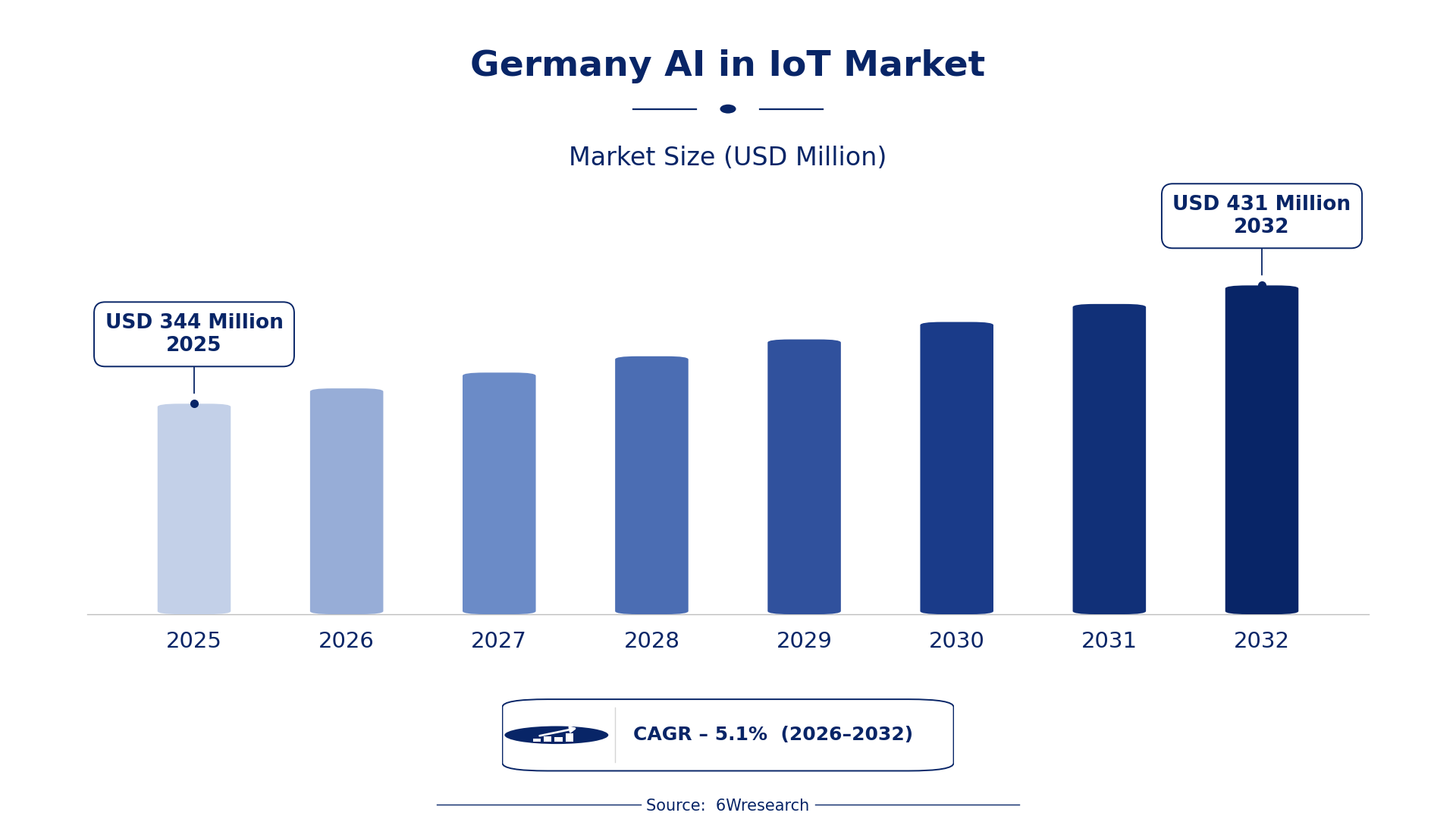
The Germany AI in IoT Market was estimated at USD 344 Million in 2025 and is projected to reach USD 431 Million by 2032, growing at a CAGR of 5.1% from 2026 to 2032.
Germany AI in IoT Market Synopsis
The demand for AI in IoT solutions in Germany is being driven by the urgent need for enhanced operational efficiency across key sectors. Industries such as manufacturing, healthcare, and automotive are increasingly recognizing the transformative potential of integrating AI algorithms with IoT technologies.
As companies seek to streamline processes and improve customer engagement, the fusion of AI and IoT is facilitating smarter decision-making. This trend is further bolstered by governmental support for digitalization initiatives and the Industry 4.0 framework, positioning Germany as a frontrunner in this innovative market.
Germany AI in IoT Market Year-wise Growth Rate and Key Drivers
This graph illustrates the annual growth rates of the Germany AI in IoT Market from 2021 to 2032, highlighting a steady upward trajectory and projected expansion over the forecast period.
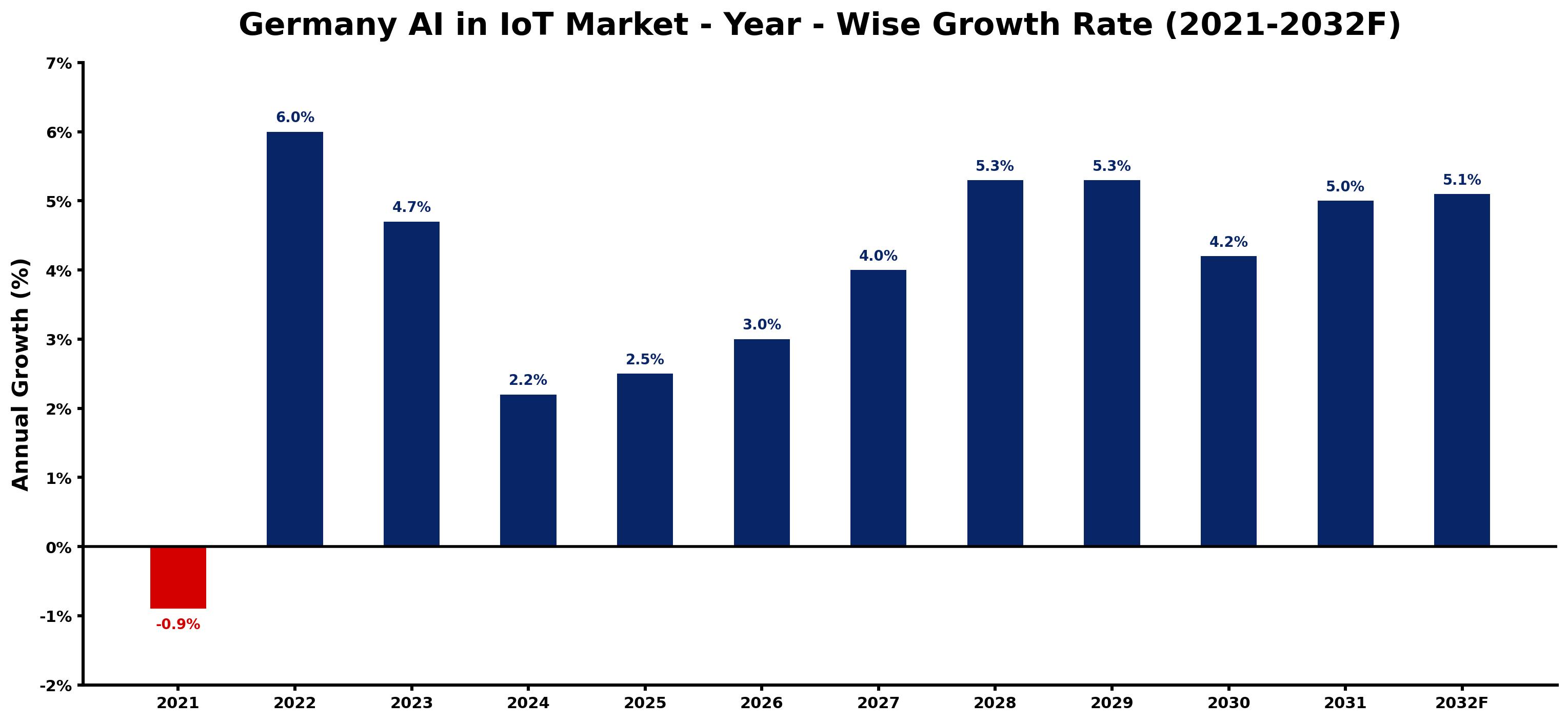
The table below presents the year‑wise growth rates along with the key drivers influencing the market
| Year | Growth Rate | Major Drivers |
| 2021 | -0.9% | Chip shortage affecting IoT device production in Germany |
| 2022 | 6.0% | Government funding for AI-driven smart city projects |
| 2023 | 4.7% | Increased investment in Industry 4.0 automation initiatives |
| 2024 | 2.2% | Rising adoption of AI in logistics management systems |
| 2025 | 2.5% | Technological partnerships boosting AI integration in IoT |
| 2026 | 3.0% | Focus on energy efficiency in smart building solutions |
| 2027 | 4.0% | National AI strategy promoting IoT advancements |
| 2028 | 5.3% | Integration of AI for predictive maintenance in industries |
| 2029 | 5.3% | Growing interest in AI for transportation optimization |
| 2030 | 4.2% | Regulatory support for AI-driven data protection solutions |
| 2031 | 5.0% | Local startups innovating in AI for healthcare IoT |
| 2032 | 5.1% | Collaborations enhancing smart agricultural technology implementation |
Note: Market size estimations and growth projections presented in this report are based on 6Wresearch's proprietary forecasting methodology, utilizing the latest available industry data, government publications, and primary research inputs.
Germany AI in IoT Market Key Takeaways
Below are some of the specific key takeaways from the market, including:
- The market is driven by the integration of AI technologies across various sectors, enhancing efficiency and decision-making.
- Edge computing is becoming crucial for real-time data processing, reducing latency in IoT applications.
- Data privacy and security concerns are significant challenges, necessitating stringent regulatory compliance.
- Investment opportunities are emerging in sectors like manufacturing and healthcare, particularly for predictive maintenance solutions.
- Government initiatives are actively promoting AI adoption, fostering a supportive environment for innovation.
Evaluation of Restraints in Germany AI in IoT Market
The Germany AI in IoT market faces several restraints that can hinder growth. One of the primary issues is the increasing scrutiny surrounding data privacy and security, particularly with the implementation of GDPR regulations. This raises concerns for companies looking to collect and analyze vast datasets.
on top of that, the shortage of skilled professionals in AI and IoT technologies is a pressing challenge, creating a talent gap that companies struggle to bridge. Additionally, the financial burden associated with the implementation and maintenance of advanced AI systems can deter smaller businesses from entering the market. Together, these factors pose significant challenges to the market's sustainable growth.
Germany AI in IoT Market Trends
Current trends indicate a strong focus on using AI to enhance IoT device capabilities, particularly through predictive maintenance and energy optimization. Companies are investing in sophisticated AI algorithms to improve operational efficiency and customer experiences.
on top of that, the rise of edge computing is facilitating real-time analytics at the device level, significantly improving responsiveness. The demand for AI-driven security solutions is also escalating as businesses prioritize data protection in their IoT deployments.
Germany AI in IoT Market Opportunities
Investment opportunities are abundant in the Germany AI in IoT market, particularly in sectors like manufacturing and healthcare. In manufacturing, integrating AI can lead to increased efficiency and improved product quality, while in healthcare, AI-powered IoT solutions can enhance patient monitoring and treatment personalization.
Transportation and agriculture also stand to gain significantly from AI in IoT, optimizing logistics and improving resource management. As these industries look for innovative solutions, investing in AI in IoT technology promises substantial returns.
Government Initiatives in the Germany AI in IoT Market
The German government is actively fostering the development of AI and IoT technologies through a range of policies aimed at promoting innovation and ensuring ethical standards. The regulatory environment is supportive of digital transformation, making it a critical time for businesses to align with public-sector priorities.
- A national digital infrastructure upgrade programme is currently in its rollout phase to improve connectivity for IoT devices.
- The "AI Made in Germany" strategy was launched to promote AI applications across various sectors, including IoT, enhancing innovation.
- The Data Ethics Commission has introduced guidelines emphasizing the importance of responsible AI use, ensuring user privacy.
- Current funding initiatives are underway to support research and development in AI and IoT technologies, driving economic growth.
- A planned public-private partnership aims to enhance smart city projects, integrating AI into urban infrastructure by 2028.
Future Insights of the Germany AI in IoT Market
Looking ahead to 2026-2032, the Germany AI in IoT market is expected to continue its upward trajectory, driven by ongoing advancements in AI and IoT integration. Companies will increasingly invest in AI-powered solutions to remain competitive and responsive to market demands.
The convergence of these technologies promises to redefine operational efficiencies across multiple sectors, positioning Germany as a leader in this space. With the government’s backing and a focus on ethical standards, the market is set for significant expansion and innovation.
Germany AI in IoT Market Latest Developments
Over the past year, the Germany AI in IoT market has witnessed notable activity, with companies and government agencies pushing for innovative solutions. The drive for digital transformation is evident as various sectors look to integrate AI into their IoT strategies.
- A major technology vendor launched a new AI-driven IoT platform in early 2025, enhancing operational capabilities for manufacturers.
- An initiative to develop smart healthcare solutions has been underway since mid-2025, focusing on real-time patient monitoring.
- In Q3 2025, a regional operator began implementing AI-based predictive maintenance systems in its fleet management processes.
- A planned rollout of AI-enhanced agricultural technologies is expected to begin in late 2026, promoting sustainability in farming practices.
- A partnership between key stakeholders in the automotive sector was announced in early 2025 to enhance AI integration in smart vehicles.
Germany AI in IoT Market - Key Attractiveness of the Report
- 10 Years of Market Numbers
- Historical Data Starting from 2022 to 2025
- Base Year: 2025
- Forecast Data until 2032
- Key Performance Indicators Impacting the Market
- Major Upcoming Developments and Projects
The German government has introduced several initiatives like the "AI Made in Germany" strategy and funding for R&D, which actively promote the adoption and ethical application of AI technologies in the IoT sector.
Key Highlights of the Report:
- Germany AI in IoT Market Outlook
- Market Size of Germany AI in IoT Market, 2025
- Forecast of Germany AI in IoT Market, 2032
- Historical Data and Forecast of Germany AI in IoT Revenues & Volume for the Period 2022-2032F
- Germany AI in IoT Market Trend Evolution
- Germany AI in IoT Market Drivers and Challenges
- Germany AI in IoT Price Trends
- Germany AI in IoT Porter's Five Forces
- Germany AI in IoT Industry Life Cycle
- Historical Data and Forecast of Germany AI in IoT Market Revenues & Volume By Component for the Period 2022-2032F
- Historical Data and Forecast of Germany AI in IoT Market Revenues & Volume By Platforms for the Period 2022-2032F
- Historical Data and Forecast of Germany AI in IoT Market Revenues & Volume By Software Solutions for the Period 2022-2032F
- Historical Data and Forecast of Germany AI in IoT Market Revenues & Volume By Services for the Period 2022-2032F
- Historical Data and Forecast of Germany AI in IoT Market Revenues & Volume By Vertical for the Period 2022-2032F
- Historical Data and Forecast of Germany AI in IoT Market Revenues & Volume By Manufacturing for the Period 2022-2032F
- Historical Data and Forecast of Germany AI in IoT Market Revenues & Volume By Energy and Utilities for the Period 2022-2032F
- Historical Data and Forecast of Germany AI in IoT Market Revenues & Volume By Transportation and Mobility for the Period 2022-2032F
- Historical Data and Forecast of Germany AI in IoT Market Revenues & Volume By BFSI for the Period 2022-2032F
- Historical Data and Forecast of Germany AI in IoT Market Revenues & Volume By Government and Defense for the Period 2022-2032F
- Historical Data and Forecast of Germany AI in IoT Market Revenues & Volume By Retail for the Period 2022-2032F
- Historical Data and Forecast of Germany AI in IoT Market Revenues & Volume By Healthcare and Life Sciences for the Period 2022-2032F
- Historical Data and Forecast of Germany AI in IoT Market Revenues & Volume By Telecom for the Period 2022-2032F
- Historical Data and Forecast of Germany AI in IoT Market Revenues & Volume By Technology for the Period 2022-2032F
- Historical Data and Forecast of Germany AI in IoT Market Revenues & Volume By ML and Deep Learning for the Period 2022-2032F
- Historical Data and Forecast of Germany AI in IoT Market Revenues & Volume By NLP for the Period 2022-2032F
- Germany AI in IoT Import Export Trade Statistics
- Market Opportunity Assessment By Component
- Market Opportunity Assessment By Vertical
- Market Opportunity Assessment By Technology
- Germany AI in IoT Top Companies Market Share
- Germany AI in IoT Competitive Benchmarking By Technical and Operational Parameters
- Germany AI in IoT Company Profiles
- Germany AI in IoT Key Strategic Recommendations






































