Kenya AI in IoT Market Size & Growth Rate (2026-2032)
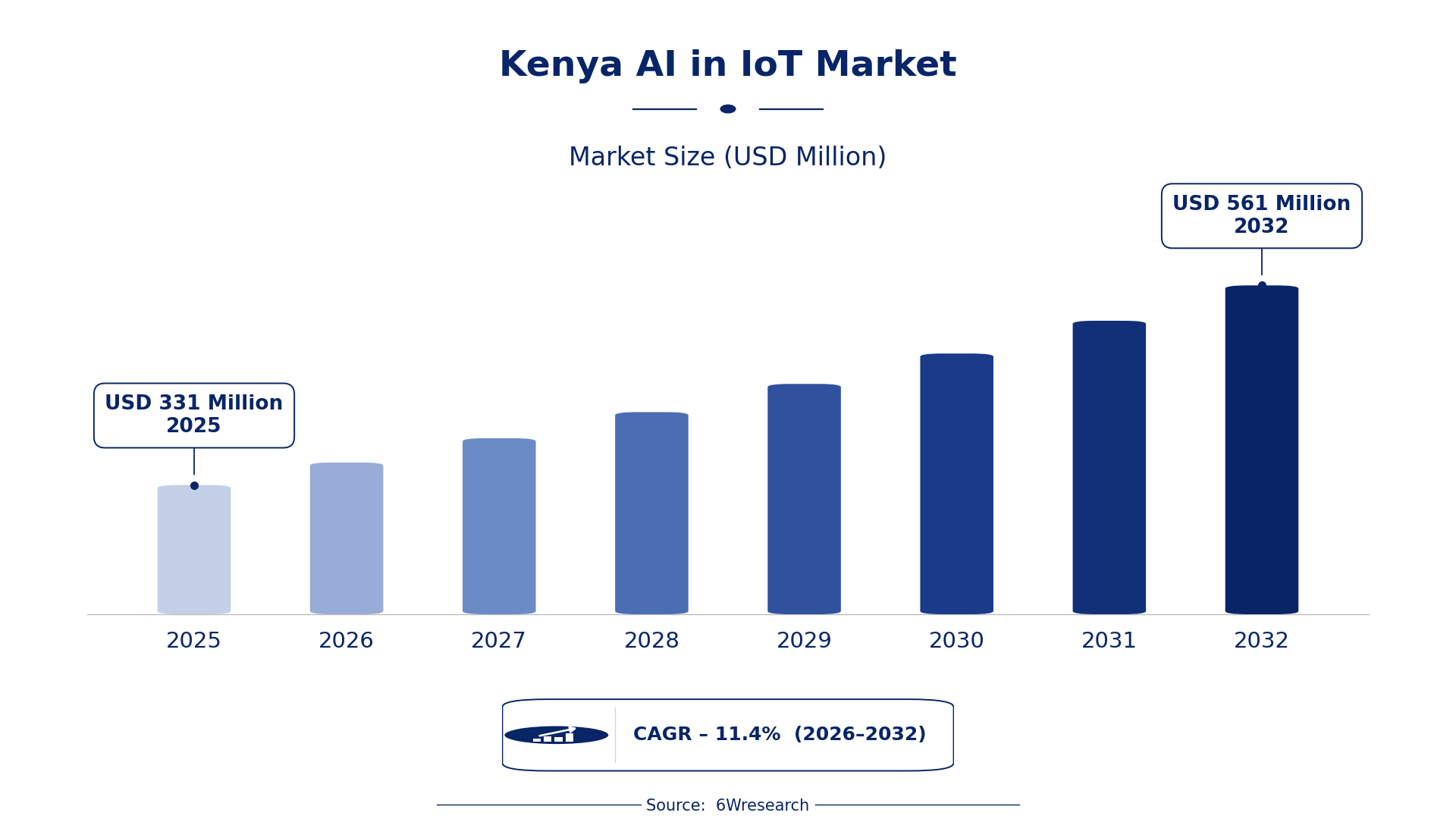
The Kenya AI in IoT Market was estimated at USD 331 Million in 2025 and is projected to reach USD 561 Million by 2032, growing at a CAGR of 11.4% from 2026 to 2032.
Kenya AI in IoT Market Synopsis
The Kenya AI in IoT market is witnessing a surge in adoption, catalyzed by an increasing reliance on connected devices across sectors like agriculture and healthcare. As businesses embrace these technologies, the landscape is shifting towards advanced analytics and automated solutions that enhance operational efficiencies.
Looking ahead, the growth trajectory appears strong, driven by government support and rising investments in AI applications. The local market is evolving rapidly, with stakeholders eager to implement tailored solutions that meet specific needs, ensuring that Kenya remains at the forefront of AI in IoT advancements.
Kenya AI in IoT Market Year-wise Growth Rate and Key Drivers
This graph illustrates the annual growth rates of the Kenya AI in IoT Market from 2021 to 2032, highlighting a steady upward trajectory and projected expansion over the forecast period.
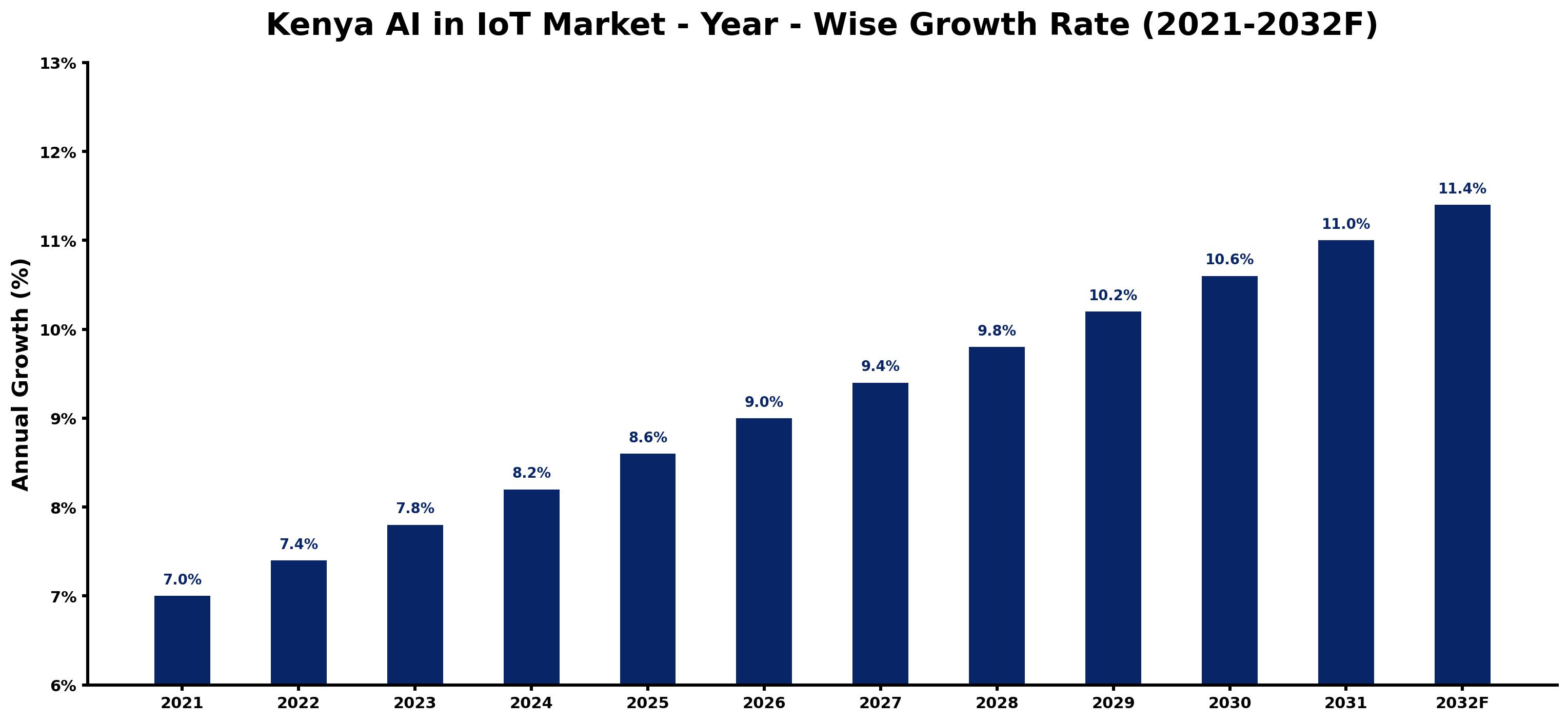
The table below presents the year‑wise growth rates along with the key drivers influencing the market
| Year | Growth Rate | Major Drivers |
| 2021 | 7.0% | Launch of Kenya Vision 2030 promotes tech innovation. |
| 2022 | 7.4% | Growing mobile connectivity enhances IoT deployment strategies. |
| 2023 | 7.8% | Government partnerships accelerate AI research funding initiatives. |
| 2024 | 8.2% | Increased smartphone penetration drives IoT adoption in households. |
| 2025 | 8.6% | Local startups innovate AI solutions for agriculture monitoring. |
| 2026 | 9.0% | Regulatory support for smart farming initiatives boosts demand. |
| 2027 | 9.4% | Rising interest in smart city developments fuels investments. |
| 2028 | 9.8% | Government subsidies encourage IoT solutions in healthcare. |
| 2029 | 10.2% | Adoption of renewable energy spurs intelligent energy management. |
| 2030 | 10.6% | The National Telecom Policy promotes AI-driven connectivity projects. |
| 2031 | 11.0% | Increased urbanization spurs IoT applications in transport sector. |
| 2032 | 11.4% | Growing focus on cybersecurity enhances trust in IoT technologies. |
Note: Market size estimations and growth projections presented in this report are based on 6Wresearch's proprietary forecasting methodology, utilizing the latest available industry data, government publications, and primary research inputs.
Kenya AI in IoT Market Key Takeaways
Below are some of the specific key takeaways from the market, including:
- The market is projected to grow from USD 331 Million in 2025 to USD 561 Million by 2032.
- Healthcare, agriculture, and transportation are leading sectors driving AI integration in IoT solutions.
- Government initiatives are pivotal in promoting innovation and technology adoption in the AI and IoT space.
- Investment in R&D is increasing as companies seek to develop localized AI applications.
- Data security and privacy are becoming increasingly critical as IoT adoption expands.
Evaluation of Restraints in Kenya AI in IoT Market
Despite the promising outlook for the Kenya AI in IoT market, several constraints are impeding its growth. Awareness levels about AI and IoT technologies remain low among many businesses, leading to a slower uptake of solutions. on top of that, concerns regarding data privacy are hindering organizations from fully embracing these technologies. Infrastructure challenges, such as inconsistent internet connectivity and frequent power outages, further complicate implementation efforts. A shortage of skilled professionals in the AI and IoT fields also poses a significant barrier, limiting innovation and deployment capabilities.
Kenya AI in IoT Market Trends
A key trend in the Kenya AI in IoT market is the growing focus on integrating AI to enhance IoT capabilities. Companies are investing heavily in AI-driven analytics to facilitate real-time decision-making and improve process automation. As the demand for smart cities and sustainable agricultural practices rises, the relevance of AI in optimizing resource management is becoming more pronounced. Data privacy measures are also gaining traction, as stakeholders work to build trust with consumers in this interconnected environment.
Kenya AI in IoT Market Opportunities
Opportunities in the Kenya AI in IoT market are abundant, especially in sectors like agriculture and healthcare. The need for predictive analytics in manufacturing and resource optimization in agriculture creates fertile ground for investment. on top of that, the push for smart city initiatives presents a chance for companies to develop infrastructure management solutions. Tailoring AI-powered IoT applications to meet the unique demands of the Kenyan market can yield significant returns for savvy investors willing to navigate this dynamic environment.
Government Initiatives in the Kenya AI in IoT Market
The Kenyan government is actively shaping the AI in IoT market through a series of strategic initiatives aimed at fostering technological innovation. By prioritizing digital transformation, these policies are designed to facilitate the growth of AI and IoT technologies, ultimately enhancing the country's competitive edge in the global market.
- A national digital infrastructure upgrade programme, currently in its rollout phase, aims to enhance connectivity and support IoT development.
- The Kenya National Innovation Agency (KeNIA) was established to promote technological innovation and provide support for startups in the sector.
- The Data Protection Act, implemented to secure data privacy in AI and IoT applications, underscores the government’s commitment to safeguarding consumer information.
- Ongoing capacity building programs initiated by the Kenya ICT Authority focus on developing a skilled workforce in AI and IoT technologies.
- A planned public-private initiative expected to enhance telecom infrastructure access by 2028 aims to improve connectivity for IoT applications.
Future Insights of the Kenya AI in IoT Market
As we look toward 2026-2032, the Kenya AI in IoT market is expected to thrive, driven by an increase in internet-connected devices and advancements in AI technology. The convergence of these technologies will lead to unprecedented efficiencies across sectors such as healthcare and agriculture. With a young, tech-savvy population and government backing for digital initiatives, Kenya is well-positioned to capitalize on this growth, fostering sustainable economic development and improved living standards.
Kenya AI in IoT Market Latest Developments
Recent months have seen a flurry of activity in the Kenya AI in IoT market, highlighting the increasing interest and investment in this sector. Companies are embracing new technologies, while government policies are evolving to further support innovation and adoption.
- A major technology vendor launched a new AI-driven IoT platform in early 2025, aimed at enhancing supply chain efficiencies in the agricultural sector.
- Current initiatives focusing on smart city projects are underway, with partnerships being formed between local governments and technology firms to deploy IoT solutions.
- In mid-2025, a leading regional operator announced an expansion of its IoT services, targeting the healthcare sector to improve patient monitoring systems.
- A rollout of a national digital literacy program is expected to commence in the second half of 2026, aimed at educating businesses on the benefits of AI and IoT.
- Upcoming infrastructure projects are set to enhance connectivity, with plans for new data centers expected to be operational by late 2026.
Kenya AI in IoT Market - Key Attractiveness of the Report
- 10 Years of Market Numbers
- Historical Data Starting from 2022 to 2025
- Base Year: 2025
- Forecast Data until 2032
- Key Performance Indicators Impacting the Market
- Major Upcoming Developments and Projects
Key Highlights of the Report:
- Kenya AI in IoT Market Outlook
- Market Size of Kenya AI in IoT Market, 2025
- Forecast of Kenya AI in IoT Market, 2032
- Historical Data and Forecast of Kenya AI in IoT Revenues & Volume for the Period 2022-2032F
- Kenya AI in IoT Market Trend Evolution
- Kenya AI in IoT Market Drivers and Challenges
- Kenya AI in IoT Price Trends
- Kenya AI in IoT Porter's Five Forces
- Kenya AI in IoT Industry Life Cycle
- Historical Data and Forecast of Kenya AI in IoT Market Revenues & Volume By Component for the Period 2022-2032F
- Historical Data and Forecast of Kenya AI in IoT Market Revenues & Volume By Platforms for the Period 2022-2032F
- Historical Data and Forecast of Kenya AI in IoT Market Revenues & Volume By Software Solutions for the Period 2022-2032F
- Historical Data and Forecast of Kenya AI in IoT Market Revenues & Volume By Services for the Period 2022-2032F
- Historical Data and Forecast of Kenya AI in IoT Market Revenues & Volume By Vertical for the Period 2022-2032F
- Historical Data and Forecast of Kenya AI in IoT Market Revenues & Volume By Manufacturing for the Period 2022-2032F
- Historical Data and Forecast of Kenya AI in IoT Market Revenues & Volume By Energy and Utilities for the Period 2022-2032F
- Historical Data and Forecast of Kenya AI in IoT Market Revenues & Volume By Transportation and Mobility for the Period 2022-2032F
- Historical Data and Forecast of Kenya AI in IoT Market Revenues & Volume By BFSI for the Period 2022-2032F
- Historical Data and Forecast of Kenya AI in IoT Market Revenues & Volume By Government and Defense for the Period 2022-2032F
- Historical Data and Forecast of Kenya AI in IoT Market Revenues & Volume By Retail for the Period 2022-2032F
- Historical Data and Forecast of Kenya AI in IoT Market Revenues & Volume By Healthcare and Life Sciences for the Period 2022-2032F
- Historical Data and Forecast of Kenya AI in IoT Market Revenues & Volume By Telecom for the Period 2022-2032F
- Historical Data and Forecast of Kenya AI in IoT Market Revenues & Volume By Technology for the Period 2022-2032F
- Historical Data and Forecast of Kenya AI in IoT Market Revenues & Volume By ML and Deep Learning for the Period 2022-2032F
- Historical Data and Forecast of Kenya AI in IoT Market Revenues & Volume By NLP for the Period 2022-2032F
- Kenya AI in IoT Import Export Trade Statistics
- Market Opportunity Assessment By Component
- Market Opportunity Assessment By Vertical
- Market Opportunity Assessment By Technology
- Kenya AI in IoT Top Companies Market Share
- Kenya AI in IoT Competitive Benchmarking By Technical and Operational Parameters
- Kenya AI in IoT Company Profiles
- Kenya AI in IoT Key Strategic Recommendations






































