Germany Apiculture Market Size, Share & Growth Rate
The Germany Apiculture Market was estimated at USD 197 Million in 2025 and is projected to reach USD 211 Million by 2032, growing at a CAGR of 1.0% from 2026 to 2032. This steady growth trajectory is largely fueled by a strong consumer preference for organic and sustainably produced honey, reflecting an increasing awareness of the essential role bees play in the ecosystem. Additionally, government support initiatives aimed at promoting sustainable beekeeping are enhancing the industry's resilience and fostering growth.
Germany Apiculture Market Year-wise Growth Rate and Key Drivers
This graph highlights how the Germany Apiculture Market has steadily grown over the years, supported by major growth factors.
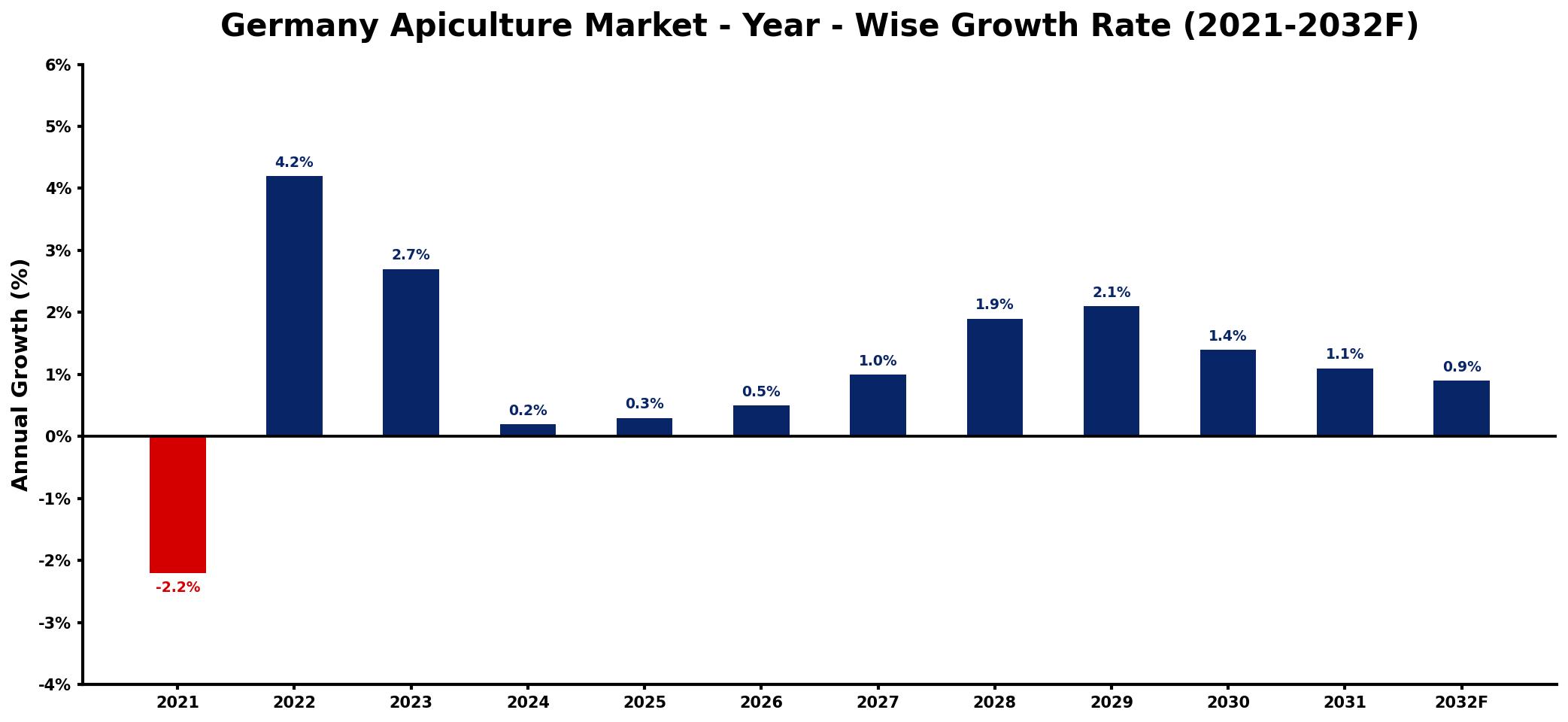
The table below presents the year‑wise growth rates along with the key drivers influencing the market
| Year | Growth Rate | Major Drivers |
| 2021 | -2.2% | Decreased consumer interest in honey |
| 2022 | 4.2% | Rising popularity of organic products |
| 2023 | 2.7% | Increased investment in sustainable practices |
| 2024 | 0.2% | Growing demand for local products |
| 2025 | 0.3% | Expansion of urban gardening initiatives |
| 2026 | 0.5% | Emerging trends in natural sweeteners |
| 2027 | 1.0% | Enhanced focus on biodiversity conservation |
| 2028 | 1.9% | Strengthening of local farmer cooperatives |
| 2029 | 2.1% | Surge in educational workshops offered |
| 2030 | 1.4% | Increased collaboration with food producers |
| 2031 | 1.1% | Growth in health-conscious consumer base |
| 2032 | 0.9% | Rising awareness of pollinator importance |
Note: Market size estimations and growth projections presented in this report are based on 6Wresearch's proprietary forecasting methodology, utilizing the latest available industry data, government publications, and primary research inputs.
Germany Apiculture Market Synopsis
The foremost force driving the Germany Apiculture Market is a cultural legacy steeped in beekeeping expertise, coupled with rising consumer awareness regarding the health and ecological benefits of bees. This deeply rooted tradition has established Germany as a key player in the production of premium honey and bee products, meeting an ever-growing demand.
In recent years, organic honey production has gained significant traction, as consumers increasingly seek out natural and environmentally friendly products. With a commitment to sustainability and high-quality offerings, German beekeepers are well-positioned to cater to this conscious consumer base, fostering innovation and ethical practices.
Germany Apiculture Market Key Takeaways
- Germanys rich beekeeping heritage bolsters its position in the global apiculture market.
- Consumer preference is shifting towards organic and ethically produced honey, driving market growth.
- Government initiatives and support programs are crucial for sustaining bee populations and promoting beekeeping.
- Niche honey varieties and value-added products are increasingly appealing to discerning consumers.
- Technological advancements in hive management are enhancing production efficiency and bee health.
Evaluation of Restraints in Germany Apiculture Market
Despite its robust growth, the Germany Apiculture Market faces significant challenges that could impede its expansion. Climate change poses a substantial threat, affecting bee health and leading to increased disease prevalence and hive loss. Furthermore, pesticide use in agriculture continues to jeopardize bee populations, creating a critical concern for beekeepers. The competitive pressure from lower-priced imported honey also strains local producers, especially smaller beekeepers who may struggle to meet compliance standards imposed by regulatory frameworks. This interplay of environmental, market, and regulatory challenges necessitates a strategic focus on sustainable practices and innovative solutions.
Germany Apiculture Market Trends
The market is witnessing a pronounced trend towards sustainability, with consumers prioritizing ethically sourced and organic honey products. The desire for transparency in sourcing is driving demand for traceable honey, pushing producers to adopt clearer labeling practices. Additionally, interest in niche honey varieties—such as raw honey, flavored options, and honeycomb—has surged as consumers seek unique culinary experiences. These trends reflect an evolving marketplace where quality and ethical production are increasingly valued.
Germany Apiculture Market Opportunities
Investment opportunities in the Germany Apiculture Market are flourishing, particularly in expanding beekeeping operations to meet rising demand. Technological innovations, such as smart hive management systems, present prospects for improving production efficiency and enhancing bee health monitoring. Moreover, there is a growing market for value-added products like beeswax candles and propolis-based skincare, catering to the eco-conscious consumer. Supporting sustainable beekeeping practices and investing in research to tackle ongoing challenges like colony collapse disorder could also yield significant returns.
Government Initiatives in the Germany Apiculture Market
The German government has established various policies and initiatives to support the apiculture sector. These include financial incentives for beekeepers aimed at maintaining bee colonies and promoting honey production. Additionally, research and development programs are in place to address bee health issues and combat diseases affecting bee populations. The government also implements regulations to limit the use of harmful pesticides and to encourage the cultivation of bee-friendly flora, all of which serve to bolster the sustainability and growth of the apiculture market in Germany.
Future Insights of the Germany Apiculture Market
Looking ahead to 2026-2032, the Germany Apiculture Market is poised for steady expansion driven by escalating consumer interest in natural and organic products. As awareness of the environmental crisis surrounding bee populations increases, initiatives aimed at protecting these vital insects are expected to gain momentum. Producers are likely to innovate continuously, introducing new products and refining practices to align with consumer preferences for quality and sustainability. The future looks bright for the sector, with significant opportunities for growth and development on the horizon.
Germany Apiculture Market Latest Developments (2025 - 2026)
Recent developments within the Germany Apiculture Market have highlighted a surge in interest towards environmentally friendly practices, particularly in organic honey production. Beekeeping communities are increasingly adopting technology-driven solutions to enhance hive management and overall bee health. Concurrently, consumer education campaigns regarding the importance of biodiversity and pollination are gaining traction, fostering a supportive environment for market growth. The evolving landscape reflects a collective commitment to sustaining bee populations while meeting consumer demands.
Germany Apiculture Market - Key Attractiveness of the Report
- 10 Years of Market Numbers
- Historical Data Starting from 2022 to 2025
- Base Year: 2025
- Forecast Data until 2032
- Key Performance Indicators Impacting the Market
- Major Upcoming Developments and Projects
Key Highlights of the Report:
- Germany Apiculture Market Outlook
- Market Size of Germany Apiculture Market, 2025
- Forecast of Germany Apiculture Market, 2032
- Historical Data and Forecast of Germany Apiculture Revenues & Volume for the Period 2022-2032F
- Germany Apiculture Market Trend Evolution
- Germany Apiculture Market Drivers and Challenges
- Germany Apiculture Price Trends
- Germany Apiculture Porter's Five Forces
- Germany Apiculture Industry Life Cycle
- Historical Data and Forecast of Germany Apiculture Market Revenues & Volume By Product Type for the Period 2022-2032F
- Historical Data and Forecast of Germany Apiculture Market Revenues & Volume By Honey for the Period 2022-2032F
- Historical Data and Forecast of Germany Apiculture Market Revenues & Volume By Beeswax for the Period 2022-2032F
- Historical Data and Forecast of Germany Apiculture Market Revenues & Volume By Live-bees for the Period 2022-2032F
- Historical Data and Forecast of Germany Apiculture Market Revenues & Volume By Others for the Period 2022-2032F
- Historical Data and Forecast of Germany Apiculture Market Revenues & Volume By Application for the Period 2022-2032F
- Historical Data and Forecast of Germany Apiculture Market Revenues & Volume By Medical for the Period 2022-2032F
- Historical Data and Forecast of Germany Apiculture Market Revenues & Volume By Food Beverages for the Period 2022-2032F
- Historical Data and Forecast of Germany Apiculture Market Revenues & Volume By Cosmetics for the Period 2022-2032F
- Historical Data and Forecast of Germany Apiculture Market Revenues & Volume By Others for the Period 2022-2032F
- Germany Apiculture Import Export Trade Statistics
- Market Opportunity Assessment By Product Type
- Market Opportunity Assessment By Application
- Germany Apiculture Top Companies Market Share
- Germany Apiculture Competitive Benchmarking By Technical and Operational Parameters
- Germany Apiculture Company Profiles
- Germany Apiculture Key Strategic Recommendations






































