Germany Auto Parts And Accessories Market Size, Share & Growth Rate
The Germany Auto Parts And Accessories Market was estimated at USD 116 Million in 2025 and is projected to reach USD 124 Million by 2032, growing at a CAGR of 1.0% from 2026 to 2032. This growth trajectory is fueled by increasing consumer demand for high-quality, innovative components, particularly in the electric vehicle segment. The shift towards eco-friendly products and advancements in automotive technology further solidify Germany's position as a leader in the auto parts market.
Germany Auto Parts And Accessories Market Year-wise Growth Rate and Key Drivers
This graph highlights how the Germany Auto Parts And Accessories Market has steadily grown over the years, supported by major growth factors.
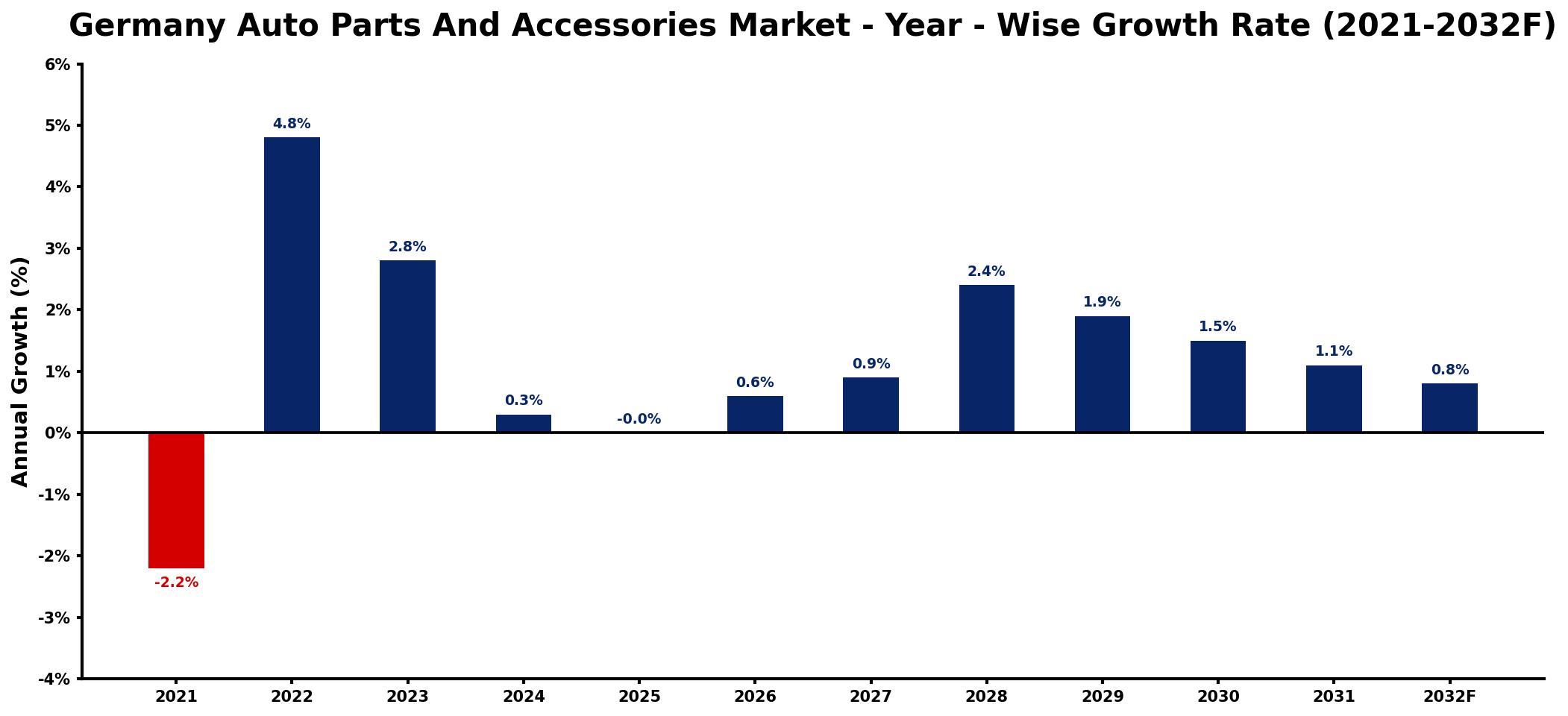
The table below presents the year‑wise growth rates along with the key drivers influencing the market
| Year | Growth Rate | Major Drivers |
| 2021 | -2.2% | Decreased consumer spending on vehicles |
| 2022 | 4.8% | Rising demand for electric vehicles |
| 2023 | 2.8% | Increased investment in manufacturing technology |
| 2024 | 0.3% | Growth in online retail platforms |
| 2025 | -0.0% | Surge in vehicle repair services |
| 2026 | 0.6% | increased capital investment inflows |
| 2027 | 0.9% | Increase in vehicle ownership rates |
| 2028 | 2.4% | enhanced product quality standards |
| 2029 | 1.9% | improved processing technologies adoption |
| 2030 | 1.5% | stronger distribution network expansion |
| 2031 | 1.1% | rising export shipment volumes |
| 2032 | 0.8% | Increased emphasis on fuel efficiency |
Note: Market size estimations and growth projections presented in this report are based on 6Wresearch's proprietary forecasting methodology, utilizing the latest available industry data, government publications, and primary research inputs.
Germany Auto Parts And Accessories Market Synopsis
The Germany Auto Parts and Accessories Market has shown considerable momentum, supported by a thriving automotive sector recognized for its engineering excellence. As the market shifts towards sustainability and innovation, it is poised for further transformation, particularly with the rise of electric vehicles and digital solutions.
Currently, a blend of domestic and international players drives competition, leading to enhanced product quality and technological advancements. As the landscape evolves, the market will likely witness a stronger focus on eco-friendly materials and smart automotive technologies, aligning with consumer preferences and regulatory requirements.
Germany Auto Parts And Accessories Market Key Takeaways
- The market is experiencing growth due to the increasing demand for electric vehicle components.
- Technological innovation and digitalization are key drivers reshaping the automotive supply chain.
- Consumer preference is shifting towards sustainable and eco-friendly products.
- Competitive pressures are rising from both domestic and international suppliers.
- Supply chain disruptions and regulatory changes present ongoing challenges in the market.
Evaluation of Restraints in Germany Auto Parts And Accessories Market
Despite the market's robust outlook, several restraints are impacting growth. The rapidly changing technological landscape necessitates continual adaptation and innovation, which can strain resources and financial planning for many companies. Additionally, stringent regulations concerning emissions and safety are increasing operational costs. Furthermore, ongoing supply chain disruptions, exacerbated by global events, highlight vulnerabilities in sourcing and production that could hinder timely delivery and increase expenses in this competitive market environment.
Germany Auto Parts And Accessories Market Trends
The demand for electric vehicle (EV) components is notably influencing market trends as automotive manufacturers pivot towards electrification. This transition is accompanied by an increasing emphasis on smart technologies, such as connected car solutions and advanced driver-assistance systems (ADAS). Additionally, the popularity of e-commerce platforms is reshaping the purchasing landscape, allowing consumers more accessible avenues to acquire auto parts and accessories.
Moreover, there is a significant consumer push towards sustainable products, fostering innovation in eco-friendly materials and recyclable auto accessories. This aligns with broader industry goals of reducing environmental impact and enhancing vehicle efficiency, marking a critical trend in the German market.
Germany Auto Parts And Accessories Market Opportunities
Investors and stakeholders in the Germany Auto Parts and Accessories Market have numerous opportunities to explore. Companies specializing in EV components, particularly batteries and charging technologies, are positioned for growth as demand for electric vehicles escalates. Additionally, the shift towards sustainable automotive solutions opens avenues for investment in green technology and materials.
The rise of autonomous vehicles offers another lucrative frontier, presenting opportunities for businesses involved in advanced sensors, software, and integrated communication systems. As the market continues to evolve, aligning investment strategies with these trends will be critical for capturing growth.
Government Initiatives in the Germany Auto Parts And Accessories Market
The German government is actively fostering innovation and sustainability within the automotive sector. Policies aimed at reducing emissions and enhancing vehicle safety are in place to encourage companies to adopt environmentally friendly practices. Additionally, incentives for electric vehicle development and investment in renewable energy technologies are designed to bolster the transition towards a greener automotive industry.
Support for research and development initiatives within the automotive space reflects the government's commitment to maintaining Germany's competitive edge. These initiatives are vital for ensuring that local manufacturers remain at the forefront of technological advancements and sustainable practices.
Future Insights of the Germany Auto Parts And Accessories Market
Looking ahead to the period from 2026 to 2032, the Germany Auto Parts and Accessories Market is likely to see continued growth driven by technological advancements and evolving consumer demands. The push for electric vehicles and sustainability will likely remain at the forefront, influencing product offerings and manufacturing processes.
E-commerce will continue to play a crucial role in reshaping the marketplace, enhancing accessibility for consumers. However, companies will need to navigate potential challenges such as supply chain issues and regulatory changes that could impact the industry landscape. Nevertheless, with strong foundations in innovation and quality, the market is well-positioned for sustained expansion.
Germany Auto Parts And Accessories Market Latest Developments (2025 - 2026)
Recent developments in the Germany Auto Parts and Accessories Market highlight a trend towards enhanced digital integration and sustainability initiatives. Companies are increasingly focusing on innovative solutions that incorporate smart technology and connectivity features, aligning with consumer expectations for advanced automotive systems. Additionally, there has been a notable surge in collaborations aimed at developing eco-friendly materials, reflecting a strong commitment to sustainability. As the market adapts to these trends, stakeholders are also prioritizing investments in supply chain resilience to mitigate disruptions.
Germany Auto Parts And Accessories Market - Key Attractiveness of the Report
- 10 Years of Market Numbers
- Historical Data Starting from 2022 to 2025
- Base Year: 2025
- Forecast Data until 2032
- Key Performance Indicators Impacting the Market
- Major Upcoming Developments and Projects
Key Highlights of the Report:
- Germany Auto Parts And Accessories Market Outlook
- Market Size of Germany Auto Parts And Accessories Market, 2025
- Forecast of Germany Auto Parts And Accessories Market, 2032
- Historical Data and Forecast of Germany Auto Parts And Accessories Revenues & Volume for the Period 2022-2032F
- Germany Auto Parts And Accessories Market Trend Evolution
- Germany Auto Parts And Accessories Market Drivers and Challenges
- Germany Auto Parts And Accessories Price Trends
- Germany Auto Parts And Accessories Porter's Five Forces
- Germany Auto Parts And Accessories Industry Life Cycle
- Historical Data and Forecast of Germany Auto Parts And Accessories Market Revenues & Volume By Product for the Period 2022-2032F
- Historical Data and Forecast of Germany Auto Parts And Accessories Market Revenues & Volume By Driveline & Powertrain for the Period 2022-2032F
- Historical Data and Forecast of Germany Auto Parts And Accessories Market Revenues & Volume By Interiors & Exteriors for the Period 2022-2032F
- Historical Data and Forecast of Germany Auto Parts And Accessories Market Revenues & Volume By Electronics for the Period 2022-2032F
- Historical Data and Forecast of Germany Auto Parts And Accessories Market Revenues & Volume By Bodies & Chassis for the Period 2022-2032F
- Historical Data and Forecast of Germany Auto Parts And Accessories Market Revenues & Volume By Wheel & Tires for the Period 2022-2032F
- Historical Data and Forecast of Germany Auto Parts And Accessories Market Revenues & Volume By Others for the Period 2022-2032F
- Historical Data and Forecast of Germany Auto Parts And Accessories Market Revenues & Volume By Application for the Period 2022-2032F
- Historical Data and Forecast of Germany Auto Parts And Accessories Market Revenues & Volume By OEMs for the Period 2022-2032F
- Historical Data and Forecast of Germany Auto Parts And Accessories Market Revenues & Volume By Aftermarket for the Period 2022-2032F
- Germany Auto Parts And Accessories Import Export Trade Statistics
- Market Opportunity Assessment By Product
- Market Opportunity Assessment By Application
- Germany Auto Parts And Accessories Top Companies Market Share
- Germany Auto Parts And Accessories Competitive Benchmarking By Technical and Operational Parameters
- Germany Auto Parts And Accessories Company Profiles
- Germany Auto Parts And Accessories Key Strategic Recommendations






































