Algeria Auto Parts And Accessories Market Size, Share & Growth Rate
The Algeria Auto Parts And Accessories Market was estimated at USD 352 Million in 2025 and is projected to reach USD 460 Million by 2032, growing at a CAGR of 3.9% from 2026 to 2032. This growth trajectory is primarily fueled by the rising vehicle ownership rates, supported by the expanding automotive industry in Algeria. Additionally, the demand for quality aftermarket products and vehicle customization trends are driving significant market opportunities.
Algeria Auto Parts And Accessories Market Year-wise Growth Rate and Key Drivers
This graph highlights how the Algeria Auto Parts And Accessories Market has steadily grown over the years, supported by major growth factors.
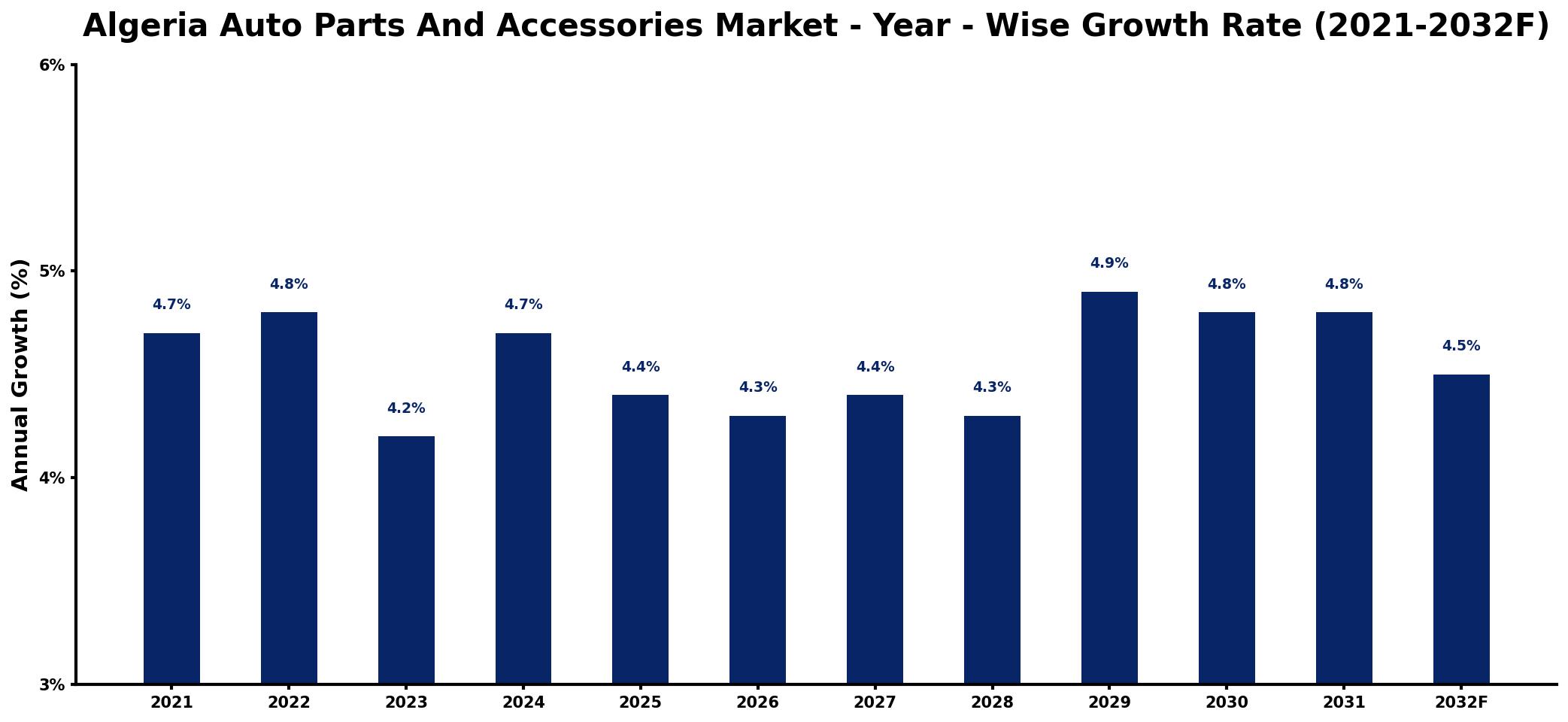
The table below presents the year‑wise growth rates along with the key drivers influencing the market
| Year | Growth Rate | Major Drivers |
| 2021 | 4.7% | Rising vehicle ownership rates |
| 2022 | 4.8% | Increased importation of vehicles |
| 2023 | 4.2% | Growing demand for maintenance services |
| 2024 | 4.7% | Expansion of local manufacturing facilities |
| 2025 | 4.4% | Investment in transportation infrastructure |
| 2026 | 4.3% | Surge in online retail platforms |
| 2027 | 4.4% | growing downstream application demand |
| 2028 | 4.3% | Increase in consumer spending habits |
| 2029 | 4.9% | Development of electric vehicle market |
| 2030 | 4.8% | Strengthening regional trade agreements |
| 2031 | 4.8% | Innovation in supply chain logistics |
| 2032 | 4.5% | expanding manufacturing base activity |
Note: Market size estimations and growth projections presented in this report are based on 6Wresearch's proprietary forecasting methodology, utilizing the latest available industry data, government publications, and primary research inputs.
Algeria Auto Parts And Accessories Market Synopsis
The Algeria auto parts and accessories market has recently seen robust growth, aligning with increased vehicle registrations and a burgeoning automotive sector. However, as the market evolves, the focus is shifting towards high-quality and technologically advanced products, catering to a more discerning consumer base that values both performance and aesthetic enhancements.
Looking ahead, the market is set for continued expansion as trends in sustainability and innovation reshape consumer expectations. As the automotive landscape adapts to new technologies, such as electric vehicles, stakeholders in the Algeria auto parts market will need to align their strategies to capitalize on emerging opportunities while addressing existing challenges.
Algeria Auto Parts And Accessories Market Key Takeaways
- The market is experiencing steady growth driven by rising vehicle ownership and an expanding automotive industry.
- There is increasing consumer demand for high-quality, technologically advanced, and customizable auto parts.
- The rise of e-commerce platforms is enhancing accessibility and convenience for purchasing auto parts.
- Sustainability trends are pushing demand for eco-friendly and innovative components within the market.
- Investment opportunities exist in local manufacturing and partnerships to meet growing demand efficiently.
Evaluation of Restraints in Algeria Auto Parts And Accessories Market
Despite the promising outlook, several constraints hinder the growth of the Algeria auto parts and accessories market. A significant limitation is the reliance on imports due to the lack of local manufacturing capabilities, which inflates costs for consumers. Furthermore, the prevalence of counterfeit products poses serious risks to both safety and quality, undermining consumer trust. Regulatory challenges, including inconsistent enforcement of standards and limited access to financing, create an environment that can stifle innovation and competitiveness in the market.
Algeria Auto Parts And Accessories Market Trends
Current trends in the Algeria auto parts and accessories market indicate a strong consumer preference for high-quality products, driven by an increasing focus on performance and safety. Additionally, there is a marked shift towards sustainable practices, with eco-friendly materials and components gaining traction. E-commerce is also transforming the buying experience, allowing consumers to access a broader range of products from the comfort of their homes. Moreover, advancements in technology, such as connected vehicle features and electric vehicle components, are emerging as significant drivers of future demand.
Algeria Auto Parts And Accessories Market Opportunities
With the automotive industry on a growth trajectory, significant investment opportunities exist in the Algeria auto parts market. Establishing local manufacturing plants for essential components like engines, batteries, and electronic systems could not only reduce import dependence but also cater to the rising demand for quality parts. Additionally, developing strategic partnerships with local distributors can enhance market penetration. Emphasizing innovative technologies and sustainable practices within manufacturing processes will further position investors for long-term success.
Government Initiatives in the Algeria Auto Parts And Accessories Market
The Algerian government is actively working to bolster the domestic auto parts and accessories market through various policies aimed at promoting local production and reducing import reliance. Measures such as import tariffs on foreign components and incentives for local manufacturers are designed to create a more self-sufficient automotive ecosystem. Quality assurance regulations are also in place to safeguard consumer interests while enhancing the market's competitiveness and sustainability.
Future Insights of the Algeria Auto Parts And Accessories Market
The outlook for the Algeria auto parts and accessories market from 2026 to 2032 appears optimistic, driven by increasing vehicle sales and rising disposable incomes. Government support for the automotive sector is expected to foster infrastructure development, which will further amplify demand for replacement parts and accessories. As trends in electrification and connectivity in vehicles gain momentum, innovative product opportunities will emerge, shaping the market's landscape and responding to evolving consumer preferences.
Algeria Auto Parts And Accessories Market Latest Developments (2025 - 2026)
Recent developments within the Algeria auto parts and accessories market include a notable increase in local initiatives aimed at enhancing manufacturing capabilities. The growing trend of e-commerce is also influencing consumer purchasing patterns, with platforms expanding their offerings to meet demand. Additionally, ongoing dialogues regarding regulatory frameworks are expected to pave the way for improved market transparency and safety standards, ultimately benefiting both consumers and suppliers.
Algeria Auto Parts And Accessories Market - Key Attractiveness of the Report
- 10 Years of Market Numbers
- Historical Data Starting from 2022 to 2025
- Base Year: 2025
- Forecast Data until 2032
- Key Performance Indicators Impacting the Market
- Major Upcoming Developments and Projects
Key Highlights of the Report:
- Algeria Auto Parts And Accessories Market Outlook
- Market Size of Algeria Auto Parts And Accessories Market, 2025
- Forecast of Algeria Auto Parts And Accessories Market, 2032
- Historical Data and Forecast of Algeria Auto Parts And Accessories Revenues & Volume for the Period 2022-2032F
- Algeria Auto Parts And Accessories Market Trend Evolution
- Algeria Auto Parts And Accessories Market Drivers and Challenges
- Algeria Auto Parts And Accessories Price Trends
- Algeria Auto Parts And Accessories Porter's Five Forces
- Algeria Auto Parts And Accessories Industry Life Cycle
- Historical Data and Forecast of Algeria Auto Parts And Accessories Market Revenues & Volume By Product for the Period 2022-2032F
- Historical Data and Forecast of Algeria Auto Parts And Accessories Market Revenues & Volume By Driveline & Powertrain for the Period 2022-2032F
- Historical Data and Forecast of Algeria Auto Parts And Accessories Market Revenues & Volume By Interiors & Exteriors for the Period 2022-2032F
- Historical Data and Forecast of Algeria Auto Parts And Accessories Market Revenues & Volume By Electronics for the Period 2022-2032F
- Historical Data and Forecast of Algeria Auto Parts And Accessories Market Revenues & Volume By Bodies & Chassis for the Period 2022-2032F
- Historical Data and Forecast of Algeria Auto Parts And Accessories Market Revenues & Volume By Wheel & Tires for the Period 2022-2032F
- Historical Data and Forecast of Algeria Auto Parts And Accessories Market Revenues & Volume By Others for the Period 2022-2032F
- Historical Data and Forecast of Algeria Auto Parts And Accessories Market Revenues & Volume By Application for the Period 2022-2032F
- Historical Data and Forecast of Algeria Auto Parts And Accessories Market Revenues & Volume By OEMs for the Period 2022-2032F
- Historical Data and Forecast of Algeria Auto Parts And Accessories Market Revenues & Volume By Aftermarket for the Period 2022-2032F
- Algeria Auto Parts And Accessories Import Export Trade Statistics
- Market Opportunity Assessment By Product
- Market Opportunity Assessment By Application
- Algeria Auto Parts And Accessories Top Companies Market Share
- Algeria Auto Parts And Accessories Competitive Benchmarking By Technical and Operational Parameters
- Algeria Auto Parts And Accessories Company Profiles
- Algeria Auto Parts And Accessories Key Strategic Recommendations






































