Germany Helicopter Market Size, Share & Growth Rate
The Germany Helicopter Market was estimated at USD 231 Million in 2025 and is projected to reach USD 250 Million by 2032, growing at a CAGR of 1.1% from 2026 to 2032. This growth trajectory is propelled by an increasing demand for helicopters in various sectors, particularly within emergency medical services and law enforcement. The ongoing modernization of governmental fleets and a rising interest in private air transport further amplify market opportunities.
Germany Helicopter Market Year-wise Growth Rate and Key Drivers
This graph highlights how the Germany Helicopter Market has steadily grown over the years, supported by major growth factors.
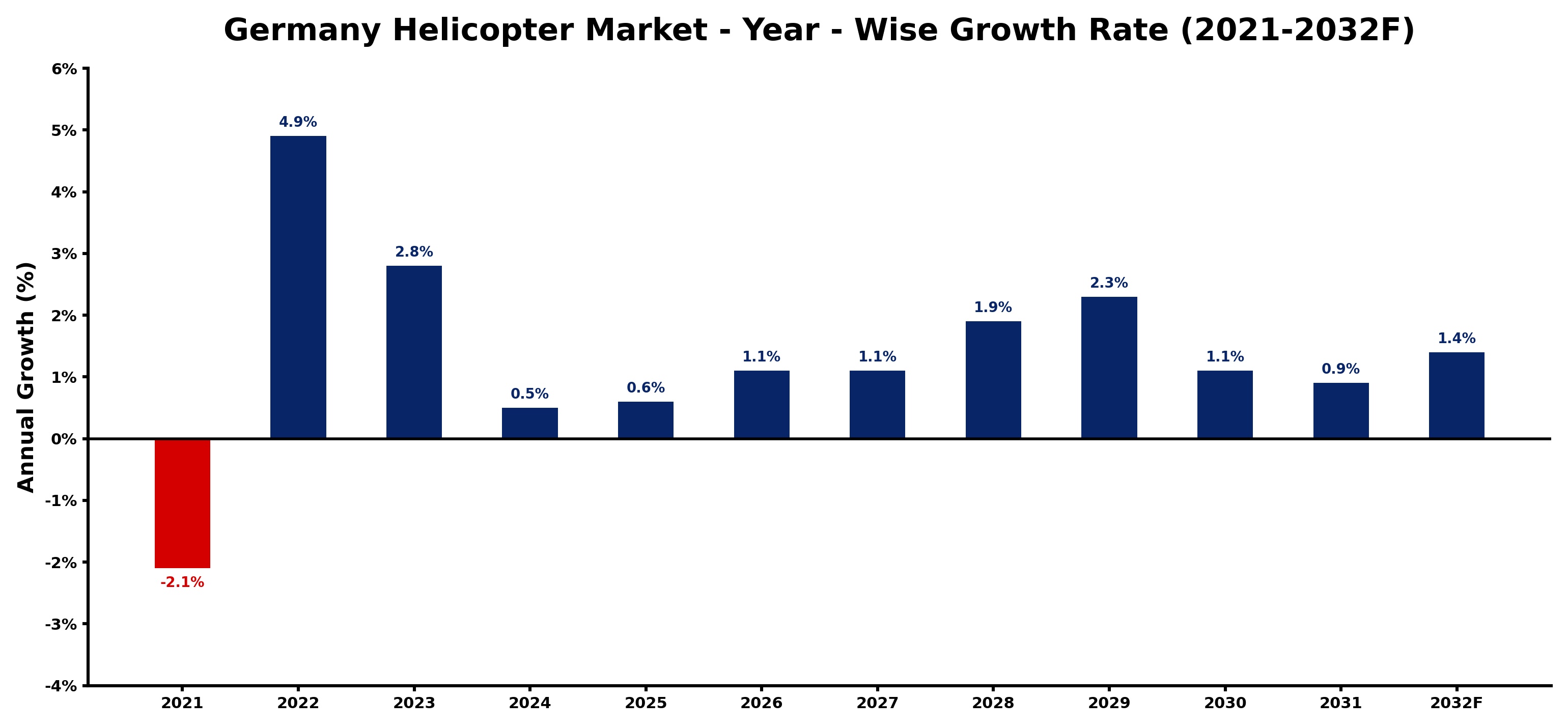
The table below presents the year‑wise growth rates along with the key drivers influencing the market
| Year | Growth Rate | Major Drivers |
| 2021 | -2.1% | Reduced defense budgets led to lower helicopter manufacturing investments |
| 2022 | 4.9% | Defense contract awards stimulate local helicopter manufacturing capacity growth |
| 2023 | 2.8% | Modernized production techniques enhance rotor blade manufacturing efficiency |
| 2024 | 0.5% | Improved manufacturing capabilities fueled helicopter component export demand |
| 2025 | 0.6% | Technology integration enhances maintenance procedures for existing helicopter fleets |
| 2026 | 1.1% | New technology partnerships boost helicopter avionics system production capabilities |
| 2027 | 1.1% | Helicopter fleet upgrades fueled component manufacturing capacity utilization improvements |
| 2028 | 1.9% | New helicopter manufacturing facilities boost local component supply chain robustness |
| 2029 | 2.3% | Domestic aerospace projects drove helicopter component manufacturing investments |
| 2030 | 1.1% | Advanced avionics integration boosts Germany's helicopter production capabilities |
| 2031 | 0.9% | Domestic helicopter manufacturing investments boost production capacity and innovation |
| 2032 | 1.4% | Defense contracts boost helicopter manufacturing capacity in Germany |
Note - Market size estimations and growth projections presented in this report are based on 6Wresearch’s advanced forecasting approach, validated with industry datasets as of June 2026.
Germany Helicopter Market Synopsis
The Germany helicopter market has recently seen a surge in demand, particularly for light and medium helicopters, attributed to critical applications such as search and rescue operations. However, as the market matures, it faces a future defined by the need for innovation and sustainable practices.
Looking ahead, the market is expected to expand steadily, fueled by technological advancements and a focus on environmental sustainability. Government initiatives promoting fleet modernization and the advent of hybrid technologies will be crucial in navigating future challenges and ensuring continued growth.
Germany Helicopter Market Key Takeaways
- The market is witnessing a shift towards sustainable aviation technologies, including electric and hybrid helicopters.
- Growth is primarily driven by emergency medical services and law enforcement applications.
- Modernization efforts of the German military helicopter fleet contribute significantly to market expansion.
- Advanced avionics and connectivity features are increasingly sought after to enhance operational safety and efficiency.
- Investment opportunities are expanding in infrastructure development and maintenance services.
Evaluation of Restraints in Germany Helicopter Market
The Germany helicopter market is constrained by several factors, including stringent regulations governing helicopter operations. High operational costs, coupled with limited infrastructure for heliports and maintenance facilities, pose significant challenges for operators. Furthermore, fluctuating fuel prices and economic uncertainties can directly impact service demand. Environmental concerns, particularly related to noise pollution, complicate public acceptance and regulatory approval for new initiatives, demanding strategic navigation from market participants.
Germany Helicopter Market Trends
The current landscape of the Germany helicopter market is shaped by a notable transition towards eco-friendly technologies, such as electric and hybrid models, which are gaining traction due to their lower carbon emissions. Additionally, there is an increasing emphasis on advanced avionics systems, which offer enhanced safety features and operational efficiency. The rise of unmanned aerial vehicles (UAVs) for applications like surveillance and logistics further signifies a shift in market demand, reflecting a broader trend toward innovation and efficiency.
Germany Helicopter Market Opportunities
Investment opportunities in the Germany helicopter market are particularly promising in the sectors of air transport, emergency services, and tourism. As demand for helicopter services grows, opportunities for expanding fleets and enhancing maintenance services become increasingly relevant. Furthermore, the focus on sustainable aviation opens doors for investments in electric helicopter development and the necessary supporting infrastructure. Collaborations with local manufacturers can yield substantial benefits for investors looking to capitalize on these evolving market dynamics.
Government Initiatives in the Germany Helicopter Market
The German government has implemented robust regulations to enhance safety and promote environmental protection within the helicopter sector. The Federal Aviation Office is pivotal in setting maintenance and operational standards, ensuring adherence to stringent airworthiness protocols. Noise pollution regulations specifically aim to minimize the environmental footprint of helicopter operations. Furthermore, the Federal Ministry of Defense plays a critical role in the procurement of military helicopters, focusing on technological advancements and operational efficiencies.
Future Insights of the Germany Helicopter Market
Looking toward the future, the Germany Helicopter Market is positioned for steady growth, bolstered by increasing demands in emergency medical services and law enforcement. Technological innovations are expected to enhance safety and fuel efficiency, further attracting investment and interest. As the government continues to modernize its fleet, and environmental concerns remain at the forefront, the sector's adaptation to these challenges will define its trajectory from 2026 to 2032.
Germany Helicopter Market Latest Developments (May 2025 - June 2026)
In recent months, the Germany helicopter market has witnessed an increased focus on technological advancements, particularly in the realm of electric and hybrid aircraft. The development of new operational frameworks for the integration of unmanned aerial vehicles is also gaining momentum. Regulatory discussions around noise pollution and safety standards are ongoing, indicating a proactive approach towards balancing innovation with environmental concerns. Collaborative efforts among industry stakeholders continue to evolve, setting the stage for promising advancements.
Germany Helicopter Market - Key Attractiveness of the Report
- 10 Years of Market Numbers
- Historical Data Starting from 2022 to 2025
- Base Year: 2025
- Forecast Data until 2032
- Key Performance Indicators Impacting the Market
- Major Upcoming Developments and Projects
Key Highlights of the Report:
- Germany Helicopter Market Outlook
- Market Size of Germany Helicopter Market, 2025
- Forecast of Germany Helicopter Market, 2032
- Historical Data and Forecast of Germany Helicopter Revenues & Volume for the Period 2022-2032F
- Germany Helicopter Market Trend Evolution
- Germany Helicopter Market Drivers and Challenges
- Germany Helicopter Price Trends
- Germany Helicopter Porter's Five Forces
- Germany Helicopter Industry Life Cycle
- Historical Data and Forecast of Germany Helicopter Market Revenues & Volume By End-users for the Period 2022-2032F
- Historical Data and Forecast of Germany Helicopter Market Revenues & Volume By Commercial for the Period 2022-2032F
- Historical Data and Forecast of Germany Helicopter Market Revenues & Volume By Military for the Period 2022-2032F
- Historical Data and Forecast of Germany Helicopter Market Revenues & Volume By Component for the Period 2022-2032F
- Historical Data and Forecast of Germany Helicopter Market Revenues & Volume By Aerostructures/Airframes for the Period 2022-2032F
- Historical Data and Forecast of Germany Helicopter Market Revenues & Volume By Rotary System for the Period 2022-2032F
- Historical Data and Forecast of Germany Helicopter Market Revenues & Volume By Engine for the Period 2022-2032F
- Historical Data and Forecast of Germany Helicopter Market Revenues & Volume By Undercarriage for the Period 2022-2032F
- Historical Data and Forecast of Germany Helicopter Market Revenues & Volume By Avionics for the Period 2022-2032F
- Historical Data and Forecast of Germany Helicopter Market Revenues & Volume By Cabin Interiors for the Period 2022-2032F
- Historical Data and Forecast of Germany Helicopter Market Revenues & Volume By Environmental Control System for the Period 2022-2032F
- Historical Data and Forecast of Germany Helicopter Market Revenues & Volume By Sales Channels for the Period 2022-2032F
- Historical Data and Forecast of Germany Helicopter Market Revenues & Volume By OEM for the Period 2022-2032F
- Historical Data and Forecast of Germany Helicopter Market Revenues & Volume By Maintenance for the Period 2022-2032F
- Historical Data and Forecast of Germany Helicopter Market Revenues & Volume By Repair for the Period 2022-2032F
- Historical Data and Forecast of Germany Helicopter Market Revenues & Volume By Overhaul for the Period 2022-2032F
- Germany Helicopter Import Export Trade Statistics
- Market Opportunity Assessment By End-users
- Market Opportunity Assessment By Component
- Market Opportunity Assessment By Sales Channels
- Germany Helicopter Top Companies Market Share
- Germany Helicopter Competitive Benchmarking By Technical and Operational Parameters
- Germany Helicopter Company Profiles
- Germany Helicopter Key Strategic Recommendations






































