Germany Packaged Water Market: Import Trend Analysis
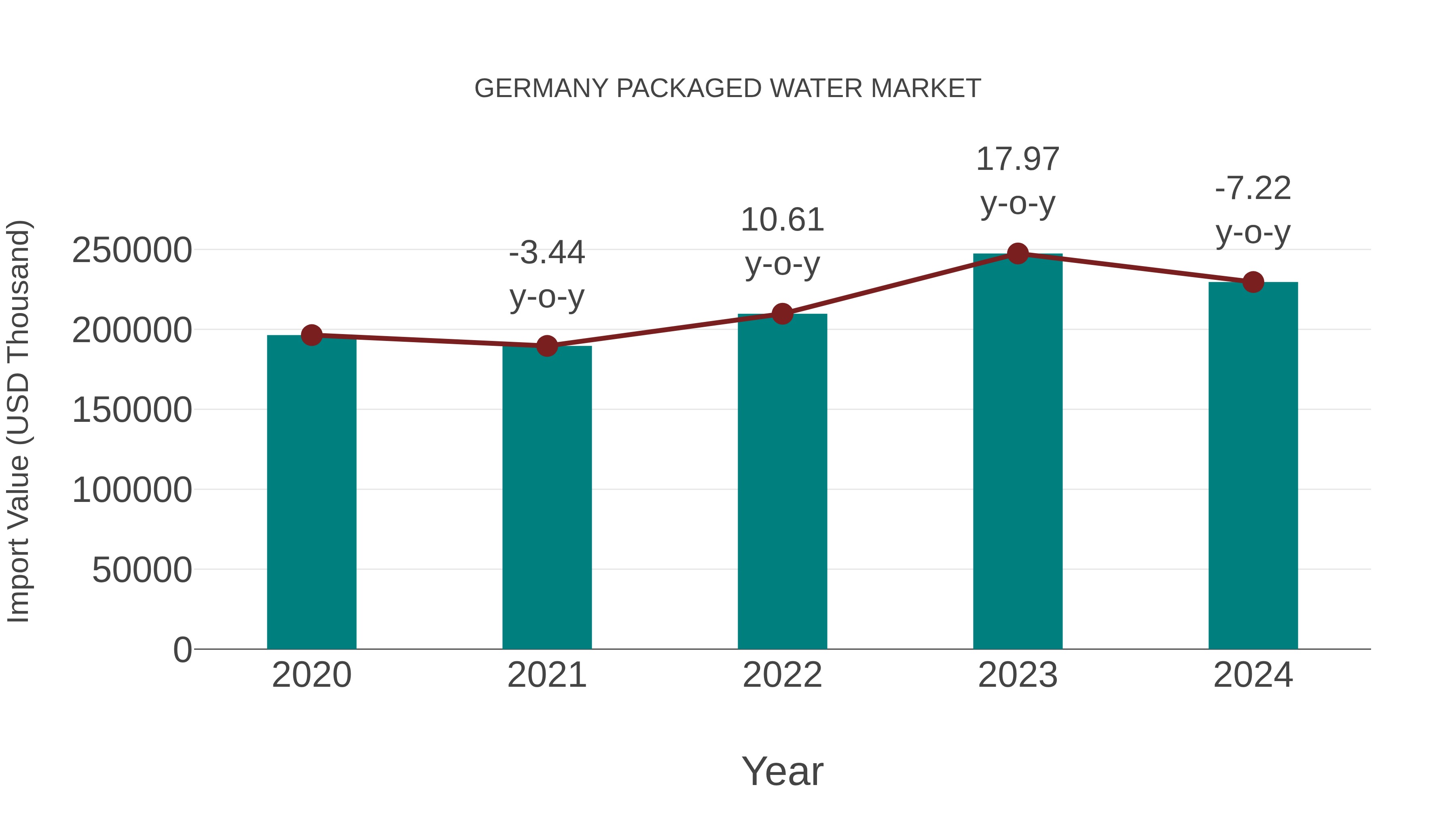
From 2023 to 2024, Germany`s import trend for the packaged water market experienced a decline of -7.22%. However, the compound annual growth rate (CAGR) for the period between 2020 and 2024 stood at 3.98%. This negative growth in 2024 could be attributed to shifting consumer preferences or changes in market dynamics impacting import momentum.
Germany Packaged water Market Overview
The Germany Packaged water market is experiencing steady growth driven by increasing health consciousness among consumers, growing concerns over water quality, and convenience of on-the-go hydration. The market is highly competitive with a wide range of players offering various types of packaged water including mineral water, spring water, purified water, and flavored water. Key trends in the market include the rising popularity of functional waters infused with vitamins, electrolytes, and other additives, as well as the shift towards environmentally friendly packaging options such as biodegradable bottles. Major players in the Germany Packaged water market include Nestle Waters, Coca-Cola, Danone, and Rhodius Mineralquellen. With consumers prioritizing health and wellness, the market is expected to continue its growth trajectory in the coming years.
Germany Packaged water Market Trends and Opportunities
The Germany packaged water market is experiencing significant growth driven by the increasing consumer preference for healthy and convenient beverage options. With growing awareness about the importance of hydration and the health benefits of consuming water, there is a rising demand for packaged water products in the country. The market is also witnessing a shift towards sustainable packaging solutions, with consumers showing a preference for eco-friendly and recyclable packaging materials. Opportunities exist for companies to innovate in product offerings by introducing flavored and functional water varieties to cater to diverse consumer preferences. Furthermore, the online retail sector is gaining traction as a distribution channel for packaged water products, presenting an avenue for market expansion and reaching a wider consumer base.
Germany Packaged water Market Challenges
In the Germany Packaged water market, several challenges are faced, including increasing competition from other beverage options like flavored water and sports drinks. Consumers are becoming more health-conscious and seeking alternatives to traditional packaged water, leading to a fragmented market with various product offerings. Additionally, environmental concerns around plastic waste and sustainability are putting pressure on companies to find eco-friendly packaging solutions. Regulatory changes and government initiatives promoting tap water consumption further add to the challenges faced by packaged water brands in Germany. To succeed in this competitive landscape, companies need to innovate, differentiate their products, and invest in sustainable practices to meet the evolving consumer preferences and regulatory requirements.
Germany Packaged water Market Drivers
The Germany Packaged water market is primarily driven by factors such as increasing health consciousness among consumers, growing concerns regarding water quality, convenience and on-the-go consumption habits, and the rise in disposable income levels. Consumers are seeking safe and clean drinking water options, leading to a preference for packaged water over tap water. Additionally, the trend towards eco-friendly packaging materials and sustainable practices is influencing purchasing decisions in the market. The convenience of packaged water in single-serve bottles or on-the-go formats further contributes to the market growth. Marketing efforts emphasizing the health benefits and purity of packaged water also play a significant role in driving consumer demand in the Germany Packaged water market.
Germany Packaged water Market Government Policy
In Germany, the packaged water market is subject to various government policies aimed at ensuring consumer safety and environmental sustainability. The German government closely regulates the quality and labeling of packaged water through the Mineral and Table Water Ordinance, which sets strict standards for the production and bottling of water. Additionally, there are regulations in place to minimize the environmental impact of packaging materials, such as the Packaging Act which mandates recycling and waste management practices for packaged products. These policies aim to protect consumer health, promote transparency in labeling, and encourage sustainable practices in the packaged water industry in Germany.
Germany Packaged water Market Future Outlook
The Germany Packaged water market is projected to experience steady growth in the coming years, driven by increasing health consciousness among consumers, growing awareness about hydration benefits, and the convenience of on-the-go packaging. Rising concerns about environmental sustainability are also expected to boost demand for eco-friendly packaging solutions in the market. Additionally, the trend towards premium and functional waters, such as vitamin-enhanced or flavored options, is likely to contribute to market expansion. With a competitive landscape and stringent regulations governing the industry, key players are anticipated to focus on innovation, product differentiation, and strategic partnerships to maintain their market share and capitalize on emerging opportunities in the evolving packaged water sector in Germany.
Key Highlights of the Report:
- Germany Packaged water Market Outlook
- Market Size of Germany Packaged water Market, 2025
- Forecast of Germany Packaged water Market, 2032
- Historical Data and Forecast of Germany Packaged water Revenues & Volume for the Period 2022 - 2032F
- Germany Packaged water Market Trend Evolution
- Germany Packaged water Market Drivers and Challenges
- Germany Packaged water Price Trends
- Germany Packaged water Porter's Five Forces
- Germany Packaged water Industry Life Cycle
- Historical Data and Forecast of Germany Packaged water Market Revenues & Volume By Product for the Period 2022 - 2032F
- Historical Data and Forecast of Germany Packaged water Market Revenues & Volume By Still for the Period 2022 - 2032F
- Historical Data and Forecast of Germany Packaged water Market Revenues & Volume By Carbonated for the Period 2022 - 2032F
- Historical Data and Forecast of Germany Packaged water Market Revenues & Volume By Flavored for the Period 2022 - 2032F
- Historical Data and Forecast of Germany Packaged water Market Revenues & Volume By Functional for the Period 2022 - 2032F
- Germany Packaged water Import Export Trade Statistics
- Market Opportunity Assessment By Product
- Germany Packaged water Top Companies Market Share
- Germany Packaged water Competitive Benchmarking By Technical and Operational Parameters
- Germany Packaged water Company Profiles
- Germany Packaged water Key Strategic Recommendations






































