Germany Predictive Analytics Market Size & Growth Rate (2026-2032)
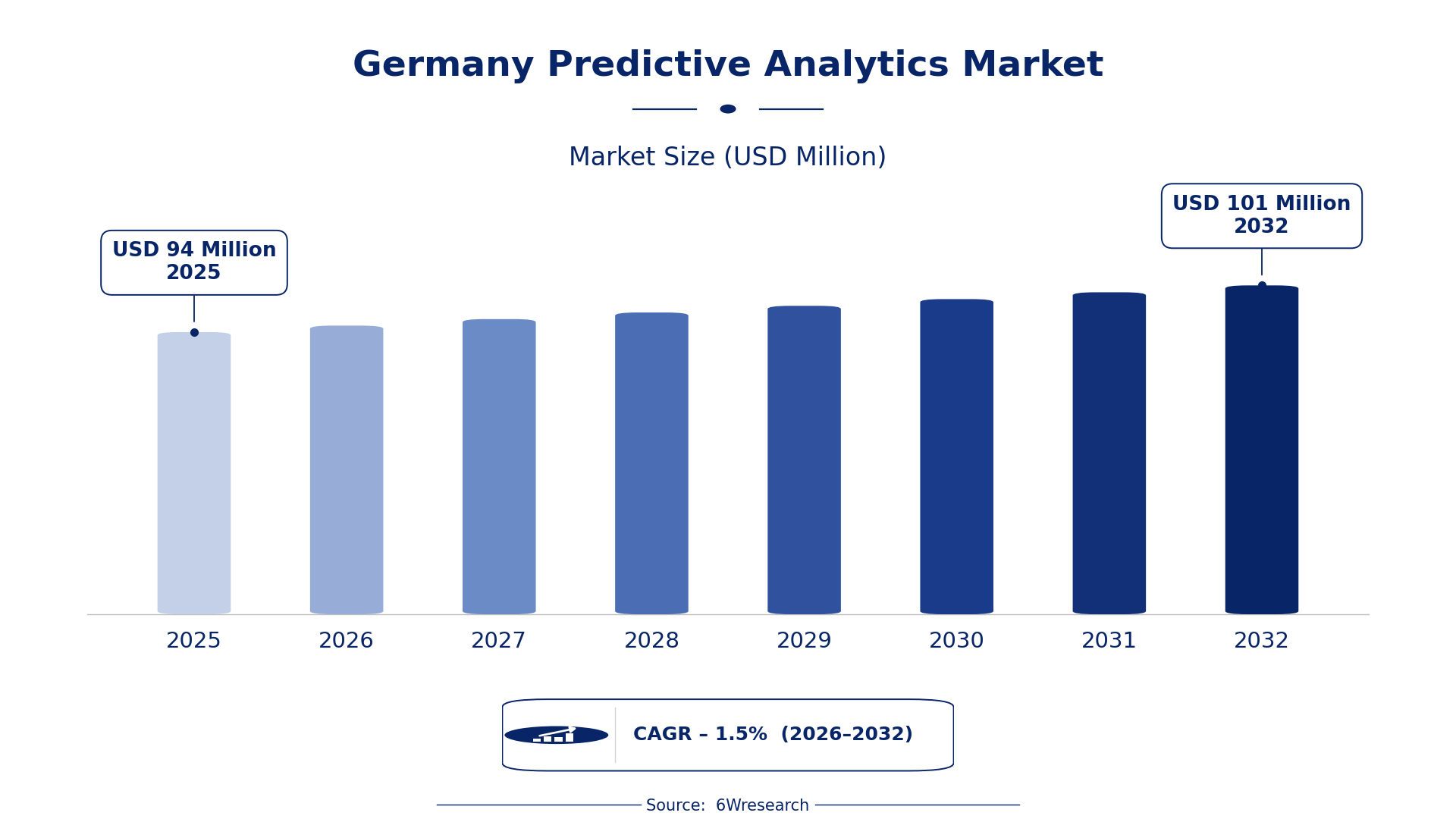
The Germany Predictive Analytics Market was estimated at USD 94 Million in 2025 and is projected to reach USD 101 Million by 2032, growing at a CAGR of 1.5% from 2026 to 2032.
Germany Predictive Analytics Market Synopsis
The demand for predictive analytics in Germany is increasingly driven by the need for companies to enhance operational efficiency and customer engagement. As organizations across finance, healthcare, retail, and manufacturing sectors harness advanced data analytics, the focus on actionable insights is at an all-time high.
This market is marked by a growing emphasis on artificial intelligence and machine learning technologies, which are being integrated into predictive analytics solutions. With the advent of cloud-based tools, companies are finding scalable options that cater to their unique data needs and contribute to more informed decision-making processes.
Germany Predictive Analytics Market Year-wise Growth Rate and Key Drivers
This graph illustrates the annual growth rates of the Germany Predictive Analytics Market from 2021 to 2032, highlighting a steady upward trajectory and projected expansion over the forecast period.
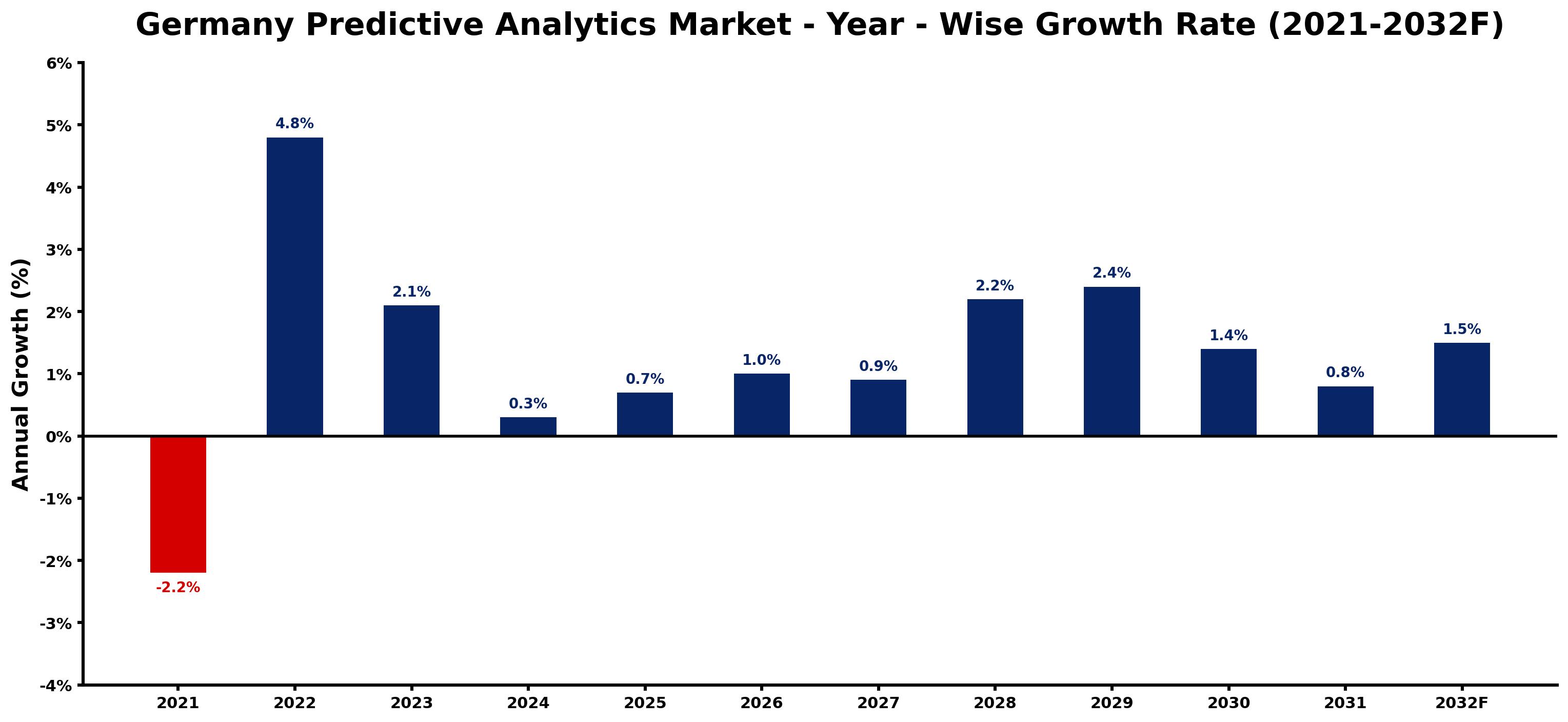
The table below presents the year‑wise growth rates along with the key drivers influencing the market
| Year | Growth Rate | Major Drivers |
| 2021 | -2.2% | GDPR compliance challenges hinder data utilization effectiveness. |
| 2022 | 4.8% | Increased adoption of AI technologies in manufacturing sectors |
| 2023 | 2.1% | Rising data-driven decision-making in healthcare institutions |
| 2024 | 0.3% | Government incentives for SMEs adopting predictive tools |
| 2025 | 0.7% | Technological advancements in consumer behavior analytics |
| 2026 | 1.0% | Emerging need for risk management in insurance industry |
| 2027 | 0.9% | Focus on sustainability driving predictive maintenance solutions |
| 2028 | 2.2% | Growth of online retail demanding advanced demand forecasting |
| 2029 | 2.4% | Rise in e-commerce logistics optimizing supply chain analytics |
| 2030 | 1.4% | Increased regulatory compliance requirements for financial institutions |
| 2031 | 0.8% | Higher reliance on smart city data integration initiatives |
| 2032 | 1.5% | Boost from digital transformation in traditional industries |
Note: Market size estimations and growth projections presented in this report are based on 6Wresearch's proprietary forecasting methodology, utilizing the latest available industry data, government publications, and primary research inputs.
Germany Predictive Analytics Market Key Takeaways
Below are some of the specific key takeaways from the market, including:
- The increasing adoption of predictive analytics tools is enhancing decision-making across various industries.
- AI and machine learning are becoming integral to predictive modeling, offering deeper insights.
- Cloud-based solutions are gaining traction for their flexibility and cost-effectiveness.
- Data privacy regulations are shaping how companies approach data collection and usage.
- The market is characterized by a shortage of skilled professionals in advanced analytics.
Evaluation of Restraints in Germany Predictive Analytics Market
Despite its growth, the Germany Predictive Analytics Market faces several hurdles. The stringent data privacy regulations, particularly the GDPR, pose significant challenges for companies attempting to utilize personal data for predictive analytics. This regulatory framework can limit the scope of data collection and complicate compliance efforts. on top of that, organizations grapple with a shortage of skilled professionals, making it difficult to implement and optimize predictive analytics solutions effectively. The complexity of integrating disparate data sources adds another layer of difficulty, as companies strive for cohesive insights from fragmented systems.
Germany Predictive Analytics Market Trends
The current trend in the Germany Predictive Analytics Market leans heavily towards the integration of AI and machine learning technologies. These advancements are not merely enhancements; they are foundational to the next generation of predictive modeling capabilities. Additionally, businesses are increasingly focusing on predictive analytics applications in marketing and risk management to uncover new opportunities. The adoption of cloud-based solutions continues to rise, driven by their scalability and cost-effectiveness, enabling organizations to keep pace with their evolving analytical needs.
Germany Predictive Analytics Market Opportunities
Investment opportunities abound as companies seek to harness predictive analytics for competitive advantage. Industries such as finance and healthcare are particularly ripe for innovative solutions that can streamline operations and enhance customer satisfaction. Firms specializing in predictive analytics software development or consulting are positioned well for growth, especially those focusing on real-time analytics. Research and development initiatives aimed at refining predictive capabilities will likely yield fruitful returns as the market continues to expand.
Government Initiatives in the Germany Predictive Analytics Market
Government policy in Germany is increasingly focused on fostering innovation while ensuring data protection in the predictive analytics market. The regulatory landscape is shaped by the GDPR, which sets a high standard for data privacy, influencing how companies operate within this space. Concurrently, the German government is promoting digital transformation initiatives, aiming to position the country as a leader in advanced technologies.
- A national digital infrastructure upgrade programme completed in late 2025 aims to enhance data connectivity across sectors.
- Current initiatives include a public-private partnership focused on developing AI capabilities in predictive analytics, which is underway and expected to drive innovation.
- Planned initiatives involve regulatory updates in 2026 aimed at balancing innovation with data privacy, ensuring companies can operate effectively while protecting consumer rights.
- The government has launched a research grant programme specifically targeting advancements in machine learning applications for predictive analytics.
Future Insights of the Germany Predictive Analytics Market
Looking ahead to 2026-2032, the Germany Predictive Analytics Market is set to experience notable growth as businesses increasingly embrace data-driven decision-making. The proliferation of IoT devices will contribute to the vast amounts of data available for analysis, further fueling the demand for predictive analytics. Continuous advancements in AI and machine learning are expected to drive innovation, enabling organizations to derive even more accurate insights. As regulatory frameworks adapt, companies that prioritize compliance while leveraging predictive tools will likely emerge as market leaders.
Germany Predictive Analytics Market Latest Developments
Recent activity in the Germany Predictive Analytics Market indicates a robust trajectory of growth and innovation. Companies are rapidly adopting advanced analytics solutions, reflecting a strong commitment to optimizing operations and enhancing customer experience.
- A major technology vendor initiated a rollout of its enhanced predictive analytics platform in early 2025, allowing clients to leverage real-time data for improved business intelligence.
- An ongoing partnership between analytics firms and regional universities started in mid-2025, aimed at developing new machine learning models tailored for industry-specific applications.
- Planned for late 2026, a new cloud-based predictive analytics service is expected to launch, focusing on small to medium-sized enterprises looking to adopt data-driven strategies.
- A recently completed research project in 2025 investigated the effectiveness of predictive analytics in improving healthcare outcomes, with promising results now guiding industry practices.
Germany Predictive Analytics Market - Key Attractiveness of the Report
- 10 Years of Market Numbers
- Historical Data Starting from 2022 to 2025
- Base Year: 2025
- Forecast Data until 2032
- Key Performance Indicators Impacting the Market
- Major Upcoming Developments and Projects
Key Highlights of the Report:
- Germany Predictive Analytics Market Outlook
- Market Size of Germany Predictive Analytics Market, 2025
- Forecast of Germany Predictive Analytics Market, 2032
- Historical Data and Forecast of Germany Predictive Analytics Revenues & Volume for the Period 2022-2032F
- Germany Predictive Analytics Market Trend Evolution
- Germany Predictive Analytics Market Drivers and Challenges
- Germany Predictive Analytics Price Trends
- Germany Predictive Analytics Porter's Five Forces
- Germany Predictive Analytics Industry Life Cycle
- Historical Data and Forecast of Germany Predictive Analytics Market Revenues & Volume By Component for the Period 2022-2032F
- Historical Data and Forecast of Germany Predictive Analytics Market Revenues & Volume By Solutions for the Period 2022-2032F
- Historical Data and Forecast of Germany Predictive Analytics Market Revenues & Volume By Services for the Period 2022-2032F
- Historical Data and Forecast of Germany Predictive Analytics Market Revenues & Volume By Deployment Mode for the Period 2022-2032F
- Historical Data and Forecast of Germany Predictive Analytics Market Revenues & Volume By Cloud for the Period 2022-2032F
- Historical Data and Forecast of Germany Predictive Analytics Market Revenues & Volume By On-premises for the Period 2022-2032F
- Historical Data and Forecast of Germany Predictive Analytics Market Revenues & Volume By Organization Size for the Period 2022-2032F
- Historical Data and Forecast of Germany Predictive Analytics Market Revenues & Volume By Large enterprises for the Period 2022-2032F
- Historical Data and Forecast of Germany Predictive Analytics Market Revenues & Volume By Small and medium-sized enterprises (SMEs) for the Period 2022-2032F
- Historical Data and Forecast of Germany Predictive Analytics Market Revenues & Volume By Vertical for the Period 2022-2032F
- Historical Data and Forecast of Germany Predictive Analytics Market Revenues & Volume By BFSI for the Period 2022-2032F
- Historical Data and Forecast of Germany Predictive Analytics Market Revenues & Volume By Manufacturing for the Period 2022-2032F
- Historical Data and Forecast of Germany Predictive Analytics Market Revenues & Volume By Retail and eCommerce for the Period 2022-2032F
- Historical Data and Forecast of Germany Predictive Analytics Market Revenues & Volume By Government and Defense for the Period 2022-2032F
- Historical Data and Forecast of Germany Predictive Analytics Market Revenues & Volume By Healthcare and Life Sciences for the Period 2022-2032F
- Historical Data and Forecast of Germany Predictive Analytics Market Revenues & Volume By Energy and Utilities for the Period 2022-2032F
- Historical Data and Forecast of Germany Predictive Analytics Market Revenues & Volume By Telecommunications and IT for the Period 2022-2032F
- Historical Data and Forecast of Germany Predictive Analytics Market Revenues & Volume By Transportation and Logistics for the Period 2022-2032F
- Germany Predictive Analytics Import Export Trade Statistics
- Market Opportunity Assessment By Component
- Market Opportunity Assessment By Deployment Mode
- Market Opportunity Assessment By Organization Size
- Market Opportunity Assessment By Vertical
- Germany Predictive Analytics Top Companies Market Share
- Germany Predictive Analytics Competitive Benchmarking By Technical and Operational Parameters
- Germany Predictive Analytics Company Profiles
- Germany Predictive Analytics Key Strategic Recommendations






































