Germany Printed Electronics Market Size, Share & Growth Rate
The Germany Printed Electronics Market was estimated at USD 196 Million in 2025 and is projected to reach USD 210 Million by 2032, growing at a CAGR of 1.0% from 2026 to 2032. This steady growth trajectory is underpinned by notable advancements in printing technologies and an increasing demand for flexible and lightweight electronic components. As sectors such as healthcare, smart packaging, and wearable devices expand, the relevance of printed electronics continues to rise, positioning Germany as a key player in this innovative landscape.
Germany Printed Electronics Market Year-wise Growth Rate and Key Drivers
This graph highlights how the Germany Printed Electronics Market has steadily grown over the years, supported by major growth factors.
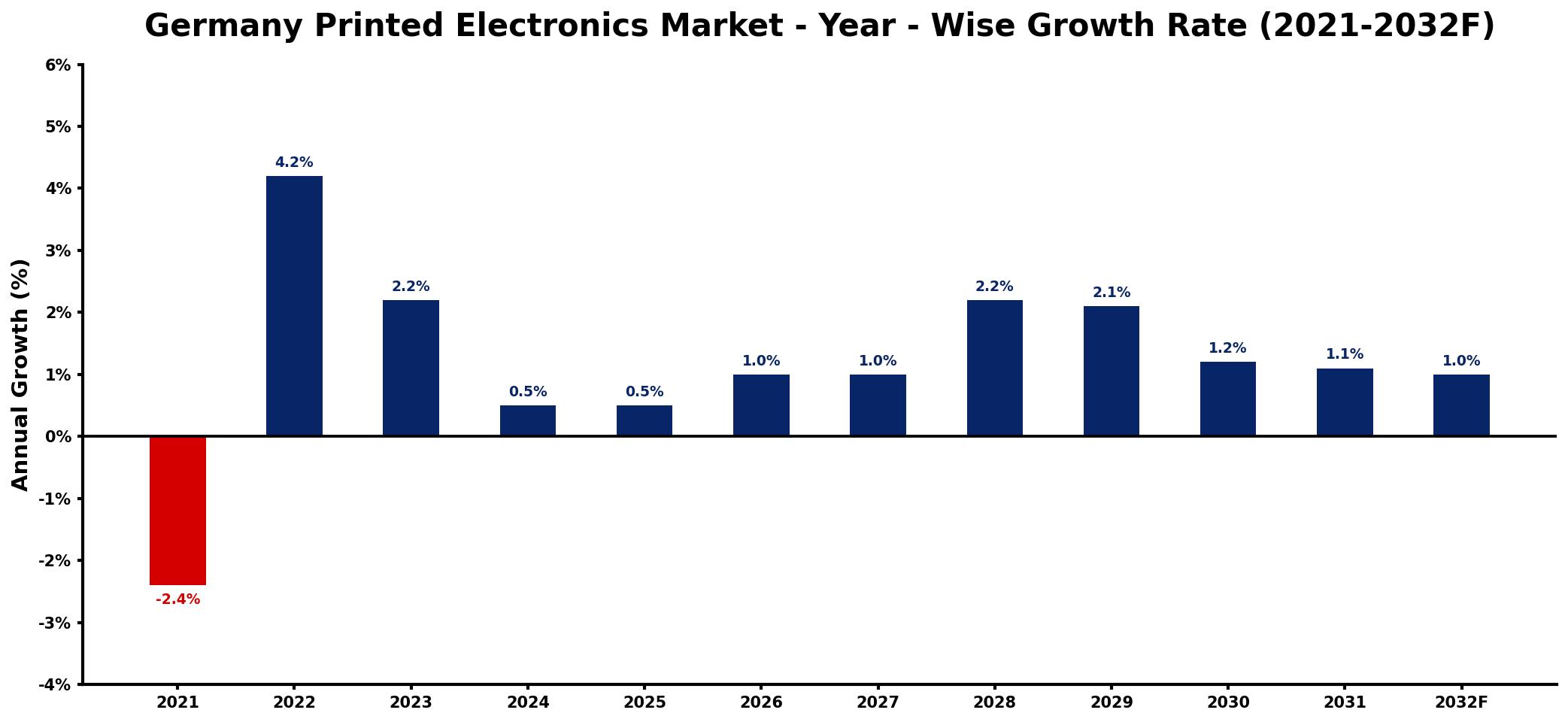
The table below presents the year‑wise growth rates along with the key drivers influencing the market
| Year | Growth Rate | Major Drivers |
| 2021 | -2.4% | decreased market investment activities |
| 2022 | 4.2% | increased adoption in packaging |
| 2023 | 2.2% | growing interest in wearables |
| 2024 | 0.5% | expansion of smart textiles market |
| 2025 | 0.5% | rising demand in automotive sector |
| 2026 | 1.0% | increased funding for innovation |
| 2027 | 1.0% | growing applications in healthcare |
| 2028 | 2.2% | surge in sustainable solutions |
| 2029 | 2.1% | expansion into consumer products |
| 2030 | 1.2% | increased focus on automation |
| 2031 | 1.1% | increased capital investment inflows |
| 2032 | 1.0% | rise in renewable energy applications |
Note: Market size estimations and growth projections presented in this report are based on 6Wresearch's proprietary forecasting methodology, utilizing the latest available industry data, government publications, and primary research inputs.
Germany Printed Electronics Market Synopsis
Despite recent rapid expansion, the future of the Germany Printed Electronics Market is being shaped by ongoing technological advancements and increasing applications across diverse sectors. The sector's growth momentum is further fueled by a concentrated focus on research and development, allowing Germany to maintain a competitive edge in material innovations and processes.
However, as the market matures, challenges surrounding material performance and manufacturing scalability have emerged. Addressing these issues will be critical for sustaining growth in the coming years, particularly as industries push for greater integration of printed electronics into everyday products.
Germany Printed Electronics Market Key Takeaways
- The market is driven by advancements in printing technologies and a growing demand for flexible electronics.
- Germany's strong emphasis on R&D enhances innovation in materials and applications within the printed electronics sector.
- Challenges related to material durability and manufacturing processes need addressing for continued market growth.
- Government policies are designed to support technological innovation and compliance in manufacturing standards.
- There are significant opportunities in smart packaging, healthcare, and wearable electronics sectors.
Evaluation of Restraints in Germany Printed Electronics Market
Several restraints currently impact the Germany Printed Electronics Market. One primary concern lies in the realm of material innovation; manufacturers face challenges in developing high-performance materials that can withstand rigorous application conditions. Furthermore, achieving scalability in production while maintaining quality and reliability presents a significant hurdle. The complexities involved in optimizing printing processes, ensuring substrate compatibility, and adhering to standardization protocols also limit the market's expansion. These issues necessitate continued research and investment in sustainable solutions to enhance product longevity and performance.
Germany Printed Electronics Market Trends
Current trends indicate a growing integration of printed electronics into the Internet of Things (IoT) ecosystem, facilitating advancements in smart devices and interconnected systems. Additionally, the demand for environmentally friendly printing materials and processes is rising, as industries increasingly focus on sustainability. Furthermore, innovations in flexible displays and energy-efficient solutions are shaping the future of printed electronics, leading to broader adoption across consumer products.
Germany Printed Electronics Market Opportunities
The German Printed Electronics Market holds promising growth potential, particularly within the healthcare sector. The rise of wearable health monitoring devices offers substantial investment opportunities. Moreover, innovations in smart packaging that enhance product safety and visibility can capture consumer interest. As companies continue to embrace IoT technologies, the development of new applications for printed electronics will further fuel market expansion.
Government Initiatives in the Germany Printed Electronics Market
The German government actively supports the printed electronics sector through policies aimed at fostering technological innovation and market competitiveness. Funding initiatives encourage research and development, with an emphasis on improving manufacturing efficiency and material safety standards. Regulatory frameworks are in place to ensure product quality assurance, allowing manufacturers to align with industry specifications and consumer protection regulations, thereby enhancing overall market stability.
Future Insights of the Germany Printed Electronics Market
Looking ahead to 2026-2032, the Germany Printed Electronics Market is poised for gradual yet steady growth, driven by sustained demand for innovative applications in various industries. As advancements in manufacturing techniques and material science continue to emerge, there will be increased emphasis on the development of reliable, high-performance printed electronics. The convergence of sustainability and technology will play a vital role in shaping market dynamics, presenting numerous opportunities for companies to differentiate themselves and achieve success.
Germany Printed Electronics Market Latest Developments (2025 - 2026)
In the latest developments, the printed electronics industry in Germany is witnessing an increased focus on collaborative projects between research institutions and manufacturers. These partnerships aim to accelerate the innovation of new materials and printing processes. Moreover, several initiatives are underway to enhance the integration of printed electronics in IoT devices, targeting applications in smart cities and healthcare technologies. There is also a notable push toward adopting sustainable practices within production processes to meet growing environmental standards.
Germany Printed Electronics Market - Key Attractiveness of the Report
- 10 Years of Market Numbers
- Historical Data Starting from 2022 to 2025
- Base Year: 2025
- Forecast Data until 2032
- Key Performance Indicators Impacting the Market
- Major Upcoming Developments and Projects
Key Highlights of the Report:
- Germany Printed Electronics Market Outlook
- Market Size of Germany Printed Electronics Market, 2025
- Forecast of Germany Printed Electronics Market, 2032
- Historical Data and Forecast of Germany Printed Electronics Revenues & Volume for the Period 2022-2032F
- Germany Printed Electronics Market Trend Evolution
- Germany Printed Electronics Market Drivers and Challenges
- Germany Printed Electronics Price Trends
- Germany Printed Electronics Porter's Five Forces
- Germany Printed Electronics Industry Life Cycle
- Historical Data and Forecast of Germany Printed Electronics Market Revenues & Volume By Material for the Period 2022-2032F
- Historical Data and Forecast of Germany Printed Electronics Market Revenues & Volume By Ink for the Period 2022-2032F
- Historical Data and Forecast of Germany Printed Electronics Market Revenues & Volume By Substrate for the Period 2022-2032F
- Historical Data and Forecast of Germany Printed Electronics Market Revenues & Volume By Technology for the Period 2022-2032F
- Historical Data and Forecast of Germany Printed Electronics Market Revenues & Volume By Screen for the Period 2022-2032F
- Historical Data and Forecast of Germany Printed Electronics Market Revenues & Volume By Inkjet for the Period 2022-2032F
- Historical Data and Forecast of Germany Printed Electronics Market Revenues & Volume By Flexographic for the Period 2022-2032F
- Historical Data and Forecast of Germany Printed Electronics Market Revenues & Volume By Gravure for the Period 2022-2032F
- Historical Data and Forecast of Germany Printed Electronics Market Revenues & Volume By Device for the Period 2022-2032F
- Historical Data and Forecast of Germany Printed Electronics Market Revenues & Volume By Displays for the Period 2022-2032F
- Historical Data and Forecast of Germany Printed Electronics Market Revenues & Volume By Photovoltaic for the Period 2022-2032F
- Historical Data and Forecast of Germany Printed Electronics Market Revenues & Volume By Lighting for the Period 2022-2032F
- Historical Data and Forecast of Germany Printed Electronics Market Revenues & Volume By RFID for the Period 2022-2032F
- Historical Data and Forecast of Germany Printed Electronics Market Revenues & Volume By Others for the Period 2022-2032F
- Germany Printed Electronics Import Export Trade Statistics
- Market Opportunity Assessment By Material
- Market Opportunity Assessment By Technology
- Market Opportunity Assessment By Device
- Germany Printed Electronics Top Companies Market Share
- Germany Printed Electronics Competitive Benchmarking By Technical and Operational Parameters
- Germany Printed Electronics Company Profiles
- Germany Printed Electronics Key Strategic Recommendations






































