Germany Public Cloud Market Size & Growth Rate (2026-2032)
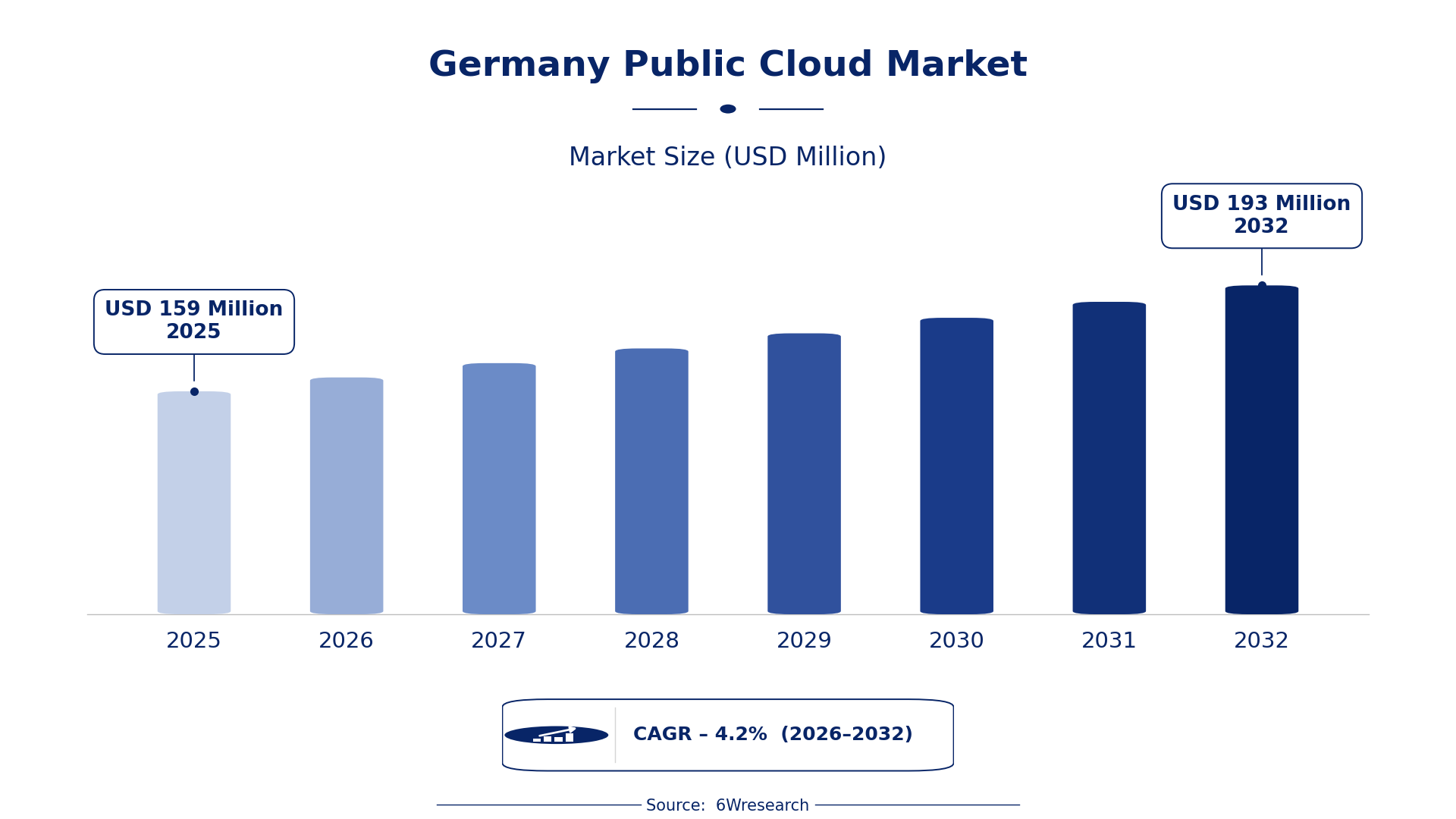
The Germany Public Cloud Market was estimated at USD 159 Million in 2025 and is projected to reach USD 193 Million by 2032, growing at a CAGR of 4.2% from 2026 to 2032.
Germany Public Cloud Market Synopsis
The demand for public cloud services in Germany is rising sharply, driven by sectors such as IT and finance increasingly seeking scalable solutions. Companies are prioritizing cloud adoption to enhance operational efficiency and support remote work, marking a significant shift in how businesses operate.
This growing adoption aligns with Germany’s robust regulatory framework, which emphasizes data protection and compliance. Businesses are leveraging cloud technology to innovate while navigating stringent legal requirements, ensuring that their cloud strategies are both effective and compliant.
Germany Public Cloud Market Year-wise Growth Rate and Key Drivers
This graph illustrates the annual growth rates of the Germany Public Cloud Market from 2021 to 2032, highlighting a steady upward trajectory and projected expansion over the forecast period.
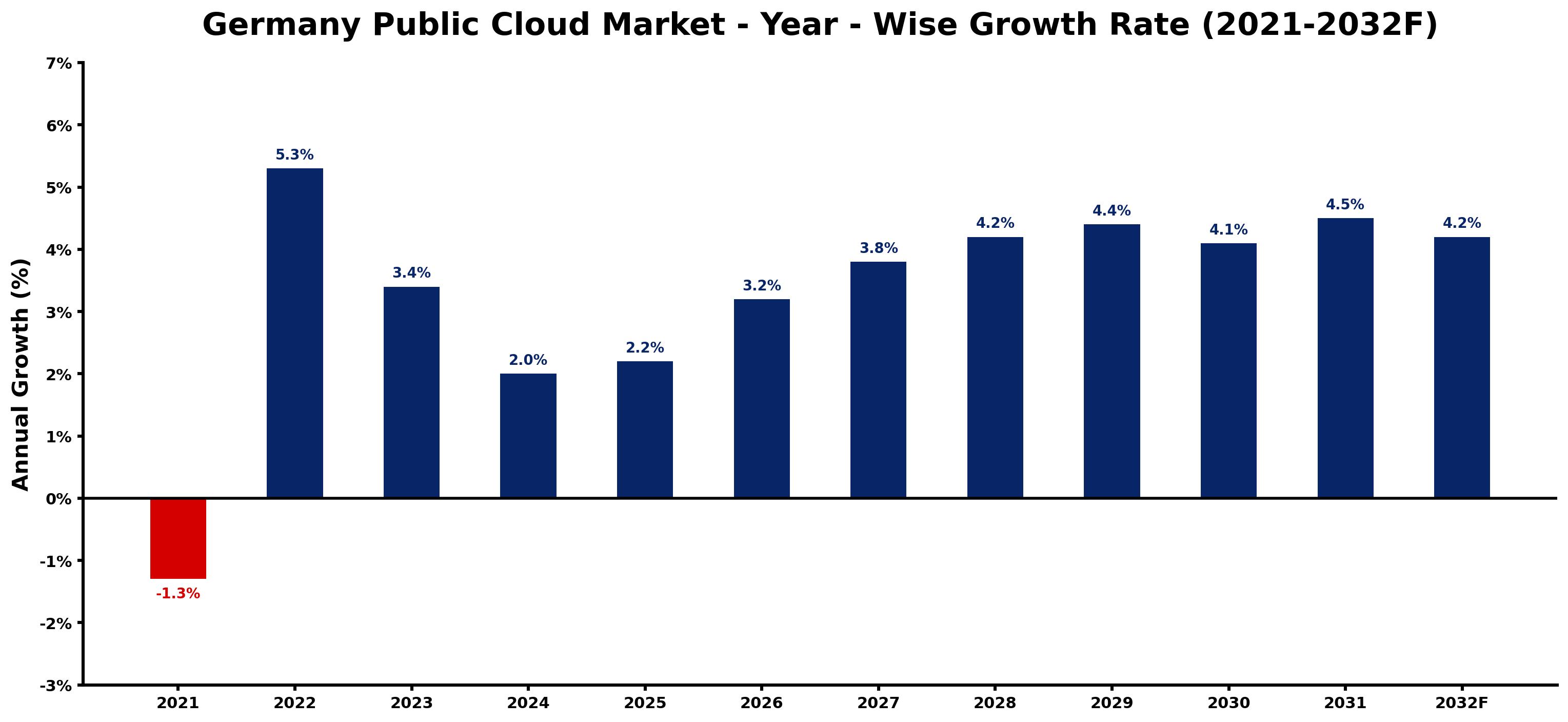
The table below presents the year‑wise growth rates along with the key drivers influencing the market
| Year | Growth Rate | Major Drivers |
| 2021 | -1.3% | Berlin's stringent data protection regulations hindered adoption. |
| 2022 | 5.3% | Data Privacy Regulation enhancements driving cloud adoption |
| 2023 | 3.4% | Increased investment in AI technologies boosting cloud services |
| 2024 | 2.0% | Growing e-commerce sector enhancing demand for cloud solutions |
| 2025 | 2.2% | Local startups leveraging cloud for innovation and scalability |
| 2026 | 3.2% | Sustainability initiatives promoting green cloud services usage |
| 2027 | 3.8% | Digital transformation mandates from German Enterprises increasing cloud growth |
| 2028 | 4.2% | Public sector digitization projects expanding cloud service requirements |
| 2029 | 4.4% | Consumer demand for data analytics pushing cloud storage needs |
| 2030 | 4.1% | Government support for digital infrastructure improving cloud access |
| 2031 | 4.5% | Cybersecurity regulations necessitating cloud-based security solutions |
| 2032 | 4.2% | Increased IoT adoption requiring robust cloud platforms |
Note: Market size estimations and growth projections presented in this report are based on 6Wresearch's proprietary forecasting methodology, utilizing the latest available industry data, government publications, and primary research inputs.
Germany Public Cloud Market Key Takeaways
Below are some of the specific key takeaways from the market, including:
- Rapid growth in cloud service adoption among various sectors, particularly finance and healthcare.
- Increased preference for hybrid cloud solutions tailored to specific business needs.
- Heightened focus on data security and compliance, notably with GDPR regulations.
- Expansion of cloud service providers through investments in local data centers and partnerships.
- Opportunities for specialized cloud services, including AI and machine learning solutions.
Evaluation of Restraints in Germany Public Cloud Market
Despite the positive trajectory, the Germany Public Cloud Market faces significant challenges. Chief among these is the stringent regulatory environment, particularly GDPR, which mandates that data be stored within Germany. This limitation can hamper the flexibility and scalability that public cloud services typically offer. Concerns regarding data sovereignty and security further complicate the landscape, as businesses remain hesitant to fully embrace public cloud solutions. The variability in compliance standards across different industries adds an additional layer of complexity, making it difficult for companies to adopt a unified cloud strategy.
Germany Public Cloud Market Trends
Several trends are shaping the Germany Public Cloud Market. A marked shift towards hybrid cloud solutions is evident, allowing businesses to maintain control over sensitive data while leveraging public cloud advantages. Additionally, there’s an increasing emphasis on integrating advanced technologies such as AI and machine learning into cloud offerings, enhancing operational capabilities. Companies are also prioritizing investments in cloud security solutions, driven by the need for compliance with strict data protection regulations.
Germany Public Cloud Market Opportunities
Investment opportunities abound in the Germany Public Cloud Market, particularly in infrastructure-as-a-service (IaaS) and software-as-a-service (SaaS) sectors. As enterprises of all sizes embrace cloud computing, there is a burgeoning demand for cloud security services and data analytics. Companies that specialize in hybrid cloud solutions are well-positioned to capitalize on this trend. on top of that, as digital transformation accelerates, there’s a growing need for consulting services that aid in cloud integration and strategy development.
Government Initiatives in the Germany Public Cloud Market
Government policies in Germany are significantly shaping the public cloud market, focusing on data protection, security, and compliance with regulations such as GDPR. These initiatives aim to foster a secure environment for businesses to adopt cloud technologies while ensuring data privacy remains a top priority. The government's approach is both proactive and regulatory, emphasizing transparency and accountability among cloud service providers.
- A recently completed initiative focused on enhancing data security frameworks for cloud providers operating within Germany.
- A current program promoting digital transformation across public sector entities, encouraging the adoption of cloud services to improve efficiency.
- A planned regulatory framework expected to be introduced by 2026, mandating stricter compliance measures for cloud service providers.
- Ongoing partnerships between government agencies and tech firms to develop secure cloud infrastructure tailored to local needs.
- Upcoming investment in national data centers to support the growing demand for cloud services while ensuring data sovereignty.
Future Insights of the Germany Public Cloud Market
Looking ahead to 2026-2032, the Germany Public Cloud Market is set to witness continued expansion, driven by widespread digital transformation initiatives across industries. The increasing adoption of cloud services by both large enterprises and SMEs will be a significant growth driver. Additionally, the persistent focus on cybersecurity and compliance will shape the development of new cloud solutions. As businesses increasingly recognize the value of cloud computing, the market will likely experience a surge in innovation and investment.
Germany Public Cloud Market Latest Developments
In the past year, the Germany Public Cloud Market has seen notable activity as companies ramp up efforts to enhance their cloud offerings. This includes investments in infrastructure, partnerships, and advancements in technology to meet growing demand. The competitive landscape is intensifying as businesses aim to differentiate themselves through innovative solutions.
- A major technology vendor launched a new cloud security product aimed at helping businesses comply with GDPR, introduced in Q2 2025.
- An ongoing initiative started in early 2025 to upgrade existing data centers across Germany, enhancing capacity and security.
- A partnership announced in late 2025 between local firms to develop specialized AI cloud solutions tailored for the German market.
- A rollout expected to begin in early 2026 focusing on hybrid cloud services designed for small and medium enterprises.
- A new public-private partnership aimed at expanding cloud infrastructure access, set to begin implementation by mid-2026.
Germany Public Cloud Market - Key Attractiveness of the Report
- 10 Years of Market Numbers
- Historical Data Starting from 2022 to 2025
- Base Year: 2025
- Forecast Data until 2032
- Key Performance Indicators Impacting the Market
- Major Upcoming Developments and Projects
Key Highlights of the Report:
- Germany Public Cloud Market Outlook
- Market Size of Germany Public Cloud Market, 2025
- Forecast of Germany Public Cloud Market, 2032
- Historical Data and Forecast of Germany Public Cloud Revenues & Volume for the Period 2022-2032F
- Germany Public Cloud Market Trend Evolution
- Germany Public Cloud Market Drivers and Challenges
- Germany Public Cloud Price Trends
- Germany Public Cloud Porter's Five Forces
- Germany Public Cloud Industry Life Cycle
- Historical Data and Forecast of Germany Public Cloud Market Revenues & Volume By Service Model for the Period 2022-2032F
- Historical Data and Forecast of Germany Public Cloud Market Revenues & Volume By Infrastructure as a Service for the Period 2022-2032F
- Historical Data and Forecast of Germany Public Cloud Market Revenues & Volume By Platform as a Service for the Period 2022-2032F
- Historical Data and Forecast of Germany Public Cloud Market Revenues & Volume By Software as a Service for the Period 2022-2032F
- Historical Data and Forecast of Germany Public Cloud Market Revenues & Volume By Organization Size Large enterprises for the Period 2022-2032F
- Historical Data and Forecast of Germany Public Cloud Market Revenues & Volume By Small for the Period 2022-2032F
- Historical Data and Forecast of Germany Public Cloud Market Revenues & Volume By Medium Enterprises SMEs for the Period 2022-2032F
- Historical Data and Forecast of Germany Public Cloud Market Revenues & Volume By Verticals for the Period 2022-2032F
- Historical Data and Forecast of Germany Public Cloud Market Revenues & Volume By BFSI for the Period 2022-2032F
- Historical Data and Forecast of Germany Public Cloud Market Revenues & Volume By Telecommunication for the Period 2022-2032F
- Historical Data and Forecast of Germany Public Cloud Market Revenues & Volume By IT & ITeS for the Period 2022-2032F
- Historical Data and Forecast of Germany Public Cloud Market Revenues & Volume By Government & Public Sector for the Period 2022-2032F
- Historical Data and Forecast of Germany Public Cloud Market Revenues & Volume By Retail & Consumer Goods for the Period 2022-2032F
- Historical Data and Forecast of Germany Public Cloud Market Revenues & Volume By Manufacturing for the Period 2022-2032F
- Historical Data and Forecast of Germany Public Cloud Market Revenues & Volume By Energy & Utility for the Period 2022-2032F
- Historical Data and Forecast of Germany Public Cloud Market Revenues & Volume By Media & Entertainment for the Period 2022-2032F
- Germany Public Cloud Import Export Trade Statistics
- Market Opportunity Assessment By Service Model
- Market Opportunity Assessment By Organization Size Large enterprises
- Market Opportunity Assessment By Verticals
- Germany Public Cloud Top Companies Market Share
- Germany Public Cloud Competitive Benchmarking By Technical and Operational Parameters
- Germany Public Cloud Company Profiles
- Germany Public Cloud Key Strategic Recommendations






































