Germany Television Broadcasting Market Size, Share & Growth Rate
The Germany Television Broadcasting Market was estimated at USD 480 Million in 2025 and is projected to reach USD 590 Million by 2032, growing at a CAGR of 3.0% from 2026 to 2032. This growth trajectory is largely driven by the increasing integration of digital streaming services, as traditional broadcasters seek to capture the shifting preferences of viewers who favor on-demand content. Additionally, the market is supported by significant investments in original programming and the rise of innovative advertising solutions that enhance audience engagement.
Germany Television Broadcasting Market Year-wise Growth Rate and Key Drivers
This graph highlights how the Germany Television Broadcasting Market has steadily grown over the years, supported by major growth factors.
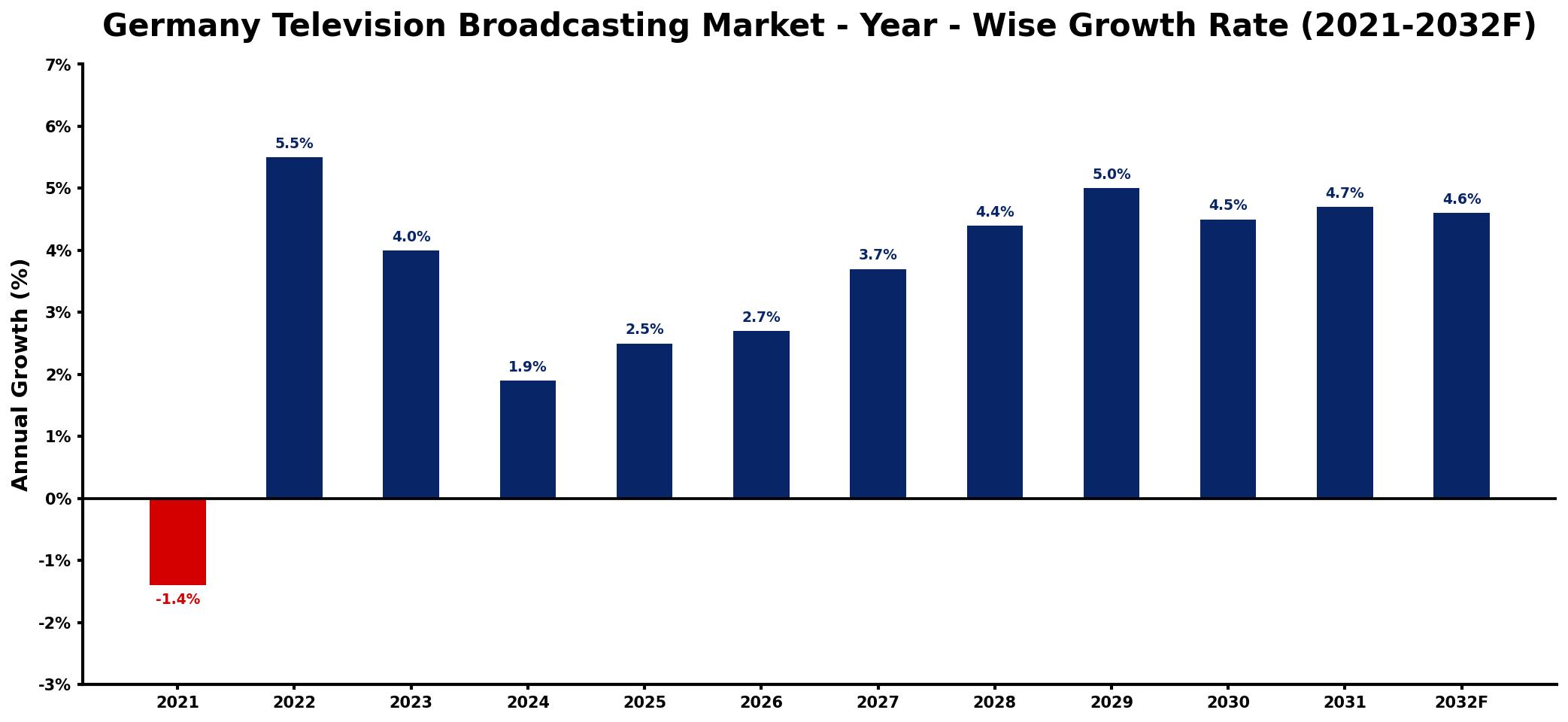
The table below presents the year‑wise growth rates along with the key drivers influencing the market
| Year | Growth Rate | Major Drivers |
| 2021 | -1.4% | shift towards digital content consumption |
| 2022 | 5.5% | increase in streaming service subscriptions |
| 2023 | 4.0% | rising demand for original content |
| 2024 | 1.9% | expansion of advertising revenue streams |
| 2025 | 2.5% | growth in mobile viewing habits |
| 2026 | 2.7% | surge in interactive content offerings |
| 2027 | 3.7% | enhanced viewer engagement strategies |
| 2028 | 4.4% | development of advanced viewing technologies |
| 2029 | 5.0% | increased production capacity utilization |
| 2030 | 4.5% | growing popularity of niche programming |
| 2031 | 4.7% | growing commercial sector adoption |
| 2032 | 4.6% | enhancement of user experience features |
Note: Market size estimations and growth projections presented in this report are based on 6Wresearch's proprietary forecasting methodology, utilizing the latest available industry data, government publications, and primary research inputs.
Germany Television Broadcasting Market Synopsis
In Germany, the demand for high-quality, diverse content remains robust, fostering a competitive environment among both public service and commercial broadcasters. As traditional linear television faces challenges, broadcasters are increasingly exploring partnerships and collaborations with emerging streaming platforms to cater to evolving viewer habits.
The regulatory landscape also plays a significant role, with entities like KEK and Landesmedienanstalten ensuring that programming meets quality standards while promoting media pluralism. This regulatory framework is essential in balancing the interests of various stakeholders, from content creators to advertisers.
Germany Television Broadcasting Market Key Takeaways
- The market is transitioning towards digitalization, significantly affecting viewer engagement and advertising strategies.
- There is a marked increase in investment towards original content production, critical for attracting and retaining audiences.
- Regulatory bodies maintain stringent oversight to ensure programming diversity and compliance with content standards.
- Advertisers are shifting focus towards integrating digital campaigns with traditional TV advertising to enhance reach.
- Opportunities abound for investors in tech-driven companies that support the evolving broadcasting landscape.
Evaluation of Restraints in Germany Television Broadcasting Market
The increasing prevalence of streaming services continues to pose significant challenges for traditional broadcasters in Germany. Viewer migration toward on-demand platforms is leading to fragmented audiences, ultimately affecting advertising revenues. Furthermore, regulatory restrictions can hinder the ability of broadcasters to adapt quickly to technological advancements and changing viewer preferences, thus limiting their competitive edge in a rapidly evolving market.
Germany Television Broadcasting Market Trends
The landscape of the Germany Television Broadcasting Market is heavily influenced by several key trends. The rise of streaming services has dramatically reshaped viewer consumption patterns, pushing traditional networks to innovate and invest in digital platforms. Notably, there is a growing emphasis on mobile-friendly content delivery, responding to the increasing number of viewers consuming media via smartphones and tablets. Additionally, the incorporation of data analytics is becoming essential for targeted advertising, enabling broadcasters to reach specific demographics effectively.
Germany Television Broadcasting Market Opportunities
With the ongoing shift towards digital streaming and on-demand content, the Germany Television Broadcasting Market presents lucrative investment opportunities. Investors can capitalize on companies that focus on original content production, which is vital for attracting and engaging audiences. Moreover, technology firms specializing in streaming solutions and analytics are increasingly relevant, offering avenues for growth. Traditional broadcasters looking to diversify revenue through digital partnerships also represent potential investment hotspots.
Government Initiatives in the Germany Television Broadcasting Market
The German government actively regulates the television broadcasting sector through various bodies to promote fairness and diversity. The Commission on Licensing and Supervision (ZAK) and the State Media Authorities oversee compliance with licensing requirements, advertising restrictions, and content standards. This regulatory environment aims to sustain public service broadcasting while ensuring a competitive landscape that benefits viewers and content producers alike. Public funding mechanisms also bolster channels such as ARD and ZDF, reflecting the government's commitment to maintaining a diverse media ecosystem.
Future Insights of the Germany Television Broadcasting Market
Looking ahead to 2026-2032, the Germany Television Broadcasting Market is poised for significant transformation, driven by the continued rise of digital platforms and viewer demands for on-demand content. While traditional broadcasters will encounter ongoing challenges, strategic partnerships with tech firms and streaming services may offer pathways for adaptation and growth. As the market evolves, a focus on innovative content delivery and personalized viewer experiences will be paramount to engage increasingly discerning audiences.
Germany Television Broadcasting Market Latest Developments (2025 - 2026)
Recently, the industry has seen a notable shift in how content is distributed, with traditional networks ramping up their efforts to launch or enhance streaming platforms. The landscape is further influenced by strategic collaborations between broadcasters and digital service providers, aiming to create a seamless viewing experience across multiple devices. Additionally, there has been an uptick in the production of localized original content to cater specifically to German audiences, reflecting a keen awareness of cultural preferences.
Germany Television Broadcasting Market - Key Attractiveness of the Report
- 10 Years of Market Numbers
- Historical Data Starting from 2022 to 2025
- Base Year: 2025
- Forecast Data until 2032
- Key Performance Indicators Impacting the Market
- Major Upcoming Developments and Projects
Key Highlights of the Report:
- Germany Television Broadcasting Market Outlook
- Market Size of Germany Television Broadcasting Market, 2025
- Forecast of Germany Television Broadcasting Market, 2032
- Historical Data and Forecast of Germany Television Broadcasting Revenues & Volume for the Period 2022-2032F
- Germany Television Broadcasting Market Trend Evolution
- Germany Television Broadcasting Market Drivers and Challenges
- Germany Television Broadcasting Price Trends
- Germany Television Broadcasting Porter's Five Forces
- Germany Television Broadcasting Industry Life Cycle
- Historical Data and Forecast of Germany Television Broadcasting Market Revenues & Volume By Type for the Period 2022-2032F
- Historical Data and Forecast of Germany Television Broadcasting Market Revenues & Volume By Television Station for the Period 2022-2032F
- Historical Data and Forecast of Germany Television Broadcasting Market Revenues & Volume By Television Network for the Period 2022-2032F
- Historical Data and Forecast of Germany Television Broadcasting Market Revenues & Volume By Broadcaster Type for the Period 2022-2032F
- Historical Data and Forecast of Germany Television Broadcasting Market Revenues & Volume By Public for the Period 2022-2032F
- Historical Data and Forecast of Germany Television Broadcasting Market Revenues & Volume By Commercial for the Period 2022-2032F
- Historical Data and Forecast of Germany Television Broadcasting Market Revenues & Volume By Revenue Source for the Period 2022-2032F
- Historical Data and Forecast of Germany Television Broadcasting Market Revenues & Volume By Subscription-based for the Period 2022-2032F
- Historical Data and Forecast of Germany Television Broadcasting Market Revenues & Volume By Advertisement-based for the Period 2022-2032F
- Germany Television Broadcasting Import Export Trade Statistics
- Market Opportunity Assessment By Type
- Market Opportunity Assessment By Broadcaster Type
- Market Opportunity Assessment By Revenue Source
- Germany Television Broadcasting Top Companies Market Share
- Germany Television Broadcasting Competitive Benchmarking By Technical and Operational Parameters
- Germany Television Broadcasting Company Profiles
- Germany Television Broadcasting Key Strategic Recommendations






































