Germany Whiskey Market Size (2020-2030)
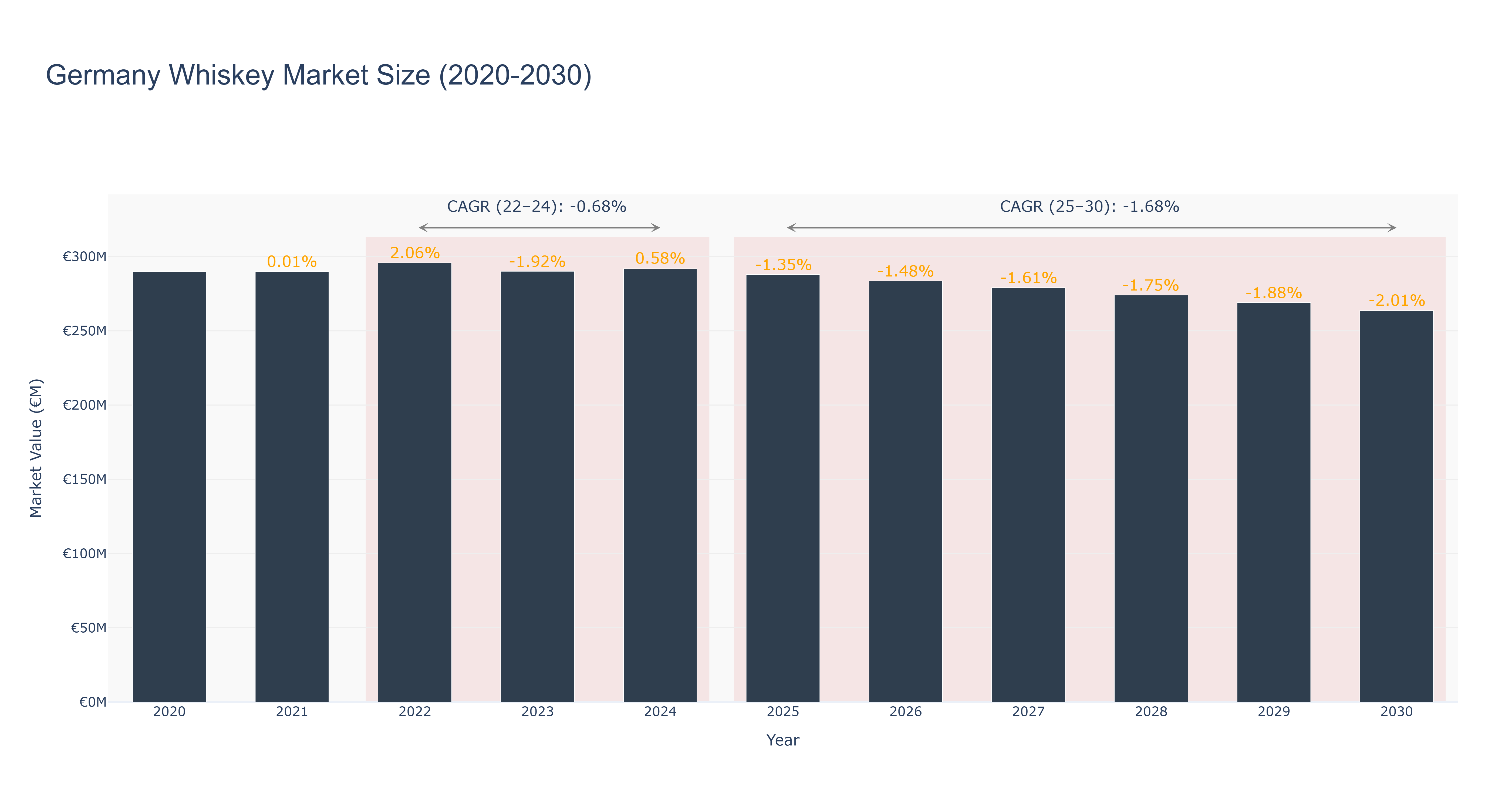
Germany Whiskey Market has experienced a fluctuating trend in recent years. The peak market size of €295.79 million was observed in 2022, followed by a slight decline to €291.79 million in 2024. Forecasted market sizes show a downward trajectory from €287.86 million in 2025 to €263.60 million in 2030, with CAGR values of -0.68% (2022-24) and -1.68% (2025-30). The market's decline can be attributed to changing consumer preferences towards healthier alternatives, increased competition from other alcoholic beverages, and economic uncertainties. To counter this trend, key players in the market are focusing on product innovation, marketing strategies targeting niche segments, and expanding into international markets. Looking ahead, the Germany Whiskey Market is expected to witness further challenges but opportunities lie in sustainability initiatives, digital marketing advancements, and collaborations with local distilleries for unique product offerings.
Germany Whiskey Market: Production & Trade Performance (2019-2025)
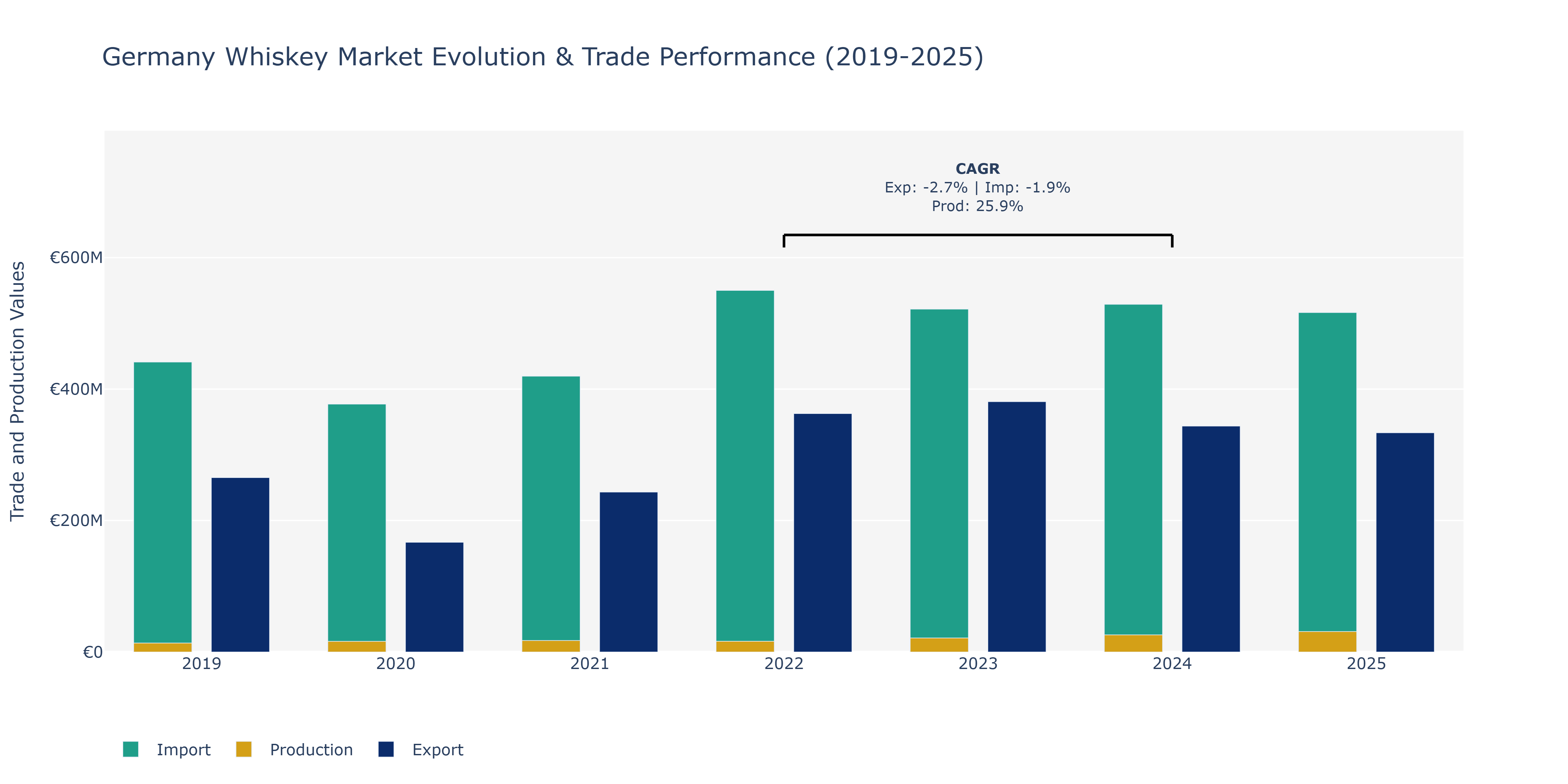
Between 2019 and 2025, the Germany Whiskey Market experienced fluctuations in exports, imports, and production. Export value started at €265.34 million in 2019, dropped to €166.95 million in 2020, and then showed a gradual recovery, reaching €333.58 million in 2025. In contrast, imports began at €441.17 million in 2019, decreased to €377.08 million in 2020, and remained relatively stable around €500 million from 2022 to 2025. Production notably increased from €13.72 million in 2019 to €31.20 million in 2025. The market saw peak production in 2025 at €31.20 million, driven by factors like increasing consumer demand for quality whiskey and the rise of craft distilleries in Germany. Export fluctuations can be attributed to global economic conditions, trade agreements, and evolving consumer preferences for premium whiskey products, impacting both domestic production and international trade dynamics.
Germany Whiskey Market Overview
The whiskey market in Germany is flourishing, fueled by the growing appreciation for premium and craft spirits among consumers. Factors such as diverse flavor profiles, innovative branding, and the emergence of whiskey cocktails contribute to the market`s growth.
Drivers of the market
The growing appreciation for premium spirits, craft beverages, and mixology culture is driving the demand for whiskey in Germany. Whiskey, a distilled alcoholic beverage made from fermented grain mash, is experiencing increasing popularity among Germany consumers, particularly among younger demographics. With a burgeoning cocktail culture and a growing number of whiskey enthusiasts, the demand for diverse whiskey varieties, including single malt, blended, and aged expressions, is expanding in the Germany market.
Challenges of the market
In the Germany Whiskey Market, one of the primary challenges is balancing tradition with innovation to meet evolving consumer preferences and regulatory standards. Whiskey consumption is influenced by factors such as taste, provenance, and brand heritage. However, changing demographics and trends, such as the rise of craft distilleries and flavored spirits, require adaptation from traditional whiskey producers. Moreover, navigating trade regulations and market access barriers adds complexity to international whiskey trade.
Government Policy of the market
Germany regulates the production, sale, and consumption of whiskey through alcohol licensing laws and quality standards. Government policies may include excise taxes, labeling requirements, and age verification measures to ensure responsible consumption and prevent alcohol-related harm.
Key Highlights of the Report:
- Germany Whiskey Market Outlook
- Market Size of Germany Whiskey Market, 2024
- Forecast of Germany Whiskey Market, 2031
- Historical Data and Forecast of Germany Whiskey Revenues & Volume for the Period 2018 - 2031
- Germany Whiskey Market Trend Evolution
- Germany Whiskey Market Drivers and Challenges
- Germany Whiskey Price Trends
- Germany Whiskey Porter's Five Forces
- Germany Whiskey Industry Life Cycle
- Historical Data and Forecast of Germany Whiskey Market Revenues & Volume By Product Type for the Period 2018 - 2031
- Historical Data and Forecast of Germany Whiskey Market Revenues & Volume By American Whisky for the Period 2018 - 2031
- Historical Data and Forecast of Germany Whiskey Market Revenues & Volume By Irish Whisky for the Period 2018 - 2031
- Historical Data and Forecast of Germany Whiskey Market Revenues & Volume By Scotch Whisky for the Period 2018 - 2031
- Historical Data and Forecast of Germany Whiskey Market Revenues & Volume By Canadian Whisky for the Period 2018 - 2031
- Historical Data and Forecast of Germany Whiskey Market Revenues & Volume By Others for the Period 2018 - 2031
- Historical Data and Forecast of Germany Whiskey Market Revenues & Volume By Distribution Channel for the Period 2018 - 2031
- Historical Data and Forecast of Germany Whiskey Market Revenues & Volume By On-trade for the Period 2018 - 2031
- Historical Data and Forecast of Germany Whiskey Market Revenues & Volume By Off-trade for the Period 2018 - 2031
- Germany Whiskey Import Export Trade Statistics
- Market Opportunity Assessment By Product Type
- Market Opportunity Assessment By Distribution Channel
- Germany Whiskey Top Companies Market Share
- Germany Whiskey Competitive Benchmarking By Technical and Operational Parameters
- Germany Whiskey Company Profiles
- Germany Whiskey Key Strategic Recommendations






































