Germany Wholesale Market Summary
The germany wholesale market was estimated at USD 229 Million in 2025 and is projected to reach USD 245 Million by 2032, growing at a CAGR of 0.5% from 2026 to 2032.
Germany Wholesale Market Year-wise Growth Rate and Key Drivers
This graph highlights how the Germany Wholesale Market has steadily grown over the past five years, supported by major growth factors.
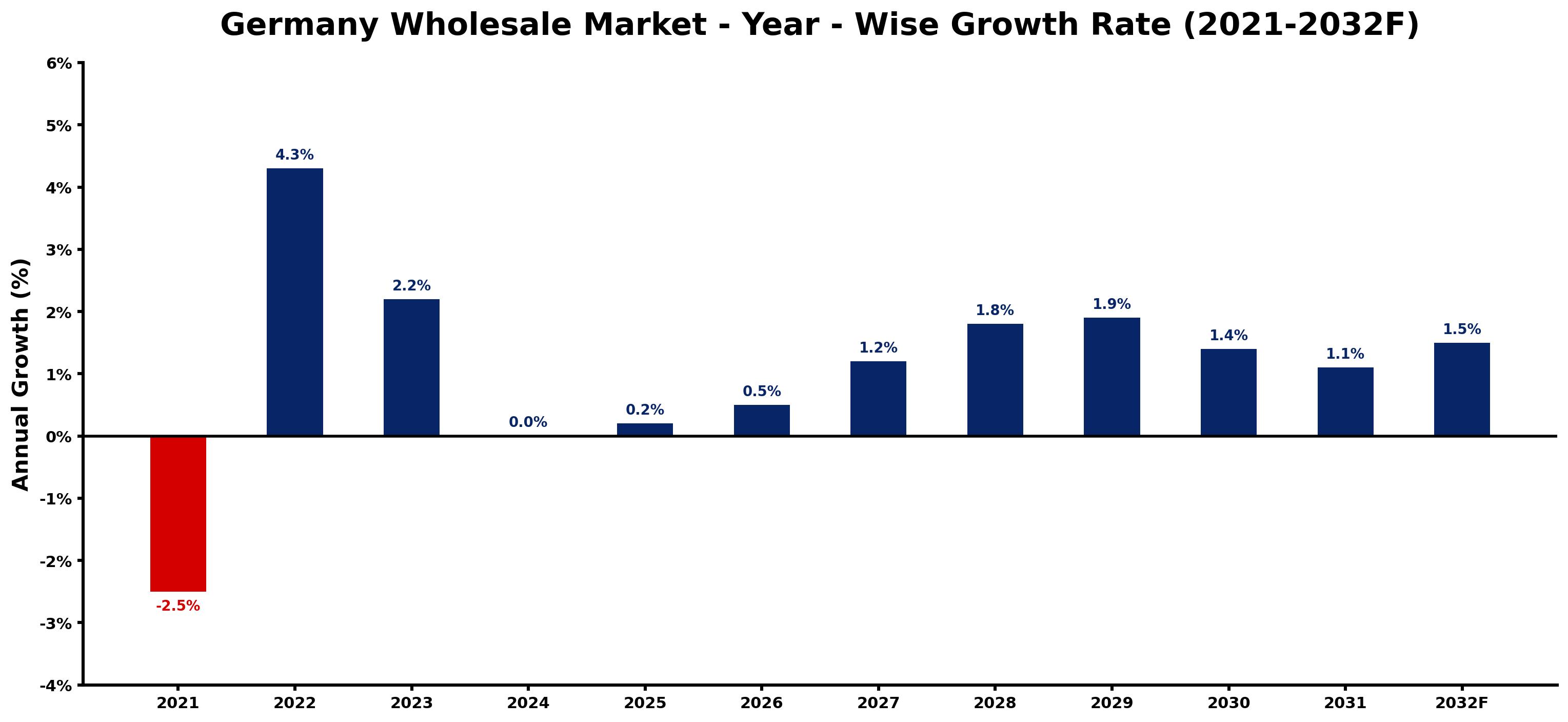
The table below presents the year wise growth rates along with the key drivers influencing the market
| Year | Growth Rate | Major Drivers |
| 2021 | -2.5% | Supply chain disruptions due to pandemic restrictions hindered inventory availability and stifled wholesale transactions. |
| 2022 | 4.3% | Localized supply chain strategies addressed disruptions from the pandemic's ongoing effects. |
| 2023 | 2.2% | Digital transformation initiatives in wholesaling boosted efficiency and reduced operational costs. |
| 2024 | 0.0% | Sustainability requirements prompted wholesalers to adopt greener procurement practices. |
| 2025 | 0.2% | Emerging technologies like AI optimized inventory management for better profitability. |
| 2026 | 0.5% | Integration of e-commerce platforms became essential for competitive positioning among wholesalers. |
| 2027 | 1.2% | Increased reliance on data analytics enabled informed decision-making in inventory control. |
| 2028 | 1.8% | Rising import costs pushed wholesalers to explore domestic sourcing and production. |
| 2029 | 1.9% | Collaborations with logistics firms improved delivery speed and customer satisfaction rates. |
| 2030 | 1.4% | Focus on circular economy principles reshaped product offerings and waste management strategies. |
| 2031 | 1.1% | Customization of products for niche markets enhanced customer loyalty across sectors. |
| 2032 | 1.5% | Emerging markets within Germany presented new avenues for growth and expansion. |
Note - Market size estimations and growth projections presented in this report are based on 6Wresearch's advanced forecasting approach, validated with industry datasets as of June 2026.
Germany Wholesale Market Synopsis
The Germany Wholesale Market is projected to reach 0.5% and witness significant growth during the forecast period (2026-2032). This market serves as an essential intermediary between manufacturers and retailers, significantly contributing to the economy's overall health. Covering a broad spectrum of products ranging from electronics to food and household goods, the Germany wholesale market displays a diverse operational landscape. Wholesaling in Germany often occurs through specialized channels including cash-and-carry operations, general wholesaling, and niche trade. The competitive environment pushes wholesalers to continually enhance their pricing strategies and product quality to sustain their market position.
Germany Wholesale Market Trends and Opportunities
A prominent trend in the Germany wholesale market is the increasing inclination towards sustainable and environmentally friendly products. Retailers are driven by consumers' heightened expectations for ethical sourcing, fair trade, and eco-conscious packaging. In response to this growing demand, wholesalers are expanding their portfolios to include a wider range of sustainable products across various sectors including:
- Food and beverages, where organic and locally sourced items are becoming staples in wholesale offerings.
- Clothing, with an emphasis on materials that adhere to sustainable production practices.
- Household goods, where eco-friendly alternatives are increasingly preferred by consumers.
- Technological gadgets that are made from recyclable materials or designed to use less energy.
- Beauty products where natural and organic ingredients are now favored.
Moreover, digitalization and e-commerce continue to evolve within the wholesale sector. Wholesalers are investing in online platforms and digital marketing strategies, enhancing their ability to reach a broader audience. The acceleration of online transactions, largely fueled by the COVID-19 pandemic, has compelled businesses to adapt their sales approaches.
Germany Wholesale Market Challenges and Restraints
The Germany wholesale market faces several challenges that can hinder growth and operational efficiency. Key challenges include:
- Intense competition: With numerous players in the market, wholesalers need to consistently innovate in pricing, service, and quality.
- Demand fluctuations: Economic conditions and seasonal patterns can lead to unpredictable consumer purchasing behaviors, complicating inventory management.
- Evolving consumer preferences: Staying attuned to the rapid shift towards sustainability and other consumer demands poses a sourcing challenge.
- Regulatory compliance: Adhering to product safety standards and various regulations requires constant vigilance and resource allocation.
- Supply chain disruptions: Global events can impact supply chains, necessitating agile responses to maintain product availability.
Germany Wholesale Market Investment Opportunities
The dynamic landscape of the Germany wholesale market presents several investment opportunities across various sectors. Investors may consider:
- Exploring the wholesale trade of automotive parts and machinery, driving growth in Germany's robust manufacturing sector.
- Investing in electronics wholesale, where demand for innovative technology continues to rise.
- Capitalizing on the pharmaceutical sector, which is bolstered by ongoing advancements in healthcare.
- Focusing on consumer goods, especially with the increasing popularity of e-commerce platforms.
- Enhancing logistics and supply chain management services, crucial for the efficient distribution of goods.
Germany Wholesale Market Government Investment and Initiatives
The German government actively supports the wholesale market through various policies aimed at fostering fair competition and consumer protection. The Act Against Restraints of Competition (ARC) establishes a framework prohibiting anti-competitive practices, ensuring a level playing field. The Federal Cartel Office (Bundeskartellamt) is responsible for enforcing these regulations, investigating potential violations, and maintaining market transparency. Additionally, Germany's commitment to high product safety standards, mandated by the Product Safety Act, reinforces consumer confidence in wholesale offerings. Public spending initiatives also contribute to infrastructure improvements, aiding wholesalers in enhancing their distribution capabilities.
Germany Wholesale Market Latest Developments (May 2025 - June 2026)
Recent developments within the Germany wholesale market indicate a strategic shift towards digitalization and sustainability. Wholesalers across the board have been increasingly adapting their operations to incorporate advanced digital technologies for improved logistics and customer engagement. Furthermore, there has been a growing emphasis on sustainable practices, with many companies initiating partnerships focused on ethical sourcing and transparent supply chains. The regulatory environment continues to evolve, impacting how wholesalers operate, particularly regarding compliance with new product standards and competition laws.
Germany Wholesale Market - Key Attractiveness of the Report
- 10 Years of Market Numbers
- Historical Data Starting from 2022 to 2025
- Base Year: 2025
- Forecast Data until 2032
- Key Performance Indicators Impacting the Market
- Major Upcoming Developments and Projects
Key Highlights of the Report:
- Germany Wholesale Market Outlook
- Market Size of Germany Wholesale Market, 2025
- Forecast of Germany Wholesale Market, 2032F
- Historical Data and Forecast of Germany Wholesale Revenues & Volume for the Period 2022-2032F
- Germany Wholesale Market Trend Evolution
- Germany Wholesale Market Drivers and Challenges
- Germany Wholesale Price Trends
- Germany Wholesale Porter's Five Forces
- Germany Wholesale Industry Life Cycle
- Historical Data and Forecast of Germany Wholesale Market Revenues & Volume By Type for the Period 2022-2032F
- Historical Data and Forecast of Germany Wholesale Market Revenues & Volume By Non-Durable Goods Merchant Wholesalers for the Period 2022-2032F
- Historical Data and Forecast of Germany Wholesale Market Revenues & Volume By Wholesale Electronic Markets And Agents And Brokers for the Period 2022-2032F
- Historical Data and Forecast of Germany Wholesale Market Revenues & Volume By Durable Goods Merchant Wholesalers for the Period 2022-2032F
- Historical Data and Forecast of Germany Wholesale Market Revenues & Volume By Ownership for the Period 2022-2032F
- Historical Data and Forecast of Germany Wholesale Market Revenues & Volume By Wholesale/Distribution Chain for the Period 2022-2032F
- Historical Data and Forecast of Germany Wholesale Market Revenues & Volume By Independent Wholesalers for the Period 2022-2032F
- Germany Wholesale Import Export Trade Statistics
- Market Opportunity Assessment By Type
- Market Opportunity Assessment By Ownership
- Germany Wholesale Top Companies Market Share
- Germany Wholesale Competitive Benchmarking By Technical and Operational Parameters
- Germany Wholesale Company Profiles
- Germany Wholesale Key Strategic Recommendations






































