Kenya Wholesale Market Summary
The kenya wholesale market was estimated at USD 331 Million in 2025 and is projected to reach USD 478 Million by 2032, growing at a CAGR of 6.3% from 2026 to 2032.
Kenya Wholesale Market Year-wise Growth Rate and Key Drivers
This graph highlights how the Kenya Wholesale Market has steadily grown over the past five years, supported by major growth factors.
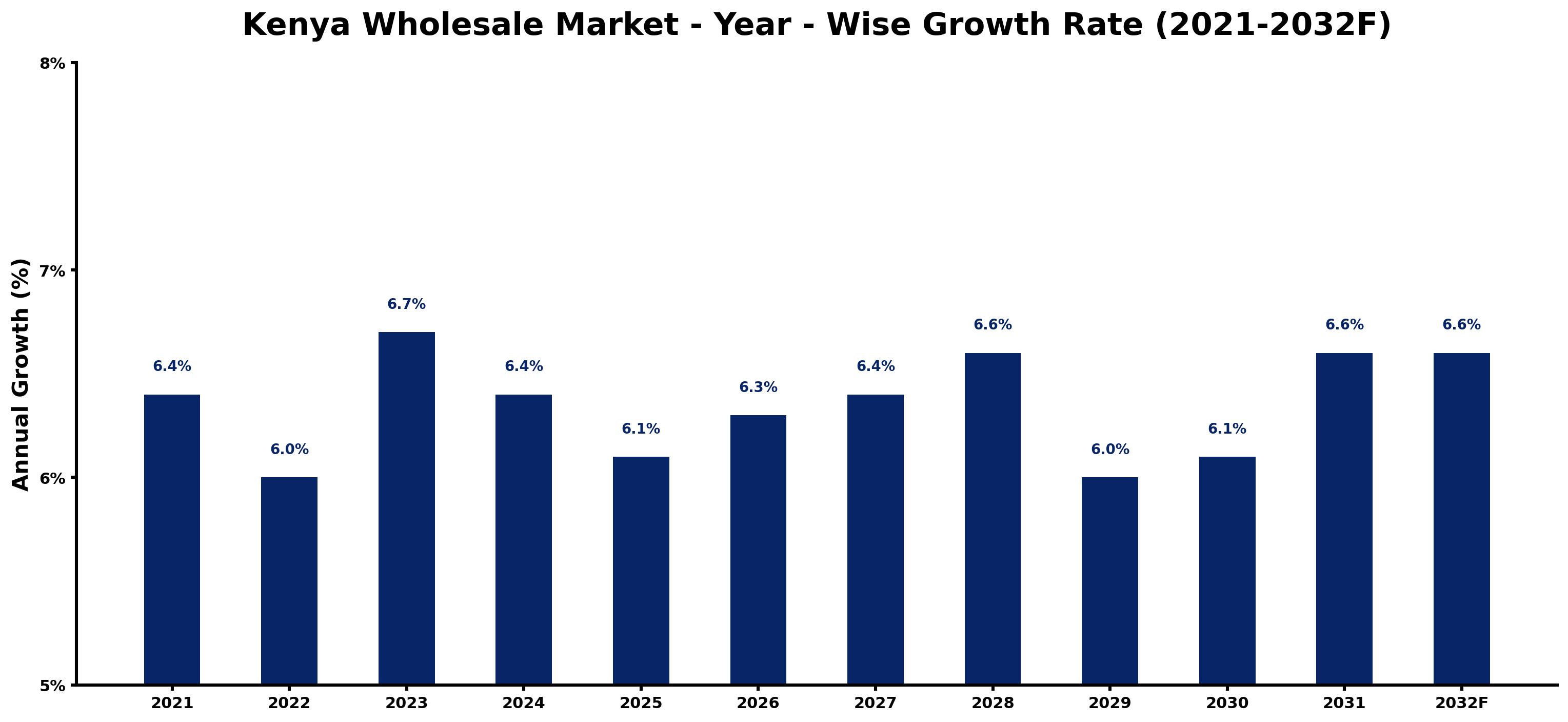
The table below presents the year wise growth rates along with the key drivers influencing the market
| Year | Growth Rate | Major Drivers |
| 2021 | 6.4% | Trade volumes in Kenya's wholesale sector began recovering from pandemic-induced disruptions. |
| 2022 | 6.0% | Digital payment solutions started transforming transaction methods within wholesale retail operations. |
| 2023 | 6.7% | Improved supply chain logistics enhanced product availability and market efficiency significantly. |
| 2024 | 6.4% | The emergence of e-commerce platforms reshaped traditional wholesale purchasing behaviors dramatically. |
| 2025 | 6.1% | Local demand for agricultural products fueled growth in wholesale distribution networks substantially. |
| 2026 | 6.3% | Investment in infrastructure, particularly roads, facilitated smoother distribution channels across regions. |
| 2027 | 6.4% | Rising urbanization drove an increase in consumer spending, benefiting wholesale market dynamics. |
| 2028 | 6.6% | Technological improvements in inventory management optimized stock levels for wholesale businesses. |
| 2029 | 6.0% | Emerging small and medium enterprises entered the market, intensifying competition among wholesalers. |
| 2030 | 6.1% | Partnerships between manufacturers and wholesalers streamlined the supply chain process effectively. |
| 2031 | 6.6% | Sustainability initiatives encouraged wholesalers to adopt eco-friendly practices in their operations. |
| 2032 | 6.6% | Global economic recovery opened new export opportunities for Kenyan wholesale market players. |
Note - Market size estimations and growth projections presented in this report are based on 6Wresearch's advanced forecasting approach, validated with industry datasets as of June 2026.
Kenya Wholesale Market Synopsis
The Kenya Wholesale Market is projected to reach 6.3% and witness significant growth during the forecast period (2026-2032). This market encompasses a diverse array of products, including food items, textiles, electronics, and consumer goods, serving as an essential component of the nation's supply chain. Wholesalers act as vital intermediaries between manufacturers or importers and retailers, ensuring a streamlined process for distributing products across various sectors. The competitive landscape of the Kenya wholesale market is marked by constant efforts from wholesalers to enhance their offerings through competitive pricing, quality assurance, and reliable distribution services.
Kenya Wholesale Market Trends and Opportunities
In recent years, the Kenya Wholesale Market has been undergoing notable transformations, driven by several key trends. A significant shift towards digitalization has emerged, with an increasing number of wholesalers adopting e-commerce platforms to enhance their customer reach. Internet penetration and smartphone adoption in Kenya are also accelerating this trend, allowing buyers to conveniently browse and order products online.
Moreover, there is a rising consumer demand for environmentally sustainable products. This growing awareness has prompted wholesalers to introduce more eco-friendly options and consider sustainable packaging solutions. Additionally, a focus on local sourcing is gaining traction, with consumers increasingly prioritizing products that support small-scale producers, reflecting an evolving preference for quality and product origin.
- Digital platforms are enabling wholesalers to operate more effectively in a competitive marketplace.
- The drift towards sustainability is influencing product offerings and packaging standards.
- Local sourcing initiatives are helping to foster community growth and support small producers.
- Technological advancements are facilitating better inventory management and operational efficiencies.
- Consumer engagement strategies are increasingly important as businesses seek to build loyalty and understanding of buyer preferences.
Kenya Wholesale Market Challenges and Restraints
While the Kenya wholesale market presents numerous opportunities, it also faces several significant challenges. One of the primary issues is related to supply chain logistics, which often lead to delivery delays and inconsistencies that can disrupt operations. Furthermore, the market's competitive nature has resulted in price wars, eroding profit margins for many wholesalers.
Access to affordable financing remains a hurdle for small-scale wholesalers, limiting their capacity to expand and improve their services. Additionally, inadequate storage facilities can negatively affect the quality and availability of goods. Poor infrastructure, lack of comprehensive market data, and regulatory obstacles further complicate the operational landscape of the wholesale market in Kenya. As wholesalers navigate these challenges, investment in infrastructure improvement, supply chain efficiency, and financial inclusion will be vital for sustainable growth.
- Logistical inconsistencies hinder timely product availability and disrupt market fluidity.
- Competitive pricing pressures can diminish profitability for wholesalers.
- Lack of financing options restricts the growth potential for smaller wholesalers.
- Insufficient storage capacity can compromise product integrity and availability.
- Regulatory challenges can create barriers to market entry and expansion for new entrants.
Kenya Wholesale Market Investment Opportunities
The evolving landscape of the Kenya wholesale market presents numerous investment opportunities. A key area for potential investment lies within distribution and logistics companies. Efficient transportation and supply chain management are crucial for meeting the needs of both retailers and consumers, making this sector highly attractive.
Additionally, wholesalers specializing in fast-moving consumer goods (FMCGs), agricultural products, or construction materials are positioned to thrive, given the high demand in these categories. Technology solutions and services that enhance inventory management, order processing, and customer relationship management are also seeing increased interest as businesses seek to streamline operations and improve efficiency.
- The logistics sector is a prime investment target due to its essential role in market operations.
- FMCGs continue to see robust demand, presenting lucrative wholesale opportunities.
- Investing in agricultural wholesaling can capitalize on the growing food sector.
- Technology-driven innovations enhance operational capabilities and customer interaction.
- Infrastructure development will provide a foundation for future growth and market expansion.
Kenya Wholesale Market Government Investment and Initiatives
The Kenya Wholesale Market is governed by a framework of policies aimed at promoting equitable trade practices and enhancing market efficiency. The Competition Act of 2010 is pivotal in ensuring a fair competitive environment, preventing anti-competitive behaviors among wholesalers. Additionally, the Kenya Bureau of Standards (KEBS) plays a critical role in establishing product quality standards that wholesalers must adhere to, ensuring consumer safety and confidence.
In alignment with its economic objectives, the government has also developed trade policies that facilitate import and export activities within the wholesale sector. These initiatives not only bolster local commerce but also enhance international trade relations, fostering an environment conducive to economic growth. Overall, government intervention and support are essential in creating a transparent, competitive, and consumer-protective landscape within the Kenya wholesale market.
Kenya Wholesale Market Latest Developments (May 2025 - June 2026)
Between May 2025 and June 2026, the Kenya wholesale market has seen a range of developments reflecting its dynamic nature. The adoption of e-commerce solutions has accelerated, with many wholesalers investing in digital platforms to enhance customer engagement and streamline transactions. This growth in online presence makes it easier for retailers to access various products efficiently, even in remote regions.
Furthermore, an increasing emphasis on sustainability has driven wholesalers to incorporate more eco-friendly practices in both sourcing and packaging. This shift is not just a response to consumer demand but also aligns with global sustainability trends. The government has ramped up infrastructure investments to improve transport networks essential for wholesale operations, which will likely underpin future growth and market stability.
- The rise of e-commerce is changing the purchasing landscape for wholesale buyers.
- Sustainability initiatives are becoming more prominent in wholesale operations.
- Government investments in infrastructure are enhancing logistics efficiency.
- Wholesalers are adapting to evolving consumer preferences through innovative product offerings.
- Investment in technology is expected to support operational enhancements and market competitiveness.
Kenya Wholesale Market - Key Attractiveness of the Report
- 10 Years of Market Numbers
- Historical Data Starting from 2022 to 2025
- Base Year: 2025
- Forecast Data until 2032
- Key Performance Indicators Impacting the Market
- Major Upcoming Developments and Projects
Key Highlights of the Report:
- Kenya Wholesale Market Outlook
- Market Size of Kenya Wholesale Market, 2025
- Forecast of Kenya Wholesale Market, 2032F
- Historical Data and Forecast of Kenya Wholesale Revenues & Volume for the Period 2022-2032F
- Kenya Wholesale Market Trend Evolution
- Kenya Wholesale Market Drivers and Challenges
- Kenya Wholesale Price Trends
- Kenya Wholesale Porter's Five Forces
- Kenya Wholesale Industry Life Cycle
- Historical Data and Forecast of Kenya Wholesale Market Revenues & Volume By Type for the Period 2022-2032F
- Historical Data and Forecast of Kenya Wholesale Market Revenues & Volume By Non-Durable Goods Merchant Wholesalers for the Period 2022-2032F
- Historical Data and Forecast of Kenya Wholesale Market Revenues & Volume By Wholesale Electronic Markets And Agents And Brokers for the Period 2022-2032F
- Historical Data and Forecast of Kenya Wholesale Market Revenues & Volume By Durable Goods Merchant Wholesalers for the Period 2022-2032F
- Historical Data and Forecast of Kenya Wholesale Market Revenues & Volume By Ownership for the Period 2022-2032F
- Historical Data and Forecast of Kenya Wholesale Market Revenues & Volume By Wholesale/Distribution Chain for the Period 2022-2032F
- Historical Data and Forecast of Kenya Wholesale Market Revenues & Volume By Independent Wholesalers for the Period 2022-2032F
- Kenya Wholesale Import Export Trade Statistics
- Market Opportunity Assessment By Type
- Market Opportunity Assessment By Ownership
- Kenya Wholesale Top Companies Market Share
- Kenya Wholesale Competitive Benchmarking By Technical and Operational Parameters
- Kenya Wholesale Company Profiles
- Kenya Wholesale Key Strategic Recommendations






































