Ghana Advertising Market Size, Share & Growth Rate
The Ghana Advertising Market was estimated at USD 156 Million in 2025 and is projected to reach USD 214 Million by 2032, growing at a CAGR of 4.6% from 2026 to 2032. This growth trajectory is largely fueled by the increasing internet penetration and the expanding middle-class population in Ghana, which is driving demand for more targeted and effective advertising strategies. As both local and international brands seek to connect with an increasingly digital-savvy consumer base, the emphasis on innovative and engaging advertising will only strengthen.
Ghana Advertising Market Year-wise Growth Rate and Key Drivers
This graph highlights how the Ghana Advertising Market has steadily grown over the years, supported by major growth factors.
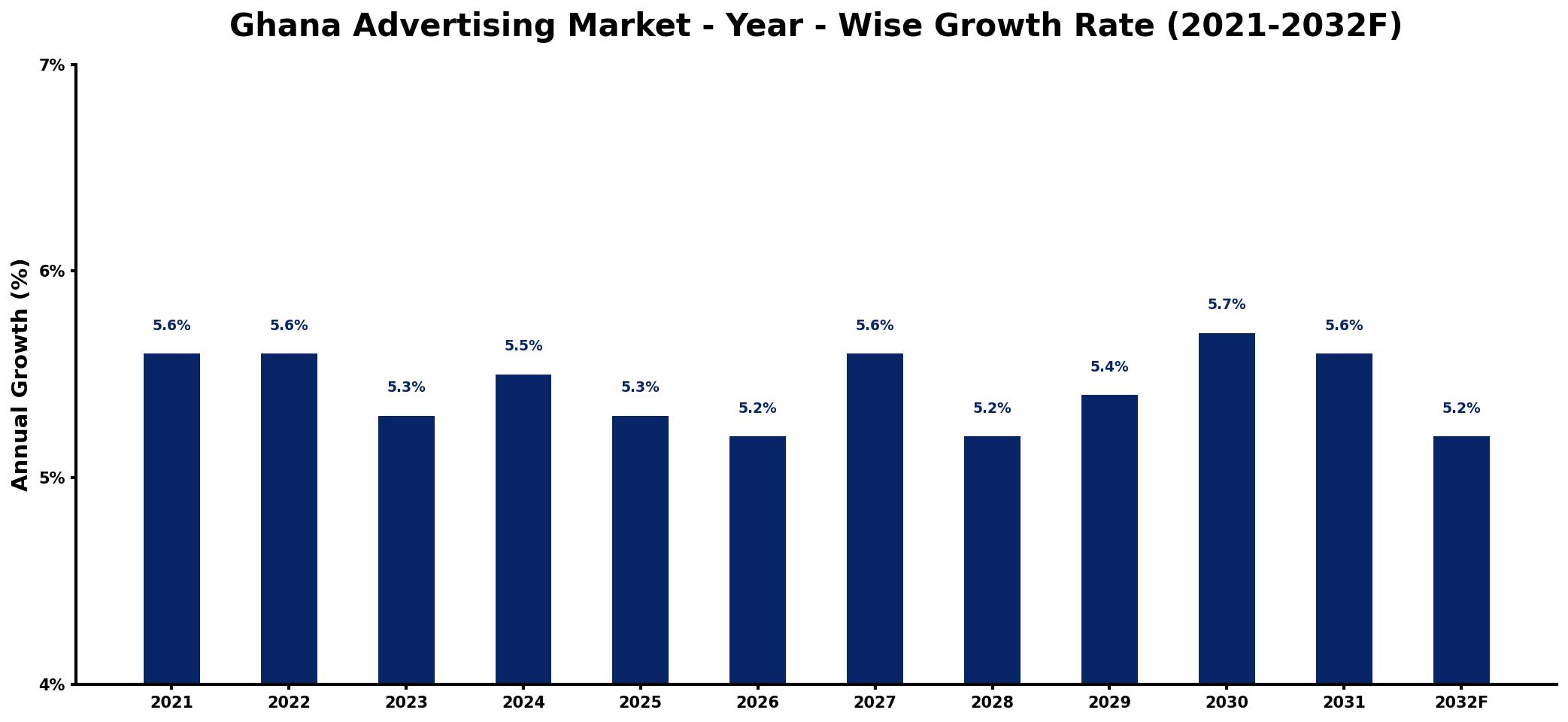
The table below presents the year‑wise growth rates along with the key drivers influencing the market
| Year | Growth Rate | Major Drivers |
| 2021 | 5.6% | Rising digital media consumption trends |
| 2022 | 5.6% | Expansion of mobile internet access |
| 2023 | 5.3% | Increasing investment in technology |
| 2024 | 5.5% | Growth in local business startups |
| 2025 | 5.3% | Surge in social media usage |
| 2026 | 5.2% | Development of e-commerce platforms |
| 2027 | 5.6% | Emergence of influencer marketing strategies |
| 2028 | 5.2% | Strengthening of brand partnerships |
| 2029 | 5.4% | Rising demand for personalized content |
| 2030 | 5.7% | Improvement in consumer spending power |
| 2031 | 5.6% | Adoption of data analytics tools |
| 2032 | 5.2% | Focus on sustainable marketing practices |
Note: Market size estimations and growth projections presented in this report are based on 6Wresearch's proprietary forecasting methodology, utilizing the latest available industry data, government publications, and primary research inputs.
Ghana Advertising Market Synopsis
The Ghana advertising market is currently at a pivotal point, marked by a dynamic shift towards digital platforms. While traditional media like television and radio remain significant, the rapidly growing digital advertising sector is capturing the attention of brands eager to reach younger demographics. This evolution reflects a broader global trend, where creativity and engagement have become essential for brand visibility.
Moreover, urbanization is playing a critical role in shaping advertising strategies. As cities expand, the opportunities for outdoor advertising are considerable, providing a means to engage diverse audiences. Companies are increasingly investing in data analytics and insights, allowing them to craft more effective campaigns tailored to consumer preferences.
Ghana Advertising Market Key Takeaways
- The advertising market is rapidly transitioning from traditional media to digital platforms.
- Key growth sectors include telecommunications, banking, and consumer goods.
- Influencer marketing is emerging as a powerful tool, especially among younger consumers.
- Investments in data analytics are transforming how brands measure campaign effectiveness.
- Urban outdoor advertising continues to be an effective channel for reaching large audiences.
Evaluation of Restraints in Ghana Advertising Market
Despite its growth potential, the Ghana advertising market faces notable challenges that hinder its full capacity. A significant issue is the lack of reliable data, which complicates the targeting of specific audiences for advertisers. This is compounded by limited technology access and internet connectivity in certain areas, affecting the reach and effectiveness of digital campaigns. Moreover, the regulatory landscape presents its own complexities, with stringent laws that require careful navigation. Informal advertising channels clutter the market, making it difficult for clear messages to stand out amidst the noise.
Ghana Advertising Market Trends
A prominent trend within the Ghana advertising market is the increasing investment in digital advertising and social media campaigns. Businesses are recognizing the value of engaging consumers where they are most active online. Additionally, there is a growing demand for creative storytelling in advertisements, as brands strive to forge deeper connections with their audiences. This shift is further supported by advancements in data analytics, empowering marketers to refine their strategies based on real-time insights and customer behaviors.
Ghana Advertising Market Opportunities
Investors looking to enter the Ghana advertising market will find numerous opportunities, particularly within the digital sphere. As consumer spending rises in various sectors including FMCG and retail, companies are seeking innovative advertising solutions. There is also a promising future for influencer marketing, which aligns perfectly with the preferences of the digitally engaged youth. Furthermore, partnerships with local agencies and investments in technology can yield substantial returns as the market continues to expand.
Government Initiatives in the Ghana Advertising Market
The Ghanaian government plays an integral role in shaping the advertising landscape through various policies and regulatory frameworks. The Advertising Council of Ghana (AdCoG) oversees advertising standards to ensure ethical practices are upheld across the board. The National Communications Authority (NCA) regulates content on electronic media platforms, aiming to maintain fair competition and protect consumers from misleading information. These initiatives are crucial for fostering a responsible advertising environment and encouraging sustainable growth in the sector.
Future Insights of the Ghana Advertising Market
Looking ahead to 2026-2032, the Ghana advertising market is poised for continued growth as economic conditions improve and digital penetration deepens. With a youthful population increasingly attuned to digital platforms, brands will have more avenues to engage consumers through innovative campaigns. The rise in urbanization will further facilitate diverse advertising channels, allowing businesses to tailor their approaches. As competition intensifies, the focus on data-driven strategies will become essential for brands striving to maintain relevance and impact.
Ghana Advertising Market Latest Developments (2025 - 2026)
Recent developments in the Ghana advertising market indicate a heightened focus on digital initiatives as brands adapt to evolving consumer preferences. The trend towards integrating technology and advertising strategies is evident, with many companies exploring augmented reality and interactive campaigns. Furthermore, collaboration between brands and local influencers is becoming more prevalent, amplifying reach and engagement. Overall, the landscape is shifting towards a more innovative and integrated advertising environment.
Ghana Advertising Market - Key Attractiveness of the Report
- 10 Years of Market Numbers
- Historical Data Starting from 2022 to 2025
- Base Year: 2025
- Forecast Data until 2032
- Key Performance Indicators Impacting the Market
- Major Upcoming Developments and Projects
Key Highlights of the Report:
- Ghana Advertising Market Outlook
- Market Size of Ghana Advertising Market, 2025
- Forecast of Ghana Advertising Market, 2032
- Historical Data and Forecast of Ghana Advertising Revenues & Volume for the Period 2022-2032F
- Ghana Advertising Market Trend Evolution
- Ghana Advertising Market Drivers and Challenges
- Ghana Advertising Price Trends
- Ghana Advertising Porter's Five Forces
- Ghana Advertising Industry Life Cycle
- Historical Data and Forecast of Ghana Advertising Market Revenues & Volume By Type for the Period 2022-2032F
- Historical Data and Forecast of Ghana Advertising Market Revenues & Volume By Television for the Period 2022-2032F
- Historical Data and Forecast of Ghana Advertising Market Revenues & Volume By Print (Newspaper and Magazine) for the Period 2022-2032F
- Historical Data and Forecast of Ghana Advertising Market Revenues & Volume By Radio for the Period 2022-2032F
- Historical Data and Forecast of Ghana Advertising Market Revenues & Volume By Outdoor for the Period 2022-2032F
- Historical Data and Forecast of Ghana Advertising Market Revenues & Volume By Internet (Search, Display, Classified, Video) for the Period 2022-2032F
- Historical Data and Forecast of Ghana Advertising Market Revenues & Volume By Mobile for the Period 2022-2032F
- Historical Data and Forecast of Ghana Advertising Market Revenues & Volume By Cinema for the Period 2022-2032F
- Ghana Advertising Import Export Trade Statistics
- Market Opportunity Assessment By Type
- Ghana Advertising Top Companies Market Share
- Ghana Advertising Competitive Benchmarking By Technical and Operational Parameters
- Ghana Advertising Company Profiles
- Ghana Advertising Key Strategic Recommendations






































