Global Advertising Market Highlights
| Market Size (2025) | USD 90000 Billion |
| Forecast Size (2032) | USD 153000 Billion |
| CAGR | 7.20% |
| Base Year | 2025 |
| Forecast Period | 2026-2032 |
| Largest Region | North America |
| Fastest Growing Region | Asia |
| Largest Segment | Television |
| Fastest Growing Segment | Digital Advertising |
| Leading Companies | WPP, Omnicom Group, Publicis Groupe, Dentsu, Interpublic Group |
Global Advertising Market Size & Growth Rate (2026-2032)
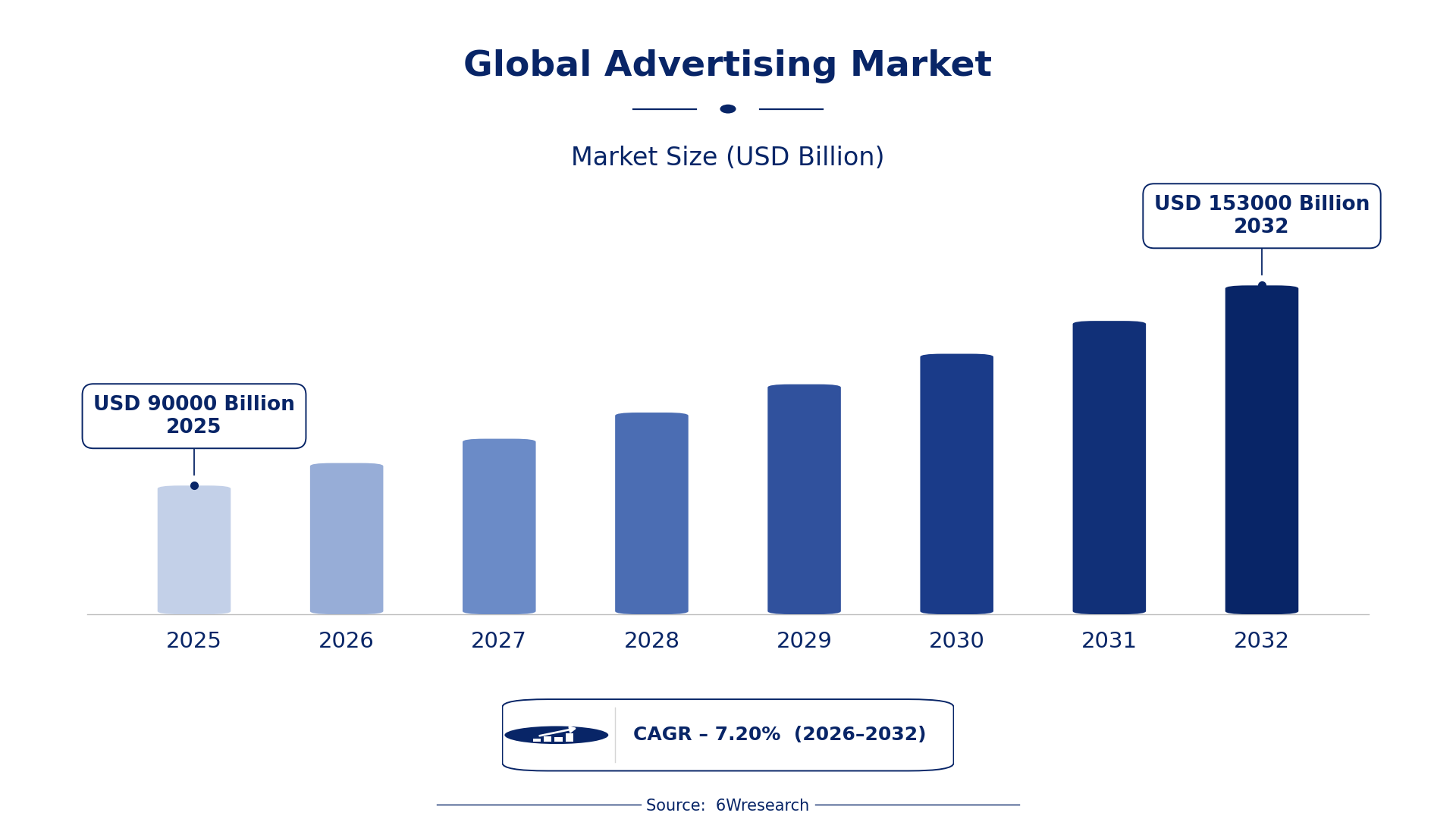
The Global Advertising Market was estimated at USD 90000 Billion in 2025 and is projected to reach USD 153000 Billion by 2032, growing at a CAGR of 7.20% from 2026 to 2032.
Global Advertising Market Synopsis
The Global Advertising Market is witnessing a substantial transformation, largely fueled by increased digital penetration and evolving consumer behaviors. Advertisers are shifting focus towards personalized experiences, utilizing data analytics to improve targeting precision. This evolution is reshaping investment strategies, with companies reallocating budgets from traditional media to online platforms.
Additionally, the rise of programmatic advertising is streamlining processes, allowing for more efficient ad placements. This technology-driven shift has made real-time bidding a significant factor, enhancing the adaptability of advertising campaigns. As these trends unfold, the differentiation between traditional and digital advertising becomes more pronounced, creating a competitive edge for early adopters.
Global Advertising Market Year-wise Growth Rate and Key Drivers
This graph illustrates the annual growth rates of the Global Advertising Market from 2022 to 2032, highlighting a steady upward trajectory and projected expansion over the forecast period.
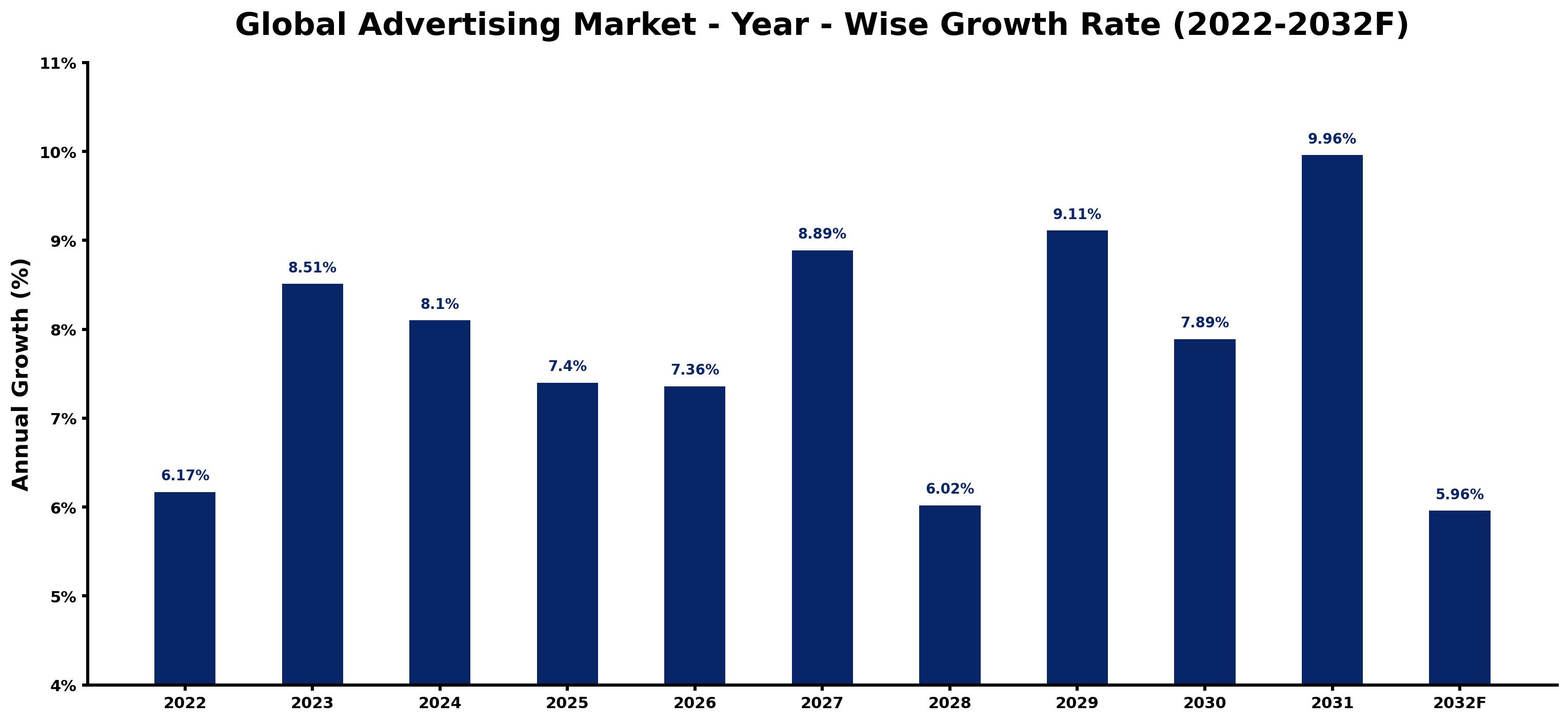
The table below presents the year‑wise growth rates along with the key drivers influencing the market
| Year | Growth Rate (%) | Major Drivers |
| 2022 | 6.17 | Advertisers faced increased raw material costs, impacting overall advertising spending strategies. |
| 2023 | 8.51 | Implementing stricter advertising regulations enhances compliance and shifts marketing approaches. |
| 2024 | 8.1 | A shift toward sustainability in advertising encourages brands to adopt ESG-focused campaigns. |
| 2025 | 7.4 | Content streaming platforms attract users, leading to higher advertising revenue opportunities. |
| 2026 | 7.36 | With advancements in digital advertising technology, targeting capabilities significantly improve. |
| 2027 | 8.89 | Expanding into emerging markets opens new channels for advertising revenue growth. |
| 2028 | 6.02 | Current supply chain disruptions challenge advertisers to adapt their strategies effectively. |
| 2029 | 9.11 | Rising consumer preference for ad-supported content is reshaping advertising strategies. |
| 2030 | 7.89 | Advertisers prioritize skilled digital marketers to enhance campaign effectiveness in targeting. |
| 2031 | 9.96 | Programmatic advertising technology is driving significant merger and acquisition activity. |
| 2032 | 5.96 | While competition among platforms increases, advertising innovation continues to shape strategies. |
Note - Market size estimations and growth projections presented in this report are based on 6Wresearch's proprietary research methodology, combining internal industry data, secondary research, and primary validation, updated periodically to reflect current market conditions. As markets evolve rapidly, figures for certain industries may vary slightly and are intended as informed estimates rather than absolute figures. For the most current market sizing, we recommend validating figures with a 6Wresearch analyst.
Global Advertising Market Key Takeaways
Below are some of the specific key takeaways from the market, including:
- Digital Advertising accounted for approximately 55% of total advertising expenditure in 2025.
- Television advertising remains a significant player, commanding ~40% market share in 2025.
- Influencer marketing is set to grow at a CAGR of 10.5% from 2026 to 2032, driven by authenticity demands from consumers.
- Programmatic ad spending is projected to reach USD 100 billion by 2032, underlining its pivotal role in future advertising strategies.
- As of 2025, mobile ad spend is anticipated to surpass USD 200 billion, reflecting the shift towards on-the-go consumption.
Evaluation of Restraints in Global Advertising Market
The Global Advertising Market faces notable constraints driven primarily by regulatory challenges and technological complexities. A significant example is the imposition of fines up to $20 million for violations associated with data privacy regulations, such as GDPR, which has affected advertisers' data collection practices across Europe. For instance, companies relying heavily on targeted ads may find their strategies curtailed due to stricter compliance requirements.
Global Advertising Market Trends
The shift towards more interactive advertising formats is reshaping engagement strategies within the Global Advertising Market. Virtual and augmented reality campaigns, employed by brands like Coca-Cola, exemplify this trend. These initiatives not only offer immersive experiences but have also shown to increase engagement rates by up to 30% in some campaigns. Moreover, the rise of AI-powered analytics is enabling advertisers to derive actionable insights from user data, leading to more strategic campaign management.
In addition, sustainability is becoming a focal point, with major companies like Unilever committing to greener advertising practices. By 2025, Unilever plans to allocate at least 20% of its advertising budget to promoting sustainable products, thereby influencing customer perceptions and preferences. Such trends highlight a significant operational shift towards leveraging technology and social consciousness in advertising strategies.
Global Advertising Market Opportunities
The Global Advertising Market presents robust opportunities anchored in the burgeoning sectors of e-commerce and digital marketing. For example, Shopify's partnership with TikTok is set to create a seamless shopping experience, projecting a revenue increase of over USD 1 billion for participating brands by the end of 2032. This innovative approach will likely drive further investments into social commerce, emphasizing direct consumer engagement.
Moreover, Connected TV (CTV) advertising is gaining traction, with estimates indicating a market size expected to reach USD 30 billion by 2032. As consumer shifts from traditional cable to streaming services accelerate, companies like Roku are reaping the benefits from increased ad revenues. These examples illustrate how adapting to technological advancements will be pivotal for marketers looking to capitalize on evolving consumer behaviors.
Global Advertising Market by Type
Television advertising is the leading segment in the Global Advertising Market, commanding a substantial share of approximately ~40% in 2025. This segment maintains its dominance due to high reach and audience engagement potential. Conversely, Digital Advertising is the fastest-growing segment with a projected CAGR of 9.5% from 2026 to 2032, attributed to the rising shift towards online platforms and consumer interactions. The operational flexibility and precise targeting capabilities of digital formats make them increasingly appealing to advertisers, allowing them to effectively engage with distinct audience segments.
Global Advertising Market by Region
North America is the largest region in the Global Advertising Market, accounting for approximately ~48% share in 2025, primarily due to a well-established advertising infrastructure and the presence of leading media companies. Meanwhile, Asia emerges as the fastest-growing region with a projected CAGR of 9.2% from 2026 to 2032, driven by rapid digital adoption and a surging middle-class population. Countries like India and China are becoming hotbeds for digital ad investments as their consumer base increasingly shifts online, fostering new opportunities for international and local brands alike.
Government Initiatives in the Global Advertising Market
The regulatory landscape governing the Global Advertising Market is continuously evolving, necessitating compliance with a range of policies aimed at consumer protection and advertising ethics. These initiatives impact how companies approach their advertising strategies and expenditure, especially in light of scrutiny regarding data privacy and misinformation.
- Federal Trade Commission (FTC) - Truth in Advertising Act, 2023: This law requires advertisers to disclose sponsorships and collaborations, impacting how influencer marketing is conducted.
- European Commission - General Data Protection Regulation (GDPR), 2018: A pivotal regulation that mandates stringent data privacy practices affecting digital advertising globally.
- Advertising Standards Authority (ASA) - Online Advertising Codes, 2022: These guidelines govern online advertisements ensuring transparency and protecting consumer interests.
- Department of Digital, Culture, Media & Sport (DCMS) - Online Safety Bill, 2023: A proposed regulation aimed at enhancing standards in online advertising practices to protect consumers from misinformation.
- Consumer Financial Protection Bureau (CFPB) - Promotions and Advertising Regulations, 2024: This upcoming policy will set stringent advertising rules specific to financial services, aiming for clearer communication to consumers.
Future Insights of the Global Advertising Market
The Global Advertising Market is anticipated to undergo transformative shifts driven by emerging technologies and enhanced consumer interactions. Notably, the integration of artificial intelligence in campaign analytics is gaining traction, with companies like WPP investing significantly in automated solutions to increase precision in audience targeting. This shift is likely to redefine engagement metrics, as advertisers become more adept at tailoring content to consumer preferences, ultimately leading to higher conversion rates through personalized advertising experiences.
Global Advertising Market Latest Developments
Recent activities among key players in the Global Advertising Market signal a strategic pivot towards digital innovation and consumer engagement enhancements. The following developments exemplify this trend:
- WPP launched an AI-driven creative optimization tool in early 2023, enhancing the effectiveness of advertising campaigns and improving return on investment for clients.
- Omnicom Group unveiled a comprehensive data analytics platform in mid-2023, designed to offer real-time insights into consumer behavior, thereby elevating the effectiveness of targeted advertising strategies.
- Publicis Groupe expanded its digital marketing capabilities through the acquisition of a leading social media analytics company in late 2022, positioning itself to leverage social trends for enhanced ad placements.
- Dentsu entered a strategic partnership with a prominent e-commerce platform in early 2023, aiming to integrate advertising solutions into online shopping experiences, providing a more streamlined customer journey.
Global Advertising Market Key Players and Industry Positioning
The competitive structure of the Global Advertising Market is characterized by a mix of consolidated and fragmented elements. Leading companies leverage technological advancements and diversified service offerings to maintain market share, while smaller firms often specialize in niche segments or innovative strategies, creating room for collaboration and competition.
| Leading Company | Core Strength | Strategic Focus |
|---|---|---|
| WPP | Expertise in integrated marketing and global reach. | Investing in AI and data-driven solutions. |
| Omnicom Group | Strong creative capabilities and strategic partnerships. | Enhancing digital analytics and consumer insights. |
| Publicis Groupe | Robust digital marketing services and global network. | Expanding e-commerce advertising solutions. |
| Dentsu | Leadership in integrated communication and media planning. | Focusing on sustainable advertising practices. |
| Interpublic Group | Diverse portfolio with a focus on metrics-driven marketing. | Strengthening programmatic advertising capabilities. |
As the competition intensifies, companies must adapt strategically to technological advancements and changing consumer preferences to sustain their market positions and capitalize on new opportunities.
Key Attractiveness of the Report
- 10 Years of Market Numbers
- Historical Data Starting from 2022 to 2025
- Base Year: 2025
- Forecast Data until 2032
- Key Performance Indicators Impacting the Market
- Major Upcoming Developments and Projects
Key Highlights of the Report:
- Global Advertising Market Outlook
- Market Size of Global Advertising Market, 2025
- Forecast of Global Advertising Market, 2032
- Historical Data and Forecast of Global Advertising Revenues & Volume for the Period 2022-2032
- Global Advertising Market Trend Evolution
- Global Advertising Market Drivers and Challenges
- Global Advertising Price Trends
- Global Advertising Porter's Five Forces
- Global Advertising Industry Life Cycle
- Historical Data and Forecast of Global Advertising Market Revenues & Volume
- Historical Data and Forecast of Global Advertising Market Revenues & Volume By Type for the Period 2022-2032
- Historical Data and Forecast of Global Advertising Market Revenues & Volume By Television for the Period 2022-2032
- Historical Data and Forecast of Global Advertising Market Revenues & Volume By Print (Newspaper and Magazine) for the Period 2022-2032
- Historical Data and Forecast of Global Advertising Market Revenues & Volume By Radio for the Period 2022-2032
- Historical Data and Forecast of Global Advertising Market Revenues & Volume By Outdoor for the Period 2022-2032
- Historical Data and Forecast of Global Advertising Market Revenues & Volume By Internet (Search, Display, Classified, Video) for the Period 2022-2032
- Historical Data and Forecast of Global Advertising Market Revenues & Volume By Mobile for the Period 2022-2032
- Historical Data and Forecast of Global Advertising Market Revenues & Volume By Cinema for the Period 2022-2032
- Historical Data and Forecast of North America Advertising Market Revenues & Volume By Type for the Period 2022-2032
- Historical Data and Forecast of North America Advertising Market Revenues & Volume By Television for the Period 2022-2032
- Historical Data and Forecast of North America Advertising Market Revenues & Volume By Print (Newspaper and Magazine) for the Period 2022-2032
- Historical Data and Forecast of North America Advertising Market Revenues & Volume By Radio for the Period 2022-2032
- Historical Data and Forecast of North America Advertising Market Revenues & Volume By Outdoor for the Period 2022-2032
- Historical Data and Forecast of North America Advertising Market Revenues & Volume By Internet (Search, Display, Classified, Video) for the Period 2022-2032
- Historical Data and Forecast of North America Advertising Market Revenues & Volume By Mobile for the Period 2022-2032
- Historical Data and Forecast of North America Advertising Market Revenues & Volume By Cinema for the Period 2022-2032
- Historical Data and Forecast of United States of America Advertising Market Revenues & Volume for the Period 2022-2032
- Historical Data and Forecast of Canada Advertising Market Revenues & Volume for the Period 2022-2032
- Historical Data and Forecast of Rest of North America Advertising Market Revenues & Volume for the Period 2022-2032
- Historical Data and Forecast of Latin America (LATAM) Advertising Market Revenues & Volume By Type for the Period 2022-2032
- Historical Data and Forecast of Latin America (LATAM) Advertising Market Revenues & Volume By Television for the Period 2022-2032
- Historical Data and Forecast of Latin America (LATAM) Advertising Market Revenues & Volume By Print (Newspaper and Magazine) for the Period 2022-2032
- Historical Data and Forecast of Latin America (LATAM) Advertising Market Revenues & Volume By Radio for the Period 2022-2032
- Historical Data and Forecast of Latin America (LATAM) Advertising Market Revenues & Volume By Outdoor for the Period 2022-2032
- Historical Data and Forecast of Latin America (LATAM) Advertising Market Revenues & Volume By Internet (Search, Display, Classified, Video) for the Period 2022-2032
- Historical Data and Forecast of Latin America (LATAM) Advertising Market Revenues & Volume By Mobile for the Period 2022-2032
- Historical Data and Forecast of Latin America (LATAM) Advertising Market Revenues & Volume By Cinema for the Period 2022-2032
- Historical Data and Forecast of Brazil Advertising Market Revenues & Volume for the Period 2022-2032
- Historical Data and Forecast of Mexico Advertising Market Revenues & Volume for the Period 2022-2032
- Historical Data and Forecast of Argentina Advertising Market Revenues & Volume for the Period 2022-2032
- Historical Data and Forecast of Rest of LATAM Advertising Market Revenues & Volume for the Period 2022-2032
- Historical Data and Forecast of Asia Advertising Market Revenues & Volume By Type for the Period 2022-2032
- Historical Data and Forecast of Asia Advertising Market Revenues & Volume By Television for the Period 2022-2032
- Historical Data and Forecast of Asia Advertising Market Revenues & Volume By Print (Newspaper and Magazine) for the Period 2022-2032
- Historical Data and Forecast of Asia Advertising Market Revenues & Volume By Radio for the Period 2022-2032
- Historical Data and Forecast of Asia Advertising Market Revenues & Volume By Outdoor for the Period 2022-2032
- Historical Data and Forecast of Asia Advertising Market Revenues & Volume By Internet (Search, Display, Classified, Video) for the Period 2022-2032
- Historical Data and Forecast of Asia Advertising Market Revenues & Volume By Mobile for the Period 2022-2032
- Historical Data and Forecast of Asia Advertising Market Revenues & Volume By Cinema for the Period 2022-2032
- Historical Data and Forecast of China Advertising Market Revenues & Volume for the Period 2022-2032
- Historical Data and Forecast of India Advertising Market Revenues & Volume for the Period 2022-2032
- Historical Data and Forecast of Japan Advertising Market Revenues & Volume for the Period 2022-2032
- Historical Data and Forecast of Rest of Asia Advertising Market Revenues & Volume for the Period 2022-2032
- Historical Data and Forecast of Africa Advertising Market Revenues & Volume By Type for the Period 2022-2032
- Historical Data and Forecast of Africa Advertising Market Revenues & Volume By Television for the Period 2022-2032
- Historical Data and Forecast of Africa Advertising Market Revenues & Volume By Print (Newspaper and Magazine) for the Period 2022-2032
- Historical Data and Forecast of Africa Advertising Market Revenues & Volume By Radio for the Period 2022-2032
- Historical Data and Forecast of Africa Advertising Market Revenues & Volume By Outdoor for the Period 2022-2032
- Historical Data and Forecast of Africa Advertising Market Revenues & Volume By Internet (Search, Display, Classified, Video) for the Period 2022-2032
- Historical Data and Forecast of Africa Advertising Market Revenues & Volume By Mobile for the Period 2022-2032
- Historical Data and Forecast of Africa Advertising Market Revenues & Volume By Cinema for the Period 2022-2032
- Historical Data and Forecast of South Africa Advertising Market Revenues & Volume for the Period 2022-2032
- Historical Data and Forecast of Nigeria Advertising Market Revenues & Volume for the Period 2022-2032
- Historical Data and Forecast of Egypt Advertising Market Revenues & Volume for the Period 2022-2032
- Historical Data and Forecast of Rest of Africa Advertising Market Revenues & Volume for the Period 2022-2032
- Historical Data and Forecast of Europe Advertising Market Revenues & Volume By Type for the Period 2022-2032
- Historical Data and Forecast of Europe Advertising Market Revenues & Volume By Television for the Period 2022-2032
- Historical Data and Forecast of Europe Advertising Market Revenues & Volume By Print (Newspaper and Magazine) for the Period 2022-2032
- Historical Data and Forecast of Europe Advertising Market Revenues & Volume By Radio for the Period 2022-2032
- Historical Data and Forecast of Europe Advertising Market Revenues & Volume By Outdoor for the Period 2022-2032
- Historical Data and Forecast of Europe Advertising Market Revenues & Volume By Internet (Search, Display, Classified, Video) for the Period 2022-2032
- Historical Data and Forecast of Europe Advertising Market Revenues & Volume By Mobile for the Period 2022-2032
- Historical Data and Forecast of Europe Advertising Market Revenues & Volume By Cinema for the Period 2022-2032
- Historical Data and Forecast of United Kingdom Advertising Market Revenues & Volume for the Period 2022-2032
- Historical Data and Forecast of France Advertising Market Revenues & Volume for the Period 2022-2032
- Historical Data and Forecast of Germany Advertising Market Revenues & Volume for the Period 2022-2032
- Historical Data and Forecast of Rest of Europe Advertising Market Revenues & Volume for the Period 2022-2032
- Historical Data and Forecast of Middle East Advertising Market Revenues & Volume By Type for the Period 2022-2032
- Historical Data and Forecast of Middle East Advertising Market Revenues & Volume By Television for the Period 2022-2032
- Historical Data and Forecast of Middle East Advertising Market Revenues & Volume By Print (Newspaper and Magazine) for the Period 2022-2032
- Historical Data and Forecast of Middle East Advertising Market Revenues & Volume By Radio for the Period 2022-2032
- Historical Data and Forecast of Middle East Advertising Market Revenues & Volume By Outdoor for the Period 2022-2032
- Historical Data and Forecast of Middle East Advertising Market Revenues & Volume By Internet (Search, Display, Classified, Video) for the Period 2022-2032
- Historical Data and Forecast of Middle East Advertising Market Revenues & Volume By Mobile for the Period 2022-2032
- Historical Data and Forecast of Middle East Advertising Market Revenues & Volume By Cinema for the Period 2022-2032
- Historical Data and Forecast of Saudi Arabia Advertising Market Revenues & Volume for the Period 2022-2032
- Historical Data and Forecast of UAE Advertising Market Revenues & Volume for the Period 2022-2032
- Historical Data and Forecast of Turkey Advertising Market Revenues & Volume for the Period 2022-2032
- Historical Data and Forecast of Rest of Middle East Advertising Market Revenues & Volume for the Period 2022-2032
- Global Advertising Market - Key Performance Indicators
- Global Advertising Market - Import Export Trade Statistics
- Global Advertising Market - Opportunity Assessment By Countries
- Global Advertising Market - Opportunity Assessment By Type
- 0
- Global Advertising Market - Top Companies Market Share
- Global Advertising Market - Top Companies Profiles
- Global Advertising Market - Comparison of Players in Technical and Operating Parameters
- Global Advertising Market - Strategic Recommendations
Markets Covered
The Global Advertising Market report provides a detailed analysis of the following market segments:
By Regions and Countries:
- North America
- Europe
- LATAM
- Middle East
- Asia
- Africa
By Type:
- Television
- Print (Newspaper
- Magazine)
- Radio
- Outdoor
- Internet (Search
- Display
- Classified
- Video)
- Mobile
- Cinema






































