Hungary Advertising Market Size, Share & Growth Rate
The Hungary Advertising Market was estimated at USD 491 Million in 2025 and is projected to reach USD 691 Million by 2032, growing at a CAGR of 5.0% from 2026 to 2032. This growth trajectory is fueled by the continued shift towards digital platforms and the rising demand for targeted, data-driven advertising solutions. With a burgeoning online consumer base and increasing mobile usage, advertisers are investing more heavily in digital strategies to enhance engagement and ROI.
Hungary Advertising Market Year-wise Growth Rate and Key Drivers
This graph highlights how the Hungary Advertising Market has steadily grown over the years, supported by major growth factors.
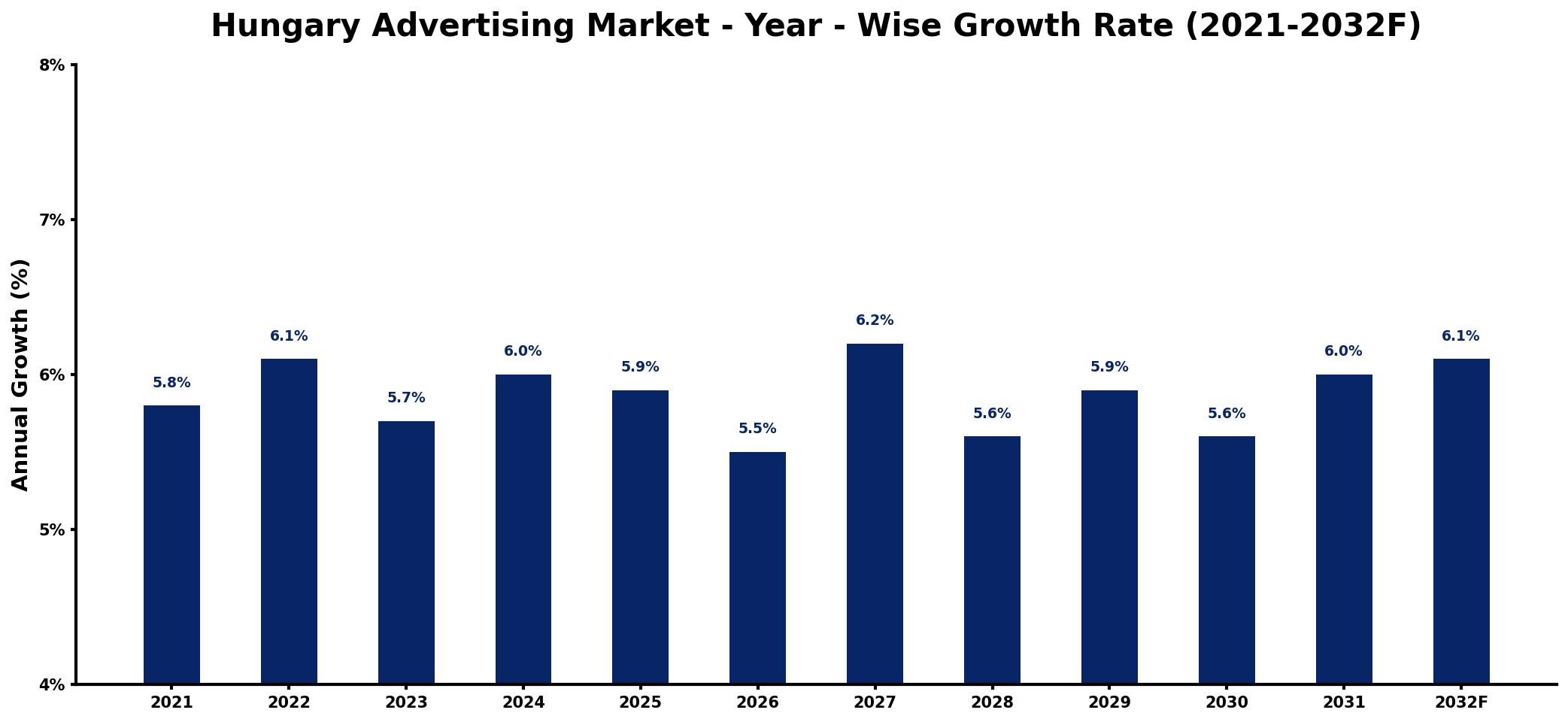
The table below presents the year‑wise growth rates along with the key drivers influencing the market
| Year | Growth Rate | Major Drivers |
| 2021 | 5.8% | Digital transformation in enterprises |
| 2022 | 6.1% | Increased consumer spending trends |
| 2023 | 5.7% | Emergence of new platforms |
| 2024 | 6.0% | Investment in creative technologies |
| 2025 | 5.9% | Expansion of mobile internet usage |
| 2026 | 5.5% | Growth in local content production |
| 2027 | 6.2% | Rise in influencer marketing strategies |
| 2028 | 5.6% | Diverse media consumption habits |
| 2029 | 5.9% | Boost in e-commerce activities |
| 2030 | 5.6% | Sustained interest in experiential marketing |
| 2031 | 6.0% | Development of data analytics tools |
| 2032 | 6.1% | Focus on sustainability initiatives |
Note: Market size estimations and growth projections presented in this report are based on 6Wresearch's proprietary forecasting methodology, utilizing the latest available industry data, government publications, and primary research inputs.
Hungary Advertising Market Synopsis
The Hungary advertising market has witnessed significant transformation, moving from a predominance of traditional media to a burgeoning digital landscape. This shift is reflected in increased spending across digital channels, particularly as consumer behaviors evolve and favor online engagement.
As advertisers adjust their strategies, theres a notable focus on personalized advertising and mobile optimization. While the market is competitive, the opportunities for brands to engage creatively with their audiences are rapidly expanding, paving the way for innovation and growth.
Hungary Advertising Market Key Takeaways
- Rapid growth in digital advertising is reshaping the market landscape.
- Investments in data-driven and programmatic advertising are becoming essential.
- The popularity of social media and mobile platforms is influencing advertising strategies.
- Regulatory compliance and ethical advertising practices are key considerations.
- New technologies and consumer trends present continual investment opportunities.
Evaluation of Restraints in Hungary Advertising Market
The Hungary advertising market faces several restraints that challenge its growth potential. One significant factor is the country's relatively small population size compared to larger European markets, which limits the reach of advertising campaigns. This constrained audience can make it difficult for advertisers to achieve optimal scale. Furthermore, the fierce competition among both local and international players complicates market penetration, as brands strive to differentiate themselves in a saturated space. The rise of ad-blocking technologies adds another layer of complexity, forcing advertisers to become more innovative in their approach to capturing consumer attention. Additionally, adherence to the evolving regulatory landscape is crucial, as any misstep can impact brand reputation and operational efficacy.
Hungary Advertising Market Trends
Current trends within the Hungary advertising market indicate a decisive move towards digital and interactive formats. Social media advertising and influencer partnerships are increasingly vital, as brands recognize the power of peer recommendations. Programmatic advertising is gaining traction, allowing for real-time ad placements that enhance targeting efficiency. Personalization is also a dominant theme; brands are employing sophisticated data analytics to tailor content and advertisements to individual preferences, thereby increasing user engagement. As mobile device usage continues to rise, mobile advertising strategies are becoming more prominent, necessitating mobile-optimized content and location-based marketing solutions.
Hungary Advertising Market Opportunities
Investment opportunities abound within the Hungary advertising market, particularly in the digital advertising sector. With a tech-savvy consumer base, brands can capitalize on the growing demand for innovative advertising solutions that blend creativity with technology. Emerging sectors like programmatic advertising and data analytics firms present lucrative avenues for investment, given their critical role in enhancing campaign effectiveness. As traditional media continues to wane, the transition to digital platforms offers fertile ground for both established players and new entrants aiming to capture market share in this evolving environment.
Government Initiatives in the Hungary Advertising Market
Government policies in Hungary play a crucial role in shaping the advertising market. The Media Act regulates advertising practices, ensuring fair competition while protecting consumers and public interests. The Media Council oversees compliance, focusing on standards that prohibit misleading advertisements and protect vulnerable demographics, such as children. Transparency is mandated in advertising practices, which includes the proper disclosure of sponsored content. These initiatives are designed to create an ethical advertising landscape that balances the needs of consumers and advertisers, fostering trust within the market.
Future Insights of the Hungary Advertising Market
Looking ahead to 2026-2032, the Hungary advertising market is poised for steady growth, driven primarily by a surge in digital ad spending and the increasing adoption of programmatic strategies. As more consumers engage with online platforms, brands will likely intensify their focus on digital channels, seeking to leverage personalized, data-driven marketing solutions. However, market dynamics will continue to evolve, influenced by regulatory changes and the competitive landscape. Overall, the future holds promise for innovation and increased investment in the advertising sector as businesses adapt to the shifting media consumption habits of Hungarian consumers.
Hungary Advertising Market Latest Developments (2025 - 2026)
In recent months, the Hungary advertising market has seen a notable shift towards enhancing digital capabilities. Brands are increasingly experimenting with immersive advertising formats and interactive content as they strive to engage consumers on digital platforms. Furthermore, the rise of artificial intelligence in programmatic advertising has become a topic of focus, driving efficiency and optimization in campaign management. As advertisers navigate the evolving landscape, collaboration among industry stakeholders has increased, aiming for shared insights that fuel market growth and innovation.
Hungary Advertising Market - Key Attractiveness of the Report
- 10 Years of Market Numbers
- Historical Data Starting from 2022 to 2025
- Base Year: 2025
- Forecast Data until 2032
- Key Performance Indicators Impacting the Market
- Major Upcoming Developments and Projects
Key Highlights of the Report:
- Hungary Advertising Market Outlook
- Market Size of Hungary Advertising Market, 2025
- Forecast of Hungary Advertising Market, 2032
- Historical Data and Forecast of Hungary Advertising Revenues & Volume for the Period 2022-2032F
- Hungary Advertising Market Trend Evolution
- Hungary Advertising Market Drivers and Challenges
- Hungary Advertising Price Trends
- Hungary Advertising Porter's Five Forces
- Hungary Advertising Industry Life Cycle
- Historical Data and Forecast of Hungary Advertising Market Revenues & Volume By Type for the Period 2022-2032F
- Historical Data and Forecast of Hungary Advertising Market Revenues & Volume By Television for the Period 2022-2032F
- Historical Data and Forecast of Hungary Advertising Market Revenues & Volume By Print (Newspaper and Magazine) for the Period 2022-2032F
- Historical Data and Forecast of Hungary Advertising Market Revenues & Volume By Radio for the Period 2022-2032F
- Historical Data and Forecast of Hungary Advertising Market Revenues & Volume By Outdoor for the Period 2022-2032F
- Historical Data and Forecast of Hungary Advertising Market Revenues & Volume By Internet (Search, Display, Classified, Video) for the Period 2022-2032F
- Historical Data and Forecast of Hungary Advertising Market Revenues & Volume By Mobile for the Period 2022-2032F
- Historical Data and Forecast of Hungary Advertising Market Revenues & Volume By Cinema for the Period 2022-2032F
- Hungary Advertising Import Export Trade Statistics
- Market Opportunity Assessment By Type
- Hungary Advertising Top Companies Market Share
- Hungary Advertising Competitive Benchmarking By Technical and Operational Parameters
- Hungary Advertising Company Profiles
- Hungary Advertising Key Strategic Recommendations






































