Ghana Carbon Credit Market Size, Share & Growth Rate
The Ghana Carbon Credit Market was estimated at USD 362 Million in 2025 and is projected to reach USD 509 Million by 2032, growing at a CAGR of 5.0% from 2026 to 2032. This growth trajectory is primarily driven by increased investments in renewable energy and sustainable land use practices. As Ghana intensifies its commitment to the Paris Agreement, companies are increasingly recognizing the financial incentives associated with carbon credits.
Ghana Carbon Credit Market Year-wise Growth Rate and Key Drivers
This graph highlights how the Ghana Carbon Credit Market has steadily grown over the years, supported by major growth factors.
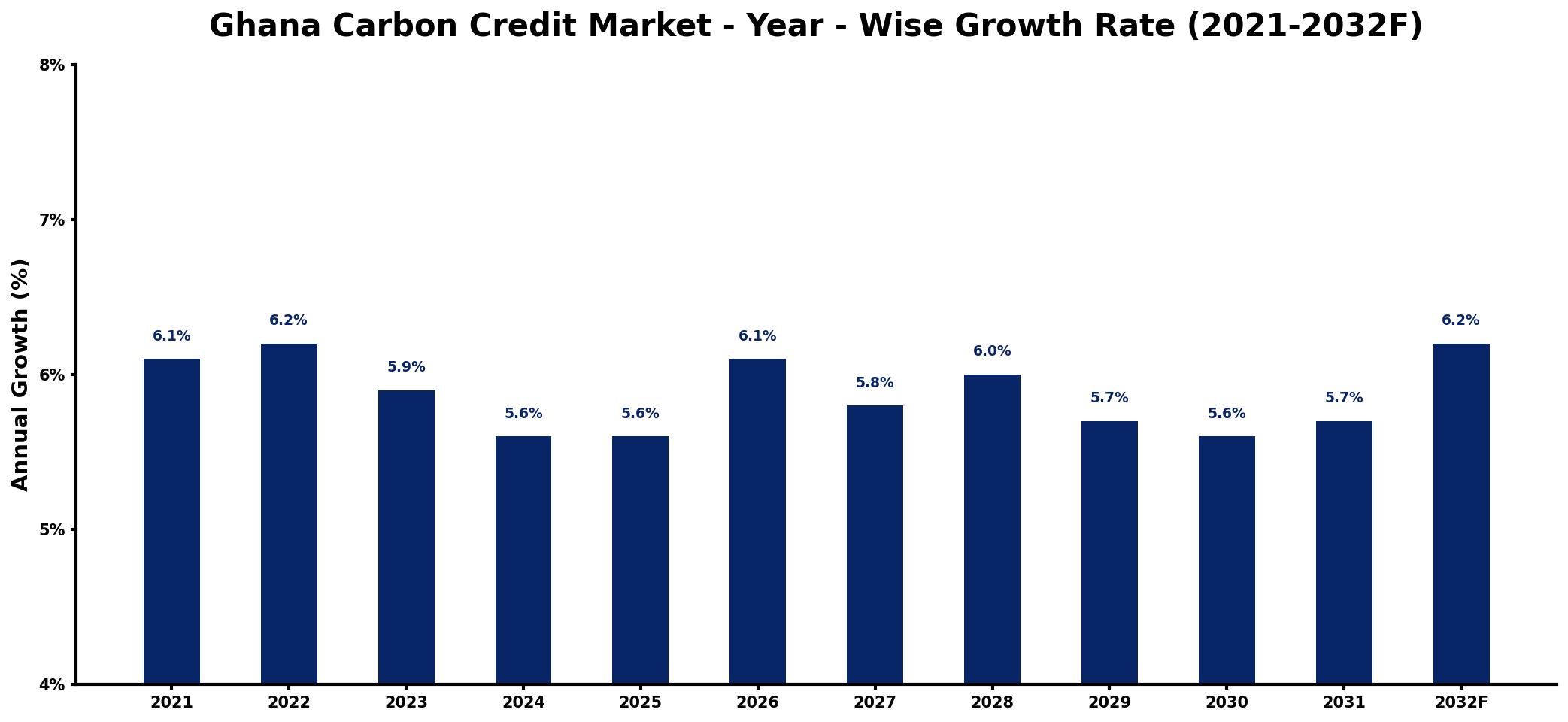
The table below presents the year‑wise growth rates along with the key drivers influencing the market
| Year | Growth Rate | Major Drivers |
| 2021 | 6.1% | Increased renewable energy investments |
| 2022 | 6.2% | Growing interest in sustainability initiatives |
| 2023 | 5.9% | Expansion of environmental regulations |
| 2024 | 5.6% | Rising corporate social responsibility focus |
| 2025 | 5.6% | Enhanced public awareness campaigns |
| 2026 | 6.1% | Emergence of new technology solutions |
| 2027 | 5.8% | strengthening underlying market demand |
| 2028 | 6.0% | Diversification of green finance options |
| 2029 | 5.7% | Increased participation in global markets |
| 2030 | 5.6% | Development of innovative financing mechanisms |
| 2031 | 5.7% | Strengthened local community engagement |
| 2032 | 6.2% | improved processing technologies adoption |
Note: Market size estimations and growth projections presented in this report are based on 6Wresearch's proprietary forecasting methodology, utilizing the latest available industry data, government publications, and primary research inputs.
Ghana Carbon Credit Market Synopsis
The Ghana Carbon Credit Market is gaining momentum as a vital component of the countrys environmental and economic strategy. Focused on projects that mitigate greenhouse gas emissions, the market is particularly active in renewable energy, energy efficiency initiatives, and sustainable agricultural practices. This diverse project portfolio creates unique opportunities for both local and international investors.
With the rising global emphasis on sustainability, Ghana is positioned to benefit from a growing interest in carbon credit projects. Organizations can capitalize on this by implementing innovative solutions that not only contribute to emission reductions but also enhance economic growth and promote job creation across various sectors.
Ghana Carbon Credit Market Key Takeaways
- The market is projected to grow from USD 362 Million in 2025 to USD 509 Million by 2032, indicating robust interest in sustainability initiatives.
- Major sectors driving this growth include renewable energy, sustainable agriculture, and energy efficiency projects.
- Government policies are actively fostering a favorable regulatory environment for carbon credit trading.
- Investors can expect potential financial returns while supporting environmental conservation efforts.
- International collaborations are on the rise, enhancing Ghana's standing in the global carbon market.
Evaluation of Restraints in Ghana Carbon Credit Market
Despite its promising outlook, the Ghana Carbon Credit Market faces several challenges that limit its expansion. One significant barrier is the general lack of awareness among potential participants regarding the mechanisms and advantages of carbon credits. This knowledge gap can impede widespread adoption and engagement in the market. Additionally, the absence of standardized methodologies for measuring and verifying emissions reductions hampers accurate reporting and trading, leading to uncertainty. Furthermore, the limited infrastructure and high transaction costs often discourage participation, especially from small-scale projects that could drive innovation and diversity in the market.
Ghana Carbon Credit Market Trends
The market is witnessing a notable increase in projects focusing on solar and wind energy, reflecting a shift towards cleaner energy sources. Concurrently, there is heightened interest in agroforestry and sustainable agricultural practices that not only sequester carbon but also improve soil health and biodiversity. The active participation of both public and private sectors is also shaping the landscape, with collaborations aimed at enhancing project viability and scalability. These trends indicate a collective drive towards a more sustainable approach to combatting climate change in Ghana.
Ghana Carbon Credit Market Opportunities
For investors, the Ghana Carbon Credit Market presents a range of lucrative opportunities. With a focus on emissions reduction and environmental sustainability, there is a high demand for carbon credits from projects that deliver measurable impacts. Investors can engage in various initiatives, including renewable energy projects, reforestation, and energy efficiency programs. Not only can they achieve financial returns, but they also play a pivotal role in supporting Ghanas transition to a low-carbon economy and contributing to significant social and environmental benefits.
Government Initiatives in the Ghana Carbon Credit Market
The Ghanaian government has enacted several policies to encourage the growth of the carbon credit market. The National Climate Change Policy Framework is a cornerstone initiative designed to promote sustainable development while aiming for substantial greenhouse gas emission reductions. Additionally, the establishment of the Ghana National Clean Development Mechanism (CDM) Office facilitates the implementation of CDM projects, further enhancing the market's efficiency. Other significant measures include the Renewable Energy Act and the National Energy Policy, both aimed at increasing energy efficiency and fostering cleaner energy use. Together, these initiatives create a solid foundation for future market growth.
Future Insights of the Ghana Carbon Credit Market
Looking ahead to the period from 2026 to 2032, the Ghana Carbon Credit Market is set for substantial growth. Increasing awareness of climate change, combined with proactive governmental policies, will likely stimulate investment in carbon offset projects. The engagement of businesses in sustainable practices will be critical as Ghana continues to align with global climate goals. Furthermore, as demand for carbon credits intensifies internationally, Ghana is poised to attract both domestic and foreign investors eager to participate in the global carbon trading landscape.
Ghana Carbon Credit Market Latest Developments (2025 - 2026)
Recent developments indicate a growing shift towards public-private partnerships aimed at facilitating large-scale carbon credit projects. Efforts are also being made to enhance regulatory clarity and increase capacity building among stakeholders. Collaborative international projects are emerging, particularly in the renewable energy sector, which are expected to bolster the credibility of Ghanas carbon credits on the global market. As the market evolves, these advancements will play a crucial role in shaping its future trajectory.
Ghana Carbon Credit Market - Key Attractiveness of the Report
- 10 Years of Market Numbers
- Historical Data Starting from 2022 to 2025
- Base Year: 2025
- Forecast Data until 2032
- Key Performance Indicators Impacting the Market
- Major Upcoming Developments and Projects
Key Highlights of the Report:
- Ghana Carbon Credit Market Outlook
- Market Size of Ghana Carbon Credit Market, 2025
- Forecast of Ghana Carbon Credit Market, 2032
- Historical Data and Forecast of Ghana Carbon Credit Revenues & Volume for the Period 2022-2032F
- Ghana Carbon Credit Market Trend Evolution
- Ghana Carbon Credit Market Drivers and Challenges
- Ghana Carbon Credit Price Trends
- Ghana Carbon Credit Porter's Five Forces
- Ghana Carbon Credit Industry Life Cycle
- Historical Data and Forecast of Ghana Carbon Credit Market Revenues & Volume By Sector for the Period 2022-2032F
- Historical Data and Forecast of Ghana Carbon Credit Market Revenues & Volume By Energy for the Period 2022-2032F
- Historical Data and Forecast of Ghana Carbon Credit Market Revenues & Volume By Transportation for the Period 2022-2032F
- Historical Data and Forecast of Ghana Carbon Credit Market Revenues & Volume By Residential And Commercial Buildings for the Period 2022-2032F
- Historical Data and Forecast of Ghana Carbon Credit Market Revenues & Volume By Industry for the Period 2022-2032F
- Historical Data and Forecast of Ghana Carbon Credit Market Revenues & Volume By Agriculture for the Period 2022-2032F
- Historical Data and Forecast of Ghana Carbon Credit Market Revenues & Volume By Forestry for the Period 2022-2032F
- Historical Data and Forecast of Ghana Carbon Credit Market Revenues & Volume By Water And Wastewater for the Period 2022-2032F
- Ghana Carbon Credit Import Export Trade Statistics
- Market Opportunity Assessment By Sector
- Ghana Carbon Credit Top Companies Market Share
- Ghana Carbon Credit Competitive Benchmarking By Technical and Operational Parameters
- Ghana Carbon Credit Company Profiles
- Ghana Carbon Credit Key Strategic Recommendations






































