Ghana Connected Mining Market Size & Growth Rate (2026-2032)
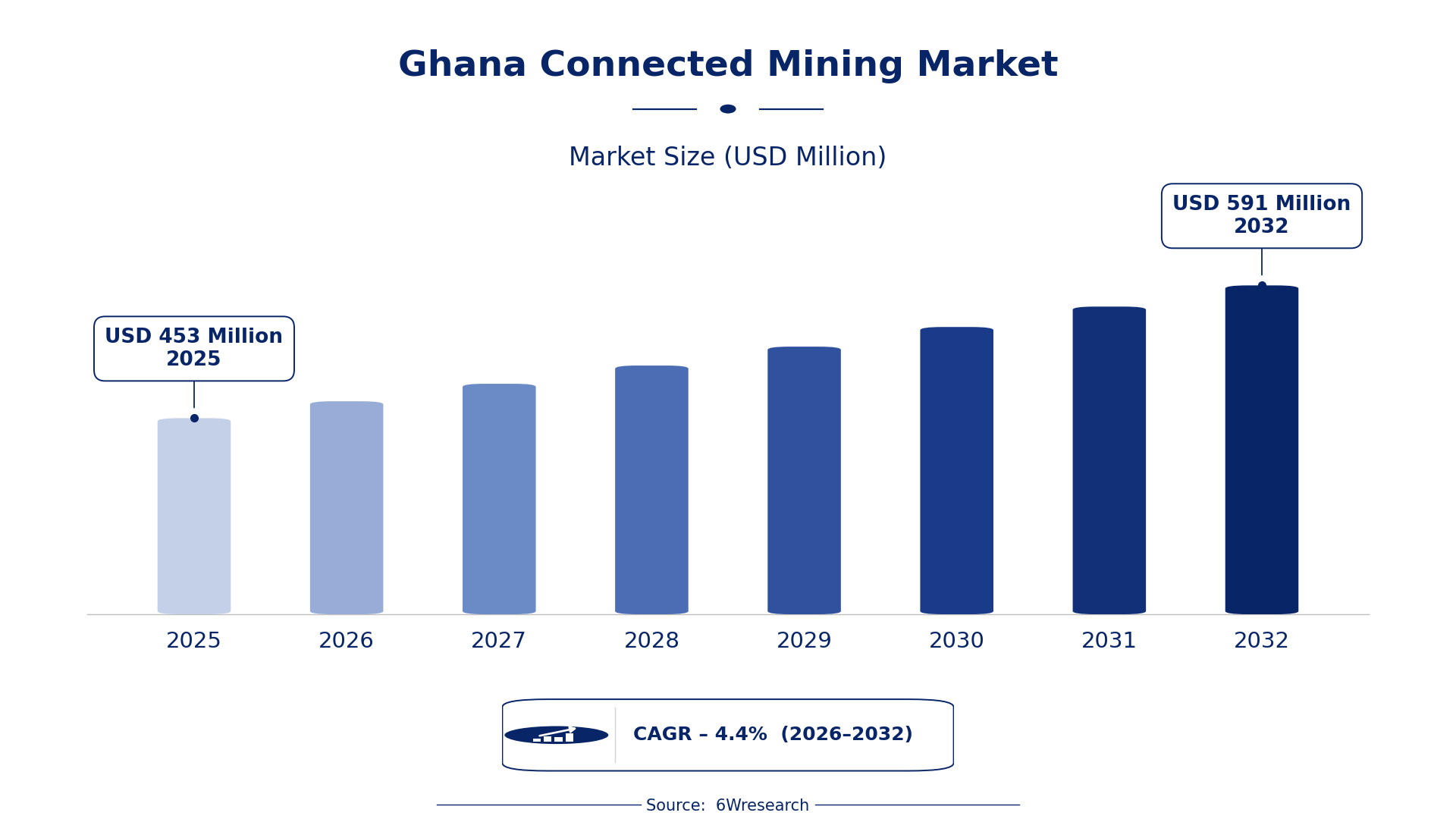
The Ghana Connected Mining Market was estimated at USD 453 Million in 2025 and is projected to reach USD 591 Million by 2032, growing at a CAGR of 4.4% from 2026 to 2032.
Ghana Connected Mining Market Synopsis
The rapid adoption of digital technologies is the primary force shaping the Ghana Connected Mining Market today. Mining operations are increasingly leveraging IoT devices and data analytics, which enable real-time monitoring and predictive maintenance.
As companies strive to enhance productivity and reduce operational costs, the integration of automation and robotics is becoming commonplace. This trend not only improves safety but also aligns with the government's push for sustainable mining practices and infrastructure development.
Ghana Connected Mining Market Year-wise Growth Rate and Key Drivers
This graph illustrates the annual growth rates of the Ghana Connected Mining Market from 2021 to 2032, highlighting a steady upward trajectory and projected expansion over the forecast period.
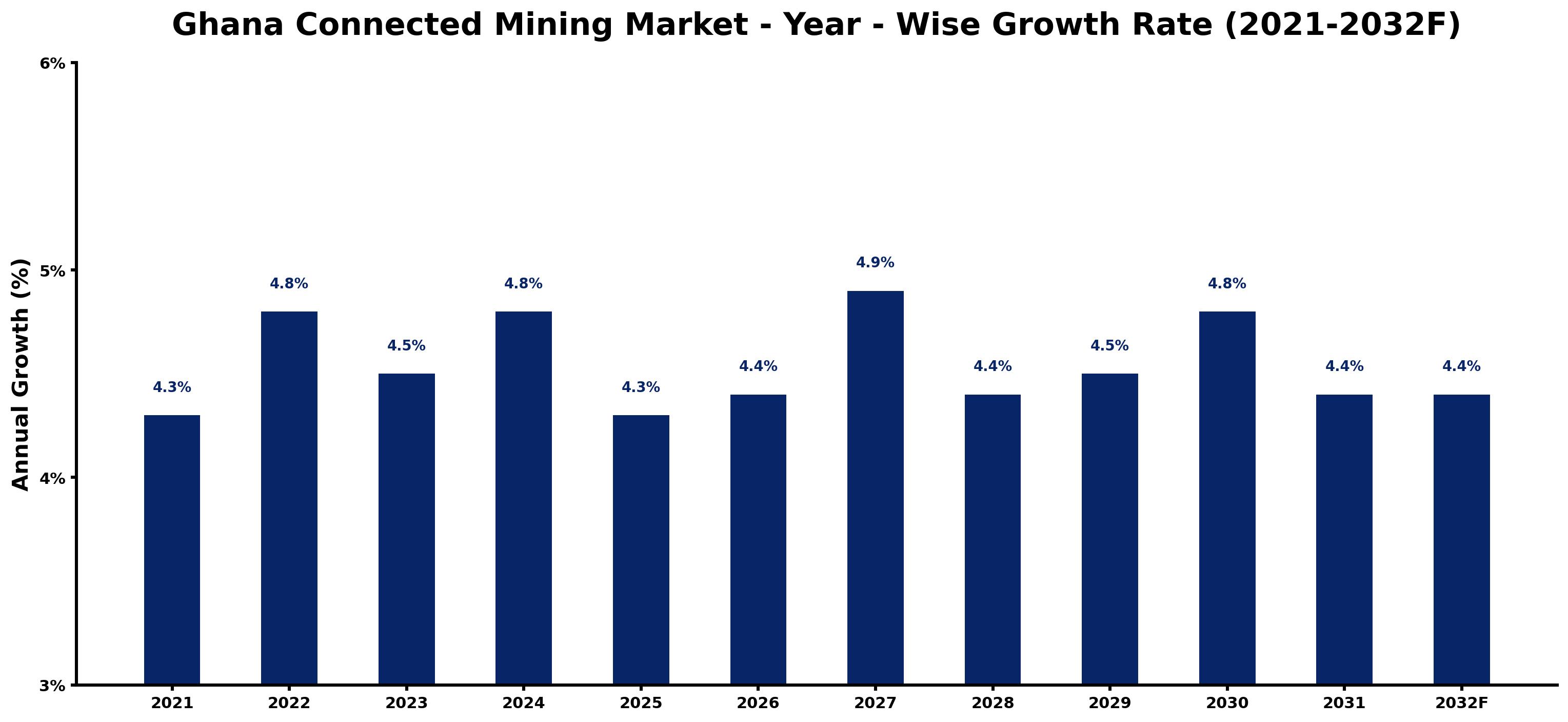
The table below presents the year‑wise growth rates along with the key drivers influencing the market
| Year | Growth Rate | Major Drivers |
| 2021 | 4.3% | Government's Digital Ghana initiative boosting mining automation |
| 2022 | 4.8% | Increased foreign investment in sustainable mining technologies |
| 2023 | 4.5% | Implementation of local content policies enhancing technology adoption |
| 2024 | 4.8% | Growing adoption of IoT for operational efficiency |
| 2025 | 4.3% | Rise in mobile network availability aiding mining connectivity |
| 2026 | 4.4% | Incentives for renewable energy usage in mining operations |
| 2027 | 4.9% | Youth workforce training programs increasing tech-savvy labor pool |
| 2028 | 4.4% | Regulatory support for data-driven mining practices |
| 2029 | 4.5% | Increased focus on environmental compliance driving innovation |
| 2030 | 4.8% | Partnerships with local universities fostering mining tech research |
| 2031 | 4.4% | Mining corporations prioritizing digital transformation initiatives |
| 2032 | 4.4% | Rising export demand for ethically sourced minerals |
Note: Market size estimations and growth projections presented in this report are based on 6Wresearch's proprietary forecasting methodology, utilizing the latest available industry data, government publications, and primary research inputs.
Ghana Connected Mining Market Key Takeaways
Below are some of the specific key takeaways from the market, including:
- The market is driven by the integration of IoT and data analytics for operational efficiency.
- Government initiatives support the transition towards sustainable mining practices.
- Investments in advanced technologies like AI are on the rise among industry players.
- Challenges such as limited internet access and a skilled workforce remain significant.
- Growing focus on cybersecurity solutions is crucial for data protection in mining.
Evaluation of Restraints in Ghana Connected Mining Market
The Ghana Connected Mining Market faces several restraints that can impede growth. A primary challenge is the limited access to reliable internet connectivity in remote mining regions, which hampers the effective deployment of connected technologies. on top of that, the lack of skilled professionals proficient in digital technologies restricts companies from fully capitalizing on available solutions. Regulatory complexities and data privacy concerns also pose hurdles, requiring companies to navigate a challenging compliance landscape.
Ghana Connected Mining Market Trends
Several key trends are emerging in the Ghana Connected Mining Market. The adoption of IoT devices for real-time equipment monitoring is gaining traction, allowing mining companies to enhance operational efficiency. Additionally, data analytics is increasingly being used for predictive maintenance, helping to minimize downtime. There is also a notable shift towards automation and robotics, which are being integrated to improve safety standards and streamline processes. on top of that, companies are prioritizing sustainable practices to reduce environmental impact, reflecting a broader industry commitment to responsible mining.
Ghana Connected Mining Market Opportunities
The Ghana Connected Mining Market is rife with investment opportunities. Companies focused on developing IoT solutions, predictive maintenance technologies, and automation processes are particularly well-positioned for growth. There is also a rising demand for cybersecurity measures to safeguard sensitive data within the mining sector. Collaborations with local firms to provide tailored technological solutions can yield long-term partnerships and contribute to the overall expansion of the industry.
Government Initiatives in the Ghana Connected Mining Market
The Ghanaian government is actively fostering an environment conducive to the growth of the Connected Mining Market. Various policies and initiatives are designed to promote technological adoption and improve the sector's infrastructure. These efforts are essential as they align with national priorities for sustainable development and economic growth.
- A national digital infrastructure upgrade programme now in its rollout phase aims to enhance connectivity in remote mining areas.
- The Ghana Innovation and Technology Summit, recently completed, encouraged the adoption of innovative technologies in mining.
- Current initiatives include ongoing workshops to train the workforce on digital technologies relevant to mining operations.
- A regulatory framework introduced in 2025 mandates greater transparency in mining operations, fostering trust and compliance.
- Planned public-private initiatives are expected to expand access to reliable energy sources by 2028, crucial for technology deployment.
Future Insights of the Ghana Connected Mining Market
Looking ahead to 2026-2032, the Ghana Connected Mining Market appears to be on an upward trajectory. The continued integration of advanced technologies such as IoT, AI, and automation is set to redefine operational standards in the mining sector. Demand for real-time monitoring and predictive analytics will likely escalate, driven by the need for improved efficiency and reduced downtime. With the government's commitment to sustainable practices, the adoption of connected technologies will also align with regulatory requirements, further propelling market growth.
Ghana Connected Mining Market Latest Developments
In the past year, the Ghana Connected Mining Market has seen a flurry of activity aimed at enhancing technological integration and operational efficiency. Companies are increasingly investing in digital solutions to meet the evolving demands of the industry, as the focus on sustainable mining continues to intensify.
- A major technology vendor launched a new IoT platform in Q1 2025, designed to facilitate real-time monitoring of mining equipment.
- An initiative that began in mid-2025 and remains underway focuses on developing local talent through targeted training programs in digital mining technologies.
- In late 2025, a leading regional operator upgraded its cybersecurity infrastructure to protect against potential data breaches.
- A rollout expected to begin in the second half of 2026 will introduce automation technologies aimed at improving safety and operational efficiency.
- Recent collaborations between mining firms and tech providers are fostering innovation, with several projects currently in the planning stage.
Ghana Connected Mining Market - Key Attractiveness of the Report
- 10 Years of Market Numbers
- Historical Data Starting from 2022 to 2025
- Base Year: 2025
- Forecast Data until 2032
- Key Performance Indicators Impacting the Market
- Major Upcoming Developments and Projects
Key Highlights of the Report:
- Ghana Connected Mining Market Outlook
- Market Size of Ghana Connected Mining Market, 2025
- Forecast of Ghana Connected Mining Market, 2032
- Historical Data and Forecast of Ghana Connected Mining Revenues & Volume for the Period 2022-2032F
- Ghana Connected Mining Market Trend Evolution
- Ghana Connected Mining Market Drivers and Challenges
- Ghana Connected Mining Price Trends
- Ghana Connected Mining Porter's Five Forces
- Ghana Connected Mining Industry Life Cycle
- Historical Data and Forecast of Ghana Connected Mining Market Revenues & Volume By Component for the Period 2022-2032F
- Historical Data and Forecast of Ghana Connected Mining Market Revenues & Volume By Solutions for the Period 2022-2032F
- Historical Data and Forecast of Ghana Connected Mining Market Revenues & Volume By Services for the Period 2022-2032F
- Historical Data and Forecast of Ghana Connected Mining Market Revenues & Volume By Service for the Period 2022-2032F
- Historical Data and Forecast of Ghana Connected Mining Market Revenues & Volume By Professional for the Period 2022-2032F
- Historical Data and Forecast of Ghana Connected Mining Market Revenues & Volume By Managed for the Period 2022-2032F
- Historical Data and Forecast of Ghana Connected Mining Market Revenues & Volume By Solution for the Period 2022-2032F
- Historical Data and Forecast of Ghana Connected Mining Market Revenues & Volume By Asset Tracking and Optimization for the Period 2022-2032F
- Historical Data and Forecast of Ghana Connected Mining Market Revenues & Volume By Fleet Management for the Period 2022-2032F
- Historical Data and Forecast of Ghana Connected Mining Market Revenues & Volume By Industrial Safety and Security for the Period 2022-2032F
- Historical Data and Forecast of Ghana Connected Mining Market Revenues & Volume By Workforce Management for the Period 2022-2032F
- Historical Data and Forecast of Ghana Connected Mining Market Revenues & Volume By Analytics and Reporting for the Period 2022-2032F
- Historical Data and Forecast of Ghana Connected Mining Market Revenues & Volume By Process Control for the Period 2022-2032F
- Historical Data and Forecast of Ghana Connected Mining Market Revenues & Volume By Others for the Period 2022-2032F
- Historical Data and Forecast of Ghana Connected Mining Market Revenues & Volume By Application for the Period 2022-2032F
- Historical Data and Forecast of Ghana Connected Mining Market Revenues & Volume By Exploration for the Period 2022-2032F
- Historical Data and Forecast of Ghana Connected Mining Market Revenues & Volume By Processing and Refining for the Period 2022-2032F
- Historical Data and Forecast of Ghana Connected Mining Market Revenues & Volume By Transportation for the Period 2022-2032F
- Historical Data and Forecast of Ghana Connected Mining Market Revenues & Volume By Deployment Mode for the Period 2022-2032F
- Historical Data and Forecast of Ghana Connected Mining Market Revenues & Volume By On-premises for the Period 2022-2032F
- Historical Data and Forecast of Ghana Connected Mining Market Revenues & Volume By Cloud for the Period 2022-2032F
- Historical Data and Forecast of Ghana Connected Mining Market Revenues & Volume By Mining Type for the Period 2022-2032F
- Historical Data and Forecast of Ghana Connected Mining Market Revenues & Volume By Surface for the Period 2022-2032F
- Historical Data and Forecast of Ghana Connected Mining Market Revenues & Volume By Underground for the Period 2022-2032F
- Ghana Connected Mining Import Export Trade Statistics
- Market Opportunity Assessment By Component
- Market Opportunity Assessment By Service
- Market Opportunity Assessment By Solution
- Market Opportunity Assessment By Application
- Market Opportunity Assessment By Deployment Mode
- Market Opportunity Assessment By Mining Type
- Ghana Connected Mining Top Companies Market Share
- Ghana Connected Mining Competitive Benchmarking By Technical and Operational Parameters
- Ghana Connected Mining Company Profiles
- Ghana Connected Mining Key Strategic Recommendations






































