Ghana Cyber Security Market Size & Growth Rate (2026-2032)
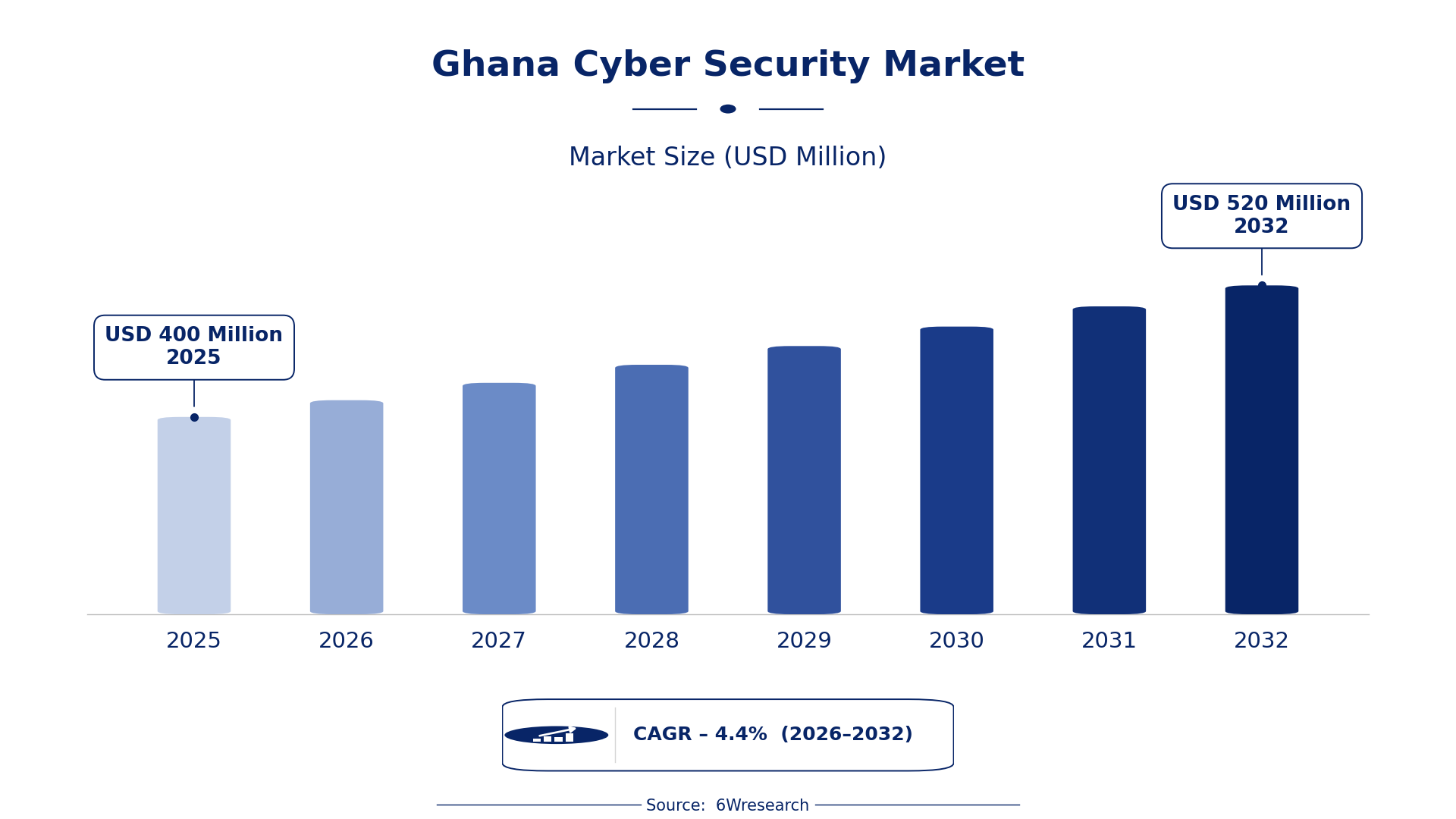
The Ghana Cyber Security Market was estimated at USD 400 Million in 2025 and is projected to reach USD 520 Million by 2032, growing at a CAGR of 4.4% from 2026 to 2032.
Ghana Cyber Security Market Synopsis
The Ghana Cyber Security Market is at a crucial juncture, driven by the rapid digitalization of both public and private sectors. As businesses and government services increasingly rely on digital platforms, the risk of cyber threats grows significantly, pushing organizations to prioritize cybersecurity investments.
Key industries such as banking, healthcare, and telecommunications are leading the charge, implementing advanced cybersecurity measures to protect sensitive data and maintain consumer trust. This upsurge in demand is further enhanced by stricter regulations surrounding data protection and privacy, encouraging a shift towards comprehensive security solutions.
Ghana Cyber Security Market Year-wise Growth Rate and Key Drivers
This graph illustrates the annual growth rates of the Ghana Cyber Security Market from 2021 to 2032, highlighting a steady upward trajectory and projected expansion over the forecast period.
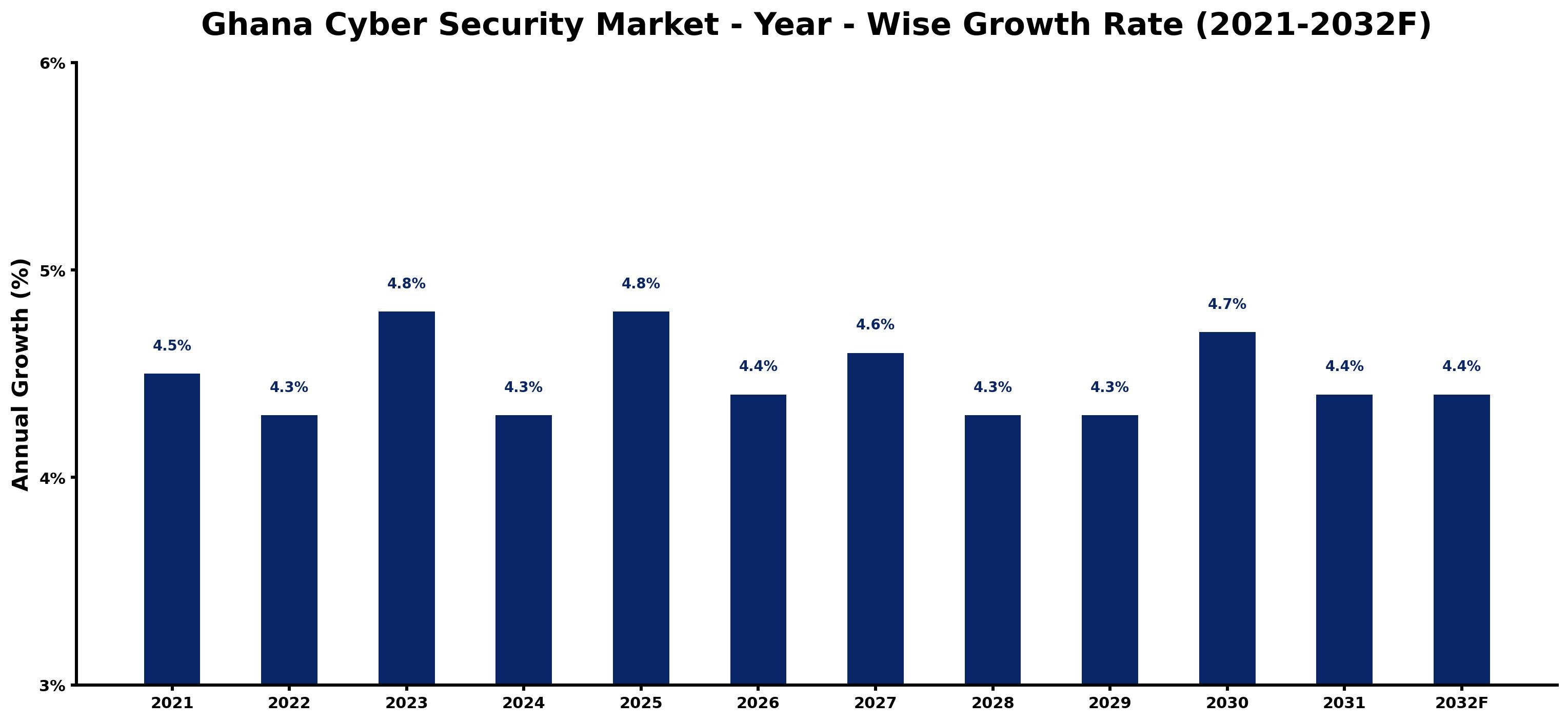
The table below presents the year‑wise growth rates along with the key drivers influencing the market
| Year | Growth Rate | Major Drivers |
| 2021 | 4.5% | Cybersecurity Authority of Ghana enhancing digital regulations. |
| 2022 | 4.3% | Increased mobile payment services fueling security needs. |
| 2023 | 4.8% | Rising cybercrime incidents driving security investments. |
| 2024 | 4.3% | National Cybersecurity Awareness Month promoting safety initiatives. |
| 2025 | 4.8% | Government funding for digital infrastructure security upgrades. |
| 2026 | 4.4% | Surge in remote work increasing cybersecurity solution adoption. |
| 2027 | 4.6% | Emergence of local cybersecurity startups boosting innovation. |
| 2028 | 4.3% | Educational programs raising cybersecurity awareness among youth. |
| 2029 | 4.3% | Banks prioritizing cybersecurity for customer data protection. |
| 2030 | 4.7% | Investment in cybersecurity training programs by NGOs. |
| 2031 | 4.4% | New KYC regulations enhancing demand for security solutions. |
| 2032 | 4.4% | Public sector increasing budgets for cybersecurity resilience. |
Note: Market size estimations and growth projections presented in this report are based on 6Wresearch's proprietary forecasting methodology, utilizing the latest available industry data, government publications, and primary research inputs.
Ghana Cyber Security Market Key Takeaways
Below are some of the specific key takeaways from the market, including:
- The market is witnessing a surge in the adoption of cloud security solutions.
- There is a heightened focus on threat intelligence and proactive risk assessment services.
- Organizations are increasingly seeking managed security services to enhance their defenses.
- Government initiatives are creating a conducive environment for cybersecurity investment.
- The demand for skilled cybersecurity professionals is rising, emphasizing the need for training programs.
Evaluation of Restraints in Ghana Cyber Security Market
Despite its growth, the Ghana Cyber Security Market faces several limitations that may impede progress. A pervasive lack of awareness among businesses about cybersecurity risks hampers the effectiveness of implemented measures. Additionally, many organizations allocate insufficient budgets for cybersecurity, leaving them vulnerable to attacks. The shortage of skilled professionals further compounds these issues, as companies struggle to find and retain talent capable of addressing the increasing complexity of cyber threats. Inadequate regulatory frameworks add another layer of challenge, as the enforcement of compliance measures can be sporadic and inconsistent.
Ghana Cyber Security Market Trends
Several trends are emerging within the Ghana Cyber Security Market that reflect its evolving dynamics. An increasing focus on cloud security highlights the growing dependency on digital infrastructure. Businesses are also investing heavily in endpoint protection solutions as mobile devices become prime targets for cybercriminals. Furthermore, the demand for threat intelligence solutions is on the rise, driven by the necessity for organizations to stay one step ahead of potential attacks. This heightened awareness is spurred by recent regulatory requirements, such as the Data Protection Act 2012 (Act 843), which underscores the importance of compliance and risk management.
Ghana Cyber Security Market Opportunities
The Ghana Cyber Security Market is ripe with investment opportunities. With increasing digitization across sectors, there is a growing need for tailored cybersecurity solutions. Companies specializing in threat intelligence, incident response, and network security stand to gain significantly. Additionally, there is a clear demand for training programs aimed at equipping the workforce with essential cybersecurity skills. As awareness of cyber threats grows among individuals and organizations alike, the market is expected to see a consistent influx of investment in cybersecurity solutions and services.
Government Initiatives in the Ghana Cyber Security Market
The Ghanaian government plays a crucial role in shaping the cyber security landscape through various policies and initiatives. By prioritizing cybersecurity at the national level, the government aims to cultivate a secure environment conducive to digital transactions. Key initiatives include the establishment of regulatory frameworks that seek to standardize practices and enhance overall security.
- A recent initiative is the establishment of the National Cyber Security Centre (NCSC), designed to coordinate governmental cyber initiatives and provide essential training.
- A current focus is on the implementation of the National Cyber Security Policy and Strategy, which aims to enhance national cyber resilience.
- Ongoing educational campaigns are being conducted to raise awareness about cybersecurity threats among the public and businesses.
- A planned public-private partnership expected to launch by mid-2026 will facilitate collaboration between government entities and private companies to strengthen cybersecurity infrastructure.
- The government aims to introduce regulations mandating compliance with the Data Protection Act, fostering a culture of accountability in data handling.
Future Insights of the Ghana Cyber Security Market
Looking ahead to 2026-2032, the Ghana Cyber Security Market is positioned for substantial growth. Digital transformation across sectors is expected to accelerate, with organizations increasingly relying on technology for their operations. As the complexity and frequency of cyber threats rise, businesses will be compelled to invest in advanced security solutions. Government support for regulatory frameworks will further drive the market, ensuring that businesses adhere to necessary compliance standards. In this environment, organizations will prioritize safeguarding their digital assets against evolving threats.
Ghana Cyber Security Market Latest Developments
Recent developments in the Ghana Cyber Security Market indicate a positive momentum towards enhanced cybersecurity measures. Organizations are actively pursuing strategies to address vulnerabilities, reflecting a shift in mindset regarding cyber risk management. The increasing number of cyber incidents has catalyzed this change, prompting both private and public sectors to act decisively.
- A major technology vendor launched a comprehensive cybersecurity solution aimed at small and medium-sized enterprises in Q1 2025, addressing their unique security challenges.
- In mid-2025, a significant training program for cybersecurity professionals was initiated to close the skills gap affecting the market.
- A notable partnership was formed between a regional operator and local cybersecurity firms in early 2025 to enhance threat detection capabilities.
- An initiative focused on developing a national incident response framework is currently underway, expected to be finalized by late 2025.
- There is a rollout planned for an updated version of the national cybersecurity strategy in 2026 to incorporate emerging threats and technological advancements.
Ghana Cyber Security Market - Key Attractiveness of the Report
- 10 Years of Market Numbers
- Historical Data Starting from 2022 to 2025
- Base Year: 2025
- Forecast Data until 2032
- Key Performance Indicators Impacting the Market
- Major Upcoming Developments and Projects
The Ghanaian government has established the National Cyber Security Centre to guide cyber initiatives and promote training. Additionally, the National Cyber Security Policy and Strategy is currently being implemented to bolster the nation’s cybersecurity posture.
Key Highlights of the Report:
- Ghana Cyber Security Market Outlook
- Market Size of Ghana Cyber Security Market, 2025
- Forecast of Ghana Cyber Security Market, 2032
- Historical Data and Forecast of Ghana Cyber Security Revenues & Volume for the Period 2022-2032F
- Ghana Cyber Security Market Trend Evolution
- Ghana Cyber Security Market Drivers and Challenges
- Ghana Cyber Security Price Trends
- Ghana Cyber Security Porter's Five Forces
- Ghana Cyber Security Industry Life Cycle
- Historical Data and Forecast of Ghana Cyber Security Market Revenues & Volume By Component for the Period 2022-2032F
- Historical Data and Forecast of Ghana Cyber Security Market Revenues & Volume By Software for the Period 2022-2032F
- Historical Data and Forecast of Ghana Cyber Security Market Revenues & Volume By Hardware for the Period 2022-2032F
- Historical Data and Forecast of Ghana Cyber Security Market Revenues & Volume By Services for the Period 2022-2032F
- Historical Data and Forecast of Ghana Cyber Security Market Revenues & Volume By Software for the Period 2022-2032F
- Historical Data and Forecast of Ghana Cyber Security Market Revenues & Volume By IAM for the Period 2022-2032F
- Historical Data and Forecast of Ghana Cyber Security Market Revenues & Volume By Antivirus/Antimalware for the Period 2022-2032F
- Historical Data and Forecast of Ghana Cyber Security Market Revenues & Volume By Log Management and SIEM for the Period 2022-2032F
- Historical Data and Forecast of Ghana Cyber Security Market Revenues & Volume By Encryption and Tokenization for the Period 2022-2032F
- Historical Data and Forecast of Ghana Cyber Security Market Revenues & Volume By Compliance and Policy Management for the Period 2022-2032F
- Historical Data and Forecast of Ghana Cyber Security Market Revenues & Volume By Patch Management for the Period 2022-2032F
- Historical Data and Forecast of Ghana Cyber Security Market Revenues & Volume By Other Software for the Period 2022-2032F
- Historical Data and Forecast of Ghana Cyber Security Market Revenues & Volume By Security Type for the Period 2022-2032F
- Historical Data and Forecast of Ghana Cyber Security Market Revenues & Volume By Network Security for the Period 2022-2032F
- Historical Data and Forecast of Ghana Cyber Security Market Revenues & Volume By Cloud Security for the Period 2022-2032F
- Historical Data and Forecast of Ghana Cyber Security Market Revenues & Volume By Application Security for the Period 2022-2032F
- Historical Data and Forecast of Ghana Cyber Security Market Revenues & Volume By Endpoint and IoT Security for the Period 2022-2032F
- Historical Data and Forecast of Ghana Cyber Security Market Revenues & Volume By Deployment Mode for the Period 2022-2032F
- Historical Data and Forecast of Ghana Cyber Security Market Revenues & Volume By Cloud for the Period 2022-2032F
- Historical Data and Forecast of Ghana Cyber Security Market Revenues & Volume By On-premises for the Period 2022-2032F
- Historical Data and Forecast of Ghana Cyber Security Market Revenues & Volume By Organization Size for the Period 2022-2032F
- Historical Data and Forecast of Ghana Cyber Security Market Revenues & Volume By Large Enterprises for the Period 2022-2032F
- Historical Data and Forecast of Ghana Cyber Security Market Revenues & Volume By SMEs for the Period 2022-2032F
- Historical Data and Forecast of Ghana Cyber Security Market Revenues & Volume By Vertical for the Period 2022-2032F
- Historical Data and Forecast of Ghana Cyber Security Market Revenues & Volume By Aerospace and Defense for the Period 2022-2032F
- Historical Data and Forecast of Ghana Cyber Security Market Revenues & Volume By BFSI for the Period 2022-2032F
- Historical Data and Forecast of Ghana Cyber Security Market Revenues & Volume By IT and ITeS for the Period 2022-2032F
- Historical Data and Forecast of Ghana Cyber Security Market Revenues & Volume By Telecommunication for the Period 2022-2032F
- Historical Data and Forecast of Ghana Cyber Security Market Revenues & Volume By Energy and Utilities for the Period 2022-2032F
- Historical Data and Forecast of Ghana Cyber Security Market Revenues & Volume By Retail and eCommerce for the Period 2022-2032F
- Historical Data and Forecast of Ghana Cyber Security Market Revenues & Volume By Healthcare for the Period 2022-2032F
- Historical Data and Forecast of Ghana Cyber Security Market Revenues & Volume By Transportation and Logistics for the Period 2022-2032F
- Ghana Cyber Security Import Export Trade Statistics
- Market Opportunity Assessment By Component
- Market Opportunity Assessment By Software
- Market Opportunity Assessment By Security Type
- Market Opportunity Assessment By Deployment Mode
- Market Opportunity Assessment By Organization Size
- Market Opportunity Assessment By Vertical
- Ghana Cyber Security Top Companies Market Share
- Ghana Cyber Security Competitive Benchmarking By Technical and Operational Parameters
- Ghana Cyber Security Company Profiles
- Ghana Cyber Security Key Strategic Recommendations






































