Ghana Functional Apparel Market Size, Share & Growth Rate
The Ghana Functional Apparel Market was estimated at USD 322 Million in 2025 and is projected to reach USD 421 Million by 2032, growing at a CAGR of 3.9% from 2026 to 2032. This growth trajectory is fueled by a notable increase in consumer interest towards active lifestyles and outdoor activities, as well as the heightened focus on occupational safety. As Ghanaian consumers become more health-conscious, the demand for technologically advanced clothing that enhances performance and comfort continues to rise.
Ghana Functional Apparel Market Year-wise Growth Rate and Key Drivers
This graph highlights how the Ghana Functional Apparel Market has steadily grown over the years, supported by major growth factors.
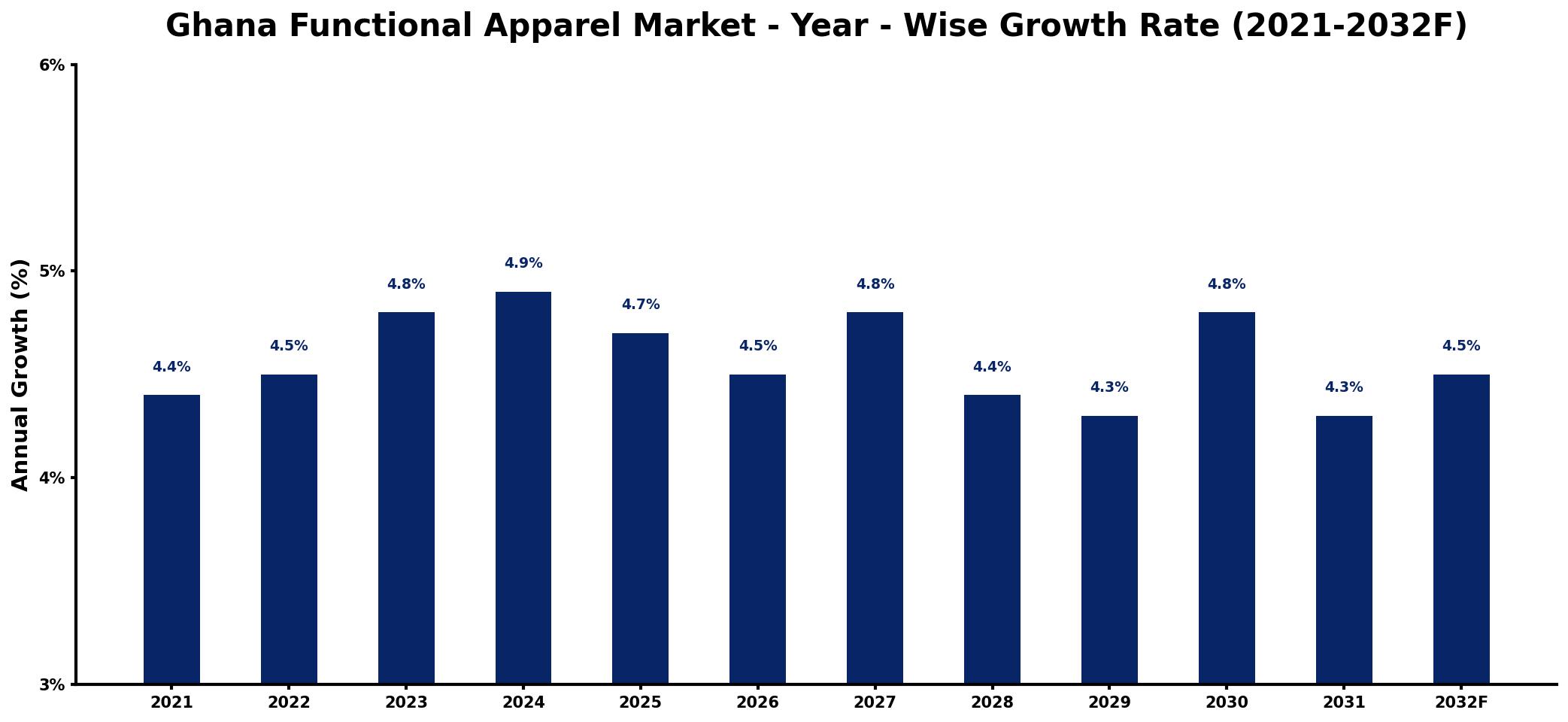
The table below presents the year‑wise growth rates along with the key drivers influencing the market
| Year | Growth Rate | Major Drivers |
| 2021 | 4.4% | Rising health awareness among consumers |
| 2022 | 4.5% | Expansion of retail distribution channels |
| 2023 | 4.8% | Increased participation in fitness activities |
| 2024 | 4.9% | Growth in e-commerce platforms |
| 2025 | 4.7% | Surge in corporate wellness programs |
| 2026 | 4.5% | Development of sustainable materials |
| 2027 | 4.8% | Increasing popularity of outdoor activities |
| 2028 | 4.4% | Adoption of technology in design |
| 2029 | 4.3% | increased production capacity utilization |
| 2030 | 4.8% | Rising interest in active lifestyles |
| 2031 | 4.3% | rising export shipment volumes |
| 2032 | 4.5% | Increased investment in local manufacturing |
Note: Market size estimations and growth projections presented in this report are based on 6Wresearch's proprietary forecasting methodology, utilizing the latest available industry data, government publications, and primary research inputs.
Ghana Functional Apparel Market Synopsis
The Ghana Functional Apparel Market is witnessing a surge in interest for moisture-wicking garments and protective gear tailored for various activities, from sports to outdoor adventures. This demand is particularly pronounced among urban populations that are increasingly engaging in fitness and recreational pursuits.
Moreover, the local market is seeing innovative design features and advanced materials enter the mainstream. Consumers are not only seeking functional clothing but are also prioritizing style, which is reshaping the way brands approach product development in Ghana.
Ghana Functional Apparel Market Key Takeaways
- The market is poised for steady growth, driven by the increasing popularity of active and outdoor lifestyles.
- Technological advancements in textile manufacturing are significantly enhancing product offerings.
- Consumer awareness and education regarding the benefits of functional apparel are gradually improving.
- The emphasis on occupational safety is pushing more companies to invest in protective functional gear.
- Local production initiatives are gaining traction, supported by favorable government policies.
Evaluation of Restraints in Ghana Functional Apparel Market
Despite its promising growth, the Ghana Functional Apparel Market faces challenges related to consumer education. Many potential buyers remain unaware of the unique benefits offered by technical textiles and performance-enhancing clothing. Additionally, affordability and accessibility remain significant barriers, hindering broader market penetration. Brands must therefore navigate these challenges effectively to expand their reach and compete against traditional apparel manufacturers who may offer lower-cost alternatives.
Ghana Functional Apparel Market Trends
Current trends indicate a growing preference for eco-friendly materials among consumers, reflecting a shift towards sustainable fashion. Furthermore, the integration of technology in functional apparel—such as embedded sensors and smart fabrics—is gaining traction, appealing to tech-savvy consumers. Fashion-forward designs combined with performance benefits are becoming a key selling point, thereby enhancing consumer interest in functional apparel.
Ghana Functional Apparel Market Opportunities
The Ghana Functional Apparel Market presents numerous opportunities for growth, particularly in the realm of local production. With the government incentivizing local manufacturing and distribution, brands have the chance to establish a strong presence. There is also room for innovation, especially in developing products that cater to specific demographics, such as women and youth, who are increasingly engaged in fitness and outdoor activities.
Government Initiatives in the Ghana Functional Apparel Market
The Ghanaian government is actively promoting the functional apparel market through policies designed to foster local production and research initiatives. This includes providing incentives for manufacturers focusing on advanced textile technologies and ensuring compliance with safety standards in apparel production. Such initiatives are aimed at enhancing the overall quality and competitiveness of the market.
Future Insights of the Ghana Functional Apparel Market
Looking ahead to 2026-2032, the Ghana Functional Apparel Market is expected to continue its upward trajectory as health and fitness become integral to the Ghanaian lifestyle. Innovations in fabric technology and designs will further cater to diverse consumer needs, while government support will likely bolster local manufacturers. The market's future appears bright, with substantial opportunities for brands willing to adapt to emerging trends and consumer preferences.
Ghana Functional Apparel Market Latest Developments (2025 - 2026)
Recent developments indicate that companies in the Ghana Functional Apparel Market are increasingly focusing on sustainability. Several brands have launched initiatives aimed at reducing their carbon footprint through the use of recycled materials. Additionally, partnerships with local designers are becoming more common as brands seek to merge functionality with cultural aesthetics, creating a unique market offering.
Ghana Functional Apparel Market - Key Attractiveness of the Report
- 10 Years of Market Numbers
- Historical Data Starting from 2022 to 2025
- Base Year: 2025
- Forecast Data until 2032
- Key Performance Indicators Impacting the Market
- Major Upcoming Developments and Projects
Key Highlights of the Report:
- Ghana Functional Apparel Market Outlook
- Market Size of Ghana Functional Apparel Market, 2025
- Forecast of Ghana Functional Apparel Market, 2032
- Historical Data and Forecast of Ghana Functional Apparel Revenues & Volume for the Period 2022-2032F
- Ghana Functional Apparel Market Trend Evolution
- Ghana Functional Apparel Market Drivers and Challenges
- Ghana Functional Apparel Price Trends
- Ghana Functional Apparel Porter's Five Forces
- Ghana Functional Apparel Industry Life Cycle
- Historical Data and Forecast of Ghana Functional Apparel Market Revenues & Volume By Product Type for the Period 2022-2032F
- Historical Data and Forecast of Ghana Functional Apparel Market Revenues & Volume By Sportswear for the Period 2022-2032F
- Historical Data and Forecast of Ghana Functional Apparel Market Revenues & Volume By Activewear for the Period 2022-2032F
- Historical Data and Forecast of Ghana Functional Apparel Market Revenues & Volume By Protective Clothing for the Period 2022-2032F
- Historical Data and Forecast of Ghana Functional Apparel Market Revenues & Volume By Others for the Period 2022-2032F
- Historical Data and Forecast of Ghana Functional Apparel Market Revenues & Volume By Application for the Period 2022-2032F
- Historical Data and Forecast of Ghana Functional Apparel Market Revenues & Volume By Sports Industry for the Period 2022-2032F
- Historical Data and Forecast of Ghana Functional Apparel Market Revenues & Volume By Outdoor Clothing for the Period 2022-2032F
- Historical Data and Forecast of Ghana Functional Apparel Market Revenues & Volume By Healthcare sector for the Period 2022-2032F
- Historical Data and Forecast of Ghana Functional Apparel Market Revenues & Volume By Distribution Channel for the Period 2022-2032F
- Historical Data and Forecast of Ghana Functional Apparel Market Revenues & Volume By Offline Store for the Period 2022-2032F
- Historical Data and Forecast of Ghana Functional Apparel Market Revenues & Volume By Online Store for the Period 2022-2032F
- Ghana Functional Apparel Import Export Trade Statistics
- Market Opportunity Assessment By Product Type
- Market Opportunity Assessment By Application
- Market Opportunity Assessment By Distribution Channel
- Ghana Functional Apparel Top Companies Market Share
- Ghana Functional Apparel Competitive Benchmarking By Technical and Operational Parameters
- Ghana Functional Apparel Company Profiles
- Ghana Functional Apparel Key Strategic Recommendations






































