Ghana Garden Furniture Market Summary
The ghana garden furniture market was estimated at USD 273 Million in 2025 and is projected to reach USD 376 Million by 2032, growing at a CAGR of 5.3% from 2026 to 2032.
Ghana Garden Furniture Market Year-wise Growth Rate and Key Drivers
This graph highlights how the Ghana Garden Furniture Market has steadily grown over the past five years, supported by major growth factors.
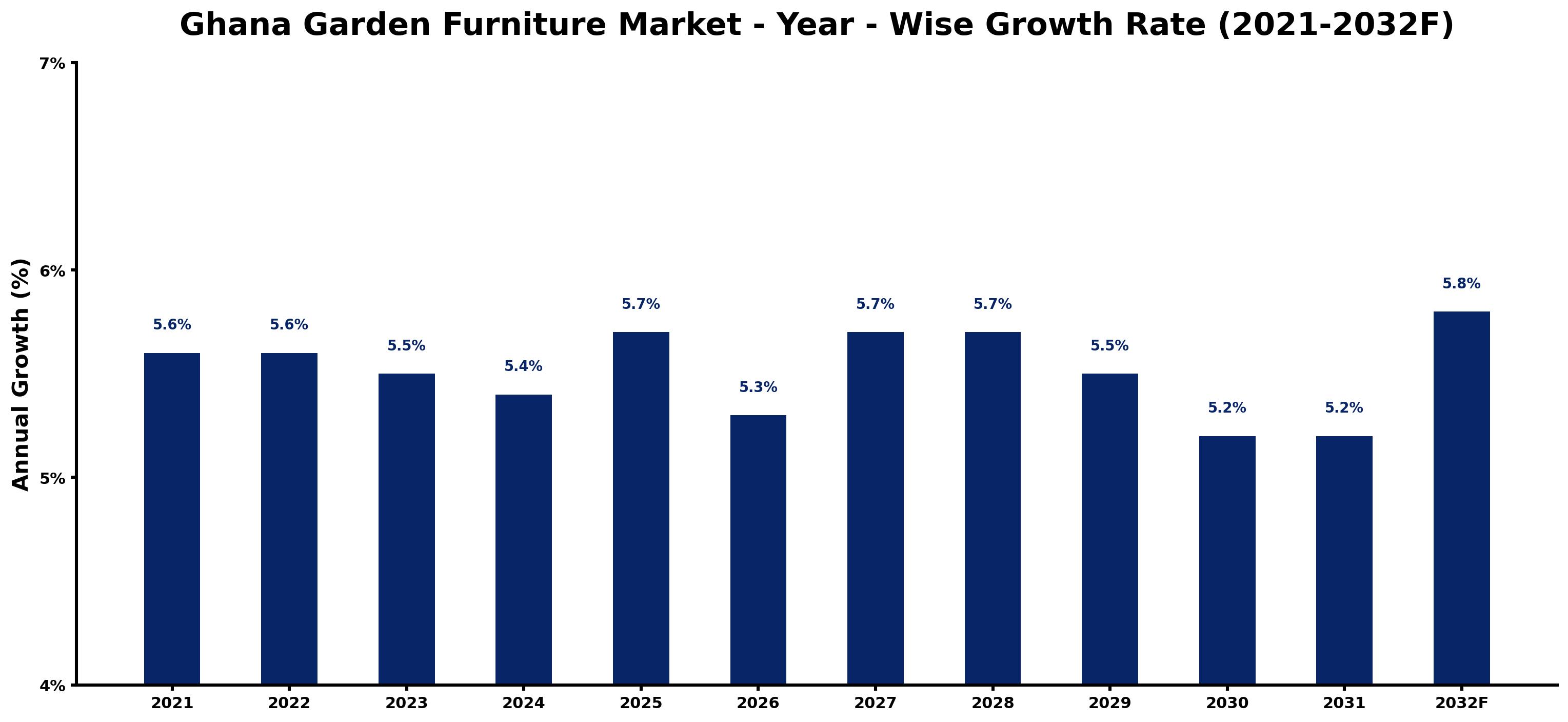
The table below presents the year wise growth rates along with the key drivers influencing the market
| Year | Growth Rate | Major Drivers |
| 2021 | 5.6% | Local artisans began creating unique designs appealing to urban consumers seeking authenticity. |
| 2022 | 5.6% | Sustainable materials gained popularity due to rising environmental awareness among consumers. |
| 2023 | 5.5% | Online retail platforms expanded, allowing brands to reach broader audiences across Ghana. |
| 2024 | 5.4% | Increased urbanization encouraged the development of outdoor living spaces in residential areas. |
| 2025 | 5.7% | Investment in tourism infrastructure created demand for stylish outdoor furniture in hotels. |
| 2026 | 5.3% | Collaborations with local designers fostered innovation and attracted a younger customer base. |
| 2027 | 5.7% | Growing interest in lifestyle branding influenced consumer preferences towards premium garden products. |
| 2028 | 5.7% | Urban gardening trends inspired consumers to purchase multifunctional outdoor furniture for limited spaces. |
| 2029 | 5.5% | E-commerce platforms enhanced logistics, improving delivery times and customer satisfaction levels. |
| 2030 | 5.2% | Health and wellness trends promoted outdoor leisure activities, boosting garden furniture sales significantly. |
| 2031 | 5.2% | Work-from-home culture led to increased outdoor office setups, driving new furniture needs. |
| 2032 | 5.8% | Luxury market expansion attracted high-net-worth individuals seeking bespoke outdoor furniture solutions. |
Note - Market size estimations and growth projections presented in this report are based on 6Wresearch's advanced forecasting approach, validated with industry datasets as of June 2026.
Ghana Garden Furniture Market Synopsis
The Ghana Garden Furniture Market is projected to reach 5.3% and witness significant growth during the forecast period (2026-2032). Driven by increasing urbanization, a rise in disposable incomes, and an expanding interest in outdoor living spaces, the market is evolving rapidly. Consumers are increasingly in search of durable, stylish, and comfortable furniture options for their gardens and outdoor areas. This evolving consumer preference is leading to a noticeable surge in demand for various garden furniture products, including outdoor dining sets, lounge chairs, and umbrellas.
Ghana Garden Furniture Market Growth Drivers
Several factors are significantly contributing to the growth of the Ghana Garden Furniture Market. Urbanization is a primary driver, as more individuals and families relocate to cities, creating a demand for outdoor living solutions. Rising disposable incomes also play a crucial role, enabling consumers to invest in quality garden furniture that enhances their outdoor experiences. Furthermore, the growing trend of outdoor entertaining is leading consumers to seek more stylish and functional outdoor furniture options. Additionally, as lifestyles shift towards more leisure-oriented outdoor activities, the need for durable and aesthetically pleasing furniture is on the rise. Lastly, the increasing interest in sustainable and eco-friendly furniture is fostering innovation and differentiation among manufacturers, aligning offerings with consumer values.
Ghana Garden Furniture Market Trends and Opportunities
The Ghana Garden Furniture Market is witnessing several notable trends that present opportunities for growth. One prominent trend is the increasing demand for eco-friendly and sustainable furniture options. Consumers are gravitating towards products made from renewable materials such as bamboo, rattan, and reclaimed wood, along with preferences for those manufactured using environmentally-friendly processes. Another observable trend involves the popularity of multifunctional and space-saving furniture designs, which cater to the needs of urban dwellers with limited outdoor space.
Moreover, there is a rising interest in modern outdoor furniture pieces that can effortlessly complement interior decor, indicating a shift toward creating cohesive indoor-outdoor living spaces. This inclination for harmony between the indoor and outdoor environments reinforces the market's potential for diverse offerings. Local manufacturers have the opportunity to explore unique, culturally-inspired designs, thus establishing a niche within this competitive landscape. Overall, these trends are shaping a promising landscape for investors and businesses in the Ghana Garden Furniture Market.
Ghana Garden Furniture Market Challenges and Restraints
Despite the growth potential, the Ghana Garden Furniture Market faces several challenges that must be navigated. One significant challenge is the limited access to quality raw materials. The reliance on imported materials and machinery results in high production costs, impacting pricing competitiveness. Additionally, inconsistent government policies can create uncertainties within the market, affecting business operations and investment decisions. The presence of cheaper imported furniture products further intensifies competition, putting local manufacturers at a disadvantage.
Furthermore, the industry faces a shortage of skilled labor, which can hinder production quality and efficiency. Inadequate infrastructure, particularly in transportation and power supply, presents additional hurdles, making it challenging for businesses to distribute products effectively. These challenges collectively pose significant barriers to the ongoing development and expansion of the garden furniture industry in Ghana, necessitating strategic approaches to overcome them.
Ghana Garden Furniture Market Investment Opportunities
The Ghana Garden Furniture Market is ripe with investment opportunities fueled by the growing demand for outdoor furniture. Investors can explore avenues in manufacturing or importing durable and high-quality garden furniture to meet consumer expectations. The rise of e-commerce also presents a significant opportunity for establishing online retail platforms, allowing businesses to reach a broader audience beyond traditional brick-and-mortar stores.
Additionally, partnerships with local artisans can foster unique offerings by incorporating culturally-inspired designs, enabling differentiation in the competitive landscape. There is also potential for innovation in sustainable practices, such as sourcing materials from responsible suppliers or developing eco-friendly production processes. Overall, the Ghana Garden Furniture Market stands as an attractive prospect for investors looking to capitalize on evolving consumer preferences towards outdoor living.
Ghana Garden Furniture Market Government Investment and Initiatives
Government policies pertaining to the Ghana Garden Furniture Market are increasingly focused on promoting sustainable practices and environmental protection. The government emphasizes the use of locally sourced materials in furniture production to support local businesses and minimize environmental impact. Furthermore, regulations are in place to ensure that manufacturers adhere to safety standards and quality regulations, protecting consumers and enhancing market credibility.
Incentives aimed at innovation and technology adoption within the industry are being implemented, encouraging manufacturers to enhance efficiency and competitiveness. Programs that support skill development and training in furniture manufacturing are also being promoted, aiming to address the industry's labor challenges. Overall, the government's initiatives seek to foster a conducive environment for growth in the garden furniture market while encouraging sustainability and supporting local industries.
Ghana Garden Furniture Market Latest Developments (May 2025 - June 2026)
In the recent months leading to mid-2026, the Ghana Garden Furniture Market has experienced a shift toward innovative and sustainable design solutions. The industry's direction suggests increasing collaboration among manufacturers and designers to cater to evolving consumer preferences. Enhanced emphasis on eco-friendly materials and processes has gained traction, with manufacturers beginning to adopt sustainable sourcing practices. Additionally, the market has seen a surge in the online retail presence, with an increasing number of businesses launching or expanding e-commerce platforms to cater to consumer demands.
Moreover, local manufacturers have begun to explore partnerships with artisans to create bespoke, culturally reflective pieces, enhancing product diversity. Overall, these trends indicate a dynamic and responsive market, well-positioned to adapt to ongoing consumer demands and preferences.
Ghana Garden Furniture Market - Key Attractiveness of the Report
- 10 Years of Market Numbers
- Historical Data Starting from 2022 to 2025
- Base Year: 2025
- Forecast Data until 2032
- Key Performance Indicators Impacting the Market
- Major Upcoming Developments and Projects
Key Highlights of the Report:
- Ghana Garden Furniture Market Outlook
- Market Size of Ghana Garden Furniture Market, 2025
- Forecast of Ghana Garden Furniture Market, 2032F
- Historical Data and Forecast of Ghana Garden Furniture Revenues & Volume for the Period 2022-2032F
- Ghana Garden Furniture Market Trend Evolution
- Ghana Garden Furniture Market Drivers and Challenges
- Ghana Garden Furniture Price Trends
- Ghana Garden Furniture Porter's Five Forces
- Ghana Garden Furniture Industry Life Cycle
- Historical Data and Forecast of Ghana Garden Furniture Market Revenues & Volume By Type for the Period 2022-2032F
- Historical Data and Forecast of Ghana Garden Furniture Market Revenues & Volume By Tables for the Period 2022-2032F
- Historical Data and Forecast of Ghana Garden Furniture Market Revenues & Volume By Chairs for the Period 2022-2032F
- Historical Data and Forecast of Ghana Garden Furniture Market Revenues & Volume By Dining Sets for the Period 2022-2032F
- Historical Data and Forecast of Ghana Garden Furniture Market Revenues & Volume By Seating Sets for the Period 2022-2032F
- Historical Data and Forecast of Ghana Garden Furniture Market Revenues & Volume By Others for the Period 2022-2032F
- Historical Data and Forecast of Ghana Garden Furniture Market Revenues & Volume By Application for the Period 2022-2032F
- Historical Data and Forecast of Ghana Garden Furniture Market Revenues & Volume By Brand Outlets for the Period 2022-2032F
- Historical Data and Forecast of Ghana Garden Furniture Market Revenues & Volume By Franchised Furniture Store for the Period 2022-2032F
- Historical Data and Forecast of Ghana Garden Furniture Market Revenues & Volume By E-Commerce for the Period 2022-2032F
- Historical Data and Forecast of Ghana Garden Furniture Market Revenues & Volume By Others for the Period 2022-2032F
- Ghana Garden Furniture Import Export Trade Statistics
- Market Opportunity Assessment By Type
- Market Opportunity Assessment By Application
- Ghana Garden Furniture Top Companies Market Share
- Ghana Garden Furniture Competitive Benchmarking By Technical and Operational Parameters
- Ghana Garden Furniture Company Profiles
- Ghana Garden Furniture Key Strategic Recommendations






































