Ghana Gold Bullion Market Size, Share & Growth Rate
The Ghana Gold Bullion Market was estimated at USD 408 Million in 2025 and is projected to reach USD 538 Million by 2032, growing at a CAGR of 4.0% from 2026 to 2032. This growth trajectory is primarily driven by the increasing global demand for gold as a safe haven asset, particularly in times of economic uncertainty. Additionally, Ghana's rich gold reserves and the governments efforts to promote transparency and sustainable practices are enhancing the countrys attractiveness to international investors.
Ghana Gold Bullion Market Year-wise Growth Rate and Key Drivers
This graph highlights how the Ghana Gold Bullion Market has steadily grown over the years, supported by major growth factors.
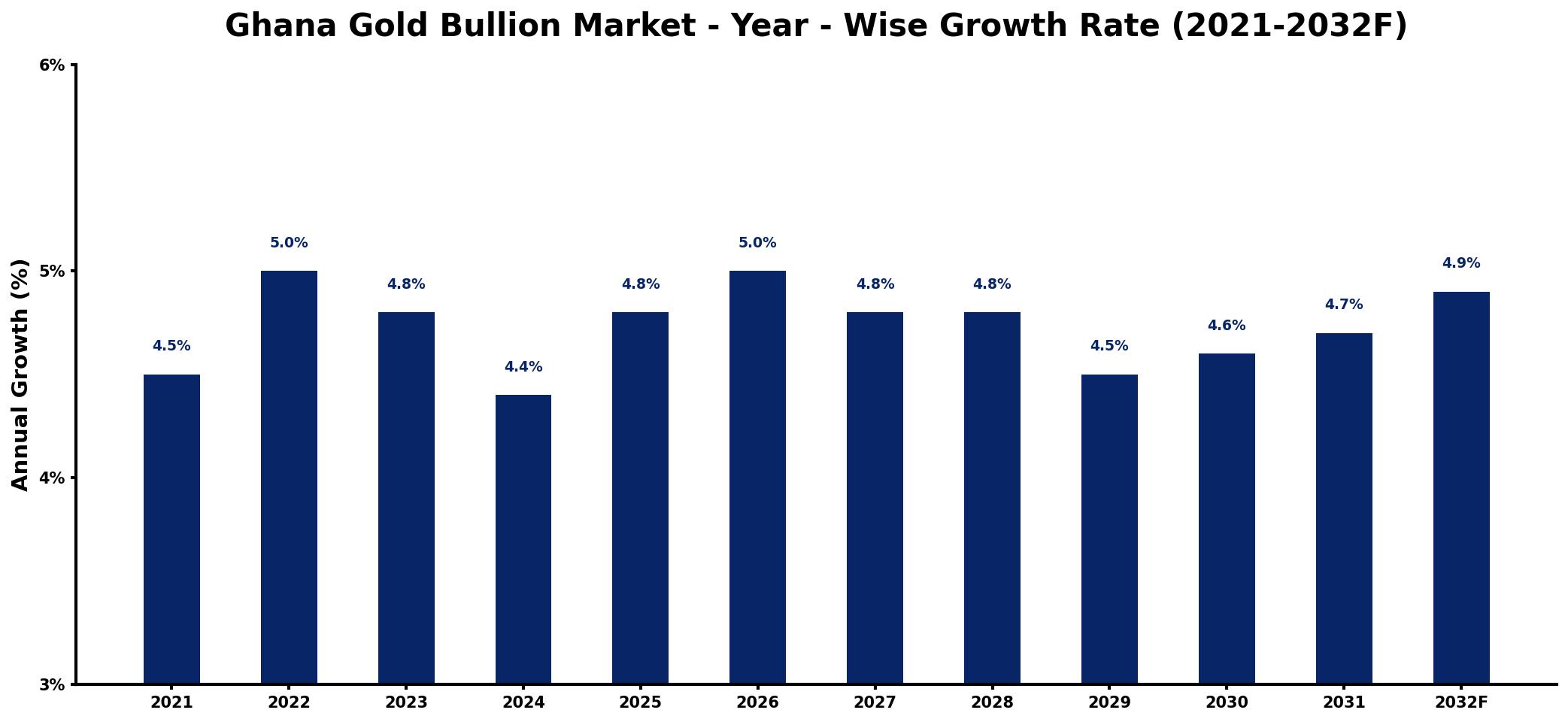
The table below presents the year‑wise growth rates along with the key drivers influencing the market
| Year | Growth Rate | Major Drivers |
| 2021 | 4.5% | Increased investor interest rises |
| 2022 | 5.0% | Growing demand from jewelry sector |
| 2023 | 4.8% | Strengthened international market confidence |
| 2024 | 4.4% | Expansion of local mining operations |
| 2025 | 4.8% | Higher consumer spending trends observed |
| 2026 | 5.0% | growing emerging market penetration |
| 2027 | 4.8% | Rising global economic stability noted |
| 2028 | 4.8% | Enhanced financial regulations enacted |
| 2029 | 4.5% | Increased use in technology applications |
| 2030 | 4.6% | Strengthened regional trade agreements formed |
| 2031 | 4.7% | Growing awareness of sustainability issues |
| 2032 | 4.9% | Boost in alternative investment strategies |
Note: Market size estimations and growth projections presented in this report are based on 6Wresearch's proprietary forecasting methodology, utilizing the latest available industry data, government publications, and primary research inputs.
Ghana Gold Bullion Market Synopsis
The Ghana Gold Bullion Market stands out due to its mix of large-scale mining operations alongside a significant presence of artisanal miners and licensed gold dealers. This unique blend supports a dynamic market that attracts international players while providing local communities with economic opportunities.
Government regulations play a vital role in shaping the landscape of this market. By enforcing strict licensing and monitoring measures, the Ghanaian authorities aim to curb illegal mining and promote ethical practices, ensuring that the gold industry contributes positively to the nations economy and social fabric.
Ghana Gold Bullion Market Key Takeaways
- The market is a key hub for gold trading, leveraging Ghana's status as a top gold producer.
- Consumer demand for ethically sourced gold is driving changes in mining practices.
- Government regulations are enhancing market transparency and accountability.
- The integration of digital technologies is transforming supply chain traceability.
- Investment opportunities are expanding across physical gold and mining equities.
Evaluation of Restraints in Ghana Gold Bullion Market
Despite the promising outlook, the Ghana Gold Bullion Market faces notable restraints. Illegal mining activities continue to pose significant threats, resulting in environmental degradation and social unrest. Additionally, smuggling and a lack of supply chain transparency challenge the legitimacy of gold transactions. These issues complicate efforts to maintain a sustainable market and necessitate continued government intervention and community engagement to create a more secure and responsible environment.
Ghana Gold Bullion Market Trends
A marked trend in the Ghana Gold Bullion Market is the growing consumer preference for ethically sourced gold. This shift is leading to increased support for certified fair trade mining practices. Additionally, the adoption of blockchain technology is becoming increasingly popular for tracking gold's provenance, enhancing consumer confidence in ethical sourcing. Another trend is the heightened interest in gold bullion as a hedge against inflation and economic instability, compelling both retail and institutional investors to increase their allocations toward physical gold assets.
Ghana Gold Bullion Market Opportunities
Investment avenues in the Ghana Gold Bullion Market are diverse and lucrative. Options include acquiring physical gold bullion, which serves as a tangible asset amidst economic volatility. Moreover, investing in mining companies operating in Ghana can yield substantial returns given the country's extensive mineral resources. The market for trading gold futures and options offers leveraged investment potential while mitigating risks associated with direct ownership. These opportunities, combined with a growing emphasis on sustainability, present an appealing landscape for prospective investors.
Government Initiatives in the Ghana Gold Bullion Market
The Ghanaian government plays a proactive role in shaping the gold bullion landscape. It has established frameworks for licensing and permitting gold trading operations, ensuring adherence to ethical mining practices. Initiatives like the Precious Minerals Marketing Company focus on overseeing the export and marketing of gold, while the Minerals Commission regulates mining activities to enhance transparency. These policies aim not only to combat illegal mining but also to foster a more sustainable gold industry that benefits the economy and local communities.
Future Insights of the Ghana Gold Bullion Market
Looking ahead to 2026-2032, the future of the Ghana Gold Bullion Market appears robust. The combination of stable political conditions, rich mineral resources, and growing international demand for gold positions Ghana favorably on the global stage. However, fluctuating gold prices and environmental considerations will require market participants to adopt strategic approaches to navigate challenges. Continued government support for sustainable mining practices will be crucial in enhancing the countrys competitiveness and reputation as a reliable gold supplier.
Ghana Gold Bullion Market Latest Developments (2025 - 2026)
Recent developments in the Ghana Gold Bullion Market indicate a significant shift towards sustainability, with initiatives focused on responsible mining gaining traction. Increased investments in technology aimed at improving traceability within the supply chain are becoming a priority. Moreover, regulatory efforts to combat illegal mining are being strengthened, reflecting the government's commitment to fostering a more ethical gold market. As these trends unfold, they are likely to shape the future dynamics of the industry positively.
Ghana Gold Bullion Market - Key Attractiveness of the Report
- 10 Years of Market Numbers
- Historical Data Starting from 2022 to 2025
- Base Year: 2025
- Forecast Data until 2032
- Key Performance Indicators Impacting the Market
- Major Upcoming Developments and Projects
Key Highlights of the Report:
- Ghana Gold Bullion Market Outlook
- Market Size of Ghana Gold Bullion Market, 2025
- Forecast of Ghana Gold Bullion Market, 2032
- Historical Data and Forecast of Ghana Gold Bullion Revenues & Volume for the Period 2022-2032F
- Ghana Gold Bullion Market Trend Evolution
- Ghana Gold Bullion Market Drivers and Challenges
- Ghana Gold Bullion Price Trends
- Ghana Gold Bullion Porter's Five Forces
- Ghana Gold Bullion Industry Life Cycle
- Historical Data and Forecast of Ghana Gold Bullion Market Revenues & Volume By Type for the Period 2022-2032F
- Historical Data and Forecast of Ghana Gold Bullion Market Revenues & Volume By Gold Bar for the Period 2022-2032F
- Historical Data and Forecast of Ghana Gold Bullion Market Revenues & Volume By Gold Coin for the Period 2022-2032F
- Historical Data and Forecast of Ghana Gold Bullion Market Revenues & Volume By Distribution Channel for the Period 2022-2032F
- Historical Data and Forecast of Ghana Gold Bullion Market Revenues & Volume By Online for the Period 2022-2032F
- Historical Data and Forecast of Ghana Gold Bullion Market Revenues & Volume By Offline for the Period 2022-2032F
- Ghana Gold Bullion Import Export Trade Statistics
- Market Opportunity Assessment By Type
- Market Opportunity Assessment By Distribution Channel
- Ghana Gold Bullion Top Companies Market Share
- Ghana Gold Bullion Competitive Benchmarking By Technical and Operational Parameters
- Ghana Gold Bullion Company Profiles
- Ghana Gold Bullion Key Strategic Recommendations






































