Ghana Groceries Market Summary
The ghana groceries market was estimated at USD 412 Million in 2025 and is projected to reach USD 580 Million by 2032, growing at a CAGR of 5.5% from 2026 to 2032.
Ghana Groceries Market Year-wise Growth Rate and Key Drivers
This graph highlights how the Ghana Groceries Market has steadily grown over the past five years, supported by major growth factors.
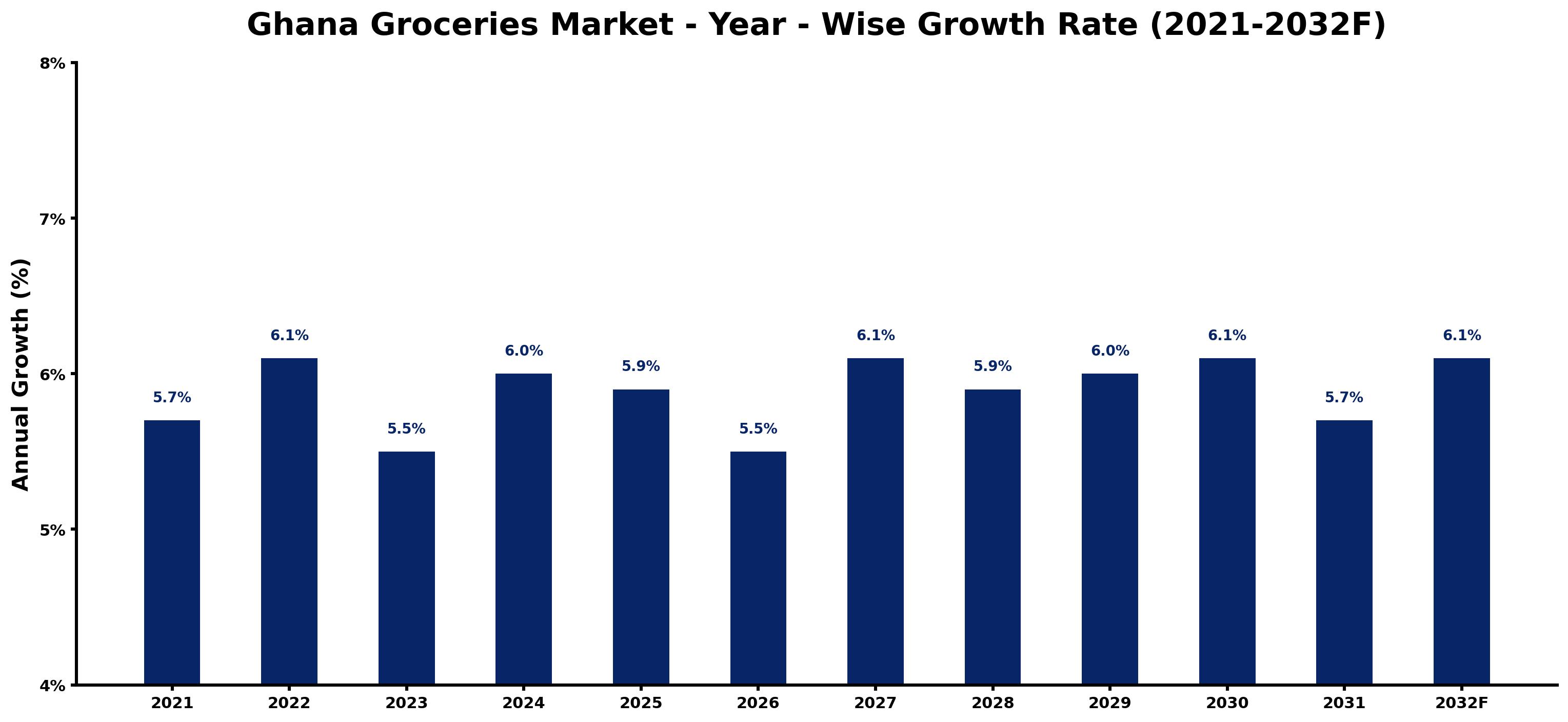
The table below presents the year wise growth rates along with the key drivers influencing the market
| Year | Growth Rate | Major Drivers |
| 2021 | 5.7% | Consumer preferences shifted towards local produce, fostering community-based grocery initiatives. |
| 2022 | 6.1% | Supply chain resilience became crucial, encouraging investment in logistical efficiencies nationwide. |
| 2023 | 5.5% | Digital shopping platforms gained traction, transforming consumer access to grocery markets. |
| 2024 | 6.0% | Sustainability emphasis encouraged organic farming, enhancing market appeal to health-conscious shoppers. |
| 2025 | 5.9% | Urban migration led to increased demand for convenient grocery delivery services. |
| 2026 | 5.5% | Innovative payment solutions emerged, facilitating seamless transactions for grocery purchases. |
| 2027 | 6.1% | Enhanced agricultural techniques improved yield, stabilizing local food supply for grocers. |
| 2028 | 5.9% | Retail diversification became common, with supermarkets offering non-food items extensively. |
| 2029 | 6.0% | Rural electrification projects expanded, enabling grocery access in previously underserved areas. |
| 2030 | 6.1% | Consumer education programs highlighted nutritional benefits, influencing purchasing behaviors significantly. |
| 2031 | 5.7% | Cross-border trade agreements introduced greater variety in international grocery offerings. |
| 2032 | 6.1% | Health crises prompted a shift towards essential goods, prioritizing basics over luxury items. |
Note - Market size estimations and growth projections presented in this report are based on 6Wresearch's advanced forecasting approach, validated with industry datasets as of June 2026.
Ghana Groceries Market Synopsis
The Ghana Groceries Market is projected to reach 5.5% and witness significant growth during the forecast period (2026-2032). This sector is characterized by a robust demand for both traditional staples and modern grocery items, reflecting the diverse consumer preferences across the nation. Factors including urbanization, increasing disposable incomes, and evolving lifestyles are serving as catalysts for market expansion, prompting the emergence of various retail formats, ranging from small local shops to larger supermarkets and innovative online grocery platforms.
Ghana Groceries Market Growth Drivers
The growth of the Ghana Groceries Market is influenced by several key drivers:
- The urbanization trend is reshaping consumer habits, leading to increased demand for modern grocery shopping options as urban dwellers seek convenience and accessibility.
- Rising disposable incomes among the population enable consumers to spend more on a diverse array of grocery products, including premium and imported items.
- Changes in lifestyle, particularly among the younger demographic, are driving a shift towards convenience foods and ready-to-eat meals, further expanding the market's scope.
- The proliferation of smartphone penetration and internet connectivity is facilitating the growth of online grocery shopping, catering to a growing preference for digital retail experiences.
- The increasing awareness and interest in health and wellness are prompting consumers to seek organic and locally sourced products, thereby shaping market offerings and demand.
Ghana Groceries Market Trends and Opportunities
The Ghana Groceries Market is currently experiencing notable trends that present various opportunities for growth:
- There is a significant shift towards online grocery shopping platforms as consumers prioritize convenience and efficiency, creating opportunities for businesses to invest in e-commerce solutions.
- Health-conscious consumers are more frequently seeking organic and specialty food products, prompting grocery retailers to diversify their product offerings to include these items.
- Sustainability practices are gaining traction, with consumers increasingly preferring products that adhere to ethical sourcing and environmental considerations.
- Partnerships with local farmers and suppliers are becoming essential for retailers to ensure a stable supply of high-quality, fresh produce, aligning with consumer demands.
- Modernizing traditional grocery stores and expanding supermarket chains can tap into the evolving consumer base, as the middle class continues to grow.
Ghana Groceries Market Challenges and Restraints
Despite the promising growth, the Ghana Groceries Market faces several challenges that can hinder its progress:
- Inconsistent supply chain infrastructure presents challenges in maintaining product availability and quality, affecting retailer operations and consumer satisfaction.
- High import tariffs and taxes can inflate prices, limiting affordability for consumers and creating obstacles for retailers looking to compete effectively.
- The absence of standardized regulations and quality control measures can undermine consumer trust and lead to safety concerns regarding food products.
- Competition from informal markets and street vendors continues to pose challenges for formal grocery retailers, often leading to price wars and decreased market share.
- Dependence on imported goods renders the market vulnerable to currency fluctuations and global supply chain disruptions, impacting pricing and availability.
Ghana Groceries Market Government Investment and Initiatives
The government of Ghana has initiated several policies aimed at bolstering the groceries market while promoting local production:
- The Planting for Food and Jobs program has been launched to enhance agricultural productivity and support local farmers, thus increasing the quality and availability of food products.
- The establishment of the Food and Drugs Authority aims to regulate food safety and quality, ensuring that consumers have access to safe grocery options.
- Import restrictions and tariffs on certain food items have been implemented to protect local producers, encouraging consumers to prefer domestically produced goods.
- Investment in agro-processing initiatives is being emphasized to add value to locally sourced products, enhancing their market appeal and competitiveness.
- Efforts are being made to ensure food security through various policies that strengthen the supply chain, improve infrastructure, and promote sustainable agricultural practices.
Ghana Groceries Market Latest Developments (May 2025 - June 2026)
Recent developments in the Ghana Groceries Market indicate a dynamic shift within the industry landscape:
- The growing penetration of digital payment systems has facilitated an increase in online grocery transactions, leading to more retailers expanding their e-commerce capabilities.
- Supermarkets have begun prioritizing health-oriented product lines amid increasing consumer demand for organic and health-conscious food options.
- Initiatives to improve supply chain resilience have gained momentum, as retailers seek to mitigate risks associated with imported goods and fluctuating currency values.
- Industry collaborations aimed at enhancing distribution efficiency are on the rise, particularly as retailers seek to streamline logistics in response to increasing competition.
- Consumer education campaigns focusing on the benefits of local sourcing and sustainable practices are being launched by various stakeholders, promoting a shift in purchasing behavior.
Ghana Groceries Market - Key Attractiveness of the Report
- 10 Years of Market Numbers
- Historical Data Starting from 2022 to 2025
- Base Year: 2025
- Forecast Data until 2032
- Key Performance Indicators Impacting the Market
- Major Upcoming Developments and Projects
Key Highlights of the Report:
- Ghana Groceries Market Outlook
- Market Size of Ghana Groceries Market, 2025
- Forecast of Ghana Groceries Market, 2032F
- Historical Data and Forecast of Ghana Groceries Revenues & Volume for the Period 2022-2032F
- Ghana Groceries Market Trend Evolution
- Ghana Groceries Market Drivers and Challenges
- Ghana Groceries Price Trends
- Ghana Groceries Porter's Five Forces
- Ghana Groceries Industry Life Cycle
- Historical Data and Forecast of Ghana Groceries Market Revenues & Volume By Product Types for the Period 2022-2032F
- Historical Data and Forecast of Ghana Groceries Market Revenues & Volume By Packaged Food for the Period 2022-2032F
- Historical Data and Forecast of Ghana Groceries Market Revenues & Volume By Unpackaged Food for the Period 2022-2032F
- Historical Data and Forecast of Ghana Groceries Market Revenues & Volume By Drinks for the Period 2022-2032F
- Historical Data and Forecast of Ghana Groceries Market Revenues & Volume By Tobacco for the Period 2022-2032F
- Historical Data and Forecast of Ghana Groceries Market Revenues & Volume By Household Products for the Period 2022-2032F
- Historical Data and Forecast of Ghana Groceries Market Revenues & Volume By Others for the Period 2022-2032F
- Historical Data and Forecast of Ghana Groceries Market Revenues & Volume By Distribution Channel for the Period 2022-2032F
- Historical Data and Forecast of Ghana Groceries Market Revenues & Volume By Supermarkets & Hypermarkets for the Period 2022-2032F
- Historical Data and Forecast of Ghana Groceries Market Revenues & Volume By Convenience Store for the Period 2022-2032F
- Historical Data and Forecast of Ghana Groceries Market Revenues & Volume By Online for the Period 2022-2032F
- Ghana Groceries Import Export Trade Statistics
- Market Opportunity Assessment By Product Types
- Market Opportunity Assessment By Distribution Channel
- Ghana Groceries Top Companies Market Share
- Ghana Groceries Competitive Benchmarking By Technical and Operational Parameters
- Ghana Groceries Company Profiles
- Ghana Groceries Key Strategic Recommendations






































