Ghana Industrial Furnace Market Size, Share & Growth Rate
The Ghana Industrial Furnace Market was estimated at USD 107 Million in 2025 and is projected to reach USD 117 Million by 2032, growing at a CAGR of 1.3% from 2026 to 2032. This growth trajectory is primarily fueled by the ongoing industrialization efforts within Ghana, as well as the increasing demand for efficient metal manufacturing processes. A notable shift toward electric furnaces, recognized for their energy efficiency and reduced environmental impact, is also significantly contributing to market dynamics.
Ghana Industrial Furnace Market Year-wise Growth Rate and Key Drivers
This graph highlights how the Ghana Industrial Furnace Market has steadily grown over the years, supported by major growth factors.
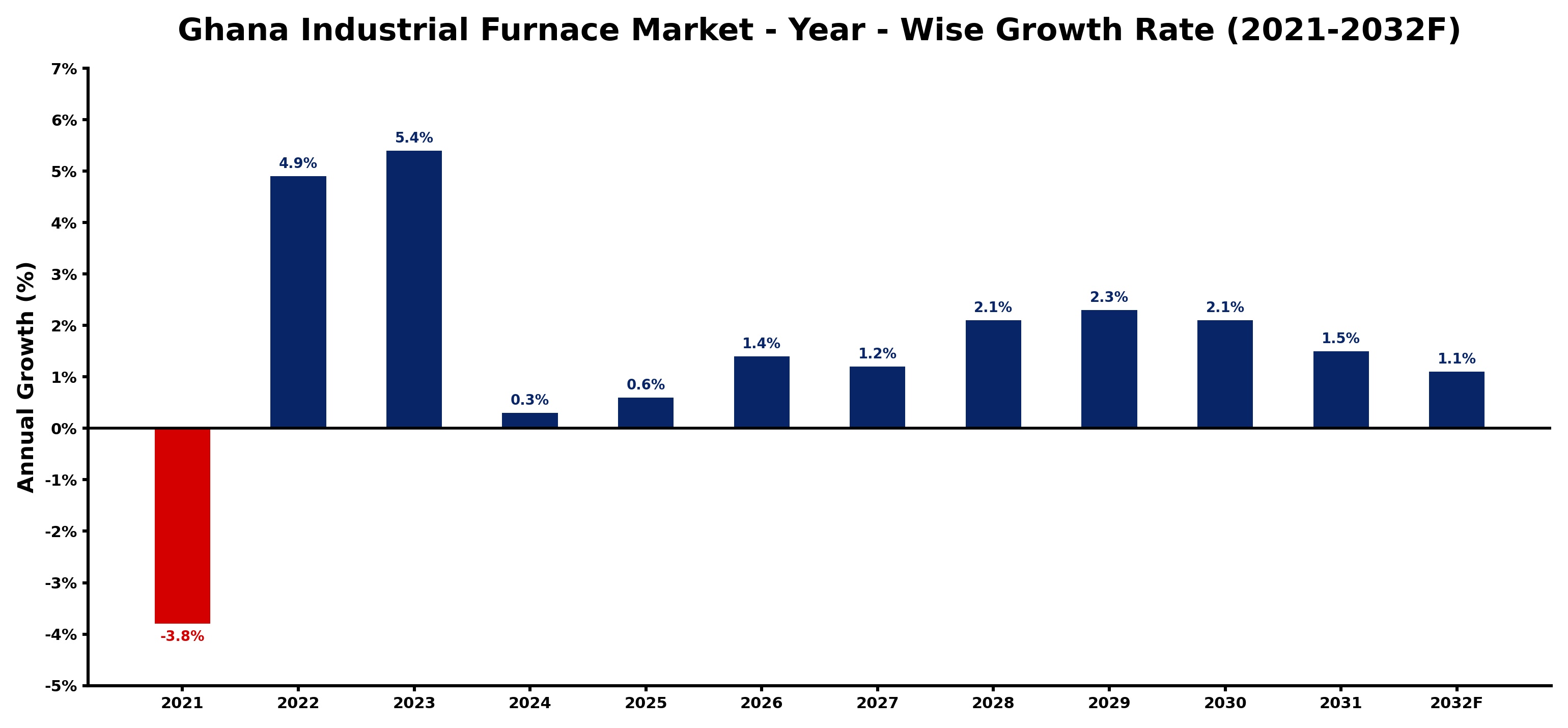
The table below presents the year‑wise growth rates along with the key drivers influencing the market
| Year | Growth Rate | Major Drivers |
| 2021 | -3.8% | Manufacturing investments declined due to increased operational cost pressures |
| 2022 | 4.9% | Strategic investments in local steel production drive furnace demand |
| 2023 | 5.4% | Domestic steel mill upgrades boost furnace installation and utilization |
| 2024 | 0.3% | Energy efficient furnace adoption boosts manufacturing sector competitiveness in Ghana |
| 2025 | 0.6% | Capacity upgrades in metalworking boost furnace demand significantly |
| 2026 | 1.4% | Technological upgrades in steel production enhanced furnace efficiency levels |
| 2027 | 1.2% | Energy efficient furnace upgrades boost steel production capabilities in Ghana |
| 2028 | 2.1% | Improved furnace technology boosted local metal recycling operations |
| 2029 | 2.3% | Modernized steel manufacturing processes boosted furnace equipment demand |
| 2030 | 2.1% | Infrastructure projects stimulated demand for industrial furnace installations |
| 2031 | 1.5% | Manufacturing investments in energy efficient furnaces drive operational efficiencies |
| 2032 | 1.1% | Local foundries upgraded technologies to boost steel production capacity |
Note - Market size estimations and growth projections presented in this report are based on 6Wresearch’s advanced forecasting approach, validated with industry datasets as of June 2026.
Ghana Industrial Furnace Market Synopsis
The strongest force currently shaping the Ghana Industrial Furnace Market is the shift towards sustainability and energy efficiency. As industries evolve, there is an escalating demand for innovative solutions that minimize environmental footprints, particularly in sectors like mining and metal fabrication.
This commitment to sustainable practices is complemented by government initiatives aimed at promoting local manufacturing and industrial growth. As a result, stakeholders are increasingly interested in adopting advanced furnace technologies that enhance productivity while adhering to stringent environmental regulations.
Ghana Industrial Furnace Market Key Takeaways
- The Ghana Industrial Furnace Market is driven by the rise of industrialization and specific sector needs for heating solutions.
- Electric furnaces dominate the market due to their operational efficiency and lower emissions.
- Technological advancements are key, with a focus on energy-efficient and smart furnaces.
- Government incentives are promoting investments in local manufacturing and furnace technology.
- Customizable solutions are increasingly in demand to meet the varied requirements of different industries.
Evaluation of Restraints in Ghana Industrial Furnace Market
Despite the positive growth indicators, several restraints continue to pose challenges for the Ghana Industrial Furnace Market. A significant barrier is the limited access to advanced technology and expertise, which may lead to operational inefficiencies and elevated costs. Furthermore, the intermittent power supply and high energy costs are detrimental to the optimal functioning of industrial furnaces. The scarcity of maintenance services and availability of spare parts exacerbates downtime, further hindering productivity. Finally, navigating regulatory compliance and environmental standards can be cumbersome for operators, necessitating careful management and adaptation to ensure continued success.
Ghana Industrial Furnace Market Trends
A prominent trend in the Ghana Industrial Furnace Market is the increasing adoption of energy-efficient furnaces utilizing clean energy sources such as natural gas and electricity. Alongside this, smart furnaces equipped with remote monitoring and automation capabilities are gaining traction, providing enhanced control over operations. The emphasis on customized furnace solutions also reflects the demand for tailored technologies that cater to specific industry needs, indicating a shift towards personalization in manufacturing processes.
Ghana Industrial Furnace Market Opportunities
The Ghana Industrial Furnace Market presents substantial investment opportunities as local industries seek modern heating solutions to enhance operational efficiency. There is a growing need for suppliers who can provide high-quality industrial furnaces that not only comply with environmental standards but also optimize energy consumption. Moreover, enhancing existing industrial furnaces through maintenance services and upgrades represents a significant growth area. Engaging with local industries and leveraging government initiatives focused on sustainable practices can further amplify investment prospects in this expanding market.
Government Initiatives in the Ghana Industrial Furnace Market
The Ghanaian government has implemented various policies to bolster the industrial furnace market, including the National Industrial Policy, which aims to enhance industrialization and competitiveness. Incentives such as tax breaks and subsidies are being offered to attract investment in advanced industrial furnace technology. These measures aim not only to stimulate market growth but also to ensure compliance with environmental sustainability and safety regulations, creating a favorable climate for innovation and development in the sector.
Future Insights of the Ghana Industrial Furnace Market
Looking ahead to 2026-2032, the Ghana Industrial Furnace Market is poised for steady advancement. The projected growth is bolstered by the continued rise of industrialization and the demand for efficient heating solutions in sectors like manufacturing, mining, and energy production. Government support for local manufacturing, alongside investments in infrastructure and technology adoption, is likely to catalyze market evolution. As industries place greater emphasis on sustainability, the shift towards innovative furnace solutions is expected to intensify, further driving growth.
Ghana Industrial Furnace Market Latest Developments (May 2025 - June 2026)
In recent months, the Ghana Industrial Furnace Market has seen notable movements toward the implementation of energy-efficient technologies. There has been an increase in pilot projects focusing on smart furnace solutions, which enhance operational efficiency through remote monitoring and automation. Additionally, discussions around regulatory frameworks concerning environmental standards have gained momentum, indicating an evolving landscape in compliance practices. Stakeholders are also actively engaging in partnerships to leverage local expertise, setting the stage for collaborative advancements in industrial furnace technologies.
Ghana Industrial Furnace Market - Key Attractiveness of the Report
- 10 Years of Market Numbers
- Historical Data Starting from 2022 to 2025
- Base Year: 2025
- Forecast Data until 2032
- Key Performance Indicators Impacting the Market
- Major Upcoming Developments and Projects
Key Highlights of the Report:
- Ghana Industrial Furnace Market Outlook
- Market Size of Ghana Industrial Furnace Market, 2025
- Forecast of Ghana Industrial Furnace Market, 2032
- Historical Data and Forecast of Ghana Industrial Furnace Revenues & Volume for the Period 2022-2032F
- Ghana Industrial Furnace Market Trend Evolution
- Ghana Industrial Furnace Market Drivers and Challenges
- Ghana Industrial Furnace Price Trends
- Ghana Industrial Furnace Porter's Five Forces
- Ghana Industrial Furnace Industry Life Cycle
- Historical Data and Forecast of Ghana Industrial Furnace Market Revenues & Volume By Furnace Type for the Period 2022-2032F
- Historical Data and Forecast of Ghana Industrial Furnace Market Revenues & Volume By Gas/fuel Operated Industrial Furnace for the Period 2022-2032F
- Historical Data and Forecast of Ghana Industrial Furnace Market Revenues & Volume By Electrically Operated Industrial Furnace for the Period 2022-2032F
- Historical Data and Forecast of Ghana Industrial Furnace Market Revenues & Volume By Arrangement for the Period 2022-2032F
- Historical Data and Forecast of Ghana Industrial Furnace Market Revenues & Volume By Tube or Clamshell Type for the Period 2022-2032F
- Historical Data and Forecast of Ghana Industrial Furnace Market Revenues & Volume By Box Type for the Period 2022-2032F
- Historical Data and Forecast of Ghana Industrial Furnace Market Revenues & Volume By Bottom Loading & Car Bottom Furnace for the Period 2022-2032F
- Historical Data and Forecast of Ghana Industrial Furnace Market Revenues & Volume By Top Loading Furnace for the Period 2022-2032F
- Historical Data and Forecast of Ghana Industrial Furnace Market Revenues & Volume By Others for the Period 2022-2032F
- Historical Data and Forecast of Ghana Industrial Furnace Market Revenues & Volume By End-User for the Period 2022-2032F
- Historical Data and Forecast of Ghana Industrial Furnace Market Revenues & Volume By Metals & Mining for the Period 2022-2032F
- Historical Data and Forecast of Ghana Industrial Furnace Market Revenues & Volume By Transportation for the Period 2022-2032F
- Historical Data and Forecast of Ghana Industrial Furnace Market Revenues & Volume By Oil & Gas for the Period 2022-2032F
- Historical Data and Forecast of Ghana Industrial Furnace Market Revenues & Volume By Chemicals for the Period 2022-2032F
- Historical Data and Forecast of Ghana Industrial Furnace Market Revenues & Volume By Others for the Period 2022-2032F
- Ghana Industrial Furnace Import Export Trade Statistics
- Market Opportunity Assessment By Furnace Type
- Market Opportunity Assessment By Arrangement
- Market Opportunity Assessment By End-User
- Ghana Industrial Furnace Top Companies Market Share
- Ghana Industrial Furnace Competitive Benchmarking By Technical and Operational Parameters
- Ghana Industrial Furnace Company Profiles
- Ghana Industrial Furnace Key Strategic Recommendations






































