Ghana Industrial Gases Market Summary
The ghana industrial gases market was estimated at USD 96 Million in 2025 and is projected to reach USD 105 Million by 2032, growing at a CAGR of 0.9% from 2026 to 2032.
Ghana Industrial Gases Market Year-wise Growth Rate and Key Drivers
This graph highlights how the Ghana Industrial Gases Market has steadily grown over the past five years, supported by major growth factors.
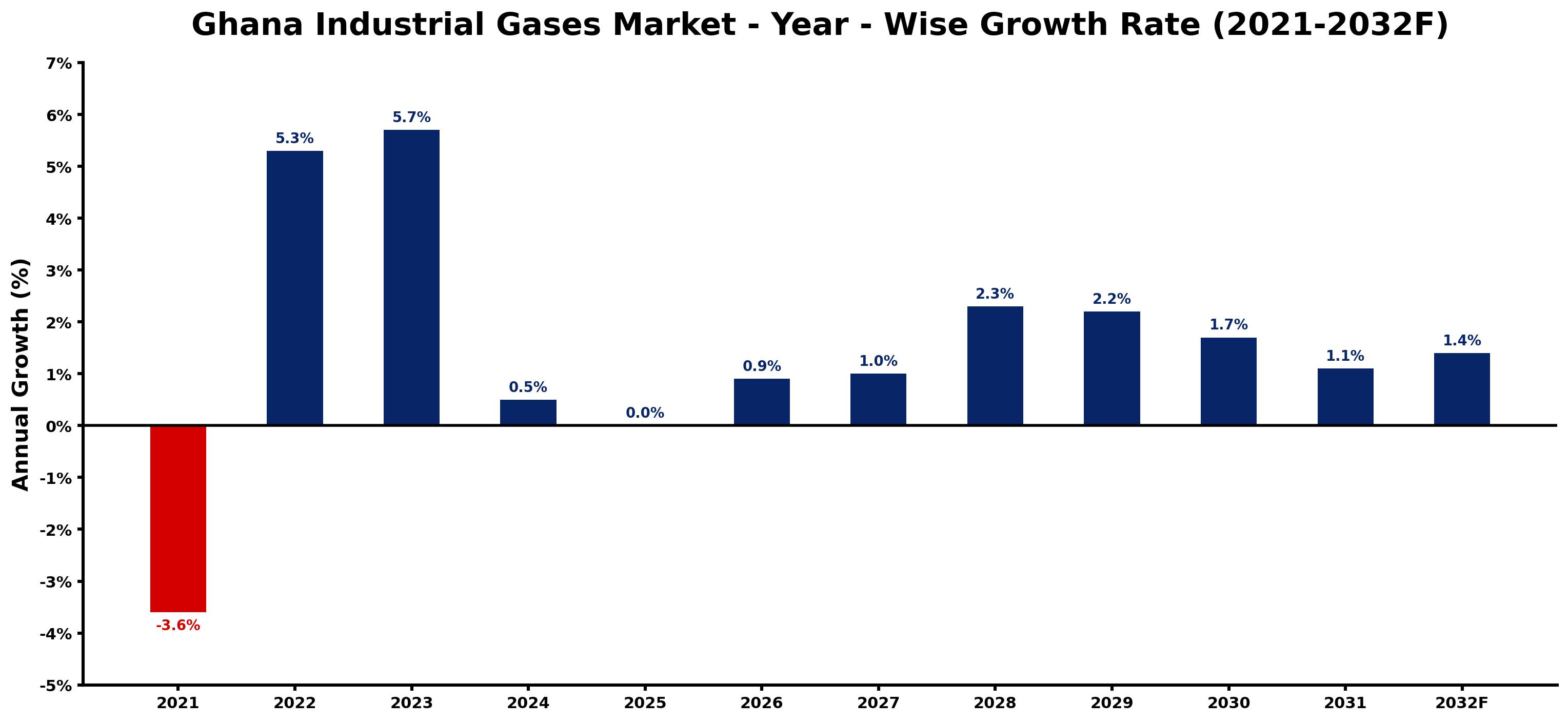
The table below presents the year wise growth rates along with the key drivers influencing the market
| Year | Growth Rate | Major Drivers |
| 2021 | -3.6% | Supply chain disruptions due to the pandemic hindered timely access to essential gases, impacting industrial operations. |
| 2022 | 5.3% | Technological enhancements in gas separation processes improved efficiency and reduced costs. |
| 2023 | 5.7% | Investment in healthcare infrastructure increased demand for medical gases across various sectors. |
| 2024 | 0.5% | Local manufacturing facilities expanded, fostering a competitive landscape for industrial gas suppliers. |
| 2025 | 0.0% | Emerging sectors like food processing began relying on gases for preservation and packaging. |
| 2026 | 0.9% | Renewable energy projects increased the need for gases in energy storage and delivery systems. |
| 2027 | 1.0% | Infrastructural improvements in transportation aligned with gas supply chain efficiencies. |
| 2028 | 2.3% | The construction sector maintained a steady growth, enhancing demand for specialty gases. |
| 2029 | 2.2% | Collaboration between local firms and international players enhanced market accessibility and innovation. |
| 2030 | 1.7% | Sustainability trends prompted industries to explore cleaner gas production methods and alternatives. |
| 2031 | 1.1% | Educational programs focused on gas technology fostered skilled labor for the industrial sector. |
| 2032 | 1.4% | Digital transformation initiatives in industries created new methodologies for gas usage optimization. |
Note - Market size estimations and growth projections presented in this report are based on 6Wresearch's advanced forecasting approach, validated with industry datasets as of June 2026.
Ghana Industrial Gases Market Synopsis
The Ghana Industrial Gases Market is projected to reach 0.9% and witness significant growth during the forecast period (2026-2032). This growth is driven by a diverse array of industries, notably healthcare, manufacturing, and food and beverage, all of which are increasingly reliant on industrial gases such as oxygen, nitrogen, carbon dioxide, and argon for various applications. The market is characterized by a mix of multinational firms and local entities, contributing to robust competition and innovation.
Ghana Industrial Gases Market Growth Drivers
Several factors are propelling the growth of the Ghana Industrial Gases Market, including:
- The expansion of the healthcare sector, where industrial gases are essential for medical applications such as anesthetics and respiratory support.
- Increasing production demands in the manufacturing industry, necessitating the use of gases for processes like welding, cutting, and material handling.
- Investment in food and beverage preservation processes, where gases are used for packaging and extending shelf life, enhancing product safety and quality.
- The government's focus on industrialization, which is driving infrastructure development and facilitating easier access to industrial gas supply chains.
- Growing foreign direct investments aimed at enhancing local production capabilities, which creates a more favorable business environment for industrial gas suppliers.
Ghana Industrial Gases Market Trends and Opportunities
The Ghana Industrial Gases Market is witnessing notable trends that provide opportunities for further development, such as:
- A shift towards environmentally sustainable practices, with companies increasingly emphasizing the reduction of carbon emissions through cleaner gas solutions.
- The emergence of specialty gases tailored for niche applications, including electronics manufacturing and aerospace engineering, signifying a diversification in demand.
- Investment in research and development initiatives aimed at creating innovative gas technologies that meet evolving industry standards and customer expectations.
- The heightened awareness among industries about the benefits of gas applications in enhancing operational efficiency and productivity, establishing a need for high-quality industrial gases.
- The growing inclination towards adopting automation and control systems in gas production and distribution, enhancing the overall efficiency of supply chains.
Ghana Industrial Gases Market Challenges and Restraints
Despite the positive outlook, the Ghana Industrial Gases Market faces several challenges, including:
- Fluctuating raw material prices, which can significantly impact the production costs of industrial gases and disrupt pricing strategies.
- Limited infrastructure for gas production and distribution, posing logistical challenges that can delay service delivery to end-users.
- High import costs for necessary equipment and raw materials, making it difficult for local manufacturers to compete on price with foreign counterparts.
- Intense competition among suppliers operating in a relatively small market, often leading to price wars and reduced profit margins.
- Regulatory challenges that can complicate market entry and compliance, hindering potential investments and expansion opportunities.
Ghana Industrial Gases Market Government Investment and Initiatives
The Ghanaian government has implemented various policies aimed at fostering the growth of the industrial gases market. Key initiatives include the Ghana Industrial Policy (2011), which seeks to create a conducive environment for industrial activities, thereby promoting local manufacturing and investment. The Ghana National Gas Policy (2011) further emphasizes the sustainable development of the gas sector, aligning energy needs with industrial growth. Additionally, regulatory bodies such as the Environmental Protection Agency (EPA) are actively monitoring environmental standards related to industrial gas production, ensuring compliance while promoting best practices across the industry. Public spending on infrastructure projects is also a crucial aspect, with efforts focused on enhancing gas supply networks that cater to the rising demands of local industries.
Ghana Industrial Gases Market Latest Developments (May 2025 - June 2026)
The Ghana Industrial Gases Market has witnessed several important developments between May 2025 and June 2026. A pronounced trend towards the adoption of cleaner technologies has been observed, with various stakeholders making strides toward implementing more sustainable practices. Investment in infrastructure to bolster gas distribution networks has also gained momentum, aimed at addressing supply challenges and enhancing service efficiency. Furthermore, there have been discussions around regulatory reforms intended to streamline compliance processes for new and existing operators. The rising demand for specialty gases in niche sectors has prompted companies to explore innovative applications, marking a significant shift in market dynamics. Additionally, collaborations between local and international firms have been initiated to leverage expertise and capital for driving research and development in gas technologies.
Ghana Industrial Gases Market - Key Attractiveness of the Report
- 10 Years of Market Numbers
- Historical Data Starting from 2022 to 2025
- Base Year: 2025
- Forecast Data until 2032
- Key Performance Indicators Impacting the Market
- Major Upcoming Developments and Projects
Key Highlights of the Report:
- Ghana Industrial Gases Market Outlook
- Market Size of Ghana Industrial Gases Market, 2025
- Forecast of Ghana Industrial Gases Market, 2032F
- Historical Data and Forecast of Ghana Industrial Gases Revenues & Volume for the Period 2022-2032F
- Ghana Industrial Gases Market Trend Evolution
- Ghana Industrial Gases Market Drivers and Challenges
- Ghana Industrial Gases Price Trends
- Ghana Industrial Gases Porter's Five Forces
- Ghana Industrial Gases Industry Life Cycle
- Historical Data and Forecast of Ghana Industrial Gases Market Revenues & Volume By Product Type for the Period 2022-2032F
- Historical Data and Forecast of Ghana Industrial Gases Market Revenues & Volume By Oxygen for the Period 2022-2032F
- Historical Data and Forecast of Ghana Industrial Gases Market Revenues & Volume By Nitrogen for the Period 2022-2032F
- Historical Data and Forecast of Ghana Industrial Gases Market Revenues & Volume By Hydrogen for the Period 2022-2032F
- Historical Data and Forecast of Ghana Industrial Gases Market Revenues & Volume By Carbon Dioxide for the Period 2022-2032F
- Historical Data and Forecast of Ghana Industrial Gases Market Revenues & Volume By Acetylene for the Period 2022-2032F
- Historical Data and Forecast of Ghana Industrial Gases Market Revenues & Volume By Argon for the Period 2022-2032F
- Historical Data and Forecast of Ghana Industrial Gases Market Revenues & Volume By Others for the Period 2022-2032F
- Historical Data and Forecast of Ghana Industrial Gases Market Revenues & Volume By Application for the Period 2022-2032F
- Historical Data and Forecast of Ghana Industrial Gases Market Revenues & Volume By Healthcare for the Period 2022-2032F
- Historical Data and Forecast of Ghana Industrial Gases Market Revenues & Volume By Manufacturing for the Period 2022-2032F
- Historical Data and Forecast of Ghana Industrial Gases Market Revenues & Volume By Metallurgy & Glasses for the Period 2022-2032F
- Historical Data and Forecast of Ghana Industrial Gases Market Revenues & Volume By Food & Beverage for the Period 2022-2032F
- Historical Data and Forecast of Ghana Industrial Gases Market Revenues & Volume By Retail for the Period 2022-2032F
- Historical Data and Forecast of Ghana Industrial Gases Market Revenues & Volume By Chemicals & Energy for the Period 2022-2032F
- Historical Data and Forecast of Ghana Industrial Gases Market Revenues & Volume By Others for the Period 2022-2032F
- Historical Data and Forecast of Ghana Industrial Gases Market Revenues & Volume By Distribution for the Period 2022-2032F
- Historical Data and Forecast of Ghana Industrial Gases Market Revenues & Volume By On-site for the Period 2022-2032F
- Historical Data and Forecast of Ghana Industrial Gases Market Revenues & Volume By Bulk (Liquid Gas Transport) for the Period 2022-2032F
- Historical Data and Forecast of Ghana Industrial Gases Market Revenues & Volume By Cylinder (Merchant) for the Period 2022-2032F
- Ghana Industrial Gases Import Export Trade Statistics
- Market Opportunity Assessment By Product Type
- Market Opportunity Assessment By Application
- Market Opportunity Assessment By Distribution
- Ghana Industrial Gases Top Companies Market Share
- Ghana Industrial Gases Competitive Benchmarking By Technical and Operational Parameters
- Ghana Industrial Gases Company Profiles
- Ghana Industrial Gases Key Strategic Recommendations






































