Ghana Metal Recycling Market Summary
The ghana metal recycling market was estimated at USD 202 Million in 2025 and is projected to reach USD 273 Million by 2032, growing at a CAGR of 5.2% from 2026 to 2032.
Ghana Metal Recycling Market Year-wise Growth Rate and Key Drivers
This graph highlights how the Ghana Metal Recycling Market has steadily grown over the past five years, supported by major growth factors.
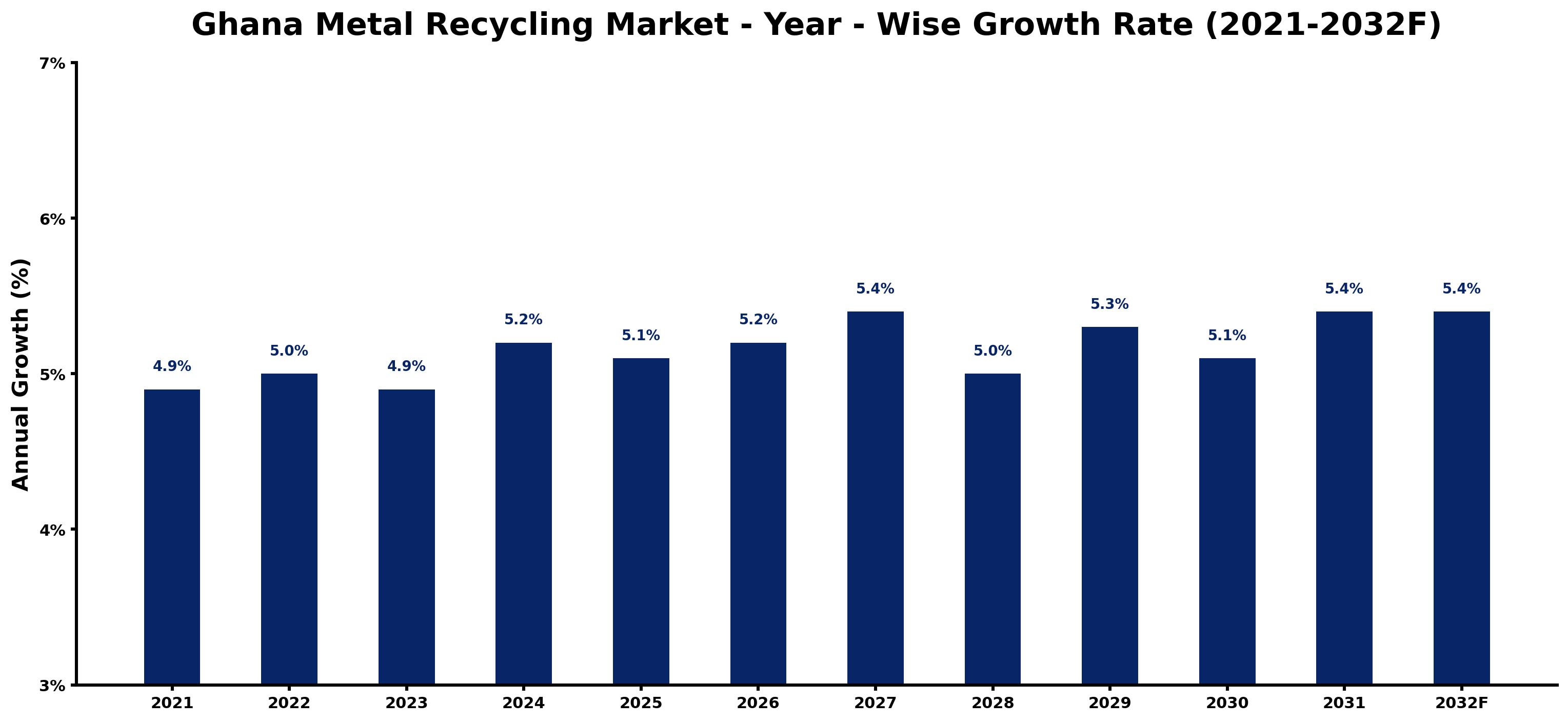
The table below presents the year wise growth rates along with the key drivers influencing the market
| Year | Growth Rate | Major Drivers |
| 2021 | 4.9% | Increased urbanization led to a surge in scrap metal sources within cities. |
| 2022 | 5.0% | Demand for construction materials intensified, boosting local metal recycling efforts significantly. |
| 2023 | 4.9% | Post-pandemic economic recovery spurred investments in recycling infrastructure across Ghana. |
| 2024 | 5.2% | Technological upgrades in processing facilities improved efficiency and output significantly. |
| 2025 | 5.1% | Local enterprises began emphasizing sustainable practices, enhancing their recycling capabilities substantially. |
| 2026 | 5.2% | Demand from international markets created new opportunities for Ghanaian metal recyclers. |
| 2027 | 5.4% | Consumer awareness around electronics recycling influenced waste management strategies positively. |
| 2028 | 5.0% | Emerging partnerships between local businesses and global firms fostered knowledge transfers effectively. |
| 2029 | 5.3% | Circular economy practices gained momentum, encouraging higher metal recovery rates regionally. |
| 2030 | 5.1% | Legislation promoting waste segregation has started reshaping recycling practices across urban areas. |
| 2031 | 5.4% | Technological innovations in sorting and processing have redefined operational efficiencies significantly. |
| 2032 | 5.4% | Regional trade agreements expanded market access for recycled metal products considerably. |
Note - Market size estimations and growth projections presented in this report are based on 6Wresearch's advanced forecasting approach, validated with industry datasets as of June 2026.
Ghana Metal Recycling Market Synopsis
The Ghana Metal Recycling Market is projected to reach 5.2% and witness significant growth during the forecast period (2026-2032). This growth is fueled by the increasing awareness of the environmental benefits brought about by metal recycling, as well as the surging demand for raw materials across various industries, including construction and manufacturing. The market is primarily driven by the activities of scrap metal collection and processing companies, which play a crucial role in gathering and repurposing different types of metal scrap for further use. Although challenges persist, such as inadequate recycling infrastructure and a lack of public awareness regarding recycling, the market presents ample opportunities for investment and development.
Ghana Metal Recycling Market Growth Drivers
Several key factors are contributing to the growth of the Ghana Metal Recycling Market. First, increased awareness regarding environmental sustainability is encouraging both consumers and industries to adopt recycled metal products. Second, government initiatives aimed at promoting recycling practices are fostering a conducive environment for market expansion. Third, the rising number of metal scrap collection centers and recycling facilities is improving the accessibility and efficiency of recycling operations. Fourth, the construction industry increasingly incorporates recycled metals to lower costs while minimizing environmental impacts, further turbocharging demand. Lastly, advancements in recycling technology are enhancing processing efficiencies and product quality, ensuring that recycled metals remain competitive in the market.
Ghana Metal Recycling Market Challenges and Restraints
Despite its growth potential, the Ghana Metal Recycling Market faces several challenges. The limited infrastructure for the collection and processing of scrap metal is a significant barrier that affects operational efficiency. Furthermore, there is a pervasive lack of public awareness regarding the importance of recycling, which limits participation and support from local communities. The absence of stringent government regulations and enforcement mechanisms for sustainable practices also hinders the effectiveness of existing recycling initiatives. Additionally, the market is characterized by informal players who operate outside regulatory frameworks, leading to concerns over quality control and environmental standards. Lastly, fluctuating global metal prices and competition from cheaper imported materials pose substantial hurdles for local recyclers.
Ghana Metal Recycling Market Investment Opportunities
Investors looking at the Ghana Metal Recycling Market will find several promising opportunities. With the increasing industrial growth and emphasis on sustainable practices, there is a growing demand for recycled metals. Establishing or expanding metal recycling facilities can be a lucrative venture, enabling investors to capitalize on this demand. Furthermore, investing in advanced technologies can facilitate more efficient recycling processes, enhancing operational profitability and market competitiveness. Strategic collaborations with local businesses and government initiatives focused on environmental sustainability also present advantageous opportunities for growth. Overall, the shift towards a circular economy in Ghana offers lucrative investment prospects for those interested in aligning financial returns with sustainable development.
Ghana Metal Recycling Market Government Investment and Initiatives
The Ghanaian government has enacted various policies aimed at regulating and supporting the metal recycling sector. The Environmental Protection Agency Act requires that companies in this sphere obtain necessary permits and comply with environmental regulations to operate. Additionally, the Hazardous and Electronic Waste Control and Management Act provides guidelines for handling electronic waste, which contains valuable metals suitable for recycling. The government also incentivizes the growth of the metal recycling industry through fiscal policies, including tax incentives and technical support for local recyclers. These initiatives are designed to foster sustainable practices, conserve the environment, and stimulate the economic development of the metal recycling sector in Ghana.
Ghana Metal Recycling Market Latest Developments (May 2025 - June 2026)
Recent trends in the Ghana Metal Recycling Market indicate a steady transition towards enhanced recycling practices and sustainability measures. Between May 2025 and June 2026, there has been a marked increase in public and private sector initiatives targeting waste reduction and recycling education. The government has intensified its campaigns to raise awareness among citizens about the benefits of recycling, while industry stakeholders are increasingly investing in improved technologies for metal processing. Furthermore, collaborative efforts between government entities and recycling firms have resulted in more streamlined operations and better resource allocation. This period has witnessed a surge in the establishment of new recycling facilities, aimed at leveraging the growing demand for recycled materials in various sectors.
Ghana Metal Recycling Market Future Outlook
Looking ahead, the Ghana Metal Recycling Market is positioned for positive growth, driven by a collective emphasis on sustainable practices and environmental stewardship. The ongoing governmental focus on promoting a circular economy is expected to bolster the demand for metal recycling in the years to come. Additionally, the anticipated growth of Ghana's industrial sector will continue to provide a steady supply of scrap metal for recycling purposes. Advancements in recycling technology are also projected to enhance processing efficiencies and product quality, further stimulating market growth. Overall, with a supportive policy framework and increasing public awareness, the Ghana Metal Recycling Market is poised for substantial expansion over the forecast period (2026-2032).
Ghana Metal Recycling Market - Key Attractiveness of the Report
- 10 Years of Market Numbers
- Historical Data Starting from 2022 to 2025
- Base Year: 2025
- Forecast Data until 2032
- Key Performance Indicators Impacting the Market
- Major Upcoming Developments and Projects
Key Highlights of the Report:
- Ghana Metal Recycling Market Outlook
- Market Size of Ghana Metal Recycling Market, 2025
- Forecast of Ghana Metal Recycling Market, 2032F
- Historical Data and Forecast of Ghana Metal Recycling Revenues & Volume for the Period 2022-2032F
- Ghana Metal Recycling Market Trend Evolution
- Ghana Metal Recycling Market Drivers and Challenges
- Ghana Metal Recycling Price Trends
- Ghana Metal Recycling Porter's Five Forces
- Ghana Metal Recycling Industry Life Cycle
- Historical Data and Forecast of Ghana Metal Recycling Market Revenues & Volume By Metal Type for the Period 2022-2032F
- Historical Data and Forecast of Ghana Metal Recycling Market Revenues & Volume By Ferrous Metal for the Period 2022-2032F
- Historical Data and Forecast of Ghana Metal Recycling Market Revenues & Volume By Non-ferrous Metal for the Period 2022-2032F
- Historical Data and Forecast of Ghana Metal Recycling Market Revenues & Volume By Scrap Types for the Period 2022-2032F
- Historical Data and Forecast of Ghana Metal Recycling Market Revenues & Volume By Old Scrap for the Period 2022-2032F
- Historical Data and Forecast of Ghana Metal Recycling Market Revenues & Volume By New Scrap for the Period 2022-2032F
- Historical Data and Forecast of Ghana Metal Recycling Market Revenues & Volume By Equipment Types for the Period 2022-2032F
- Historical Data and Forecast of Ghana Metal Recycling Market Revenues & Volume By Shears for the Period 2022-2032F
- Historical Data and Forecast of Ghana Metal Recycling Market Revenues & Volume By Shredders for the Period 2022-2032F
- Historical Data and Forecast of Ghana Metal Recycling Market Revenues & Volume By Briquette Machines for the Period 2022-2032F
- Historical Data and Forecast of Ghana Metal Recycling Market Revenues & Volume By Granulating Machines for the Period 2022-2032F
- Historical Data and Forecast of Ghana Metal Recycling Market Revenues & Volume By Others for the Period 2022-2032F
- Historical Data and Forecast of Ghana Metal Recycling Market Revenues & Volume By End-users for the Period 2022-2032F
- Historical Data and Forecast of Ghana Metal Recycling Market Revenues & Volume By Building & Construction for the Period 2022-2032F
- Historical Data and Forecast of Ghana Metal Recycling Market Revenues & Volume By Packaging for the Period 2022-2032F
- Historical Data and Forecast of Ghana Metal Recycling Market Revenues & Volume By Automotive for the Period 2022-2032F
- Historical Data and Forecast of Ghana Metal Recycling Market Revenues & Volume By Industrial Machinery for the Period 2022-2032F
- Historical Data and Forecast of Ghana Metal Recycling Market Revenues & Volume By Electronics & Electrical Equipment for the Period 2022-2032F
- Historical Data and Forecast of Ghana Metal Recycling Market Revenues & Volume By Shipbuilding for the Period 2022-2032F
- Historical Data and Forecast of Ghana Metal Recycling Market Revenues & Volume By Others for the Period 2022-2032F
- Ghana Metal Recycling Import Export Trade Statistics
- Market Opportunity Assessment By Metal Type
- Market Opportunity Assessment By Scrap Types
- Market Opportunity Assessment By Equipment Types
- Market Opportunity Assessment By End-users
- Ghana Metal Recycling Top Companies Market Share
- Ghana Metal Recycling Competitive Benchmarking By Technical and Operational Parameters
- Ghana Metal Recycling Company Profiles
- Ghana Metal Recycling Key Strategic Recommendations






































