Ghana Planting Equipment Market Size, Share & Growth Rate
The Ghana Planting Equipment Market was estimated at USD 555 Million in 2025 and is projected to reach USD 802 Million by 2032, growing at a CAGR of 5.4% from 2026 to 2032. This promising trajectory is primarily driven by the rising trend of agricultural mechanization, as farmers increasingly recognize the efficiency benefits of modern planting tools. Furthermore, government initiatives aimed at enhancing food production and addressing the mechanization gap are also playing a pivotal role in shaping this robust growth outlook.
Ghana Planting Equipment Market Year-wise Growth Rate and Key Drivers
This graph highlights how the Ghana Planting Equipment Market has steadily grown over the years, supported by major growth factors.
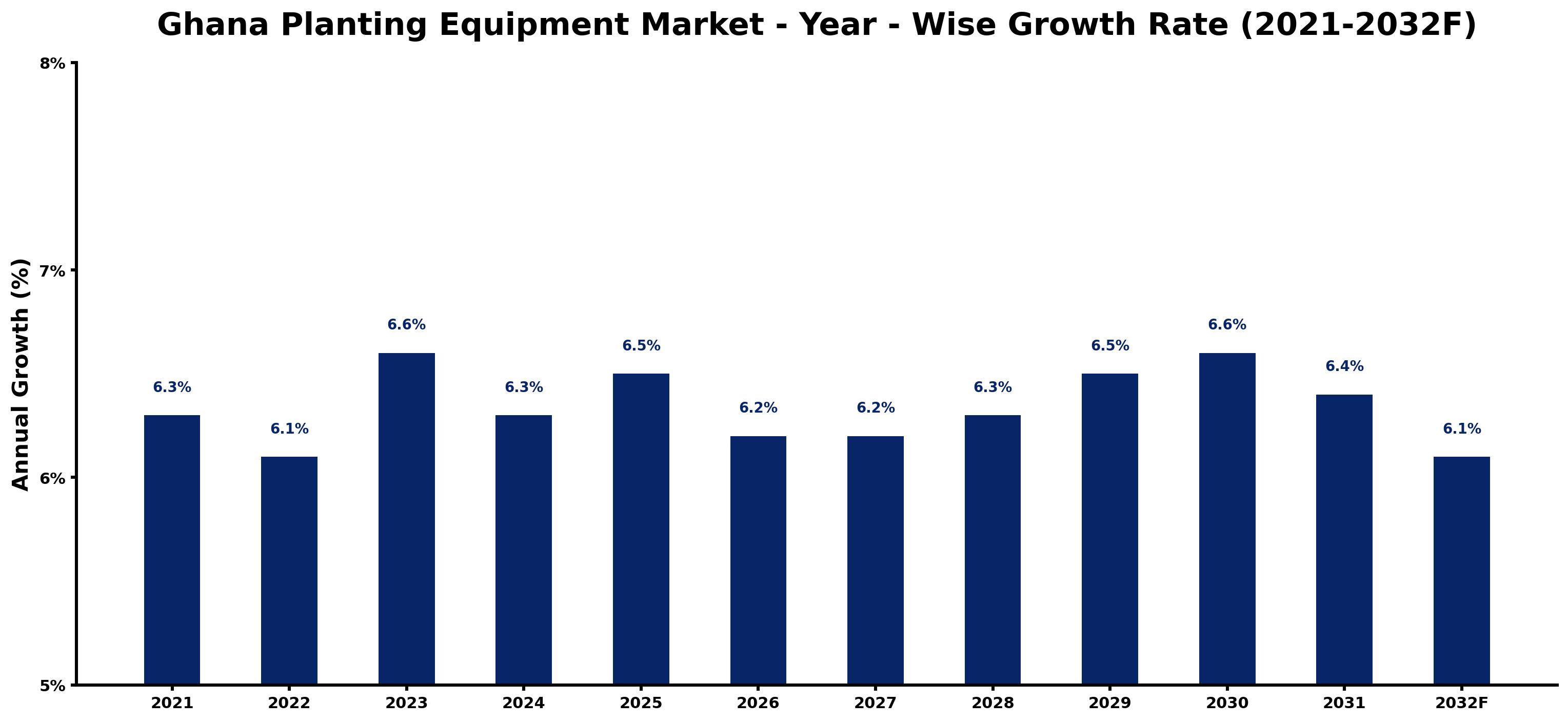
The table below presents the year‑wise growth rates along with the key drivers influencing the market
| Year | Growth Rate | Major Drivers |
| 2021 | 6.3% | Rising electricity demand across industries |
| 2022 | 6.1% | Government infrastructure modernization initiatives |
| 2023 | 6.6% | Increasing industrial infrastructure investments |
| 2024 | 6.3% | Increasing adoption of advanced technologies |
| 2025 | 6.5% | Growing urbanization and commercial development |
| 2026 | 6.2% | Expansion of transportation and logistics networks |
| 2027 | 6.2% | Expansion of transportation and logistics networks |
| 2028 | 6.3% | Rapid growth in telecom and data center sectors |
| 2029 | 6.5% | Growing renewable energy integration projects |
| 2030 | 6.6% | Rapid growth in telecom and data center sectors |
| 2031 | 6.4% | Growing urbanization and commercial development |
| 2032 | 6.1% | Rising electricity demand across industries |
Note - Market size estimations and growth projections presented in this report are based on 6Wresearch’s advanced forecasting approach, validated with industry datasets as of June 2026.
Ghana Planting Equipment Market Synopsis
The most significant force currently influencing the Ghana Planting Equipment Market is the increasing mechanization of agriculture. As farmers embrace modern planting technologies, they experience considerable gains in productivity and efficiency, leading to a more sustainable agricultural sector. This transformation is further supported by widespread awareness regarding precision planting and its advantages in enhancing crop yields.
In addition to mechanization, there is a notable diversification in crop production across the country. This shift demands versatile planting equipment that can adapt to varying soil types and farming practices. Consequently, the demand for innovative and sustainable planting solutions is on the rise, positioning the Ghana Planting Equipment Market for a future marked by significant advancements and opportunities.
Ghana Planting Equipment Market Key Takeaways
- Strong growth trajectory driven by increased mechanization in agriculture.
- Government initiatives are critical in promoting modern farming practices.
- Rising awareness of precision agriculture is fueling demand for advanced planting tools.
- Diverse agricultural practices are necessitating versatile planting equipment solutions.
- Investment opportunities are expanding for both local and international stakeholders.
Evaluation of Restraints in Ghana Planting Equipment Market
Despite the optimistic growth outlook, several constraints hinder the Ghana Planting Equipment Market. Limited access to modern and efficient planting equipment poses a significant challenge, particularly for small-scale farmers who often struggle with the high costs associated with these technologies. Inadequate financing options further exacerbate this issue, preventing many farmers from making necessary investments. Additionally, a lack of awareness and training on the effective use of modern planting machinery means that even available resources may not be fully utilized. The presence of counterfeit products in the market compounds these difficulties, creating skepticism about equipment quality and reliability. Therefore, addressing these barriers will be essential for unlocking the full potential of the planting equipment market in Ghana.
Ghana Planting Equipment Market Trends
Current trends shaping the Ghana Planting Equipment Market include a marked shift toward mechanization and sustainable agricultural practices. Farmers are increasingly investing in advanced planting technologies such as seed drills and precision planting tools that not only enhance efficiency but also promote environmental sustainability through methods like conservation tillage. Moreover, the demand for multifunctional equipment capable of handling a variety of crops and soil conditions is on the rise, reflecting the ongoing diversification in agricultural production across Ghana.
Ghana Planting Equipment Market Opportunities
The Ghana Planting Equipment Market presents numerous investment opportunities for both local and international stakeholders. With the government's commitment to enhancing agricultural productivity and the growing farmer adoption of modern practices, there is a strong demand for advanced planting equipment. Investors can explore opportunities in manufacturing or distribution, particularly by focusing on innovative, technology-driven planting solutions. Collaborations with local farmers and cooperatives can also pave the way for providing access to modern planting equipment, thereby enhancing the overall market landscape.
Government Initiatives in the Ghana Planting Equipment Market
The Ghanaian government has taken significant steps to bolster the planting equipment market, with initiatives aimed at enhancing agricultural productivity. Programs such as "Planting for Food and Jobs" provide crucial subsidies for acquiring agricultural machinery, facilitating greater efficiency and increased yields. The government has also established tax incentives and duty exemptions for the importation of planting equipment, making it more accessible to farmers. These efforts form a part of a larger strategy to promote sustainable agriculture, enhance food security, and stimulate overall economic growth in the agricultural sector.
Future Insights of the Ghana Planting Equipment Market
Looking ahead to the period between 2026 and 2032, the Ghana Planting Equipment Market is expected to continue its upward trajectory, driven by ongoing mechanization and government support. As farmers increasingly adopt precision agriculture techniques, the demand for technologically advanced planting equipment is set to rise. While challenges such as initial investment costs and limited access to credit may persist, the focus on sustainable agriculture practices and meeting the growing food demand will likely foster steady growth in this dynamic market.
Ghana Planting Equipment Market Latest Developments (May 2025 - June 2026)
Recent developments in the Ghana Planting Equipment Market highlight an ongoing emphasis on innovation and technological advancement. Efforts are being made to enhance training programs that educate farmers about the efficient use of modern planting machinery. Additionally, there is a discernible increase in partnerships between agricultural organizations and equipment manufacturers aimed at providing access to quality planting tools. Such initiatives not only facilitate the adoption of technology but also strengthen the overall agricultural framework in Ghana.
Ghana Planting Equipment Market - Key Attractiveness of the Report
- 10 Years of Market Numbers
- Historical Data Starting from 2022 to 2025
- Base Year: 2025
- Forecast Data until 2032
- Key Performance Indicators Impacting the Market
- Major Upcoming Developments and Projects
Key Highlights of the Report:
- Ghana Planting Equipment Market Outlook
- Market Size of Ghana Planting Equipment Market, 2025
- Forecast of Ghana Planting Equipment Market, 2032
- Historical Data and Forecast of Ghana Planting Equipment Revenues & Volume for the Period 2022-2032F
- Ghana Planting Equipment Market Trend Evolution
- Ghana Planting Equipment Market Drivers and Challenges
- Ghana Planting Equipment Price Trends
- Ghana Planting Equipment Porter's Five Forces
- Ghana Planting Equipment Industry Life Cycle
- Historical Data and Forecast of Ghana Planting Equipment Market Revenues & Volume By Type for the Period 2022-2032F
- Historical Data and Forecast of Ghana Planting Equipment Market Revenues & Volume By Air seeders for the Period 2022-2032F
- Historical Data and Forecast of Ghana Planting Equipment Market Revenues & Volume By Seed drills for the Period 2022-2032F
- Historical Data and Forecast of Ghana Planting Equipment Market Revenues & Volume By Planters for the Period 2022-2032F
- Historical Data and Forecast of Ghana Planting Equipment Market Revenues & Volume By Others for the Period 2022-2032F
- Historical Data and Forecast of Ghana Planting Equipment Market Revenues & Volume By Design for the Period 2022-2032F
- Historical Data and Forecast of Ghana Planting Equipment Market Revenues & Volume By Mechanical for the Period 2022-2032F
- Historical Data and Forecast of Ghana Planting Equipment Market Revenues & Volume By Automatic for the Period 2022-2032F
- Historical Data and Forecast of Ghana Planting Equipment Market Revenues & Volume By Crop Type for the Period 2022-2032F
- Historical Data and Forecast of Ghana Planting Equipment Market Revenues & Volume By Cereals & grains for the Period 2022-2032F
- Historical Data and Forecast of Ghana Planting Equipment Market Revenues & Volume By Oilseeds & pulses for the Period 2022-2032F
- Historical Data and Forecast of Ghana Planting Equipment Market Revenues & Volume By Fruits & vegetables for the Period 2022-2032F
- Historical Data and Forecast of Ghana Planting Equipment Market Revenues & Volume By Others for the Period 2022-2032F
- Ghana Planting Equipment Import Export Trade Statistics
- Market Opportunity Assessment By Type
- Market Opportunity Assessment By Design
- Market Opportunity Assessment By Crop Type
- Ghana Planting Equipment Top Companies Market Share
- Ghana Planting Equipment Competitive Benchmarking By Technical and Operational Parameters
- Ghana Planting Equipment Company Profiles
- Ghana Planting Equipment Key Strategic Recommendations






































