Ghana Refined Petroleum Products Market Size, Share & Growth Rate
The Ghana Refined Petroleum Products Market was estimated at USD 171 Million in 2025 and is projected to reach USD 231 Million by 2032, growing at a CAGR of 4.4% from 2026 to 2032. This growth is fueled by an increase in population and urbanization, which amplifies the demand for transportation and industrial fuels. As the economy diversifies and expands, the use of refined petroleum products will rise, highlighting the importance of robust infrastructure and innovative solutions in meeting consumer needs.
Ghana Refined Petroleum Products Market Year-wise Growth Rate and Key Drivers
This graph highlights how the Ghana Refined Petroleum Products Market has steadily grown over the years, supported by major growth factors.
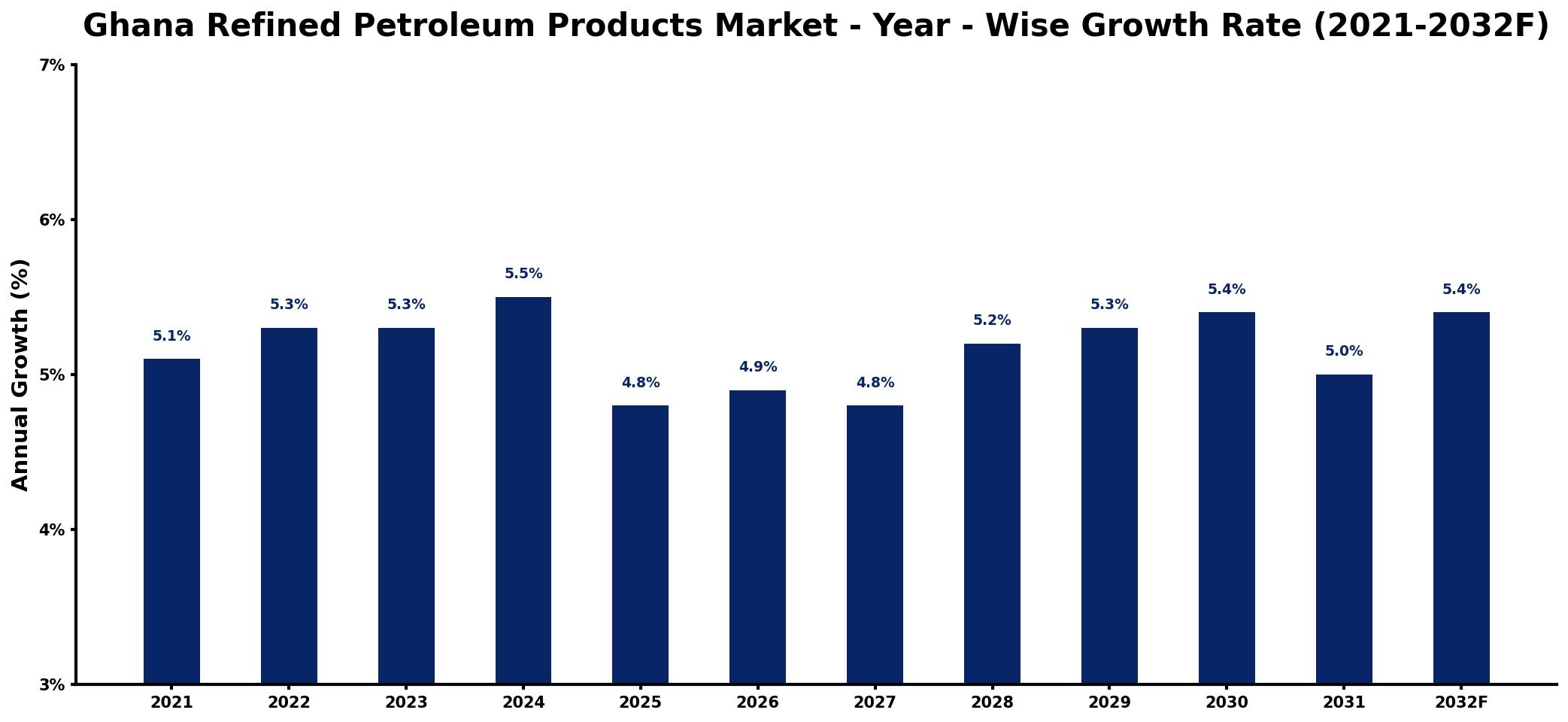
The table below presents the year‑wise growth rates along with the key drivers influencing the market
| Year | Growth Rate | Major Drivers |
| 2021 | 5.1% | Rising energy consumption patterns |
| 2022 | 5.3% | Expansion of transportation infrastructure |
| 2023 | 5.3% | Increased industrial production activities |
| 2024 | 5.5% | Growing demand for mobility solutions |
| 2025 | 4.8% | Investment in alternative energy sources |
| 2026 | 4.9% | Strengthening regional trade agreements |
| 2027 | 4.8% | Development of urbanization projects |
| 2028 | 5.2% | Surge in agricultural mechanization |
| 2029 | 5.3% | Boost in mining sector operations |
| 2030 | 5.4% | Enhancement of logistics capabilities |
| 2031 | 5.0% | Increase in tourism activities |
| 2032 | 5.4% | Emergence of renewable energy initiatives |
Note: Market size estimations and growth projections presented in this report are based on 6Wresearch's proprietary forecasting methodology, utilizing the latest available industry data, government publications, and primary research inputs.
Ghana Refined Petroleum Products Market Synopsis
Currently, the Ghana Refined Petroleum Products Market stands at a pivotal juncture, influenced by rising consumer demands for gasoline, diesel, and kerosene. With urban expansion and industrialization on the rise, the market is gearing up for significant changes that reflect the evolving needs of its populace.
As this sector expands, leading entities are optimizing their distribution networks and embracing technological advancements to improve efficiency. Government policies are progressively aligning with market dynamics, which further enhances the overall landscape of refined petroleum products in Ghana.
Ghana Refined Petroleum Products Market Key Takeaways
- Growth is driven by urbanization, population increase, and industrial activities.
- Environmental concerns are leading to a shift towards cleaner and sustainable fuels.
- Investment opportunities exist in distribution, storage, and alternative energy solutions.
- Government regulations play a critical role in shaping market dynamics and ensuring quality standards.
- Infrastructure improvements are essential for enhancing supply chain efficiency.
Evaluation of Restraints in Ghana Refined Petroleum Products Market
The Ghana Refined Petroleum Products Market faces several constraints that could limit its growth. Fluctuating global oil prices significantly impact operational costs, leading to price volatility for consumers. Furthermore, currency exchange rate fluctuations can complicate import logistics, making refined products expensive. Infrastructure inadequacies, such as limited storage and distribution capabilities, hinder supply chain efficiency, resulting in potential shortages. Regulatory uncertainties also pose challenges, as shifts in policies can affect pricing and import processes, creating an unpredictable environment for businesses. Addressing these issues will require a concerted effort from stakeholders to stabilize and strengthen market conditions.
Ghana Refined Petroleum Products Market Trends
The market is increasingly gravitating towards cleaner energy solutions, spurred by growing public awareness of environmental issues. This trend manifests in the rising adoption of liquefied petroleum gas (LPG) and biofuels, as consumers and businesses alike seek lower-emission alternatives. Additionally, there is a heightened interest in electric vehicles and hybrid technologies, driven by the government's initiatives to transition towards renewable energy sources. These trends are reshaping consumer behavior and prompting innovative developments within the sector.
Ghana Refined Petroleum Products Market Opportunities
Significant investment opportunities are emerging in the Ghana Refined Petroleum Products Market, particularly in the distribution and retail sectors. Establishing new fuel stations or expanding existing networks can effectively address the increasing demand for petroleum products. Moreover, investments in storage and logistics infrastructure are vital for optimizing transportation and ensuring product availability nationwide. The strategic geographical positioning of Ghana also opens avenues for importing and trading refined petroleum products, enhancing its role as a hub in the West African market. With the governments commitment to promoting renewable energy, there is considerable potential for integrating alternative energy solutions within the petroleum landscape.
Government Initiatives in the Ghana Refined Petroleum Products Market
The Ghanaian government is actively implementing policies to support the Refined Petroleum Products Market, focusing on deregulating pump prices to allow market forces to drive pricing. The National Petroleum Authority (NPA) plays a pivotal role in regulating the industry, ensuring compliance with quality standards, and overseeing licensing for importers. Additionally, the government offers subsidies for petroleum product imports to stabilize prices, thereby enhancing affordability for consumers. There are ongoing initiatives aimed at promoting cleaner fuels and renewable energy, aligning with global commitments to combat climate change.
Future Insights of the Ghana Refined Petroleum Products Market
Looking ahead to the period between 2026 and 2032, the Ghana Refined Petroleum Products Market is projected to experience steady growth. The continued rise in population and urbanization, coupled with increasing industrial activity, will likely sustain demand for refined petroleum products. Investments in infrastructure will be critical to enhancing supply chain efficiency, while the ongoing development of oil and gas reserves in offshore fields may further bolster the sector. However, stakeholders must remain vigilant against potential risks such as global price fluctuations and regulatory changes, which could influence the markets trajectory.
Ghana Refined Petroleum Products Market Latest Developments (2025 - 2026)
Recent developments in the Ghana Refined Petroleum Products Market indicate a shift towards modernization and sustainability. Companies are actively investing in advanced distribution networks and greener fuel alternatives. There is a notable emphasis on enhancing technological infrastructure to improve efficiency. Meanwhile, government initiatives aimed at promoting renewable energy are gaining traction, reflecting a broader commitment to reducing environmental impact and ensuring energy security.
Ghana Refined Petroleum Products Market - Key Attractiveness of the Report
- 10 Years of Market Numbers
- Historical Data Starting from 2022 to 2025
- Base Year: 2025
- Forecast Data until 2032
- Key Performance Indicators Impacting the Market
- Major Upcoming Developments and Projects
Key Highlights of the Report:
- Ghana Refined Petroleum Products Market Outlook
- Market Size of Ghana Refined Petroleum Products Market, 2025
- Forecast of Ghana Refined Petroleum Products Market, 2032
- Historical Data and Forecast of Ghana Refined Petroleum Products Revenues & Volume for the Period 2022-2032F
- Ghana Refined Petroleum Products Market Trend Evolution
- Ghana Refined Petroleum Products Market Drivers and Challenges
- Ghana Refined Petroleum Products Price Trends
- Ghana Refined Petroleum Products Porter's Five Forces
- Ghana Refined Petroleum Products Industry Life Cycle
- Historical Data and Forecast of Ghana Refined Petroleum Products Market Revenues & Volume By Product Type for the Period 2022-2032F
- Historical Data and Forecast of Ghana Refined Petroleum Products Market Revenues & Volume By Diesel for the Period 2022-2032F
- Historical Data and Forecast of Ghana Refined Petroleum Products Market Revenues & Volume By Gasoline for the Period 2022-2032F
- Historical Data and Forecast of Ghana Refined Petroleum Products Market Revenues & Volume By Fuel Oils for the Period 2022-2032F
- Historical Data and Forecast of Ghana Refined Petroleum Products Market Revenues & Volume By Kerosene for the Period 2022-2032F
- Historical Data and Forecast of Ghana Refined Petroleum Products Market Revenues & Volume By Others for the Period 2022-2032F
- Historical Data and Forecast of Ghana Refined Petroleum Products Market Revenues & Volume By Application for the Period 2022-2032F
- Historical Data and Forecast of Ghana Refined Petroleum Products Market Revenues & Volume By Fuel for the Period 2022-2032F
- Historical Data and Forecast of Ghana Refined Petroleum Products Market Revenues & Volume By Chemical for the Period 2022-2032F
- Historical Data and Forecast of Ghana Refined Petroleum Products Market Revenues & Volume By Others for the Period 2022-2032F
- Historical Data and Forecast of Ghana Refined Petroleum Products Market Revenues & Volume By Fraction for the Period 2022-2032F
- Historical Data and Forecast of Ghana Refined Petroleum Products Market Revenues & Volume By Light Distillates for the Period 2022-2032F
- Historical Data and Forecast of Ghana Refined Petroleum Products Market Revenues & Volume By Middle Distillates for the Period 2022-2032F
- Historical Data and Forecast of Ghana Refined Petroleum Products Market Revenues & Volume By Heavy Oils for the Period 2022-2032F
- Ghana Refined Petroleum Products Import Export Trade Statistics
- Market Opportunity Assessment By Product Type
- Market Opportunity Assessment By Application
- Market Opportunity Assessment By Fraction
- Ghana Refined Petroleum Products Top Companies Market Share
- Ghana Refined Petroleum Products Competitive Benchmarking By Technical and Operational Parameters
- Ghana Refined Petroleum Products Company Profiles
- Ghana Refined Petroleum Products Key Strategic Recommendations






































