Ghana Retail And Wholesale Market Size, Share & Growth Rate
The Ghana Retail And Wholesale Market was estimated at USD 904 Million in 2025 and is projected to reach USD 1491 Million by 2032, growing at a CAGR of 7.4% from 2026 to 2032. This robust growth is primarily fueled by a burgeoning urban population and an expanding middle class, both of which are driving increased consumer spending on a variety of goods and services. As the purchasing power of Ghanaians rises, there is a noticeable shift towards modern retail formats, including supermarkets and e-commerce platforms.
Ghana Retail And Wholesale Market Year-wise Growth Rate and Key Drivers
This graph highlights how the Ghana Retail And Wholesale Market has steadily grown over the years, supported by major growth factors.
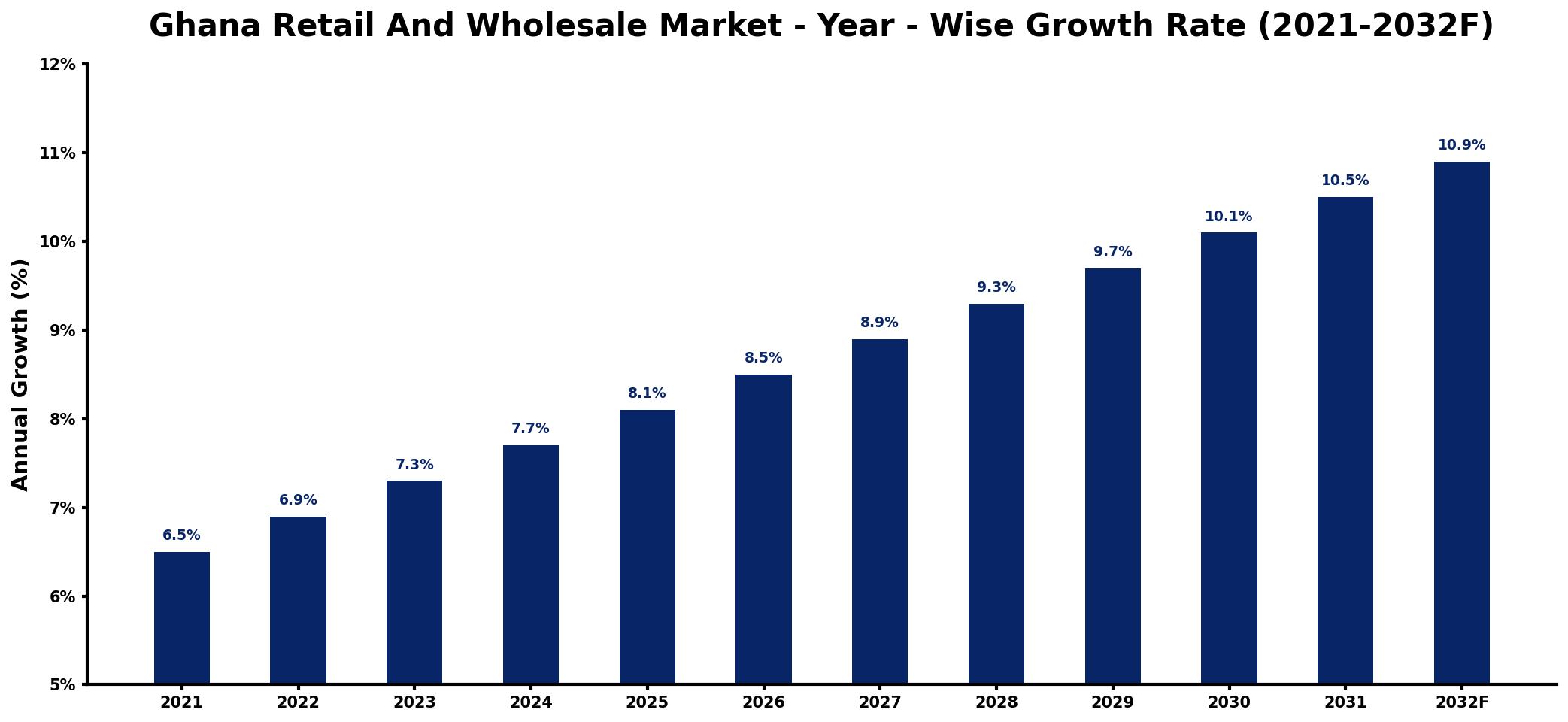
The table below presents the year‑wise growth rates along with the key drivers influencing the market
| Year | Growth Rate | Major Drivers |
| 2021 | 6.5% | Rising consumer spending power |
| 2022 | 6.9% | Expansion of e-commerce platforms |
| 2023 | 7.3% | Increase in foreign investments |
| 2024 | 7.7% | Growth of local manufacturing sector |
| 2025 | 8.1% | Rise in urban population density |
| 2026 | 8.5% | Improved logistics and distribution |
| 2027 | 8.9% | Diversification of product offerings |
| 2028 | 9.3% | Strengthening of supply chains |
| 2029 | 9.7% | Adoption of digital payment systems |
| 2030 | 10.1% | Emergence of sustainable practices |
| 2031 | 10.5% | Boost in tourism and hospitality |
| 2032 | 10.9% | Enhancement of regulatory frameworks |
Note: Market size estimations and growth projections presented in this report are based on 6Wresearch's proprietary forecasting methodology, utilizing the latest available industry data, government publications, and primary research inputs.
Ghana Retail And Wholesale Market Synopsis
Ghana's retail landscape is marked by a rich tapestry of shopping experiences ranging from bustling traditional markets to sleek modern malls. In particular, the demand for food and beverage products continues to outpace other categories, reflecting changing dietary habits and an inclination toward convenience among consumers.
Additionally, the wholesale sector remains vital, servicing a diverse array of retailers and businesses. The interplay between traditional and contemporary retail formats illustrates the dynamic nature of Ghana's market, offering both challenges and opportunities for stakeholders.
Ghana Retail And Wholesale Market Key Takeaways
- The market is witnessing significant growth due to urbanization and rising middle-class affluence.
- E-commerce is rapidly gaining traction, driven by increased internet access and changing consumer preferences.
- There is a rising demand for sustainable and eco-friendly products among consumers.
- The traditional retail sector is innovating to enhance customer experience through modern retail strategies.
- Investment opportunities abound in modern retail outlets, supply chain infrastructure, and niche markets.
Evaluation of Restraints in Ghana Retail And Wholesale Market
Despite its rapid growth, the Ghana Retail and Wholesale Market faces several structural restraints that impede its full potential. Unreliable infrastructure, such as erratic power supply and inadequate transportation systems, can significantly escalate operational costs for businesses. Furthermore, high import duties hinder competitiveness, particularly for retailers that rely on imported goods. The sizable informal sector contributes to tax evasion and presents unfair competition to regulated businesses, while limited access to financing stifles growth opportunities for smaller players in the market.
Ghana Retail And Wholesale Market Trends
A transformative wave is sweeping through the Ghana Retail and Wholesale Market, characterized by the increasing integration of e-commerce and digital payment systems. Consumers are gravitating towards online shopping experiences that offer convenience and diversity. Concurrently, there's a notable shift towards ethical consumerism; shoppers are now more inclined to support brands that prioritize sustainability and social responsibility. This evolution in consumer behavior is prompting retailers to adopt more innovative marketing strategies and modern store designs, enhancing the overall shopping experience.
Ghana Retail And Wholesale Market Opportunities
The evolving market landscape presents numerous avenues for investment and expansion. The rise of e-commerce platforms creates a fertile ground for online retail ventures, enabling businesses to reach a broader audience. Moreover, opportunities lie in developing modern retail infrastructures such as shopping malls and supermarkets to cater to the increasing consumer demand. Specialized segments, including organic foods and luxury goods, are also emerging, poised to attract discerning consumers and fill existing market gaps.
Government Initiatives in the Ghana Retail And Wholesale Market
The Ghanaian government has implemented several initiatives to foster a conducive environment for the retail and wholesale sector. The Retail Trade Act regulates foreign investment, ensuring that there are clear guidelines for participation in the market. The National Single Window system is designed to simplify trade processes, significantly reducing operational costs for retailers and wholesalers. Furthermore, the Ghana Investment Promotion Centre Act aims to draw investments into the sector, while the Competition Act ensures fair market practices, thereby promoting a level playing field for all participants.
Future Insights of the Ghana Retail And Wholesale Market
Looking ahead to 2026-2032, the Ghana Retail and Wholesale Market is positioned for sustained growth, underpinned by ongoing economic development and urbanization. As consumer preferences continue to evolve, businesses that harness technology and prioritize customer engagement will thrive. However, companies will need to navigate challenges related to infrastructure and competition from informal markets adeptly. The future will favor those who innovate, emphasize sustainability, and adapt to the shifting landscape of consumer behavior.
Ghana Retail And Wholesale Market Latest Developments (2025 - 2026)
In recent months, there has been a marked increase in the rollout of digital payment systems, with several retail businesses adopting mobile payment solutions to streamline transactions. Additionally, collaborations between tech firms and retail chains are gaining traction, aimed at enhancing the e-commerce landscape. Local retailers are also stepping up efforts to improve customer experiences through modernized store formats and innovative marketing approaches, aligning with the growing consumer demand for convenience and quality.
Ghana Retail And Wholesale Market - Key Attractiveness of the Report
- 10 Years of Market Numbers
- Historical Data Starting from 2022 to 2025
- Base Year: 2025
- Forecast Data until 2032
- Key Performance Indicators Impacting the Market
- Major Upcoming Developments and Projects
Key Highlights of the Report:
- Ghana Retail And Wholesale Market Outlook
- Market Size of Ghana Retail And Wholesale Market, 2025
- Forecast of Ghana Retail And Wholesale Market, 2032
- Historical Data and Forecast of Ghana Retail And Wholesale Revenues & Volume for the Period 2022-2032F
- Ghana Retail And Wholesale Market Trend Evolution
- Ghana Retail And Wholesale Market Drivers and Challenges
- Ghana Retail And Wholesale Price Trends
- Ghana Retail And Wholesale Porter's Five Forces
- Ghana Retail And Wholesale Industry Life Cycle
- Historical Data and Forecast of Ghana Retail And Wholesale Market Revenues & Volume By Type for the Period 2022-2032F
- Historical Data and Forecast of Ghana Retail And Wholesale Market Revenues & Volume By Retail for the Period 2022-2032F
- Historical Data and Forecast of Ghana Retail And Wholesale Market Revenues & Volume By Wholesale for the Period 2022-2032F
- Historical Data and Forecast of Ghana Retail And Wholesale Market Revenues & Volume By Ownership for the Period 2022-2032F
- Historical Data and Forecast of Ghana Retail And Wholesale Market Revenues & Volume By Retail Chain/Wholesale Chain for the Period 2022-2032F
- Historical Data and Forecast of Ghana Retail And Wholesale Market Revenues & Volume By Independent Retailer/Independent Wholesalers for the Period 2022-2032F
- Historical Data and Forecast of Ghana Retail And Wholesale Market Revenues & Volume By Price Range for the Period 2022-2032F
- Historical Data and Forecast of Ghana Retail And Wholesale Market Revenues & Volume By Premium for the Period 2022-2032F
- Historical Data and Forecast of Ghana Retail And Wholesale Market Revenues & Volume By Mid-Range for the Period 2022-2032F
- Historical Data and Forecast of Ghana Retail And Wholesale Market Revenues & Volume By Economy for the Period 2022-2032F
- Historical Data and Forecast of Ghana Retail And Wholesale Market Revenues & Volume By Distribution Channel for the Period 2022-2032F
- Historical Data and Forecast of Ghana Retail And Wholesale Market Revenues & Volume By Supermarkets/Hypermarkets for the Period 2022-2032F
- Historical Data and Forecast of Ghana Retail And Wholesale Market Revenues & Volume By Convenience Stores for the Period 2022-2032F
- Historical Data and Forecast of Ghana Retail And Wholesale Market Revenues & Volume By Department Stores for the Period 2022-2032F
- Historical Data and Forecast of Ghana Retail And Wholesale Market Revenues & Volume By Specialty Stores for the Period 2022-2032F
- Ghana Retail And Wholesale Import Export Trade Statistics
- Market Opportunity Assessment By Type
- Market Opportunity Assessment By Ownership
- Market Opportunity Assessment By Price Range
- Market Opportunity Assessment By Distribution Channel
- Ghana Retail And Wholesale Top Companies Market Share
- Ghana Retail And Wholesale Competitive Benchmarking By Technical and Operational Parameters
- Ghana Retail And Wholesale Company Profiles
- Ghana Retail And Wholesale Key Strategic Recommendations






































