Ghana Security Door Market Size, Share & Growth Rate
The Ghana Security Door Market was estimated at USD 272 Million in 2025 and is projected to reach USD 378 Million by 2032, growing at a CAGR of 4.8% from 2026 to 2032. This upward trajectory is primarily driven by an escalating demand for safety and security solutions among both residential and commercial property owners. As urbanization accelerates and the middle-class demographic expands, the emphasis on securing properties with high-quality doors becomes increasingly vital in response to rising crime rates.
Ghana Security Door Market Year-wise Growth Rate and Key Drivers
This graph highlights how the Ghana Security Door Market has steadily grown over the years, supported by major growth factors.
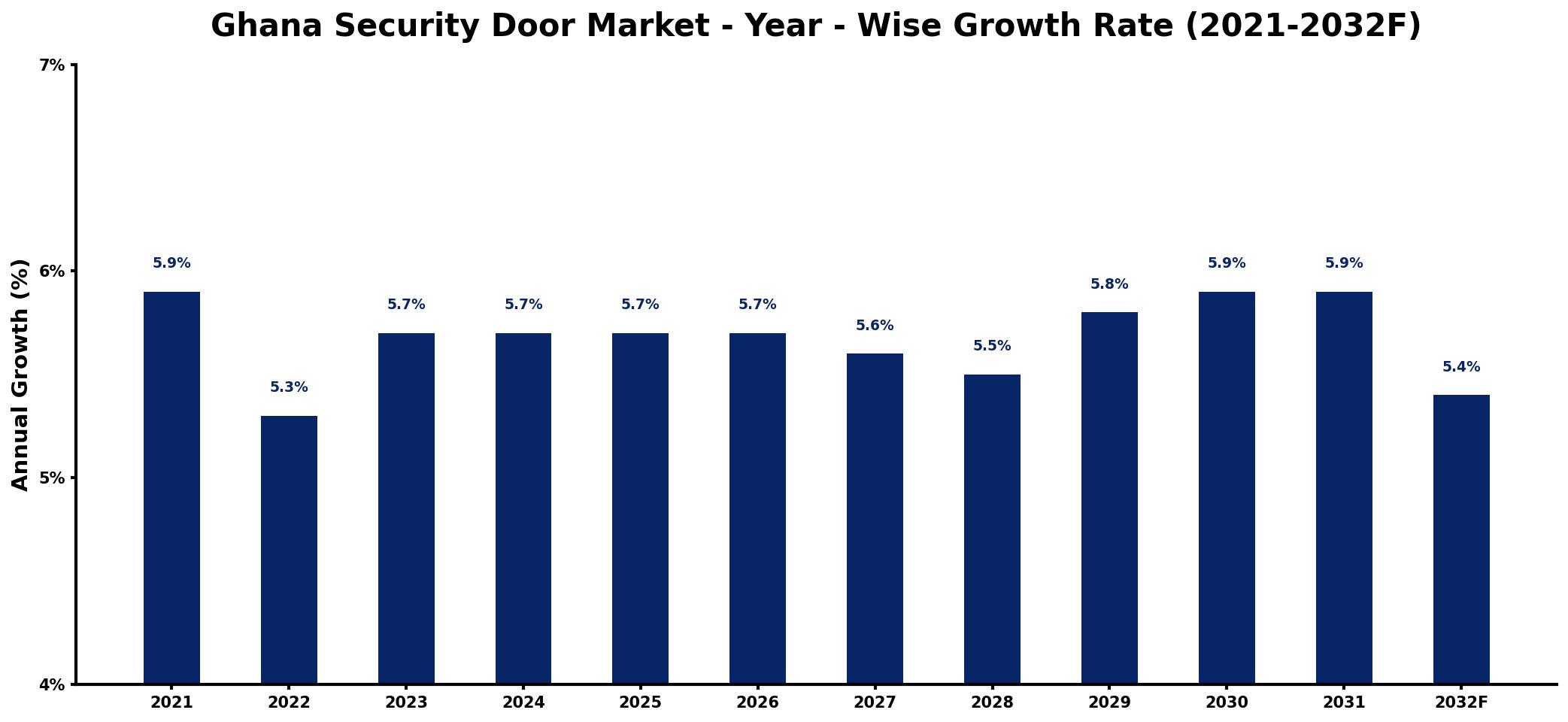
The table below presents the year‑wise growth rates along with the key drivers influencing the market
| Year | Growth Rate | Major Drivers |
| 2021 | 5.9% | Increased residential construction projects |
| 2022 | 5.3% | Growing urban population density |
| 2023 | 5.7% | Rising awareness of safety measures |
| 2024 | 5.7% | Expansion of commercial infrastructure |
| 2025 | 5.7% | Surge in real estate investments |
| 2026 | 5.7% | Strengthened regulations on safety standards |
| 2027 | 5.6% | Growing demand for home renovations |
| 2028 | 5.5% | Increase in insurance requirements |
| 2029 | 5.8% | Heightened focus on property protection |
| 2030 | 5.9% | Emergence of smart home technologies |
| 2031 | 5.9% | Boost in government housing initiatives |
| 2032 | 5.4% | Continued emphasis on urban renewal |
Note: Market size estimations and growth projections presented in this report are based on 6Wresearch's proprietary forecasting methodology, utilizing the latest available industry data, government publications, and primary research inputs.
Ghana Security Door Market Synopsis
The Ghana security door market has witnessed remarkable momentum in recent years, propelled by heightened awareness surrounding safety concerns. As the landscape evolves, the market is transitioning towards innovative and technologically advanced solutions that cater to the diverse needs of consumers. Manufacturers are responding to these trends by focusing on product differentiation, ensuring they remain relevant in a rapidly changing environment.
This shift is accompanied by a growing preference for aesthetically pleasing security doors that seamlessly integrate into modern architectural designs. Furthermore, an increased focus on energy efficiency and eco-friendly materials is reshaping consumer expectations, which are now leaning towards sustainable options without compromising on security.
Ghana Security Door Market Key Takeaways
- The market is experiencing consistent growth due to rising safety concerns among property owners.
- Technological advancements are driving demand for customizable and smart security door solutions.
- Investment opportunities lie in premium security door production and distribution tailored to local needs.
- Government policies emphasize promoting locally manufactured doors to enhance domestic industry.
- Consumer education about security doors is essential for market expansion and awareness.
Evaluation of Restraints in Ghana Security Door Market
Despite the positive outlook, several factors inhibit the growth of the Ghana security door market. One significant restraint is the competition posed by lower-cost imported doors, which can undermine the pricing strategies of local manufacturers. Additionally, the inconsistent quality of domestically produced doors creates challenges in maintaining consumer trust. Informal and unregulated suppliers contribute to this problem, making it crucial for established companies to ensure high standards to compete effectively. Furthermore, a general lack of consumer awareness regarding the critical importance of security doors adds to the challenges faced by market players, highlighting the need for strategic educational efforts.
Ghana Security Door Market Trends
The Ghana security door market is witnessing several transformative trends that are reshaping consumer preferences. There is a noticeable shift towards security doors that incorporate smart features such as biometric access control and remote monitoring capabilities. This technological integration reflects the increasing consumer demand for not only security but also convenience and efficiency. Furthermore, the market is seeing a rise in demand for aesthetically pleasing designs that blend with contemporary architecture, indicating that consumers are now prioritizing both functionality and style. Sustainability is another emerging trend, as eco-friendly options gain popularity among environmentally conscious consumers.
Ghana Security Door Market Opportunities
The Ghana security door market is ripe with investment opportunities, particularly in the realm of innovative security solutions. There is a growing preference for doors featuring advanced protective technologies such as reinforced steel construction and tamper-resistant hinges. Investors can capitalize on this trend by developing or distributing high-quality doors that meet these consumer demands. Collaborating with local contractors and real estate developers to promote innovative security solutions can enhance market penetration and help establish a competitive edge. As technology evolves, incorporating smart locks and access systems can further differentiate offerings and attract discerning customers.
Government Initiatives in the Ghana Security Door Market
Government initiatives are pivotal in shaping the Ghana security door market. Policies focused on enforcing building code regulations ensure that high-quality and durable security doors are integrated into new constructions. Additionally, the government aims to bolster the domestic security door manufacturing sector by promoting local products and reducing dependency on imports. Supportive measures such as tax incentives and subsidies are expected to encourage manufacturers to innovate and improve product offerings. Furthermore, the government is working to raise consumer awareness about the importance of certified security doors, thereby enhancing overall safety standards in the market.
Future Insights of the Ghana Security Door Market
Looking ahead to 2026-2032, the Ghana security door market is poised for substantial growth. The ongoing urbanization trends, coupled with escalating crime rates and heightened awareness of the significance of home security, will continue to propel demand for high-quality security doors. The increasing middle-class population will likely drive further investment in residential and commercial infrastructure, creating additional opportunities for growth. Moreover, advancements in technology, particularly smart security features, will be instrumental in meeting evolving consumer needs, ensuring that the market remains dynamic and competitive.
Ghana Security Door Market Latest Developments (2025 - 2026)
In recent months, the Ghana security door market has been active with developments aimed at addressing consumer demand for enhanced security features. Several manufacturers have introduced innovative products that incorporate smart technology, ensuring compatibility with modern security systems. Additionally, partnerships between local suppliers and international technology firms are emerging, aimed at boosting the quality and customization options available in the market. Consumer interest in eco-friendly products is also prompting manufacturers to explore sustainable materials in their offerings, reflecting an industry shift towards greener alternatives.
Ghana Security Door Market - Key Attractiveness of the Report
- 10 Years of Market Numbers
- Historical Data Starting from 2022 to 2025
- Base Year: 2025
- Forecast Data until 2032
- Key Performance Indicators Impacting the Market
- Major Upcoming Developments and Projects
Key Highlights of the Report:
- Ghana Security Door Market Outlook
- Market Size of Ghana Security Door Market, 2025
- Forecast of Ghana Security Door Market, 2032
- Historical Data and Forecast of Ghana Security Door Revenues & Volume for the Period 2022-2032F
- Ghana Security Door Market Trend Evolution
- Ghana Security Door Market Drivers and Challenges
- Ghana Security Door Price Trends
- Ghana Security Door Porter's Five Forces
- Ghana Security Door Industry Life Cycle
- Historical Data and Forecast of Ghana Security Door Market Revenues & Volume By Product Type for the Period 2022-2032F
- Historical Data and Forecast of Ghana Security Door Market Revenues & Volume By Wood Security Door for the Period 2022-2032F
- Historical Data and Forecast of Ghana Security Door Market Revenues & Volume By Metal Security Door for the Period 2022-2032F
- Historical Data and Forecast of Ghana Security Door Market Revenues & Volume By Industry for the Period 2022-2032F
- Historical Data and Forecast of Ghana Security Door Market Revenues & Volume By Individual Purchaser for the Period 2022-2032F
- Historical Data and Forecast of Ghana Security Door Market Revenues & Volume By Corporate Buyers for the Period 2022-2032F
- Historical Data and Forecast of Ghana Security Door Market Revenues & Volume By Channel for the Period 2022-2032F
- Historical Data and Forecast of Ghana Security Door Market Revenues & Volume By Direct Sales for the Period 2022-2032F
- Historical Data and Forecast of Ghana Security Door Market Revenues & Volume By Distributor for the Period 2022-2032F
- Ghana Security Door Import Export Trade Statistics
- Market Opportunity Assessment By Product Type
- Market Opportunity Assessment By Industry
- Market Opportunity Assessment By Channel
- Ghana Security Door Top Companies Market Share
- Ghana Security Door Competitive Benchmarking By Technical and Operational Parameters
- Ghana Security Door Company Profiles
- Ghana Security Door Key Strategic Recommendations






































