Ghana Silk Yarn Market Size, Share & Growth Rate
The Ghana Silk Yarn Market was estimated at USD 371 Million in 2025 and is projected to reach USD 521 Million by 2032, growing at a CAGR of 5.0% from 2026 to 2032. This growth trajectory is fueled by an increasing consumer demand for sustainable and high-quality textiles, as well as a rising interest in unique, artisanal silk products. Additionally, the local textile industry is gaining momentum, with artisans blending traditional methods with modern designs, effectively capturing both domestic and international markets.
Ghana Silk Yarn Market Year-wise Growth Rate and Key Drivers
This graph highlights how the Ghana Silk Yarn Market has steadily grown over the years, supported by major growth factors.
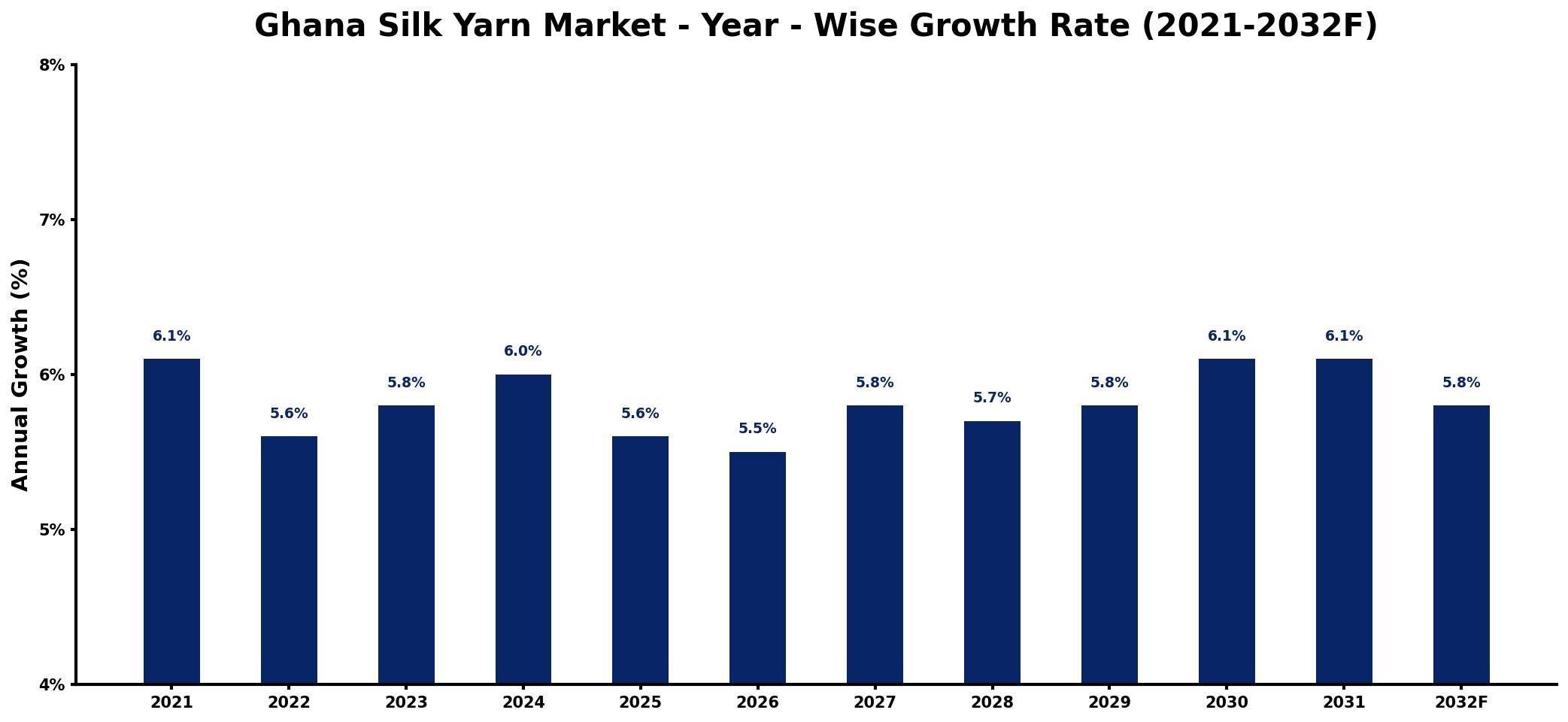
The table below presents the year‑wise growth rates along with the key drivers influencing the market
| Year | Growth Rate | Major Drivers |
| 2021 | 6.1% | Rising fashion industry demands |
| 2022 | 5.6% | Increased textile manufacturing investments |
| 2023 | 5.8% | Growing export opportunities emerging |
| 2024 | 6.0% | Surge in luxury apparel production |
| 2025 | 5.6% | Expansion of local production facilities |
| 2026 | 5.5% | Boost in artisan craftsmanship popularity |
| 2027 | 5.8% | Higher consumer interest in quality |
| 2028 | 5.7% | Strengthening global trade partnerships |
| 2029 | 5.8% | Emergence of sustainable fashion trends |
| 2030 | 6.1% | Technological advancements in production |
| 2031 | 6.1% | Diverse applications in home decor |
| 2032 | 5.8% | Strengthened online retail platforms |
Note: Market size estimations and growth projections presented in this report are based on 6Wresearch's proprietary forecasting methodology, utilizing the latest available industry data, government publications, and primary research inputs.
Ghana Silk Yarn Market Synopsis
The Ghana Silk Yarn Market is witnessing a renaissance, with a notable surge in demand for silk yarn driven by consumer preferences for ethically sourced and sustainable materials. Local artisans are redefining traditional textiles by integrating silk, showcasing Ghanas rich cultural heritage while appealing to a global audience.
While the market is characterized by vibrant creativity and potential, it also contends with obstacles such as high production costs and competition from synthetic alternatives. Nevertheless, the push for sustainable fashion provides a pathway for the growth and diversification of the Ghana Silk Yarn sector.
Ghana Silk Yarn Market Key Takeaways
- The market is poised for steady growth, driven by increasing consumer preference for sustainable textiles.
- Artisans are innovatively incorporating silk yarn into traditional Ghanaian textile practices.
- High production costs and limited access to raw materials remain pressing challenges.
- The government is actively promoting the textile industry to boost economic growth.
- Investment opportunities are abundant in local production facilities and partnerships.
Evaluation of Restraints in Ghana Silk Yarn Market
Despite its potential, the Ghana Silk Yarn Market grapples with significant challenges. High production costs, primarily due to the need to import raw silk, pose a barrier to local producers. Additionally, limited consumer awareness about the benefits of silk products further constrains demand. The market is also affected by infrastructural limitations such as unreliable electricity and poor transportation networks, which hinder efficient production and distribution. These factors collectively restrain the market's ability to scale effectively.
Ghana Silk Yarn Market Trends
Current trends in the Ghana Silk Yarn Market indicate a strong shift towards sustainability. Consumers are increasingly seeking eco-friendly products, thus driving demand for silk yarns produced with environmentally conscious methods. Furthermore, there is a rising interest in hand-dyed and artisanal silk yarns, appealing to both crafters and designers looking for unique materials. The blending of silk with other natural fibers, such as cotton and bamboo, is also becoming prominent, creating versatile options for various textile applications.
Ghana Silk Yarn Market Opportunities
The Ghana Silk Yarn Market offers numerous investment opportunities, particularly in the realm of sustainable textiles. With a strong consumer inclination toward premium, ethically sourced products, investors can benefit by partnering with local producers or establishing production facilities. The government's favorable policies aimed at enhancing the textile industry further create a conducive environment for investment, enabling stakeholders to tap into a growing market characterized by luxury and sustainability.
Government Initiatives in the Ghana Silk Yarn Market
The Ghanaian government has initiated several policies to strengthen the silk yarn market. These include providing financial incentives to silk farmers and manufacturers, promoting research and development within the industry, and fostering partnerships with international stakeholders to enhance market access. Additionally, the government is focused on improving the regulatory framework governing silk production to ensure adherence to quality and sustainability standards, thereby supporting the overall growth of the textile sector.
Future Insights of the Ghana Silk Yarn Market
Looking ahead to 2026-2032, the Ghana Silk Yarn Market is well-positioned for expansion. The growing global focus on sustainable and ethically produced textiles aligns perfectly with Ghanas potential to emerge as a key player in this niche market. Coupled with rising disposable incomes and a shift in consumer preferences towards high-quality products, the silk yarn market is expected to see robust growth. Enhanced government support and infrastructural improvements will further catalyze this positive outlook.
Ghana Silk Yarn Market Latest Developments (2025 - 2026)
Recent developments in the Ghana Silk Yarn Market highlight a growing emphasis on artisanal practices and sustainable production. Many local artisans are increasingly adopting innovative techniques to differentiate their products, leading to a rise in hand-crafted and unique silk yarn offerings. Additionally, workshops and training programs are being organized to equip producers with modern skills necessary for enhancing production efficiency and quality standards.
Ghana Silk Yarn Market - Key Attractiveness of the Report
- 10 Years of Market Numbers
- Historical Data Starting from 2022 to 2025
- Base Year: 2025
- Forecast Data until 2032
- Key Performance Indicators Impacting the Market
- Major Upcoming Developments and Projects
Key Highlights of the Report:
- Ghana Silk Yarn Market Outlook
- Market Size of Ghana Silk Yarn Market, 2025
- Forecast of Ghana Silk Yarn Market, 2032
- Historical Data and Forecast of Ghana Silk Yarn Revenues & Volume for the Period 2022-2032F
- Ghana Silk Yarn Market Trend Evolution
- Ghana Silk Yarn Market Drivers and Challenges
- Ghana Silk Yarn Price Trends
- Ghana Silk Yarn Porter's Five Forces
- Ghana Silk Yarn Industry Life Cycle
- Historical Data and Forecast of Ghana Silk Yarn Market Revenues & Volume By Production Analysis for the Period 2022-2032F
- Historical Data and Forecast of Ghana Silk Yarn Market Revenues & Volume By Volume for the Period 2022-2032F
- Historical Data and Forecast of Ghana Silk Yarn Market Revenues & Volume By Consumption Analysis for the Period 2022-2032F
- Historical Data and Forecast of Ghana Silk Yarn Market Revenues & Volume By Value for the Period 2022-2032F
- Historical Data and Forecast of Ghana Silk Yarn Market Revenues & Volume By Volume for the Period 2022-2032F
- Historical Data and Forecast of Ghana Silk Yarn Market Revenues & Volume By Export Analysis for the Period 2022-2032F
- Historical Data and Forecast of Ghana Silk Yarn Market Revenues & Volume By Value for the Period 2022-2032F
- Historical Data and Forecast of Ghana Silk Yarn Market Revenues & Volume By Volume for the Period 2022-2032F
- Historical Data and Forecast of Ghana Silk Yarn Market Revenues & Volume By Import Analysis for the Period 2022-2032F
- Historical Data and Forecast of Ghana Silk Yarn Market Revenues & Volume By Value for the Period 2022-2032F
- Historical Data and Forecast of Ghana Silk Yarn Market Revenues & Volume By Volume for the Period 2022-2032F
- Ghana Silk Yarn Import Export Trade Statistics
- Market Opportunity Assessment By Production Analysis
- Market Opportunity Assessment By Consumption Analysis
- Market Opportunity Assessment By Export Analysis
- Market Opportunity Assessment By Import Analysis
- Ghana Silk Yarn Top Companies Market Share
- Ghana Silk Yarn Competitive Benchmarking By Technical and Operational Parameters
- Ghana Silk Yarn Company Profiles
- Ghana Silk Yarn Key Strategic Recommendations






































