Ghana Sports Flooring Market Summary
The ghana sports flooring market was estimated at USD 451 Million in 2025 and is projected to reach USD 586 Million by 2032, growing at a CAGR of 4.5% from 2026 to 2032.
Ghana Sports Flooring Market Year-wise Growth Rate and Key Drivers
This graph highlights how the Ghana Sports Flooring Market has steadily grown over the past five years, supported by major growth factors.
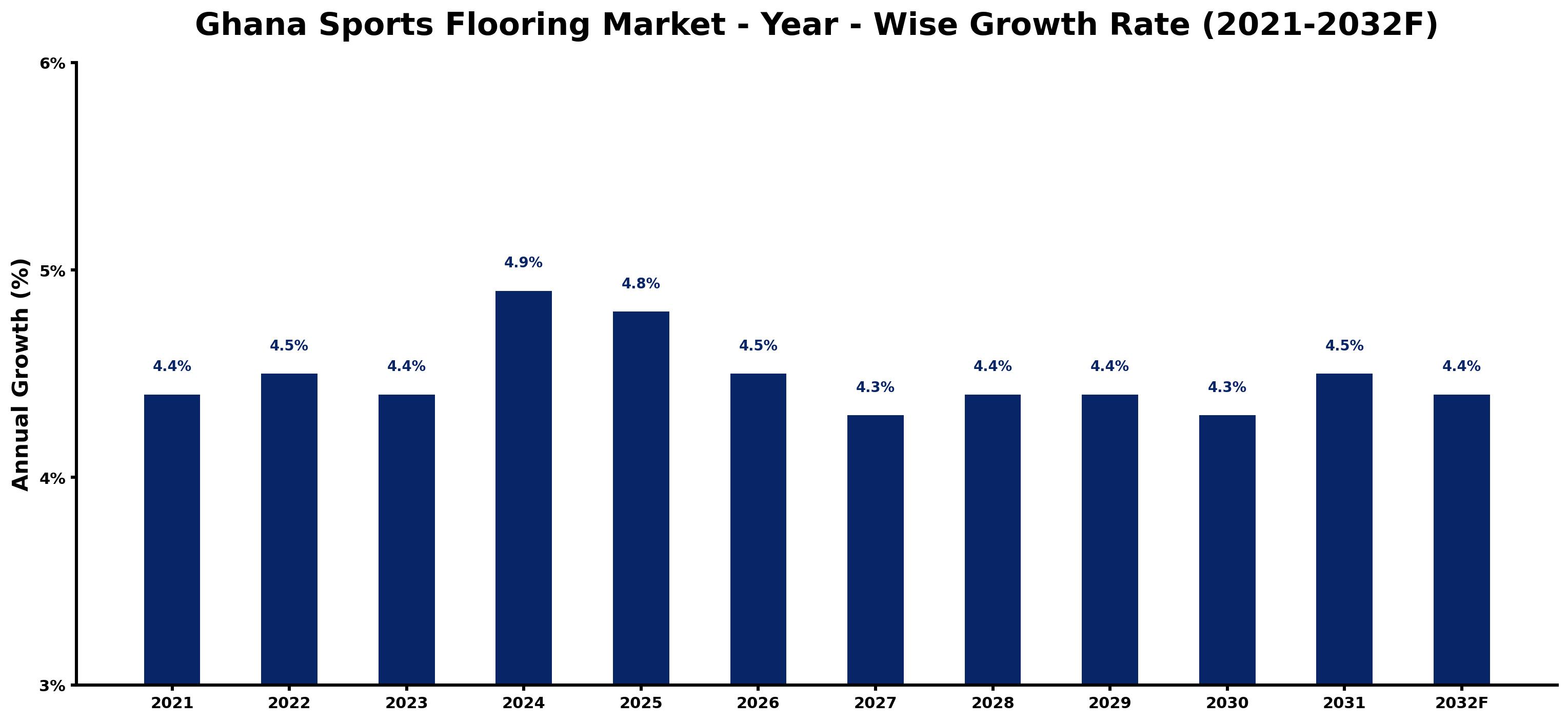
The table below presents the year wise growth rates along with the key drivers influencing the market
| Year | Growth Rate | Major Drivers |
| 2021 | 4.4% | Increased participation in sports leads to heightened demand for quality flooring solutions. |
| 2022 | 4.5% | Construction of new sports facilities enhances opportunities for flooring market expansion. |
| 2023 | 4.4% | Emerging trends in indoor sports boost interest in specialized flooring materials and designs. |
| 2024 | 4.9% | Local manufacturers begin offering competitive products, improving market accessibility and variety. |
| 2025 | 4.8% | Investment in grassroots sports initiatives directly influences flooring needs across communities. |
| 2026 | 4.5% | Sustainability trends prompt demand for eco-friendly sports flooring options among consumers. |
| 2027 | 4.3% | Technological innovations in flooring materials enhance performance qualities sought by sports institutions. |
| 2028 | 4.4% | Growing urbanization results in increased construction of sports complexes and recreational centers. |
| 2029 | 4.4% | Financing options for sports infrastructure projects expand, supporting new flooring installations. |
| 2030 | 4.3% | Partnerships with international brands introduce cutting-edge flooring technologies to the local market. |
| 2031 | 4.5% | Health and wellness trends emphasize functional spaces, driving demand for resilient flooring solutions. |
| 2032 | 4.4% | Cultural shifts towards organized sports events further stimulate market growth in flooring segments. |
Note - Market size estimations and growth projections presented in this report are based on 6Wresearch's advanced forecasting approach, validated with industry datasets as of June 2026.
Ghana Sports Flooring Market Synopsis
The Ghana Sports Flooring Market is projected to reach 4.5% and witness significant growth during the forecast period (2026-2032). The market's expansion is primarily driven by the increasing popularity of sports and fitness activities across the nation. Diverse sports flooring solutions, including synthetic turf, rubber flooring, and wooden flooring, are being adopted by sports facilities, gyms, and recreational centers to meet varying consumer demands. The emphasis on high-quality and durable sports flooring that assures safety, performance, and aesthetic appeal is fueling this growth. Furthermore, ongoing government initiatives and investments in sports infrastructure are anticipated to bolster market dynamics substantially over the coming years.
Ghana Sports Flooring Market Growth Drivers
Several key factors are contributing to the growth of the Ghana Sports Flooring Market. Firstly, the rising awareness of health and fitness among the population is leading to increased participation in sports activities. This, in turn, generates demand for advanced flooring solutions capable of accommodating a variety of sports safely and effectively. Secondly, the government's commitment to improving sports infrastructure is a significant driver; investments in public sports facilities are promoting a shift from traditional flooring to more modern, durable options. Thirdly, the trend towards multifunctional sports spaces is driving the need for versatile flooring systems that can adapt to different activities, thereby maximizing space utility. Additionally, innovations in flooring technology, such as the development of modular systems that facilitate easy installation and maintenance, are contributing to market growth. Finally, the push for sustainability has led consumers to seek eco-friendly flooring solutions, further enhancing the market opportunities.
Ghana Sports Flooring Market Trends and Opportunities
The Ghana Sports Flooring Market is observing notable trends that present several opportunities for stakeholders. There is an increasing inclination towards sustainable materials, with consumers preferring eco-friendly flooring solutions that align with environmental values while maintaining high performance standards. Additionally, the demand for multifunctional flooring is on the rise as sports facilities look to maximize their offerings by catering to various sports and activities within the same space. Innovations in flooring products that allow for customization and adaptability are becoming more prevalent, enhancing the appeal of sports facilities. The market is also witnessing the emergence of advanced installation methods, which can lower downtime for facilities transitioning to new flooring solutions. Overall, these trends indicate a rapidly evolving market landscape that is progressively adapting to consumer preferences and technological advancements.
Ghana Sports Flooring Market Challenges and Restraints
Despite its growth potential, the Ghana Sports Flooring Market faces several challenges that must be addressed. A significant barrier is the limited awareness among facility owners about modern and advanced flooring options. Many still rely on traditional materials that may not provide the necessary safety and performance standards for contemporary sports activities. Furthermore, the high initial costs associated with specialized sports flooring systems can deter investment from facility operators. There is also a shortage of skilled professionals qualified to install and maintain these advanced flooring systems, which may hinder adoption rates. To navigate these challenges, industry stakeholders should focus on educational initiatives to raise awareness, offer financing solutions to ease upfront costs, and implement training programs to develop local expertise within the sector.
Ghana Sports Flooring Market Investment Opportunities
The Ghana Sports Flooring Market is ripe for investment, driven by the country's growing interest in sports and fitness activities. The increasing emphasis on physical health, coupled with the expansion of sports facilities, creates a robust demand for high-quality flooring solutions. Opportunities exist in manufacturing and distributing various flooring materials, including synthetic turf, rubber, and hardwood. Additionally, there is a profitable venture in providing installation and maintenance services tailored to schools, gyms, and sports clubs. As the sports industry evolves in Ghana, investing in the sports flooring sector presents substantial prospects for long-term growth and profitability.
Ghana Sports Flooring Market Government Investment and Initiatives
The Ghanaian government has implemented various policies aimed at facilitating the development of the sports flooring market. These initiatives include investment incentives to attract both local and foreign investments in the sector. By supporting local manufacturers, the government aims to enhance the production of high-quality sports flooring materials that meet international standards. Furthermore, regulations have been established to ensure the safety and standardization of flooring products used in public sports facilities, thereby fostering a secure environment for athletes and the public. Through these efforts, the government is not only promoting participation in sports but also driving the overall growth of the sports industry in Ghana.
Ghana Sports Flooring Market Latest Developments (May 2025 - June 2026)
Recent developments in the Ghana Sports Flooring Market highlight a shift towards innovation and sustainability. Industry stakeholders have increasingly focused on introducing eco-friendly flooring options that cater to the growing consumer demand for environmentally responsible products. Additionally, modernization efforts in sports facilities have been a focus, with stakeholders investing in advanced flooring solutions that ensure safety and enhance performance. The market has also seen a surge in collaborative initiatives aimed at educating facility operators regarding the advantages of contemporary flooring systems. Such developments indicate a proactive approach to addressing existing challenges while capitalizing on emerging trends within the industry.
Ghana Sports Flooring Market - Key Attractiveness of the Report
- 10 Years of Market Numbers
- Historical Data Starting from 2022 to 2025
- Base Year: 2025
- Forecast Data until 2032
- Key Performance Indicators Impacting the Market
- Major Upcoming Developments and Projects
Key Highlights of the Report:
- Ghana Sports Flooring Market Outlook
- Market Size of Ghana Sports Flooring Market, 2025
- Forecast of Ghana Sports Flooring Market, 2032F
- Historical Data and Forecast of Ghana Sports Flooring Revenues & Volume for the Period 2022-2032F
- Ghana Sports Flooring Market Trend Evolution
- Ghana Sports Flooring Market Drivers and Challenges
- Ghana Sports Flooring Price Trends
- Ghana Sports Flooring Porter's Five Forces
- Ghana Sports Flooring Industry Life Cycle
- Historical Data and Forecast of Ghana Sports Flooring Market Revenues & Volume By Product Type for the Period 2022-2032F
- Historical Data and Forecast of Ghana Sports Flooring Market Revenues & Volume By Outdoor for the Period 2022-2032F
- Historical Data and Forecast of Ghana Sports Flooring Market Revenues & Volume By Indoor for the Period 2022-2032F
- Historical Data and Forecast of Ghana Sports Flooring Market Revenues & Volume By Material Type for the Period 2022-2032F
- Historical Data and Forecast of Ghana Sports Flooring Market Revenues & Volume By Wood for the Period 2022-2032F
- Historical Data and Forecast of Ghana Sports Flooring Market Revenues & Volume By Rubber for the Period 2022-2032F
- Historical Data and Forecast of Ghana Sports Flooring Market Revenues & Volume By Polymeric for the Period 2022-2032F
- Historical Data and Forecast of Ghana Sports Flooring Market Revenues & Volume By Sales Channel for the Period 2022-2032F
- Historical Data and Forecast of Ghana Sports Flooring Market Revenues & Volume By Direct Sales for the Period 2022-2032F
- Historical Data and Forecast of Ghana Sports Flooring Market Revenues & Volume By Independent Sports Outlet for the Period 2022-2032F
- Historical Data and Forecast of Ghana Sports Flooring Market Revenues & Volume By Mass Merchandiser for the Period 2022-2032F
- Historical Data and Forecast of Ghana Sports Flooring Market Revenues & Volume By Value Added Resellers for the Period 2022-2032F
- Historical Data and Forecast of Ghana Sports Flooring Market Revenues & Volume By End-users for the Period 2022-2032F
- Historical Data and Forecast of Ghana Sports Flooring Market Revenues & Volume By Commercial for the Period 2022-2032F
- Historical Data and Forecast of Ghana Sports Flooring Market Revenues & Volume By Residential for the Period 2022-2032F
- Ghana Sports Flooring Import Export Trade Statistics
- Market Opportunity Assessment By Product Type
- Market Opportunity Assessment By Material Type
- Market Opportunity Assessment By Sales Channel
- Market Opportunity Assessment By End-users
- Ghana Sports Flooring Top Companies Market Share
- Ghana Sports Flooring Competitive Benchmarking By Technical and Operational Parameters
- Ghana Sports Flooring Company Profiles
- Ghana Sports Flooring Key Strategic Recommendations






































