Ghana Structural Steel Fabrication Market Size, Share & Growth Rate
The Ghana Structural Steel Fabrication Market was estimated at USD 154 Million in 2025 and is projected to reach USD 206 Million by 2032, growing at a CAGR of 4.2% from 2026 to 2032. This anticipated growth is largely fueled by a surge in construction activities across various sectors, including infrastructure and commercial buildings, driven by increasing urbanization and government investments. The demand for high-quality steel products, coupled with an ongoing push towards sustainable practices, underscores the market's promising trajectory.
Ghana Structural Steel Fabrication Market Year-wise Growth Rate and Key Drivers
This graph highlights how the Ghana Structural Steel Fabrication Market has steadily grown over the years, supported by major growth factors.
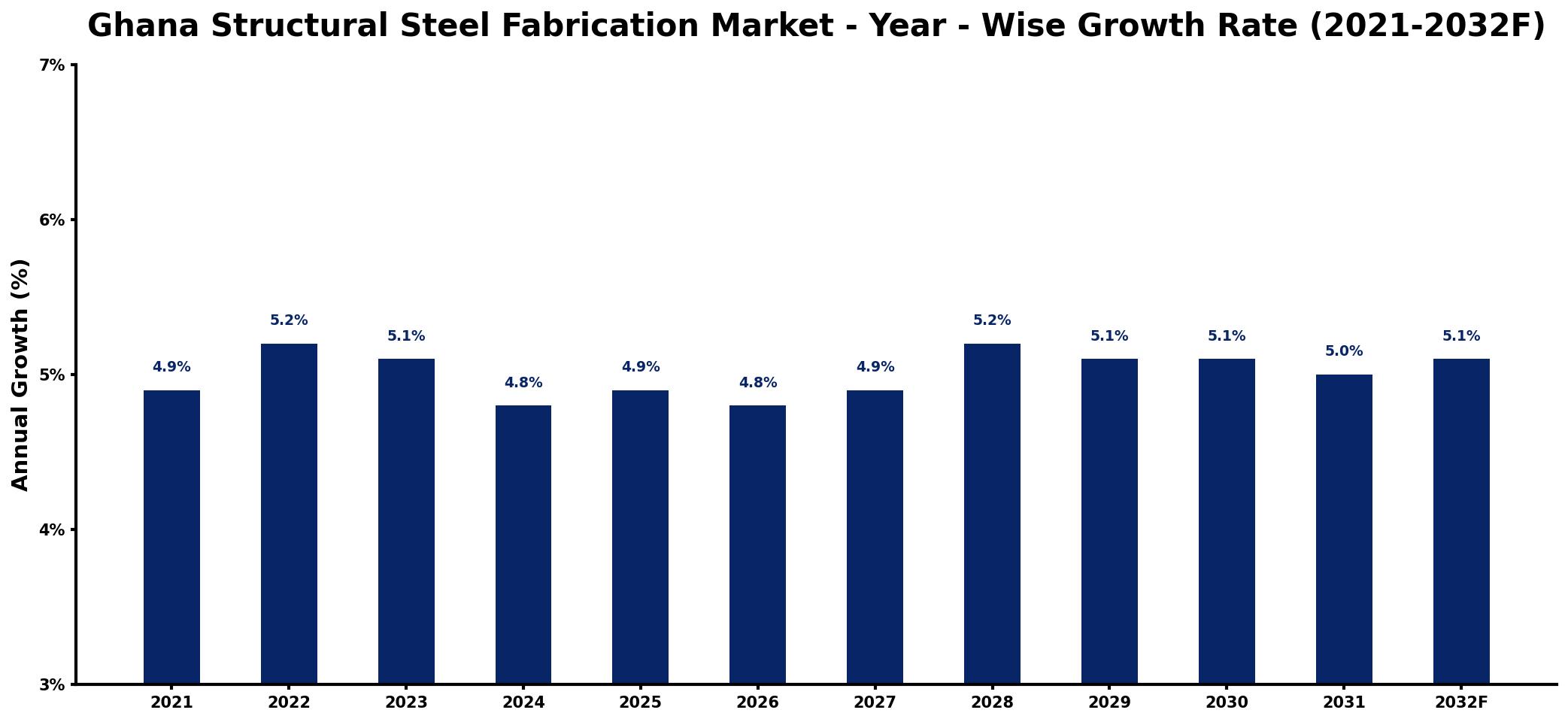
The table below presents the year‑wise growth rates along with the key drivers influencing the market
| Year | Growth Rate | Major Drivers |
| 2021 | 4.9% | Infrastructure projects drive demand |
| 2022 | 5.2% | Increased construction activity nationwide |
| 2023 | 5.1% | Government investments in housing |
| 2024 | 4.8% | Renewable energy projects expanding |
| 2025 | 4.9% | Growing commercial real estate sector |
| 2026 | 4.8% | Rising urbanization and population growth |
| 2027 | 4.9% | Strong demand from mining sector |
| 2028 | 5.2% | Boost in industrial manufacturing investments |
| 2029 | 5.1% | Rising international trade activities |
| 2030 | 5.1% | Technological advancements in construction |
| 2031 | 5.0% | Sustainability initiatives gaining traction |
| 2032 | 5.1% | Enhanced infrastructure development plans |
Note: Market size estimations and growth projections presented in this report are based on 6Wresearch's proprietary forecasting methodology, utilizing the latest available industry data, government publications, and primary research inputs.
Ghana Structural Steel Fabrication Market Synopsis
The Ghana Structural Steel Fabrication Market is witnessing a transformative phase, characterized by rapid expansion and diversification. As urban centers grow and infrastructure projects proliferate, structural steel has emerged as a favored choice among builders due to its durability, design flexibility, and cost-effectiveness.
The market is not only shaped by local demand but also reflects a global trend towards more sustainable construction materials. Key industry players are increasingly adopting advanced fabrication technologies and striving for higher quality standards, as they align their operations with global environmental initiatives.
Ghana Structural Steel Fabrication Market Key Takeaways
- Strong growth anticipated due to increased infrastructure development and urbanization.
- Shift towards sustainable and eco-friendly fabrication practices is becoming prominent.
- Advanced technology adoption is key to improving efficiency and quality.
- Investment opportunities are ripe for both local and foreign players looking to establish fabrication facilities.
- The government's supportive policies are fostering a conducive environment for market growth.
Evaluation of Restraints in Ghana Structural Steel Fabrication Market
Despite the optimistic outlook, the Ghana Structural Steel Fabrication Market faces notable challenges. One significant restraint is competition from low-cost imports, which can undermine local fabricators. Additionally, fluctuations in raw material prices can affect cost predictability, leading to budgeting challenges for construction projects. The market also grapples with inadequate logistics infrastructure and limited access to financing, particularly for small and medium-sized fabricators. A shortage of skilled labor further complicates operational efficiency, demanding innovative solutions and strategic investments in workforce development.
Ghana Structural Steel Fabrication Market Trends
Key trends influencing the Ghana Structural Steel Fabrication Market include a growing emphasis on sustainability, with manufacturers increasingly adopting eco-friendly practices. Furthermore, precision fabrication technologies are gaining traction, enabling higher quality outputs and faster production times. There is also an observable shift towards modular construction and pre-fabricated steel components, driven by the demand for quicker project turnarounds. As urbanization continues to escalate, the need for durable and cost-efficient construction solutions solidifies the importance of structural steel in the market.
Ghana Structural Steel Fabrication Market Opportunities
Investment opportunities abound in the Ghana Structural Steel Fabrication Market, particularly in the establishment of new fabrication plants to cater to the burgeoning demand. Collaborations with local construction firms and government projects can be advantageous for new entrants looking to capitalize on public infrastructure initiatives. There is also potential for innovation in product offerings, such as developing green steel solutions and utilizing automation in production processes, which can enhance competitiveness and profitability.
Government Initiatives in the Ghana Structural Steel Fabrication Market
The Ghanaian government has rolled out various initiatives to bolster the structural steel fabrication sector. Policies aimed at enhancing local content in industrial projects are encouraging domestic fabrication over imports. Additionally, foreign direct investment is being promoted through incentives that aim to attract industry players. Efforts to improve overall infrastructure are also pivotal, as they directly impact the demand for structural steel products while ensuring compliance with safety and quality standards.
Future Insights of the Ghana Structural Steel Fabrication Market
Looking ahead to 2026-2032, the Ghana Structural Steel Fabrication Market is projected to witness sustained growth. Ongoing government infrastructure projects and rising urbanization will significantly propel the demand for structural steel. Additionally, the increasing inclination towards sustainable construction practices will likely bolster the adoption of steel in various applications, including residential and industrial buildings. As industry players continue to innovate and adapt to changing market dynamics, the role of structural steel is expected to remain vital in meeting the construction sectors evolving needs.
Ghana Structural Steel Fabrication Market Latest Developments (2025 - 2026)
The Ghana Structural Steel Fabrication Market is currently undergoing significant shifts as companies are increasingly investing in advanced technologies to enhance fabrication processes. There is a noticeable push towards the adoption of automation and improved quality control measures. Additionally, industry players are exploring partnerships with local construction firms to secure long-term projects, aligning their capabilities with the governments infrastructure agenda. This dynamic landscape reflects a commitment to innovation and responsiveness to market demands.
Ghana Structural Steel Fabrication Market - Key Attractiveness of the Report
- 10 Years of Market Numbers
- Historical Data Starting from 2022 to 2025
- Base Year: 2025
- Forecast Data until 2032
- Key Performance Indicators Impacting the Market
- Major Upcoming Developments and Projects
Key Highlights of the Report:
- Ghana Structural Steel Fabrication Market Outlook
- Market Size of Ghana Structural Steel Fabrication Market, 2025
- Forecast of Ghana Structural Steel Fabrication Market, 2032
- Historical Data and Forecast of Ghana Structural Steel Fabrication Revenues & Volume for the Period 2022-2032F
- Ghana Structural Steel Fabrication Market Trend Evolution
- Ghana Structural Steel Fabrication Market Drivers and Challenges
- Ghana Structural Steel Fabrication Price Trends
- Ghana Structural Steel Fabrication Porter's Five Forces
- Ghana Structural Steel Fabrication Industry Life Cycle
- Historical Data and Forecast of Ghana Structural Steel Fabrication Market Revenues & Volume By End-user Industry for the Period 2022-2032F
- Historical Data and Forecast of Ghana Structural Steel Fabrication Market Revenues & Volume By Manufacturing for the Period 2022-2032F
- Historical Data and Forecast of Ghana Structural Steel Fabrication Market Revenues & Volume By Power and Energy for the Period 2022-2032F
- Historical Data and Forecast of Ghana Structural Steel Fabrication Market Revenues & Volume By Construction for the Period 2022-2032F
- Historical Data and Forecast of Ghana Structural Steel Fabrication Market Revenues & Volume By Oil and Gas for the Period 2022-2032F
- Historical Data and Forecast of Ghana Structural Steel Fabrication Market Revenues & Volume By Other for the Period 2022-2032F
- Historical Data and Forecast of Ghana Structural Steel Fabrication Market Revenues & Volume By Product Type for the Period 2022-2032F
- Historical Data and Forecast of Ghana Structural Steel Fabrication Market Revenues & Volume By Heavy Sectional Steel for the Period 2022-2032F
- Historical Data and Forecast of Ghana Structural Steel Fabrication Market Revenues & Volume By Light Sectional Steel for the Period 2022-2032F
- Historical Data and Forecast of Ghana Structural Steel Fabrication Market Revenues & Volume By Other for the Period 2022-2032F
- Ghana Structural Steel Fabrication Import Export Trade Statistics
- Market Opportunity Assessment By End-user Industry
- Market Opportunity Assessment By Product Type
- Ghana Structural Steel Fabrication Top Companies Market Share
- Ghana Structural Steel Fabrication Competitive Benchmarking By Technical and Operational Parameters
- Ghana Structural Steel Fabrication Company Profiles
- Ghana Structural Steel Fabrication Key Strategic Recommendations






































