Ghana Vacuum Pumps Market Summary
The ghana vacuum pumps market was estimated at USD 279 Million in 2025 and is projected to reach USD 372 Million by 2032, growing at a CAGR of 5.0% from 2026 to 2032.
Ghana Vacuum Pumps Market Year-wise Growth Rate and Key Drivers
This graph highlights how the Ghana Vacuum Pumps Market has steadily grown over the past five years, supported by major growth factors.
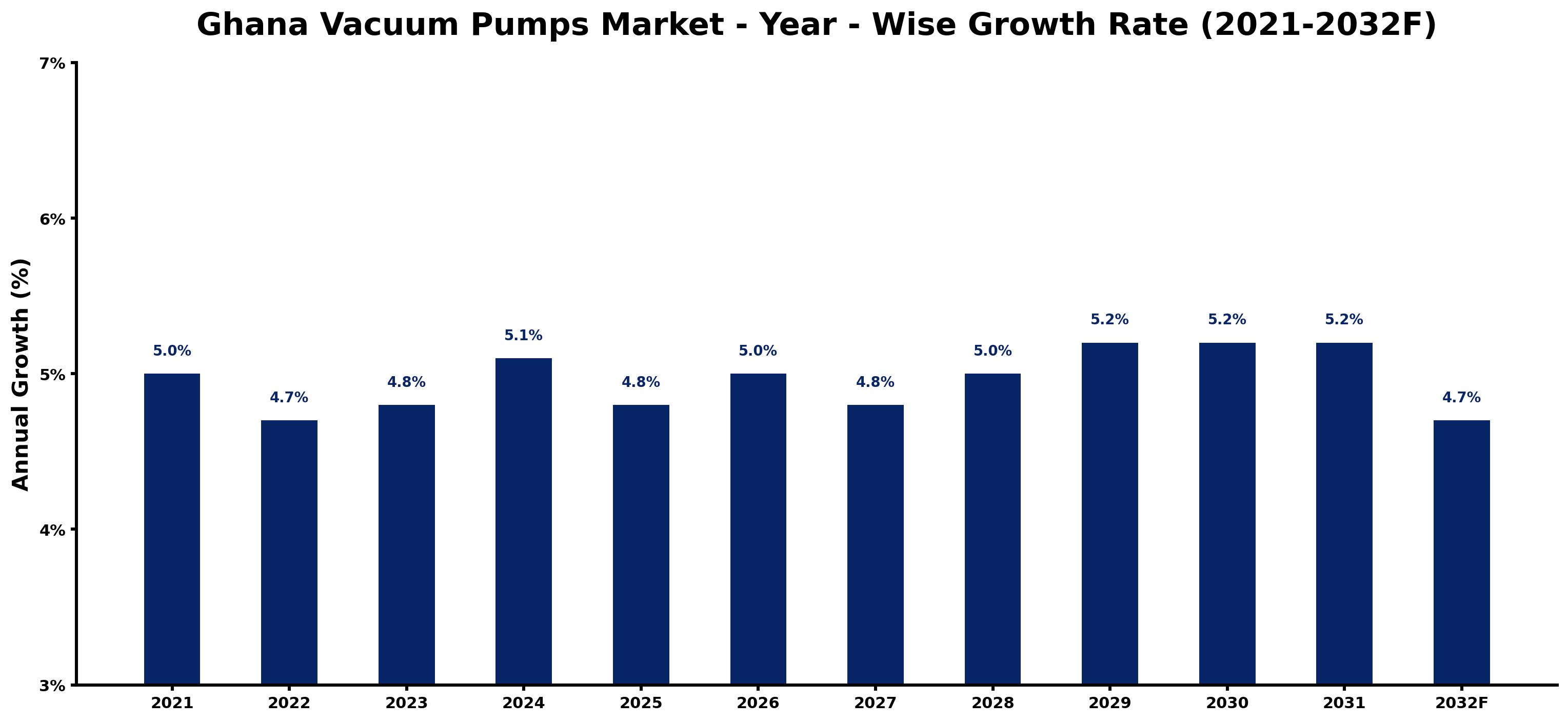
The table below presents the year wise growth rates along with the key drivers influencing the market
| Year | Growth Rate | Major Drivers |
| 2021 | 5.0% | Post-pandemic manufacturing recovery sparked increased interest in industrial efficiency solutions. |
| 2022 | 4.7% | Emerging sectors like pharmaceuticals expanded, creating demand for specialized vacuum technologies. |
| 2023 | 4.8% | Local industries began investing in modern equipment to enhance production capabilities. |
| 2024 | 5.1% | Infrastructure development projects spotlighted the essential role of vacuum pumps in construction. |
| 2025 | 4.8% | Increased awareness of energy-efficient technologies shifted preferences towards eco-friendly vacuum systems. |
| 2026 | 5.0% | Local manufacturers adopted automation trends, further promoting vacuum pump integration. |
| 2027 | 4.8% | Growth in food processing sectors highlighted the need for reliable vacuum packaging solutions. |
| 2028 | 5.0% | Rising agriculture activities necessitated vacuum pumps for improved irrigation and processing systems. |
| 2029 | 5.2% | Technological innovations in vacuum technology facilitated entry of new market players. |
| 2030 | 5.2% | Regional supply chains became more robust, allowing easier access to advanced vacuum solutions. |
| 2031 | 5.2% | Market players collaborated with local firms to enhance product offerings and service support. |
| 2032 | 4.7% | Consumer preference shifted towards customized vacuum systems tailored for specific industrial needs. |
Note - Market size estimations and growth projections presented in this report are based on 6Wresearch's advanced forecasting approach, validated with industry datasets as of June 2026.
Ghana Vacuum Pumps Market Synopsis
The Ghana Vacuum Pumps Market is projected to reach 5.0% and witness significant growth during the forecast period (2026-2032). This growth can be attributed to the accelerating pace of industrialization across the country, alongside the increasing investments in infrastructure development. Key sectors such as manufacturing, mining, oil and gas, as well as healthcare are becoming increasingly reliant on vacuum pumps, creating a robust demand for these essential devices. The market is characterized by a strong presence of international manufacturers, which offer a diverse array of vacuum pump types including rotary vane pumps, liquid ring pumps, and dry vacuum pumps, thereby appealing to various industrial needs.
Ghana Vacuum Pumps Market Growth Drivers
The expansion of the Ghana vacuum pumps market is primarily driven by several critical factors:
- The ongoing industrialization efforts in Ghana necessitate advanced equipment, with vacuum pumps playing a pivotal role in enhancing manufacturing efficiency and productivity.
- Investment in infrastructural projects leads to increased activities in sectors such as construction and transportation, thereby creating a higher demand for reliable vacuum pump systems.
- Healthcare technology advancements have spurred the need for vacuum pumps in medical equipment, highlighting the significance of this market in the healthcare sector.
- Heightened awareness regarding energy efficiency and sustainability is motivating industries to adopt modern vacuum pumps, which are designed to reduce energy consumption while maintaining performance.
- The trend toward customized solutions tailored to specific industry needs is reshaping the market dynamics, encouraging manufacturers to innovate and develop specialized vacuum pump technologies.
Ghana Vacuum Pumps Market Trends and Opportunities
The Ghana vacuum pumps market reveals notable trends that are steering its evolution and presenting ample opportunities for stakeholders:
- There is a shift towards the adoption of energy-efficient and environmentally friendly vacuum pump technologies. This trend aligns with global sustainability goals and enhances the appeal of advanced products.
- Customization is rising, with end-users increasingly seeking solutions that cater to their specific operational requirements. This trend presents opportunities for innovation in product development.
- Advancements in design and materials used in vacuum pumps are leading to improved performance, reliability, and cost-effectiveness, making them more attractive to end-users.
- Collaborative efforts between local distributors and international manufacturers are enhancing service delivery, ensuring that users receive adequate after-sales support and maintenance services.
- The pharmaceutical and food processing sectors are projected to become significant contributors to market demand, as these industries evolve and expand within Ghana's economic landscape.
Ghana Vacuum Pumps Market Challenges and Restraints
Despite its growth potential, the Ghana vacuum pumps market faces several challenges that could impact its trajectory:
- The general lack of awareness regarding vacuum pump technology's benefits among potential users can hinder adoption, resulting in slower market growth.
- A shortage of skilled technicians and maintenance personnel proficient in vacuum pump operations may lead to suboptimal installation and upkeep, affecting equipment performance.
- Geographic disparities in service availability can create challenges for end-users in remote areas seeking maintenance support and spare parts for their pumps.
- Investment costs associated with upgrading to modern vacuum pump technologies can be a barrier for some businesses, especially smaller enterprises operating on tight budgets.
- The presence of competing technologies may divert investments away from vacuum pumps, challenging market players to differentiate their offerings effectively.
Ghana Vacuum Pumps Market Investment Opportunities
The Ghana Vacuum Pumps Market offers lucrative investment opportunities fueled by the increasing demand for reliable vacuum solutions across multiple sectors:
- Investing in the distribution and sales of vacuum pumps presents a profitable opportunity, especially with the anticipated growth in sectors such as chemical processing and pharmaceuticals.
- Maintenance and servicing of vacuum pumps stands out as a viable venture, given the necessity for regular upkeep to optimize operational efficiency and lifespan.
- Innovating and introducing energy-efficient vacuum pump technologies can position companies favorably within the market as industries strive for greener alternatives.
- The development of educational initiatives aimed at improving awareness and understanding of vacuum technology can catalyze market growth and stimulate adoption rates.
- Strategic partnerships between local firms and international manufacturers can improve market penetration and enhance supply chain capabilities.
Ghana Vacuum Pumps Market Government Investment and Initiatives
The Ghanaian government is actively supporting the vacuum pumps market through various initiatives and policies aimed at fostering growth and innovation:
- Reduction of import duties on vacuum pump equipment is a significant government policy aimed at making advanced technologies more accessible to local businesses.
- Incentives for local manufacturing of vacuum pumps are being provided to encourage domestic production capabilities, contributing to job creation within the sector.
- Investment in research and development endeavors focused on enhancing technological capabilities is key to driving innovation in vacuum pump solutions.
- Implementation of regulations aimed at ensuring quality and safety standards for vacuum pumps protects consumers while enhancing industry credibility.
- Public-private partnerships are being encouraged to facilitate knowledge transfer and improve technical expertise in handling vacuum pump technologies.
Ghana Vacuum Pumps Market Latest Developments (May 2025 - June 2026)
Recent developments in the Ghana vacuum pumps market highlight a trend towards innovation and adaptation to changing industry needs:
- The market has seen a push for collaboration between domestic firms and international technology providers, aiming to leverage global expertise for local applications.
- Regulatory frameworks have been revised to encourage investments in sustainable technologies, reflecting the government's commitment to enhancing environmental performance across industries.
- Workshops and training programs have been initiated to address the skills gap in technician availability, focusing on the maintenance and operation of vacuum equipment.
- Emergence of new distribution networks is improving accessibility of vacuum pump technologies, particularly in underserved regions of the country.
- Increased emphasis on energy efficiency has prompted manufacturers to explore innovative designs that reduce operational costs for end-users.
Ghana Vacuum Pumps Market - Key Attractiveness of the Report
- 10 Years of Market Numbers
- Historical Data Starting from 2022 to 2025
- Base Year: 2025
- Forecast Data until 2032
- Key Performance Indicators Impacting the Market
- Major Upcoming Developments and Projects
Key Highlights of the Report:
- Ghana Vacuum Pumps Market Outlook
- Market Size of Ghana Vacuum Pumps Market, 2025
- Forecast of Ghana Vacuum Pumps Market, 2032F
- Historical Data and Forecast of Ghana Vacuum Pumps Revenues & Volume for the Period 2022-2032F
- Ghana Vacuum Pumps Market Trend Evolution
- Ghana Vacuum Pumps Market Drivers and Challenges
- Ghana Vacuum Pumps Price Trends
- Ghana Vacuum Pumps Porter's Five Forces
- Ghana Vacuum Pumps Industry Life Cycle
- Historical Data and Forecast of Ghana Vacuum Pumps Market Revenues & Volume By Lubrication for the Period 2022-2032F
- Historical Data and Forecast of Ghana Vacuum Pumps Market Revenues & Volume By Dry for the Period 2022-2032F
- Historical Data and Forecast of Ghana Vacuum Pumps Market Revenues & Volume By Wet for the Period 2022-2032F
- Historical Data and Forecast of Ghana Vacuum Pumps Market Revenues & Volume By Technology for the Period 2022-2032F
- Historical Data and Forecast of Ghana Vacuum Pumps Market Revenues & Volume By Gas Capture/Binding Pumps for the Period 2022-2032F
- Historical Data and Forecast of Ghana Vacuum Pumps Market Revenues & Volume By Gas Transfer Pumps for the Period 2022-2032F
- Historical Data and Forecast of Ghana Vacuum Pumps Market Revenues & Volume By Product Type for the Period 2022-2032F
- Historical Data and Forecast of Ghana Vacuum Pumps Market Revenues & Volume By Low vacuum pumps for the Period 2022-2032F
- Historical Data and Forecast of Ghana Vacuum Pumps Market Revenues & Volume By Medium vacuum pumps for the Period 2022-2032F
- Historical Data and Forecast of Ghana Vacuum Pumps Market Revenues & Volume By High vacuum pumps for the Period 2022-2032F
- Historical Data and Forecast of Ghana Vacuum Pumps Market Revenues & Volume By End-Users for the Period 2022-2032F
- Historical Data and Forecast of Ghana Vacuum Pumps Market Revenues & Volume By Chemical & pharmaceutical for the Period 2022-2032F
- Historical Data and Forecast of Ghana Vacuum Pumps Market Revenues & Volume By Semiconductor & electronics for the Period 2022-2032F
- Historical Data and Forecast of Ghana Vacuum Pumps Market Revenues & Volume By Oil & gas for the Period 2022-2032F
- Historical Data and Forecast of Ghana Vacuum Pumps Market Revenues & Volume By Food & beverages for the Period 2022-2032F
- Historical Data and Forecast of Ghana Vacuum Pumps Market Revenues & Volume By Wood, paper & pulp for the Period 2022-2032F
- Historical Data and Forecast of Ghana Vacuum Pumps Market Revenues & Volume By Other for the Period 2022-2032F
- Ghana Vacuum Pumps Import Export Trade Statistics
- Market Opportunity Assessment By Lubrication
- Market Opportunity Assessment By Technology
- Market Opportunity Assessment By Product Type
- Market Opportunity Assessment By End-Users
- Ghana Vacuum Pumps Top Companies Market Share
- Ghana Vacuum Pumps Competitive Benchmarking By Technical and Operational Parameters
- Ghana Vacuum Pumps Company Profiles
- Ghana Vacuum Pumps Key Strategic Recommendations






































