Ghana Wholesale Market Summary
The ghana wholesale market was estimated at USD 366 Million in 2025 and is projected to reach USD 511 Million by 2032, growing at a CAGR of 5.7% from 2026 to 2032.
Ghana Wholesale Market Year-wise Growth Rate and Key Drivers
This graph highlights how the Ghana Wholesale Market has steadily grown over the past five years, supported by major growth factors.
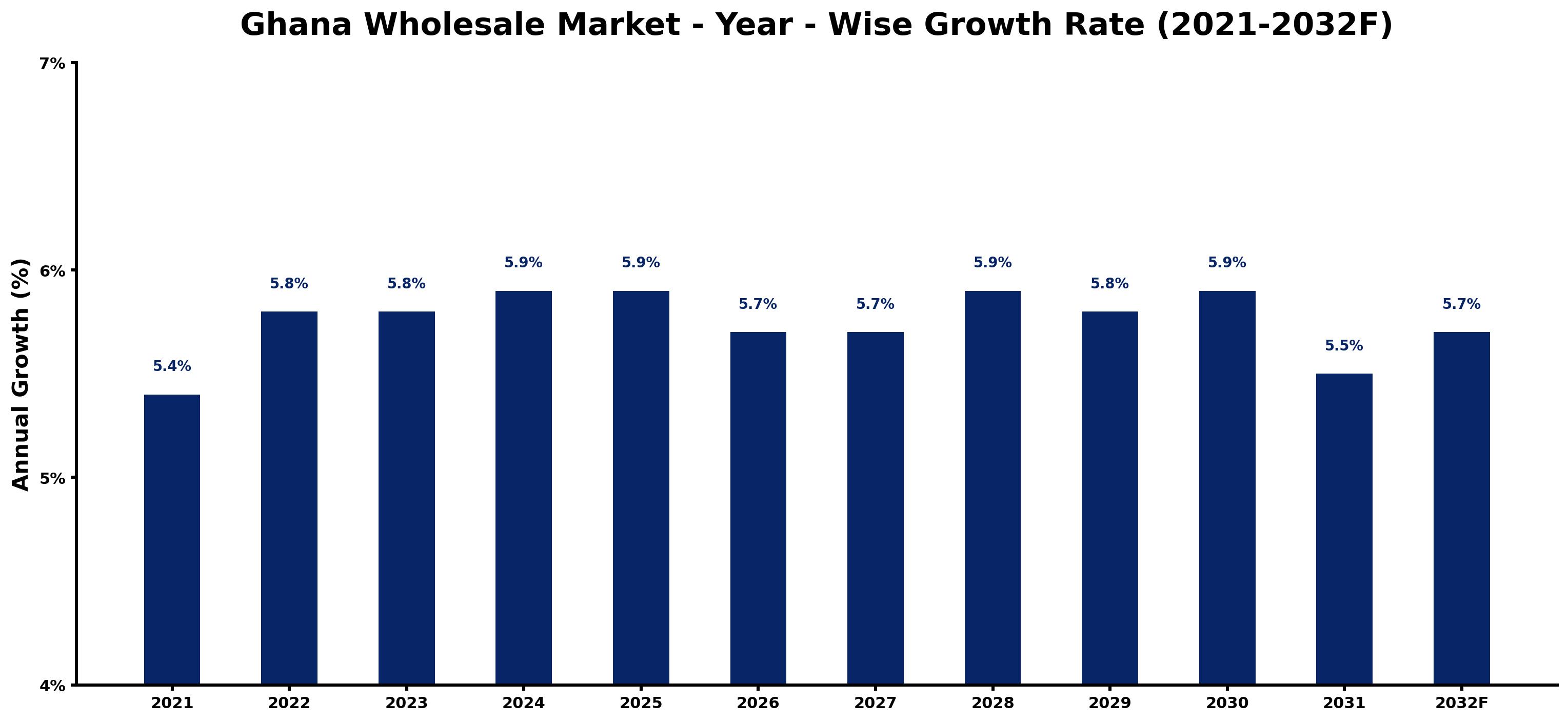
The table below presents the year wise growth rates along with the key drivers influencing the market
| Year | Growth Rate | Major Drivers |
| 2021 | 5.4% | Ghana's economic recovery post-COVID-19 presented opportunities for wholesale market revitalization. |
| 2022 | 5.8% | Rural electrification initiatives spurred demands for bulk agricultural products and services. |
| 2023 | 5.8% | Infrastructure improvements, particularly roads, enhanced access to wholesale market platforms. |
| 2024 | 5.9% | Digital payment systems gained traction, transforming transactions in the wholesale sector. |
| 2025 | 5.9% | Increased urbanization led to heightened demands for diverse consumer goods in wholesale. |
| 2026 | 5.7% | Sustainable practices began influencing wholesale operations, driving eco-friendly product offerings. |
| 2027 | 5.7% | Emergence of local manufacturing reduced reliance on imports, boosting domestic wholesale supply chains. |
| 2028 | 5.9% | E-commerce platforms gained prominence, facilitating broader access to wholesale products nationwide. |
| 2029 | 5.8% | Consumer preferences shifted towards organic products, influencing wholesale sourcing strategies. |
| 2030 | 5.9% | Partnerships among wholesalers enhanced distribution efficiency and reduced operational costs significantly. |
| 2031 | 5.5% | Logistical advancements streamlined supply chains, improving overall market responsiveness and agility. |
| 2032 | 5.7% | Wholesale market consolidation led to increased competitiveness, benefiting consumers through better prices. |
Note - Market size estimations and growth projections presented in this report are based on 6Wresearch's advanced forecasting approach, validated with industry datasets as of June 2026.
Ghana Wholesale Market Synopsis
The Ghana Wholesale Market is projected to reach 5.7% and witness significant growth during the forecast period (2026-2032). This vibrant sector serves as a critical nexus for the trading of a diversified array of products, including food, clothing, electronics, and household goods. Key cities such as Accra, Kumasi, and Takoradi are central to this wholesale activity, functioning as major conduits for trade and commerce.
Ghana Wholesale Market Growth Drivers
The growth of the Ghana Wholesale Market is fuelled by several factors that enhance both its operational capability and market attractiveness.
- Urbanization is a significant driver, with an increasing number of consumers gravitating towards urban centers, thereby expanding the customer base available to wholesalers.
- The rising middle class in Ghana is influencing consumer purchasing power, leading to increased demand for a variety of products available through wholesale channels.
- Localized sourcing and organic products are gaining popularity, with wholesalers responding to consumer trends by stocking more environmentally friendly and locally produced goods.
- Technological advancements are revolutionizing the sector, as wholesalers adopt innovative inventory management systems and online platforms to streamline their operations.
- Infrastructure development is enhancing logistics, allowing wholesalers better access to supplies and improving their ability to meet market demand efficiently.
Ghana Wholesale Market Trends and Opportunities
The Ghana Wholesale Market is witnessing emerging trends that indicate a shift towards sustainable practices and technological integration.
- There is a notable increase in demand for organic and locally sourced products, reflecting a growing consumer consciousness about health and sustainability.
- Wholesalers are increasingly adopting eco-friendly packaging solutions, aligning with global trends towards environmental responsibility.
- Investment in technology is not just limited to inventory systems; e-commerce platforms are also being utilized for improved customer engagement and distribution efficiency.
- Networking and collaboration among wholesalers are on the rise, with many seeking synergies to enhance their operational capabilities and reduce costs.
- As urbanization continues, there are substantial opportunities for wholesalers to diversify their product offerings to meet the changing preferences of urban consumers.
Ghana Wholesale Market Challenges and Restraints
Despite its robust growth, the Ghana Wholesale Market faces several challenges that could impede its progress.
- Inconsistent supply chain logistics often lead to delays in product availability, posing challenges for wholesalers in meeting consumer demands.
- Accessing affordable financing remains a significant hurdle, as many wholesalers struggle to maintain adequate inventory levels due to financial constraints.
- Lack of sufficient technological adoption hinders operational efficiency and competitiveness among wholesalers, preventing them from maximizing their market potential.
- Inadequate storage facilities contribute to post-harvest losses, which affect both wholesalers and suppliers, resulting in decreased profitability.
- The presence of counterfeit products in the market threatens the reputation of legitimate wholesalers and undermines consumer trust.
Ghana Wholesale Market Government Investment and Initiatives
The Ghana Wholesale Market operates under the regulatory oversight of the Ghana Market and Food Distribution Company Limited, a subsidiary of the Ministry of Food and Agriculture.
- Government policies aim to regulate market activities to ensure fair trade practices and prevent price manipulation, fostering a level playing field for all participants.
- Support and incentives aimed at promoting the wholesale market sector include training programs for vendors to enhance their operational capabilities.
- Infrastructure development initiatives are prioritized to strengthen market facilities, ultimately benefiting both wholesalers and consumers.
- Regulatory frameworks are established to maintain food safety standards and quality control measures that protect consumers from substandard products.
- Public spending focuses on improving transport logistics, thereby enhancing the overall efficacy and reach of wholesale operations across the country.
Ghana Wholesale Market Latest Developments (May 2025 - June 2026)
Recent developments from May 2025 to June 2026 indicate a progressive direction for the Ghana Wholesale Market.
- Increased governmental focus on enhancing market infrastructure has resulted in ongoing projects to improve accessibility and storage capabilities.
- Technological integration has been embraced, with many wholesalers adopting modern inventory management systems to better align with consumer demands.
- There is a growing collaboration among market participants, with initiatives focusing on joint investment in logistics to mitigate supply chain challenges.
- Awareness campaigns promoting the benefits of locally produced goods have gained traction, influencing wholesalers to diversify their product offerings.
- Regulatory improvements aimed at combating counterfeit products have been initiated, thus enhancing consumer trust in the wholesale market.
Ghana Wholesale Market - Key Attractiveness of the Report
- 10 Years of Market Numbers
- Historical Data Starting from 2022 to 2025
- Base Year: 2025
- Forecast Data until 2032
- Key Performance Indicators Impacting the Market
- Major Upcoming Developments and Projects
Key Highlights of the Report:
- Ghana Wholesale Market Outlook
- Market Size of Ghana Wholesale Market, 2025
- Forecast of Ghana Wholesale Market, 2032F
- Historical Data and Forecast of Ghana Wholesale Revenues & Volume for the Period 2022-2032F
- Ghana Wholesale Market Trend Evolution
- Ghana Wholesale Market Drivers and Challenges
- Ghana Wholesale Price Trends
- Ghana Wholesale Porter's Five Forces
- Ghana Wholesale Industry Life Cycle
- Historical Data and Forecast of Ghana Wholesale Market Revenues & Volume By Type for the Period 2022-2032F
- Historical Data and Forecast of Ghana Wholesale Market Revenues & Volume By Non-Durable Goods Merchant Wholesalers for the Period 2022-2032F
- Historical Data and Forecast of Ghana Wholesale Market Revenues & Volume By Wholesale Electronic Markets And Agents And Brokers for the Period 2022-2032F
- Historical Data and Forecast of Ghana Wholesale Market Revenues & Volume By Durable Goods Merchant Wholesalers for the Period 2022-2032F
- Historical Data and Forecast of Ghana Wholesale Market Revenues & Volume By Ownership for the Period 2022-2032F
- Historical Data and Forecast of Ghana Wholesale Market Revenues & Volume By Wholesale/Distribution Chain for the Period 2022-2032F
- Historical Data and Forecast of Ghana Wholesale Market Revenues & Volume By Independent Wholesalers for the Period 2022-2032F
- Ghana Wholesale Import Export Trade Statistics
- Market Opportunity Assessment By Type
- Market Opportunity Assessment By Ownership
- Ghana Wholesale Top Companies Market Share
- Ghana Wholesale Competitive Benchmarking By Technical and Operational Parameters
- Ghana Wholesale Company Profiles
- Ghana Wholesale Key Strategic Recommendations






































